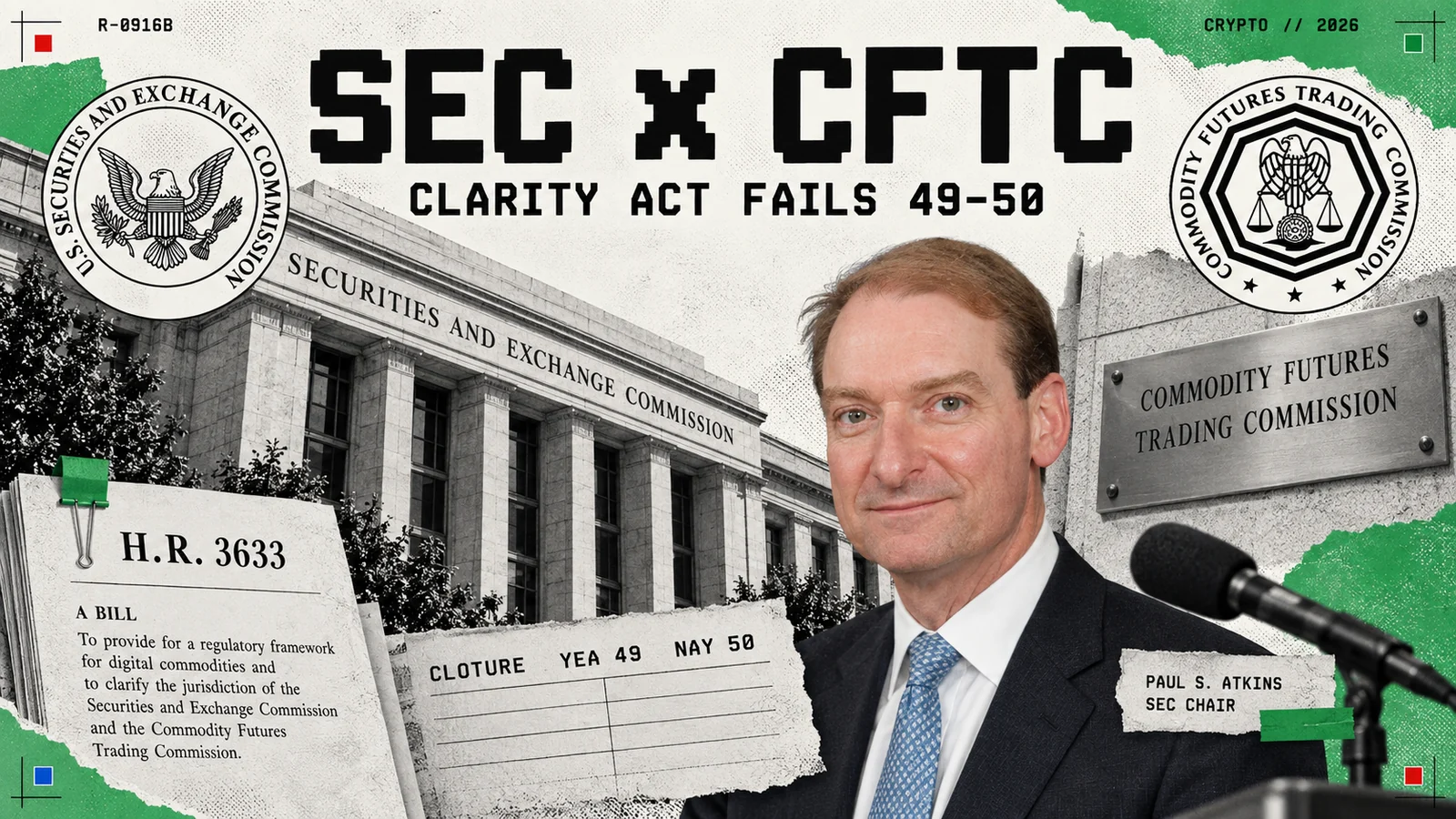
The CLARITY Act fell eleven votes short, and every yea was Republican
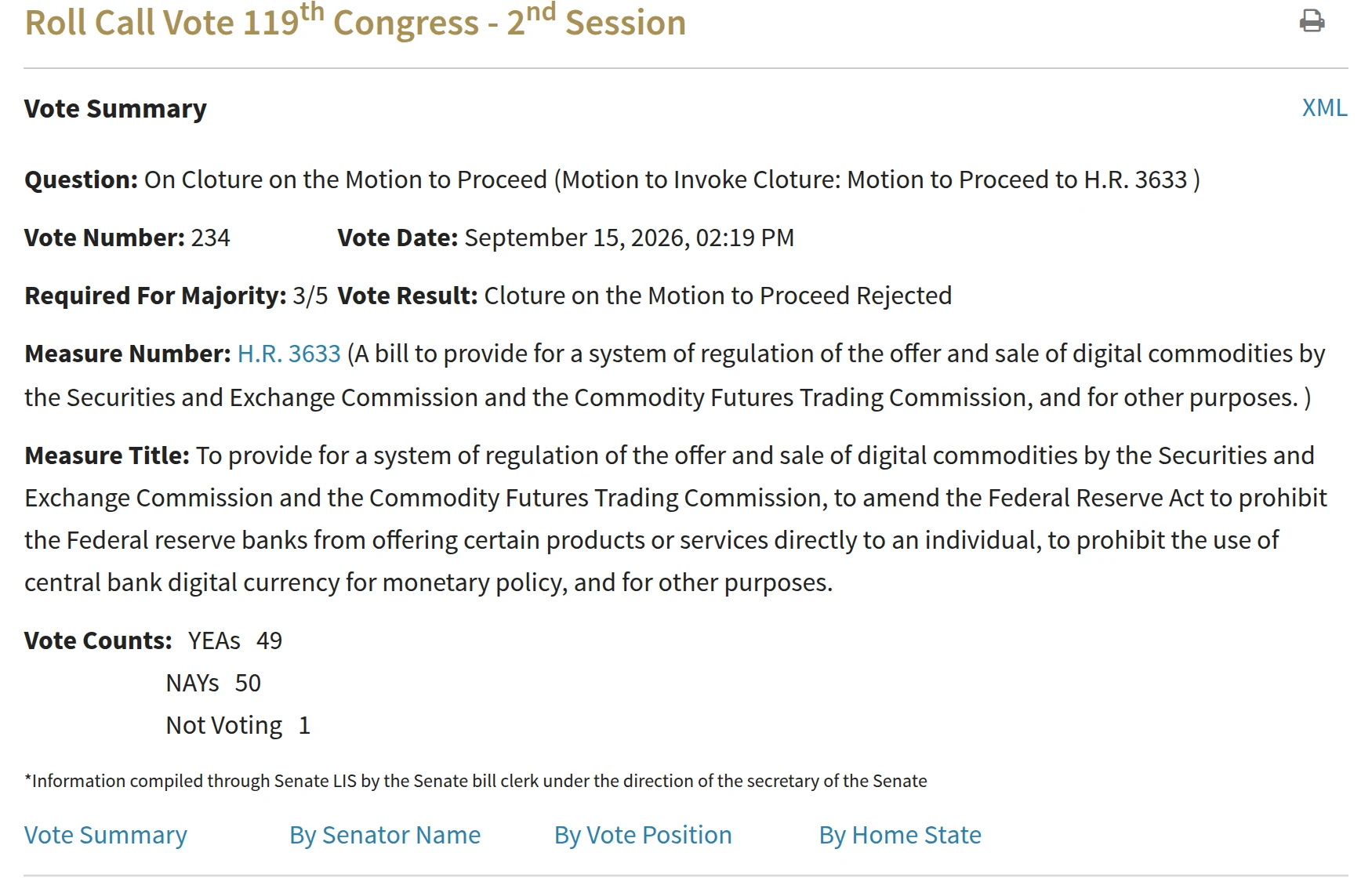
The Senate rejected cloture on H.R. 3633 by 49 to 50 on 15 September 2026. All 49 yeas were Republican, four Republicans voted nay, and Senator Tillis entered a motion to reconsider one minute later.
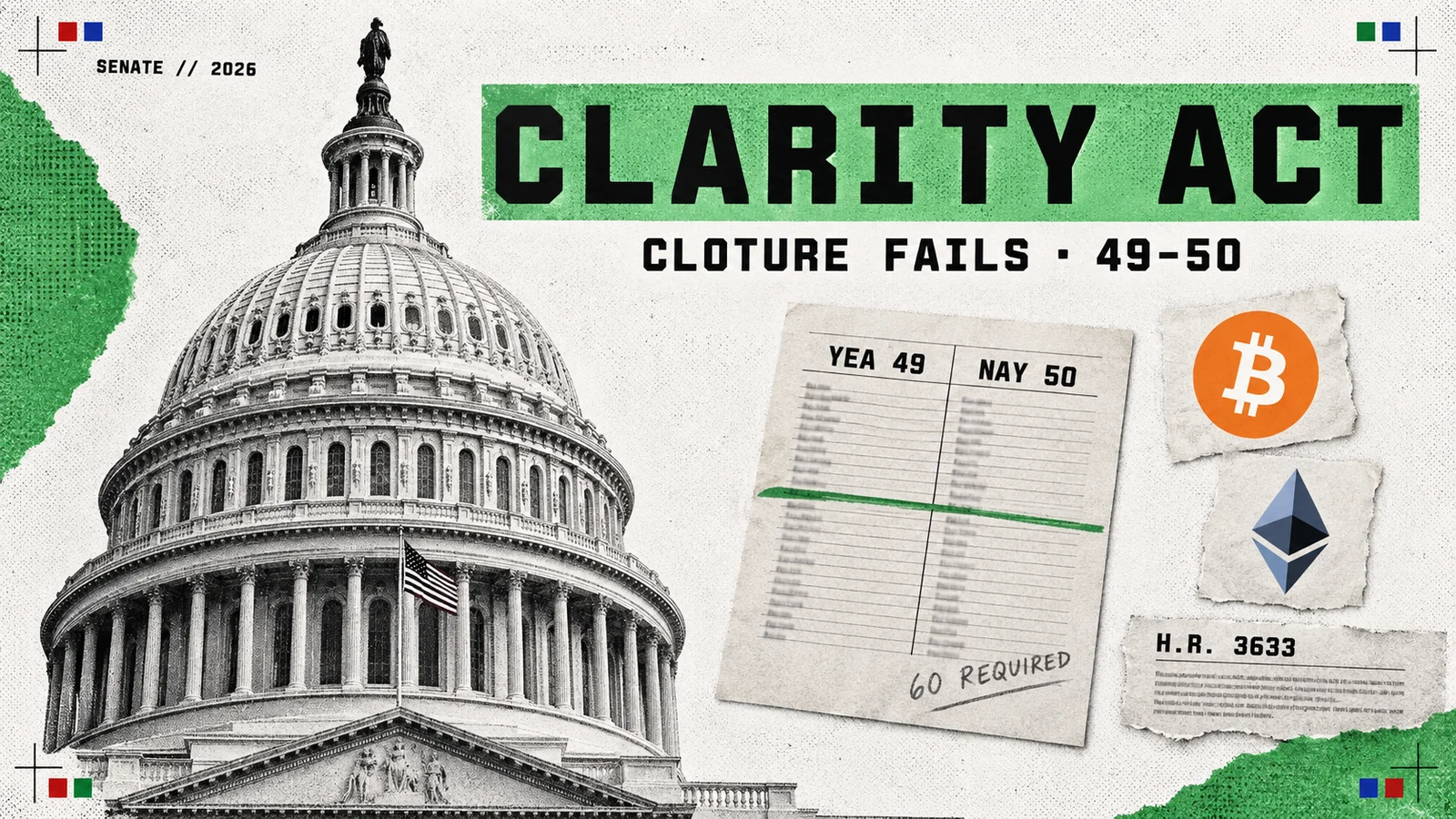
The Senate voted at 2.19pm Eastern time on 15 September on whether to begin debating the CLARITY Act, and the answer was 49 to 50. Cloture on the motion to proceed to H.R. 3633 needed three-fifths of senators duly chosen and sworn, which is 60. The roll call is the most detailed account of where the bill actually sits, and it says three things at once: the Republican conference delivered almost everything it had, no Democrat or independent voted yes, and the vote was arranged so that it can be taken again.
What the roll call records
The tally breaks down cleanly along the caucuses. Of 53 Republicans, 49 voted yea and four voted nay. Of 45 Democrats, 44 voted nay and one, Chris Coons of Delaware, did not vote. Both independents, Angus King of Maine and Bernie Sanders of Vermont, voted nay.
So the yes column and the Republican conference were the same set of people, minus four. The sponsors needed 11 more votes than they got, and since three Republicans were voting against on the merits, holding the whole conference would still have left them seven short of 60. Seven Democratic votes were the arithmetic requirement, and the roll call returned zero.
The Senate’s rule on cloture measures the three-fifths against the full membership rather than against those present, so the one absence changed nothing about the target. Sixty was the number whether 99 senators voted or 100.
The four Republican nays
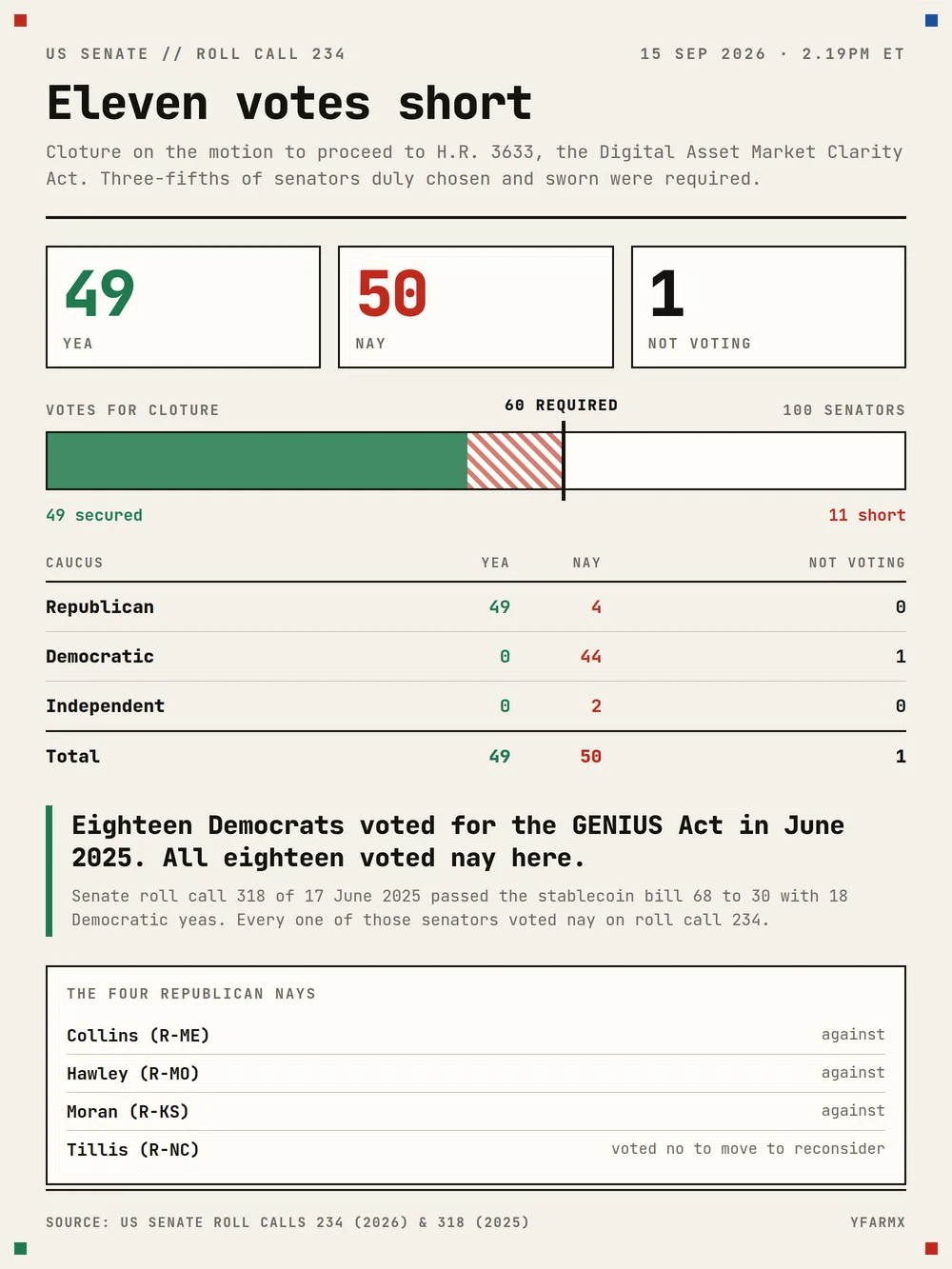
The four were Susan Collins of Maine, Josh Hawley of Missouri, Jerry Moran of Kansas and Thom Tillis of North Carolina. Three of those are votes against the question. The fourth is something else, and the Senate’s own floor record says so in terms.
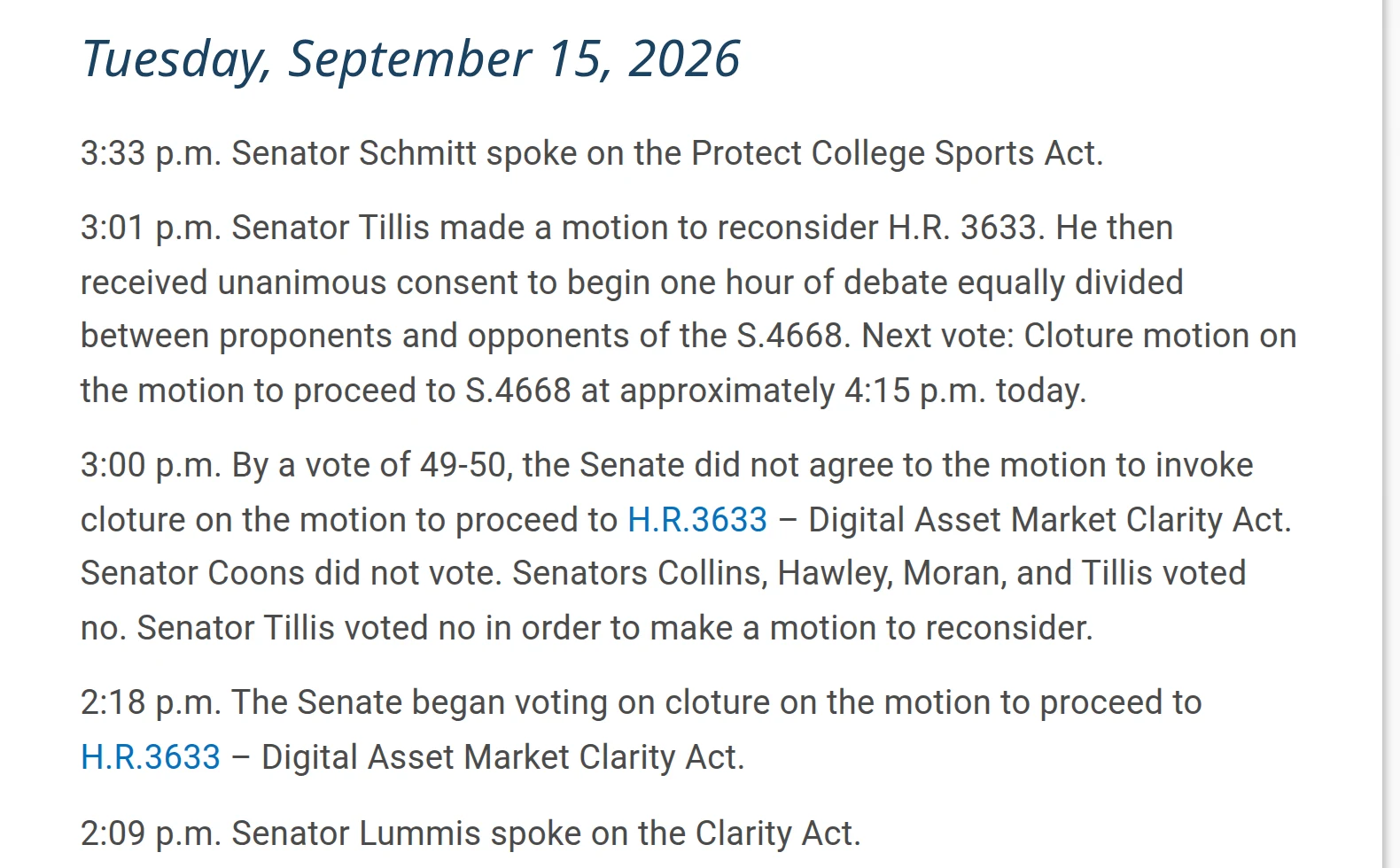
The Senate Press Gallery floor log for the day reads: “Senators Collins, Hawley, Moran, and Tillis voted no. Senator Tillis voted no in order to make a motion to reconsider.” On the merits, then, the Republican conference was 50 for and three against.
A motion to reconsider, entered one minute later
The same log records the next minute: “3:01 p.m. Senator Tillis made a motion to reconsider H.R. 3633.” One minute after the result was announced, the motion was on the table, and that single step is what separates a defeated cloture motion from a closed file.
The Congressional Research Service sets out the mechanism in Voting and Quorum Procedures in the Senate: “A motion to reconsider may be made only by a Senator who voted on the prevailing side or a Senator who did not vote.” On a rejected cloture motion the prevailing side is the nays, which is why the job fell to Tillis rather than to Majority Leader John Thune, who voted yea and is therefore on the losing side of his own motion.
The CRS report on Invoking Cloture in the Senate describes what entering the motion buys: “Should a cloture motion be defeated, the majority leader may enter a motion to reconsider the cloture vote. This allows the majority leader to call up the motion at a subsequent time when he feels he has the votes and thereby obtain an immediate second vote on cloture.”
That is the procedural position as the chamber left it. A second cloture vote on the same motion to proceed can be reached by calling up the pending motion, and the leadership chooses when. The Senate moved straight on to the college sports bill, S. 4668, with a cloture vote on that measure set for about 4.15pm.
The eighteen Democrats who carried the GENIUS Act
The reason the industry expected a different number is the stablecoin bill. On 17 June 2025 the Senate passed the GENIUS Act, S. 1582, by 68 votes to 30. Eighteen of those yeas were Democrats: Alsobrooks, Booker, Cortez Masto, Fetterman, Gallego, Gillibrand, Hassan, Heinrich, Hickenlooper, Kim, Luján, Ossoff, Padilla, Rosen, Schiff, Slotkin, Warner and Warnock.
Set that list against roll call 234 and every single one of the eighteen voted nay. The bloc that made a crypto bill bipartisan fifteen months ago voted as one against opening debate on this one.
Seven of them had been in the room. Warner, Alsobrooks, Booker, Cortez Masto, Gallego, Hickenlooper and Warnock said in a joint statement that provisions “including those addressing ethics for elected officials, consumer protection, illicit finance, conflicts of interest and market integrity must be strengthened”, adding that they had “been working in good faith with our Republican colleagues for the past year and will continue doing so to get this over the finish line”. All seven voted nay on Tuesday.
The sponsors had moved towards them the day before. Cynthia Lummis, John Boozman and Tim Scott published a final text on 14 September, 635 pages of it, that gave state attorneys general a route to enforce the crypto ethics restrictions and handed the Treasury secretary a temporary power over stablecoin rewards if community banks suffered deposit flight. The sponsors put the count of Democrat-requested changes at 126. Twenty-four hours later the yes column held no Democratic names.
The House number, for scale
H.R. 3633 reached the Senate carrying a bipartisan majority. The House passed it 294 to 134 on 17 July 2025, with Republicans voting 216 to nil and 78 Democrats joining them. A bill with 78 Democratic votes in one chamber drew none in the other on the question of whether to debate it.
What the price did in the hour of the vote
Bitcoin had opened the day on Kraken at $78,184.20 and reached $78,242.10. The vote began at 2.18pm Eastern, which is 18.18 UTC, and the hourly candle covering 18.00 to 19.00 UTC opened at $76,919.80 and printed the low of the day at $74,891.50. The day’s steepest move landed inside the hour the roll was called.
The following hour, 19.00 to 20.00 UTC, closed at $76,105.30. The whole excursion from the day’s high to the day’s low is roughly 4.3%, which is a repricing rather than a rout, and it arrived on a procedural vote that changed no rule and passed no text.
Where the bill stands
The legislative record now shows a House-passed bill, a Senate Banking Committee vote on 14 May 2026, a final sponsors’ text published on 14 September, a rejected cloture motion on the motion to proceed, and a live motion to reconsider that vote. The chamber calendar decides the rest: a second cloture vote is available whenever the leadership judges it can find 60, and the seven Democratic votes the sponsors need are the same seven they spent the past year negotiating with.
The two regulators, meanwhile, keep working from the authority they already hold. Both moved ahead of the September vote, the SEC with its own proposed crypto rulebook and the CFTC with an industry advisory committee and a prediction-markets advisory. Until a second cloture vote succeeds, the line between the SEC and the CFTC stays where those two agencies draw it, case by case, which is the arrangement H.R. 3633 was written to put into statute.
Sources
- US Senate, Roll Call Vote 234, 119th Congress 2nd session, on cloture on the motion to proceed to H.R. 3633senate.gov
- US Senate Press Gallery, live floor log carrying the 15 September 2026 entriesdailypress.senate.gov
- US Senate Press Gallery, floor record for Tuesday 15 September 2026dailypress.senate.gov
- US Senate, Roll Call Vote 318, 119th Congress 1st session, on passage of S. 1582, the GENIUS Actsenate.gov
- US House of Representatives, Roll Call 199 on H.R. 3633, 17 July 2025clerk.house.gov
- US Senate, filibuster and cloture: an overview of the rulesenate.gov
- Congressional Research Service, 'Invoking Cloture in the Senate', report 98-425everycrsreport.com
- Congressional Research Service, 'Voting and Quorum Procedures in the Senate', report 96-452everycrsreport.com
- Lummis, Boozman and Scott release the final CLARITY Act text, 14 September 2026lummis.senate.gov
- Senate sponsors, what is new in the final CLARITY Act text (PDF)lummis.senate.gov
- Senate draft EHF26724, the final CLARITY Act text, 635 pages (PDF)lummis.senate.gov
- Senate Banking Committee, 'Chairman Scott, Senate Banking Committee Advance CLARITY Act in Historic Bipartisan Vote'banking.senate.gov
- Warner, Alsobrooks, Booker, Cortez Masto, Gallego, Hickenlooper and Warnock, statement on the CLARITY Act textwarner.senate.gov
- Kraken public market data API, XBT/USD hourly and daily candlesapi.kraken.com