
Stablecoins and the GENIUS Act
the part of crypto that works
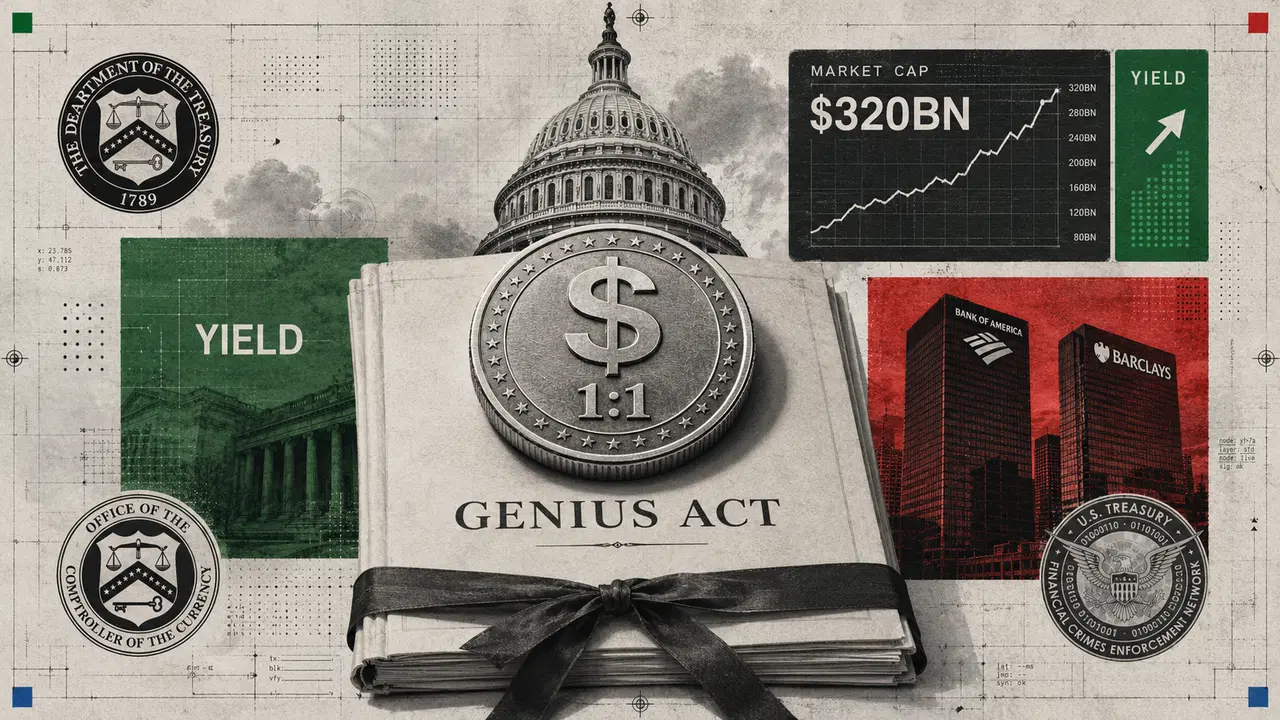
Key facts
- $311.03bnUSD pegs, 13 Oct 2026
- Market cap
- 1:1reserve rule
- Backing
- OCC and Fedplus Treasury and FinCEN
- Oversight
- 13 Oct 2026as of
- Reviewed
Stablecoins are tokens designed to track a currency. Dollar-pegged tokens totalled $311.03bn on 13 October 2026. The GENIUS Act’s issuer regime is expected to take effect on 18 January 2027.
Stablecoins track the value of a currency
Stablecoins are blockchain tokens designed to hold a fixed value against a currency, usually the US dollar. People use them for payments, trading and moving money between platforms. DefiLlama’s daily series put dollar-pegged tokens at $311.03bn on 13 October 2026, within $312.72bn across all currency pegs.
The GENIUS Act sets a US framework for payment stablecoin issuers, including reserve backing, redemption, reporting and supervision. The Act became law on 18 July 2025. Its commencement provision sets the effective date at the earlier of 18 months after enactment or 120 days after implementing final regulations by the primary federal payment stablecoin regulators. Treasury’s 30 September rule gives 18 January 2027 as the expected date. The state-certification procedure that took effect in September is a separate implementation step.
What the GENIUS Act requires
The GENIUS Act establishes a federal framework for these tokens, and its requirements read like conventional financial regulation rather than anything exotic. Once the regime takes effect, permitted issuers must hold reserves backing their tokens one for one, so every unit in circulation is matched by real assets. They must be transparent about those reserves and honour redemption rights, meaning a holder can reliably exchange a token for the dollar it represents. They must meet anti-money-laundering and counter-terrorist-financing obligations, and submit to audit and reporting. Oversight is shared across the Office of the Comptroller of the Currency, the Federal Reserve, the Financial Crimes Enforcement Network and the Treasury. Taken together, it aims to make a stablecoin something a cautious institution can use without taking a regulatory gamble.
Why the rules come now
The GENIUS Act became law on 18 July 2025; the reason its rulebook is being written now is that stablecoins have proved their usefulness under stress. When the speculative parts of the market contracted, stablecoin supply held up far better, though June 2026 brought a $7.7bn fall, the largest monthly drop since the Terra collapse of 2022, because the tokens function as dollars that move on blockchain rails: fast, around the clock, across borders. That utility is independent of whether bitcoin or ether is rising or falling, and it is why regulators have treated stablecoin rules as the most pressing part of the digital-asset agenda. The contrast with the rest of the market is what gives the legislation its urgency: rules tend to follow the products people actually use, and stablecoins have become the settlement layer for a growing share of on-chain payments. For a technology often associated with volatility, a dollar token that simply stays worth a dollar has turned out to be its most durable product.
The yield question
Yield is the reason stablecoin policy has become entangled with the rest of crypto legislation, and the statute itself settles the first half of the question. Section 4(a)(11) of the enacted GENIUS Act will bar any permitted payment stablecoin issuer from paying holders “any form of interest or yield (whether in cash, tokens, or other consideration)” for holding, using or retaining the coin. The indirect route, yield reaching holders through an affiliate or partner of the issuer, now has proposed rule text from two bank regulators. The OCC’s draft of 2 March 2026 and the Federal Reserve’s of 24 September 2026 both presume that an issuer paying an affiliate or a “related third party” that then pays yield to its holders is paying banned yield, a presumption the issuer can rebut in writing; related third parties include firms paying yield as a service and white-label partners. Treasury’s first proposed rule under the act, published on 18 August 2026 with comments open until 19 October 2026, covers who may issue, offer and sell payment stablecoins and carries no yield provisions, so the one route the drafts leave open is an unaffiliated exchange paying rewards from its own funds with no arrangement with the issuer. Banks, including Bank of America and Barclays, have lobbied hard against interest-bearing stablecoins, arguing that a token which pays a yield would pull deposits out of the banking system. Deposits fund bank lending, so the banks’ concern is ultimately about where money in the economy sits. The yield dispute helped stall the CLARITY Act in the Senate, where the cloture vote on the motion to proceed failed 49-50 on 15 September 2026, short of the 60 needed; Senator Tillis entered a motion to reconsider the same day, that motion is still pending, and the Senate adjourned on 30 September 2026 until 9 November without taking the bill up again. A broad market-structure bill stays tied to fights over single features. Our explainer on the CLARITY Act follows that thread.
What the Fed and other agencies have proposed
The Federal Reserve Board proposed two GENIUS Act rules on 24 September 2026 for the payment stablecoin issuers it supervises: full backing with short-term Treasury bills and other high-quality liquid assets, standardised capital and risk-management requirements, rules for firms that safekeep reserve assets, and an application process for Board-supervised banks that want to issue a stablecoin. Both proposals were published in the Federal Register on 29 September 2026, and comments are due by 30 November 2026. On 30 September Treasury issued an interim final rule, in force the same day, setting out how the Stablecoin Certification Review Committee will approve or deny state regulators’ certifications under section 4(c)(4) of the act; certifications are accepted only once Paperwork Reduction Act approval is in place, and comments on it also close on 30 November 2026. The OCC’s first notice on its application forms closed on 25 September, and a second notice with a 30-day comment period follows.
| Body | What it proposed | Comment period |
|---|---|---|
| Treasury | Who may issue, offer and sell payment stablecoins (published 18 August 2026) | Open to 19 October 2026 |
| FinCEN | Customer identification rule for permitted issuers | Closed 21 August 2026 |
| OCC | Licensing and registration application forms (published 27 July 2026) | First notice closed 25 September 2026; a 30-day second notice follows |
| Federal Reserve Board | Reserve, capital, custody and application rules for issuers it supervises (published 29 September 2026) | Open to 30 November 2026 |
| Treasury, for the Stablecoin Certification Review Committee | Interim final rule on how state regulators’ certifications are reviewed (in force 30 September 2026) | Open to 30 November 2026 |
What to watch
Implementation has several separate deadlines. Treasury’s proposed issuance rules remain open for comment until 19 October 2026. Comments on the Federal Reserve’s proposals and Treasury’s state-certification procedure close on 30 November. The issuer framework’s expected commencement is 18 January 2027. The final rules will determine how reserve, redemption and issuer-yield requirements operate in practice.
More Crypto
All Crypto →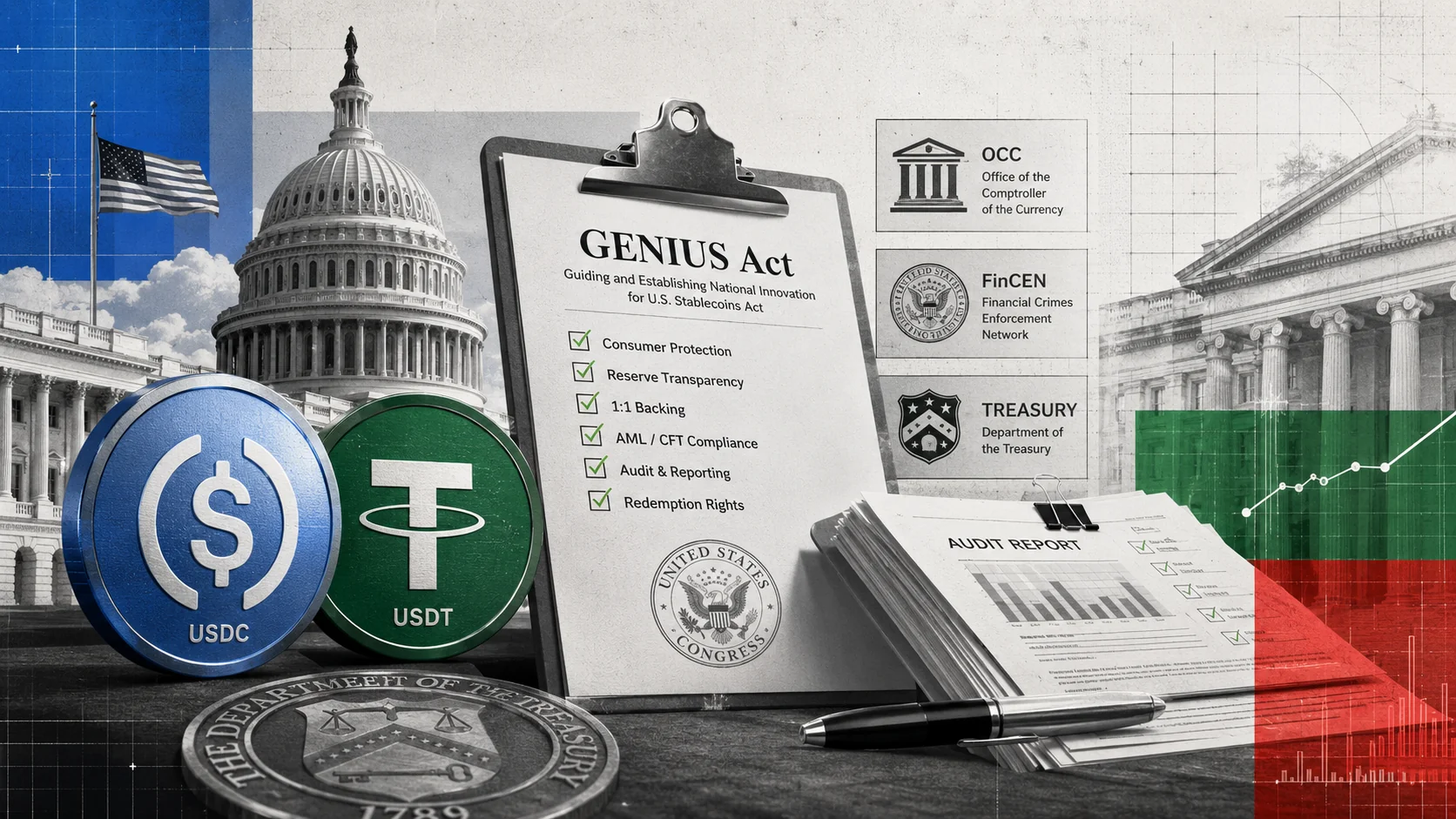
GENIUS Act stablecoin rules hit their deadline: the day digital dollars grew up
Today, 18 July 2026, is the statutory deadline for the GENIUS Act stablecoin rules, and Washington has spent the past month in an uncharacteristic sprint to meet it.
The GENIUS Act’s Impact on Stablecoin Policy
Explore how the GENIUS Act transforms stablecoin regulations, impacting issuers like Tether and Circle in the evolving digital asset market.
GENIUS Act Passes the US Senate in 66–32 Cloture Vote
The GENIUS Act passes the US Senate’s cloture test 66-32 on 20 May, catapulting America toward its first purpose-built stable-coin statute.