
How the peg holds
three designs, and the one that failed
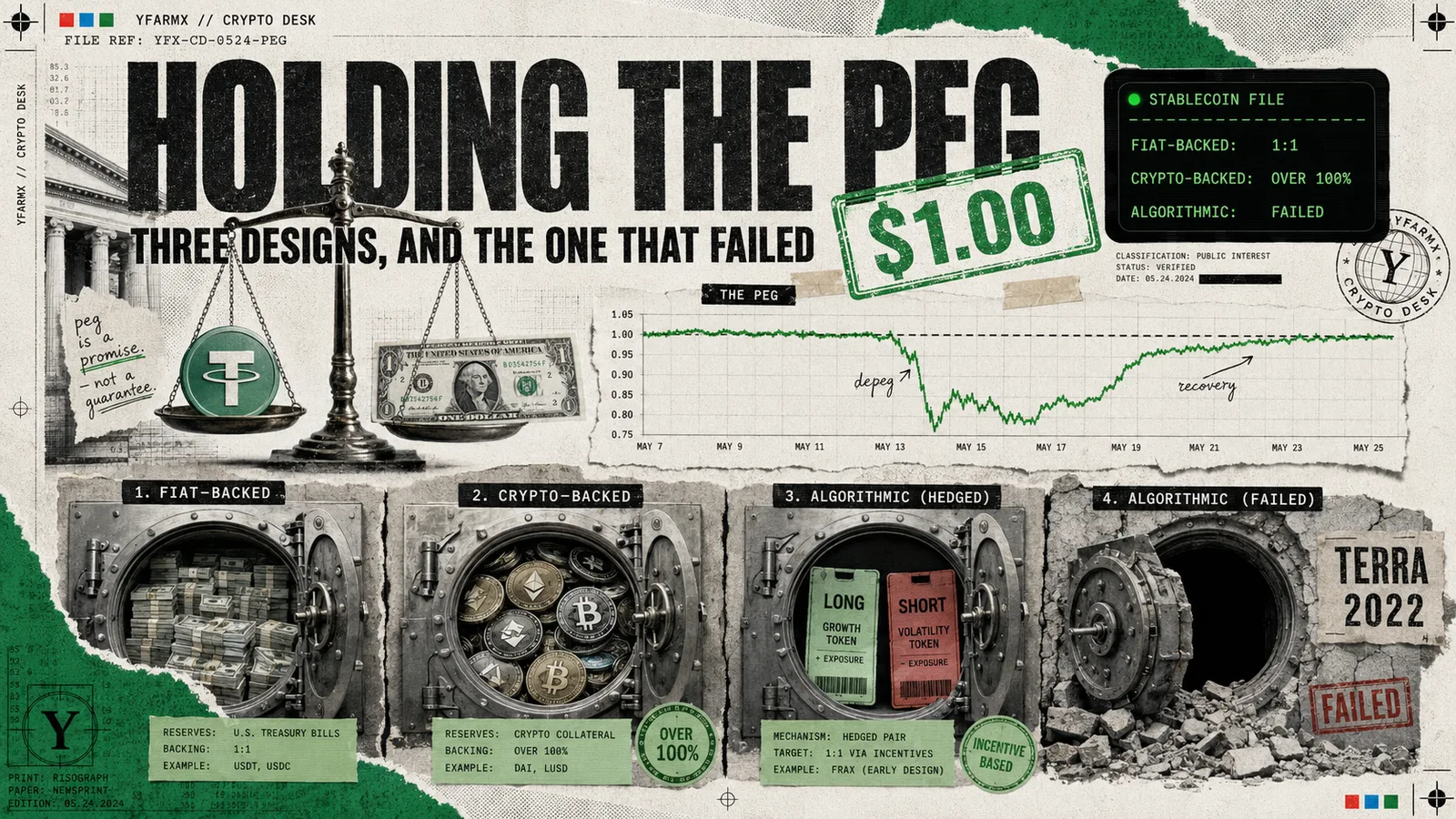
Key facts
- 1:1reserves at a bank
- Fiat-backed
- Over 100%collateral exceeds the debt
- Crypto-backed
- Hedgedlong spot, short futures
- Synthetic
- FailedTerra, May 2022
- Algorithmic
A token is only worth a dollar because somebody can be made to give you a dollar for it. There are three ways that promise gets kept, and one that spectacularly did not, taking about $40bn with it.
A stablecoin is a token that promises to be worth one dollar. Nothing about a token makes that automatic: the promise holds because of a mechanism behind it, and the mechanism differs sharply between coins that look identical on an exchange screen. Knowing which design you are holding tells you how it will behave on the day the market panics.
Fiat-backed: hold the actual money
The simplest design. For every token issued, the company holds roughly a dollar of real assets: bank deposits and short-dated government treasury bills. If the token trades below a dollar, arbitrage traders buy it cheaply and redeem it with the issuer for a full dollar, and that buying pushes the price back up. If it trades above, they mint new tokens at par and sell them.
This is how the largest stablecoins work, and the peg holds well as long as two things are true: the reserves genuinely exist, and redemption actually works at scale. The risk is not really the token, it is the issuer. USDC briefly lost its peg in March 2023 when part of its reserve sat in a bank that failed, which had nothing to do with crypto and everything to do with where the money was parked.
Reserve transparency varies. Some issuers publish monthly attestations by an accountancy firm, which is a snapshot on a single date rather than a full audit.
Crypto-backed: over-collateralise
Rather than trusting a company with dollars, this design locks crypto collateral in a smart contract and issues stablecoins against it, deliberately over-collateralised: perhaps $150 of ether backing $100 of stablecoins. The excess absorbs price falls, and if the collateral drops too far, the position is liquidated automatically to buy back and cancel the debt.
Everything is verifiable onchain, which removes the trust-the-issuer problem, and replaces it with a market-structure one: a violent crash can trigger mass liquidations into thin liquidity, which is precisely when the mechanism is most needed.
Synthetic: hedge the exposure
A newer approach holds crypto and simultaneously shorts an equivalent amount in the futures market. The two positions cancel out, so the combined value stays roughly flat in dollar terms whichever way the market moves, and the funding rate paid between traders becomes yield.
It works while derivatives markets function normally. It depends on exchanges staying solvent, funding rates not turning persistently negative, and being able to close positions in a crisis. Newer and more fragile than it looks in calm conditions.
Algorithmic: the one that failed
The fourth design backed a stablecoin with nothing but another token the same project issued, minting and burning between them to defend the price. Terra’s UST collapsed in May 2022, destroying roughly $40bn in days, when confidence broke and both tokens fell together. The lesson was straightforward: collateral cannot be something whose value depends on the thing it is collateralising.