
Yield-bearing dollars
who keeps the interest on the reserves
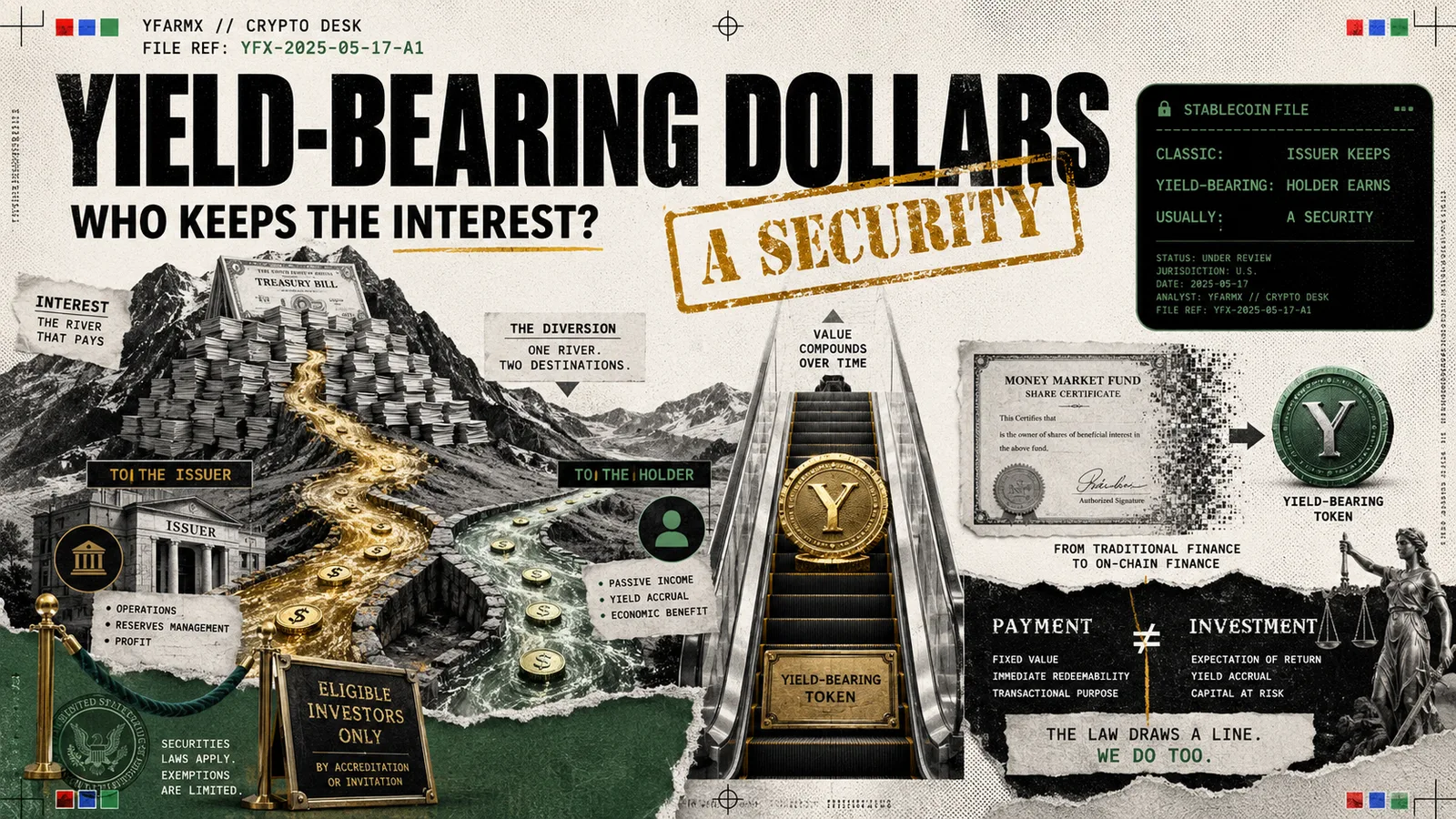
Key facts
- Issuer keepsinterest on reserves
- Classic model
- Holder earnspaid or price accrues
- Yield-bearing
- A securityrestricted to eligible buyers
- Usually
- T-billsshort-dated government debt
- Backed by
Stablecoin issuers sit on tens of billions of dollars of Treasuries and keep the interest. A newer class of token hands that yield to you instead, and in doing so stops being a stablecoin and starts being a security.
An ordinary stablecoin runs one of the better businesses in finance, with little fanfare. Customers hand over dollars and receive tokens; the issuer parks those dollars in short-dated government debt and keeps the interest. At tens of billions in reserves and meaningful interest rates, that is a very large income stream earned on other people’s money.
A newer class of token asks the obvious question: why does the holder not get that yield?
Two ways to pass on the return
Rebasing increases the number of tokens in your wallet. You go to bed with 1,000 and wake up with slightly more, each still worth a dollar. It is intuitive but awkward for accounting systems and for smart contracts that assume balances only change when you transact.
Price accrual keeps the token count fixed and lets the value climb. One token is worth $1.00 today and $1.04 a year later. This is cleaner for integration and is the model many crypto-native yield products use. The tokenised Treasury funds from large asset managers took the other route: BlackRock’s BUIDL and Franklin Templeton’s BENJI hold a stable $1.00 and pay the yield out as additional tokens.
Why this changes the legal position
A conventional stablecoin argues it is a payment instrument: a digital representation of a dollar, not an investment. The moment a token pays a return derived from underlying assets, that argument becomes difficult. An instrument that takes your money, invests it and pays you the profit is, in most jurisdictions, a security or a fund.
That is why these products behave differently from the stablecoin in a retail wallet. They are frequently restricted to professional or non-United States investors, require identity verification before transfer, and can only move between approved addresses. The transfer restrictions written into the token are a compliance requirement rather than a design flaw.
It is also why the GENIUS Act, the United States stablecoin law of July 2025, sets a rule for its forthcoming issuer regime: permitted payment stablecoin issuers will be prohibited from paying holders “any form of interest or yield (whether in cash, tokens, or other consideration)” for holding, using or retaining the coin. Treasury’s 30 September rule gives 18 January 2027 as the expected commencement date. The statutory prohibition concerns the issuer, and two bank regulators have now drafted the next step: the OCC’s proposed rule of 2 March 2026 and the Federal Reserve’s of 24 September 2026 both presume that an issuer paying an affiliate or a related third party that then pays its holders is paying banned yield, a presumption the issuer can rebut. Treasury’s first proposed rule under the act, out for comment to 19 October 2026, carries no yield provisions.
Where it fits
This is the meeting point between stablecoins and tokenised real-world assets. From the crypto side it looks like a stablecoin that pays; from the traditional finance side it looks like a money-market fund with blockchain settlement. Both descriptions are accurate, and the growth has come largely from institutions that want treasury holdings settling in minutes rather than days.
Where it stands
Tokenised Treasury products have grown quickly, led by offerings from large established asset managers rather than crypto-native firms, which is itself the notable development. The open question is whether the two categories stay separate: retail users can see the yield on offer, and pressure to blur the line between a payment token and an investment product will not go away.
More Crypto
All Crypto →
The stablecoin yield ban fight: six trillion dollars and a very nervous banking lobby
The most consequential fight in American finance right now concerns a single clause, and the stablecoin yield ban sits at the centre of it. The question sounds almost quaint: should digital dollars be allowed to pay their holders interest?