Novo will test Claude Science on specific drug discovery workflows

Novo Nordisk, which now trades day to day as Novo, announced a collaboration with Anthropic on 16 September 2026. It will test Claude Science on specific research and development workflows, on top of the Claude system that already writes its regulatory documents.
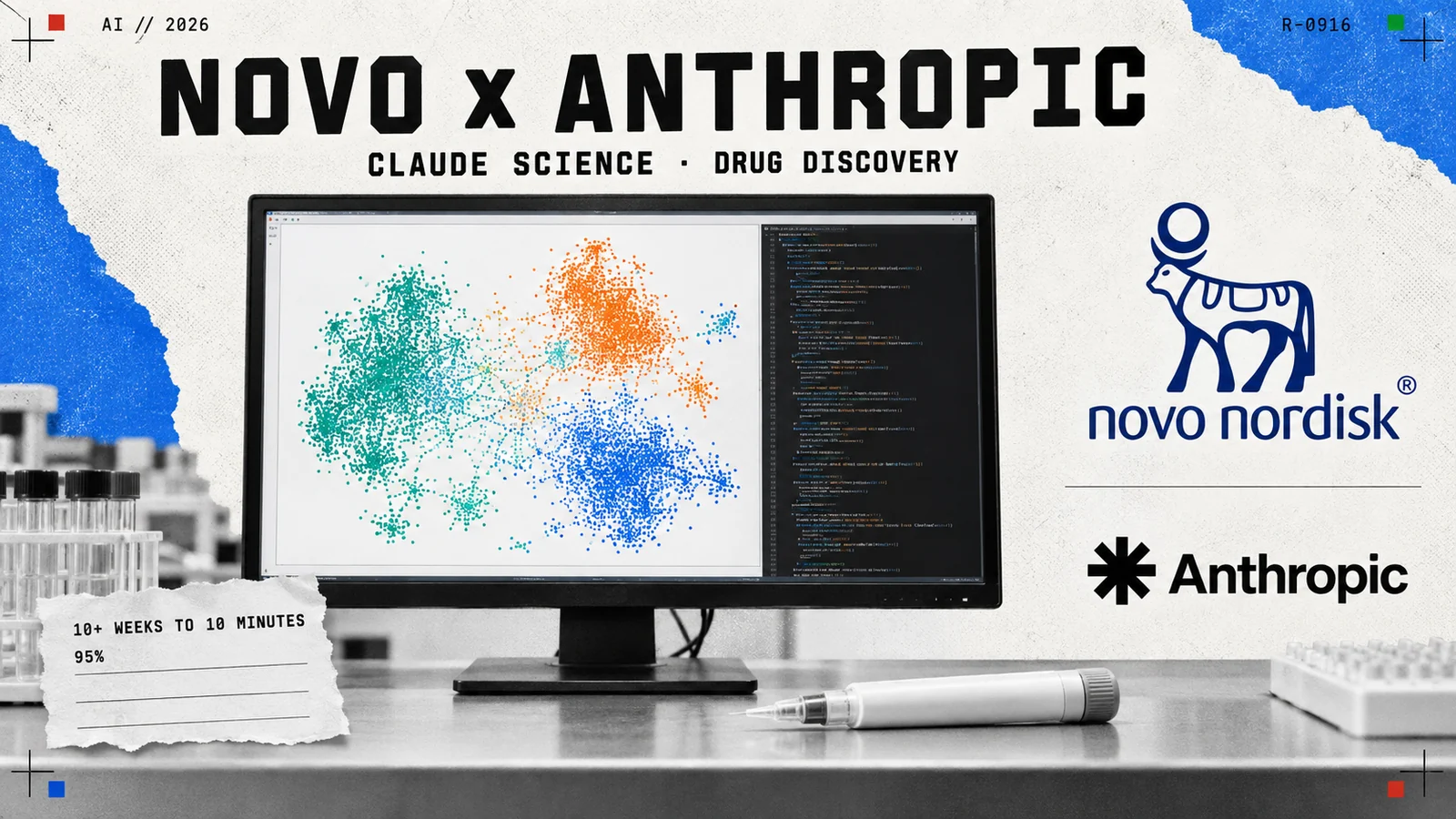
Novo Nordisk and Anthropic said on 16 September that they will work together on drug discovery, with the Danish company testing Claude Science inside its research and development organisation. The release went out from Bagsværd at 08:00 Eastern and describes a collaboration “that will help Novo accelerate the development of new medicines and advance AI-driven software development”.
Two commitments sit in it. The first: “As an initial aim, Novo will test Claude Science for specific workflows in R&D and address scientific problems where the joint capabilities of Novo and Anthropic are expected to have the greatest impact.” The second: “Novo will also use Anthropic’s frontier models to strengthen AI-driven software development”, which the release calls “a key enabler for scaling AI across the company”.
Mike Doustdar, who became president and chief executive on 7 August 2025, put the ambition in the release: “Joining forces with Anthropic will supercharge our R&D organisation and help us on our mission to bring new, transformative health solutions to people living with chronic diseases.” He added that “AI can help us increase productivity in R&D and compress the path from research to marketed product. But beyond this, AI tools can also offer completely new scientific opportunities and aid reasoning and understanding of human biology and drug mechanics.”
Dario Amodei, Anthropic’s co-founder and chief executive, is quoted in the same release: “AI’s increasing capability brings with it the potential to compress a century’s worth of biological and medical breakthroughs into a decade.”
Claude already writes Novo’s regulatory paperwork
The collaboration builds on a system that has been in production for a while. Anthropic’s own case study on Novo Nordisk describes NovoScribe, a generative AI documentation platform built on Amazon Bedrock and MongoDB Atlas, developed with Claude Code and driven by Claude models. It puts two figures at the top of the page. Clinical study documentation goes, in its words, from “10+ weeks to 10 minutes”. Device verification protocols get a “95% reduction” in the resources they need.
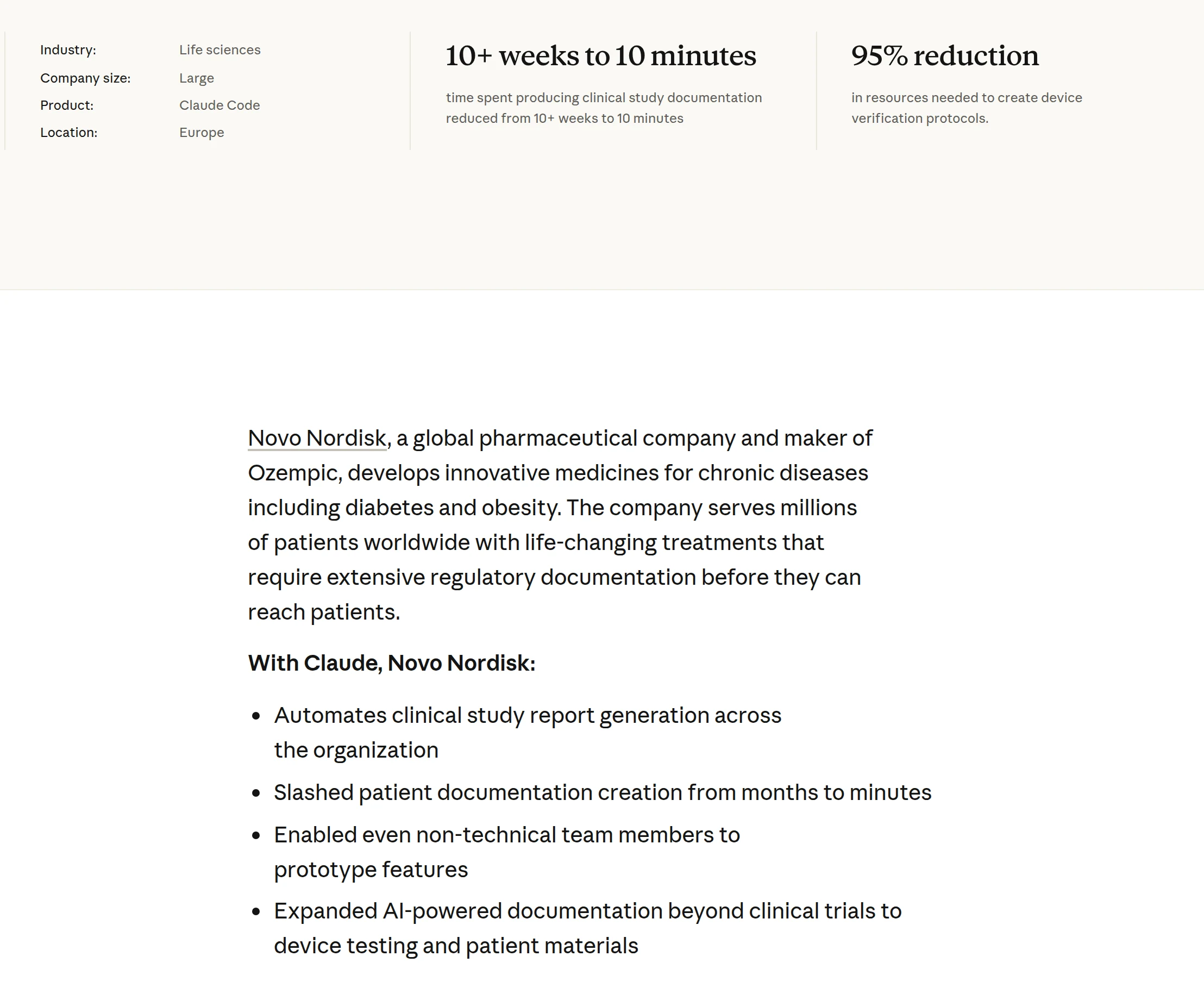
The same page gives the scale of the documents involved: a clinical study report runs “up to 300 pages”, staff writers “averaged only 2.3 CSRs per year” before the system existed, and “review cycles have been cut in half”. It records positive feedback from regulators, and a team of eleven people building it.
Louise Lind Skov, Director Content Digitalisation at the company, is quoted there saying the work “has set a new standard”, and: “we’re not just automating tasks, we’re transforming how medicines get from discovery to the patients who need them.”
So the 16 September announcement moves Claude from the writing-up end of the pipeline towards the science at the front of it.
What is Claude Science?
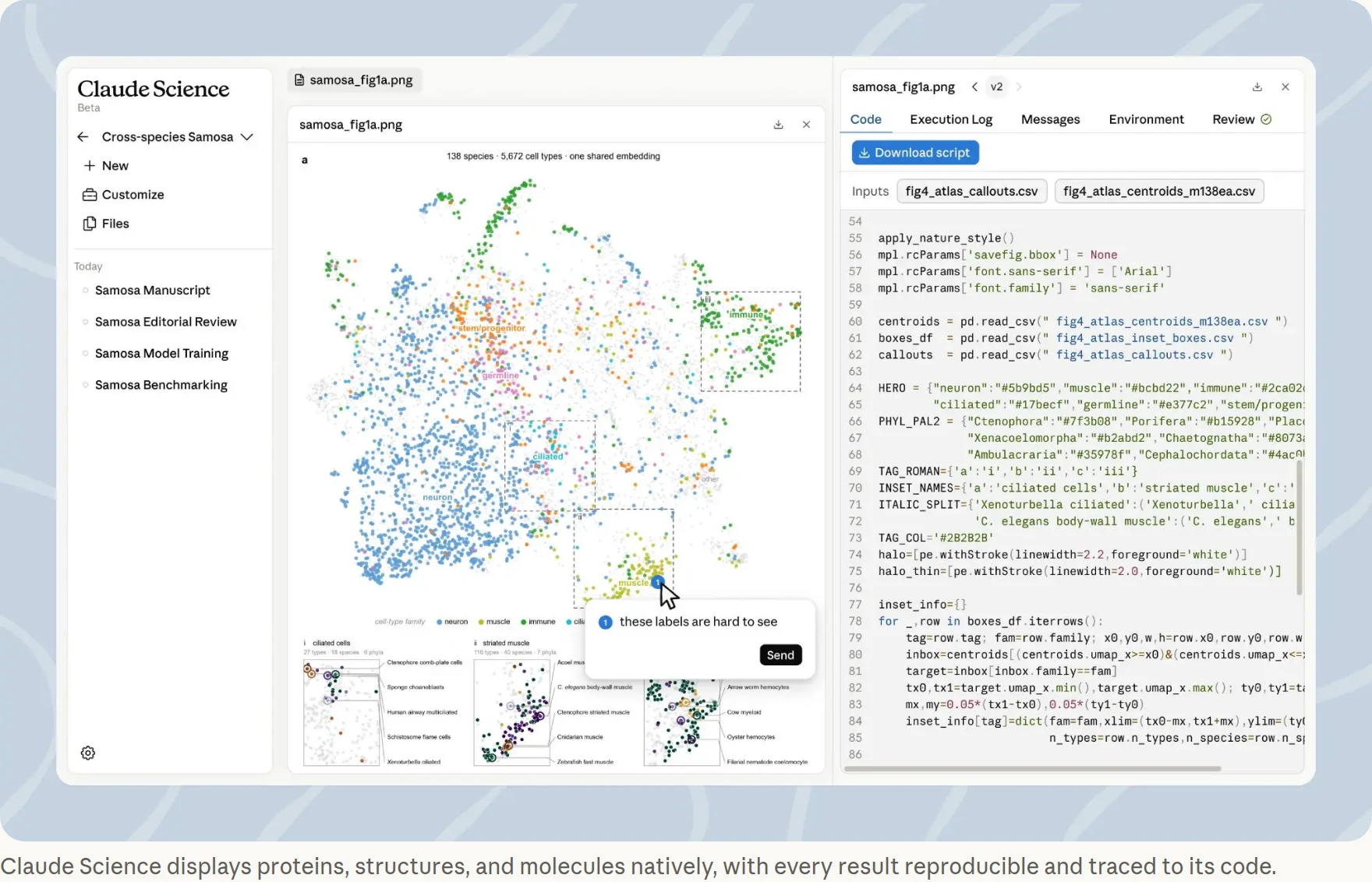
Anthropic released Claude Science on 30 June 2026 and describes it as “an AI workbench for scientists” that “integrates the tools and packages that researchers most commonly use, produces auditable artifacts, and provides flexible access to computing resources”. It runs in beta on macOS and Linux for Pro, Max, Team and Enterprise plans.
It arrives pre-wired to the databases a working biologist reaches for, among them UniProt, the Protein Data Bank, Ensembl, Reactome, ClinVar, ChEMBL and GEO, with more than 60 curated skills and connectors across genomics, single-cell work, proteomics, structural biology and cheminformatics. It uses the skills in NVIDIA’s BioNeMo Agent Toolkit to reach the life-sciences models in BioNeMo, including Evo 2, Boltz-2 and OpenFold3.
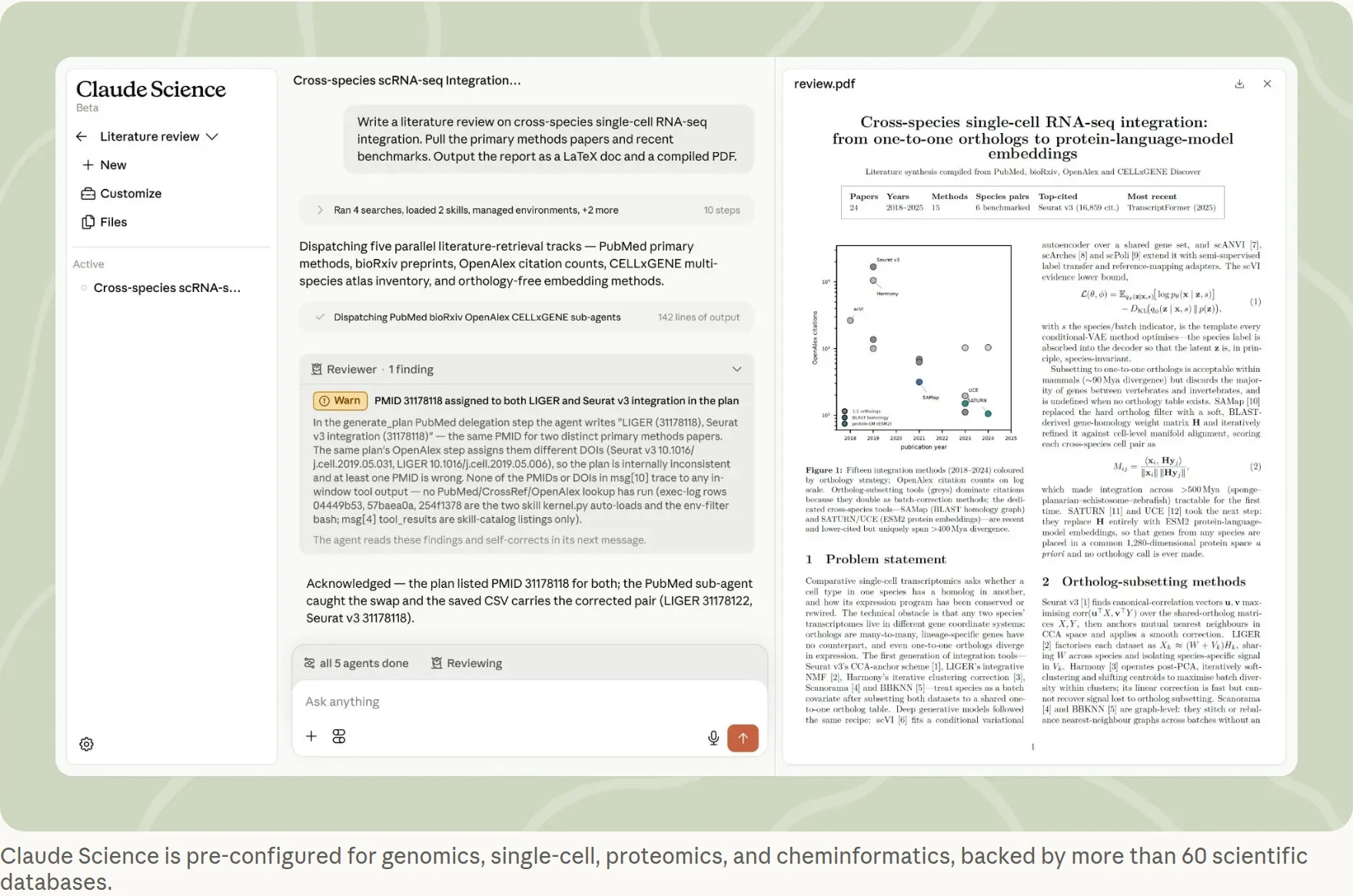
The product also carries a reviewer agent that, in Anthropic’s words, “checks citations and calculations, flagging and correcting errors”. Anthropic’s own screenshot of that feature shows it catching a duplicated PubMed identifier in a literature plan and the agent correcting itself in the next message.
That kind of check is the ground Novo’s release stands on when it says “the collaboration has been designed with robust data governance and human oversight, helping ensure AI is applied responsibly and in line with Novo’s ethical and compliance standards”.
Novo changed its name two days ago
On 14 September the company said it would use Novo as its everyday name, keeping Novo Nordisk A/S as the legal one, with a new line, “Lasting Health Starts Now”, and the Apis bull logo carried over from its heritage. On 21 September it holds a Capital Markets Day in London, where it said it would set out the corporate strategy behind that change.
The company employs more than 67,000 people, and Doustdar’s phrase in the release, “our ambition to become the world’s most AI-driven healthcare company”, runs through the rebrand and this collaboration alike.
The relationship with Anthropic goes back further than this week. Novo Nordisk was one of the organisations named when Anthropic launched Claude for Life Sciences on 20 October 2025.
What the two companies actually committed to
The release is specific about direction and general about scope. It commits to testing Claude Science “for specific workflows in R&D”, on drug discovery challenges “identified by scientists and computational teams at Novo” and then addressed by the two companies together.
What it does fix is the shape of the work: challenges identified at Novo, “targeted solutions for specific scientific challenges and workflows to support biological reasoning”, and frontier models applied to Novo’s own software engineering. Amodei’s framing of the prize, compressing “a century’s worth of biological and medical breakthroughs into a decade”, sets the ambition the work is aimed at.
For a reader watching the pharmaceutical industry adopt these systems, the measurable part is already on the record. The NovoScribe figures describe a system whose output, on Anthropic’s account, has drawn positive feedback from regulators. The discovery work announced today starts from there.
Sources
- Novo Nordisk A/S, 'Novo and Anthropic will collaborate to advance drug discovery with Claude', 16 September 2026globenewswire.com
- Novo Nordisk A/S company announcement, same release, via Investegateinvestegate.co.uk
- Anthropic, 'Claude Science, an AI workbench for scientists', 30 June 2026anthropic.com
- Anthropic, 'Novo Nordisk accelerates clinical documentation and drug development with Claude'claude.com
- Anthropic, 'Claude for Life Sciences', 20 October 2025anthropic.com
- Novo Nordisk A/S, 'Novo Nordisk enters next chapter ... supported by 'Novo' rebrand and updated corporate culture', 14 September 2026globenewswire.com