Arc opened to the public today, and it has been producing blocks since May
Circle opened its Arc blockchain to the public on 16 September 2026. The network had already been running privately since May, and every transaction fee on it is paid in USDC rather than a separate crypto token.
Circle opened Arc to the public on 16 September, calling it “an open Layer 1 blockchain purpose-built for financial markets, real-time money movement, and agentic economic activity”. Jeremy Allaire, Circle’s co-founder, chairman and chief executive, put it higher than that: “Arc is the single most significant launch in Circle’s history since USDC itself, and it is the embodiment of the premise we have operated on for thirteen years: money should work the way the internet works.”
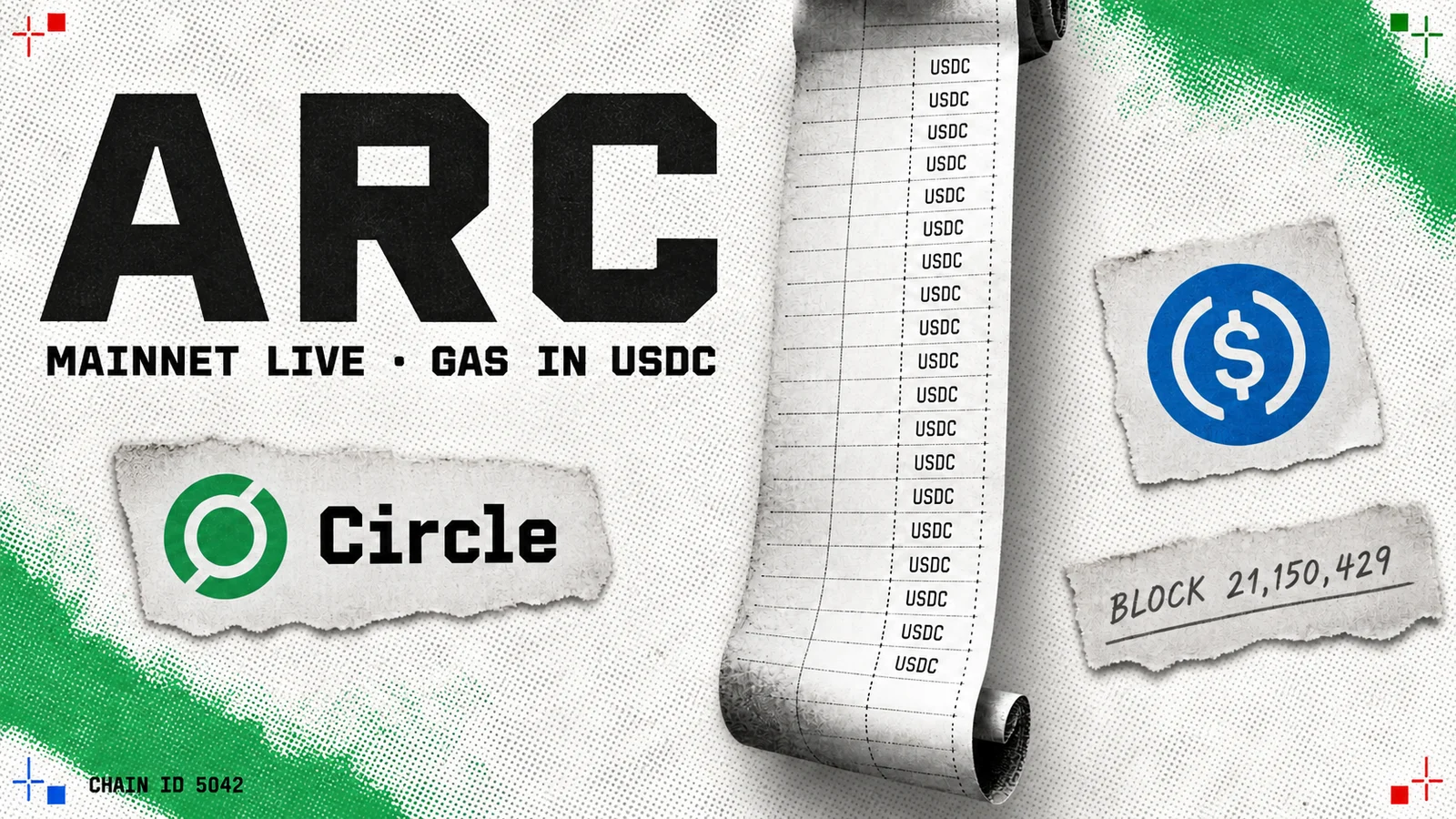

The network answers its own questions, so we asked it. Arc’s public RPC endpoint reports chain ID 5042 and dates block 1 to 15 May 2026 at 13:58:51 UTC. By 11:31 UTC today it stood at block 21,150,429. The chain a reader can connect to this morning has been producing blocks for four months.
The chain is already four months old
Circle’s release is consistent with this. It describes “more than 100 institutional and ecosystem builders” as “already live on or exploring Arc’s private mainnet ahead of today’s public launch”. Today is the opening of a network that was already running, rather than a genesis event.
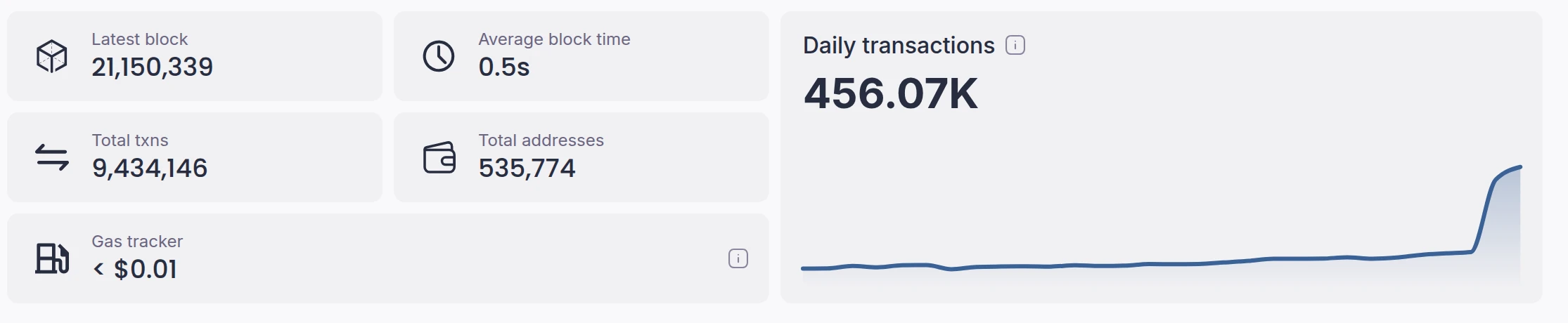
The numbers line up. The explorer reports an average block time of 0.5 seconds. Dividing the elapsed time since block 1 by the current height gives 0.506 seconds, so the chain has been running at its stated cadence throughout, without a long idle period padding the count.
What changed today is access and the product layer on top, and the daily transaction chart shows it: a flat line for months, then a step up at the right-hand edge.
You pay the fees in dollars
Circle sets out “Six design choices set Arc apart” and puts this one at the top: “Gas in dollars. Fees are paid in USDC, with no volatile native token required.” The explorer bears that out at the level of individual transactions, which is the only level that settles the question.
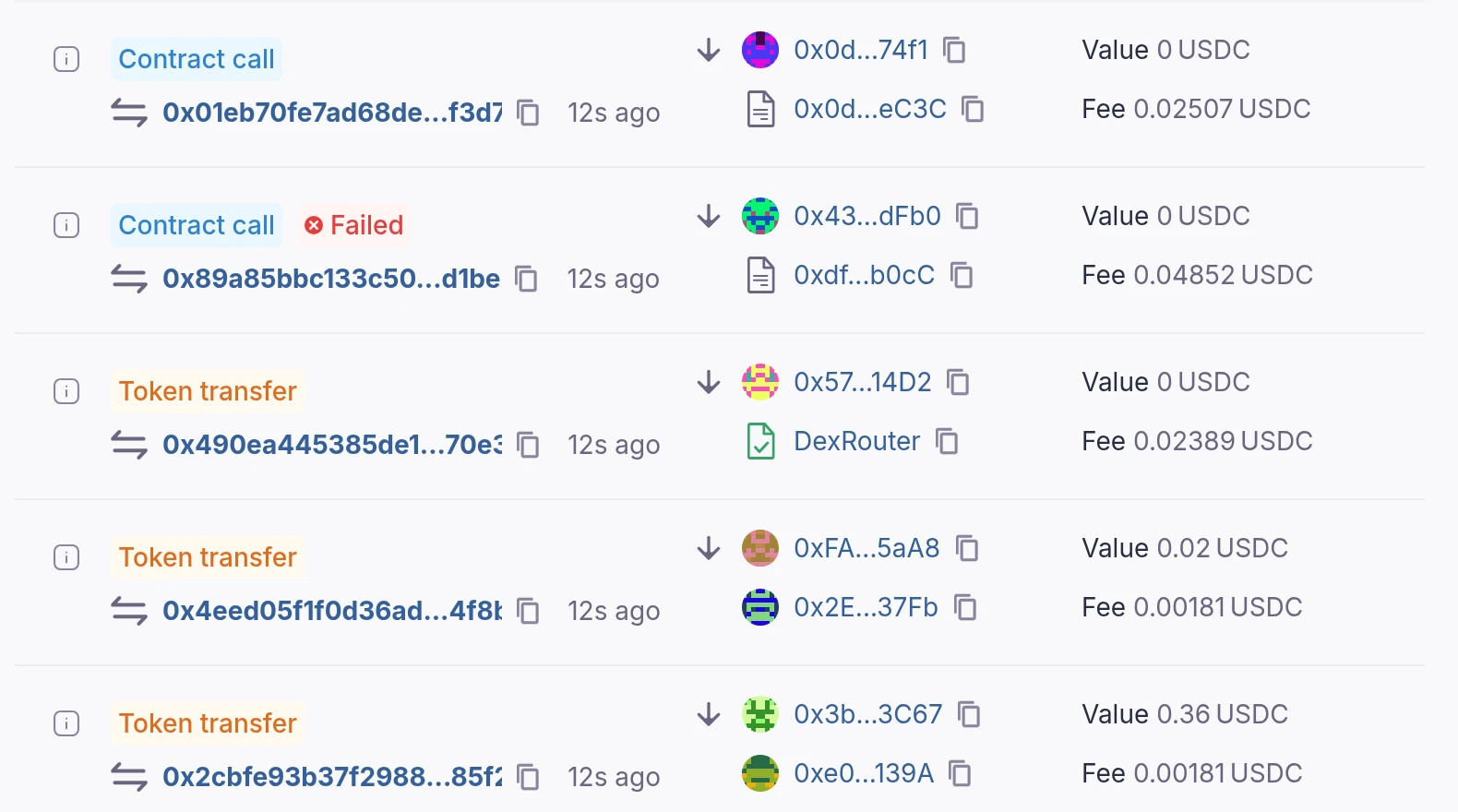
Five consecutive entries in the feed carried fees of 0.02507, 0.04852, 0.02389, 0.00181 and 0.00181 USDC. The second of those is a contract call that failed and paid anyway, which is how gas works on any chain.
The explorer’s gas tracker reads under a cent, and that figure is the price of gas rather than the total a transaction pays. On these five, a simple transfer cost about a fifth of a cent and the dearest contract call about five cents. Either way a user funds a wallet with the dollar token they already hold and transacts, without acquiring a second asset first.
The fake verification pages to watch for
An opening day is when the largest number of people go looking for an address to connect to, and that makes it the day to slow down on. The technique worth knowing before you go looking runs on the computer rather than on the chain, which is how it gets past a careful wallet habit.
Microsoft Threat Intelligence calls it ClickFix, and describes it as an attempt to “trick users into running malicious commands on their devices by taking advantage of their target’s tendency to solve minor technical issues and other seemingly benign interactions, such as human verification and CAPTCHA checks”. The page looks like a routine check that you are human. Clicking the verify button writes a command to the clipboard, and the text on screen asks the visitor to open the Windows Run box or a terminal and paste it.
What runs then is ordinary software holding the user’s own privileges, so it reaches saved passwords, browser sessions and wallet files in one pass. Malwarebytes analysed pages impersonating both Google and Cloudflare in research published on 2 July 2026, and found “multiple campaigns using the same infrastructure to deliver malware including HijackLoader, StealC, Remus, Amatera Stealer, CastleLoader, NetSupport, and a Rust-based stealer”. A separate chain in the same research begins with a trojanised build of the Franz messaging app and installs a loader the researchers named ResiLoader, which drops a signed driver and uses it to “Terminate more than 140 processes related to EDR/AV processes” before deploying the StealC infostealer.
The instruction is the tell, and Malwarebytes states it in a single line: “Google, Cloudflare, Microsoft, and other legitimate services will never ask you to paste PowerShell commands into Windows to prove you’re human or fix a problem.” Microsoft’s guidance to defenders runs the same way, asking organisations to “ensure users are aware of what they copy and paste”.
The reach is what separates this from a wallet drainer. A malicious approval takes what the approval granted. A script running as administrator takes what the machine holds.
Where to get the real Arc settings
Arc’s own documentation carries the canonical figures, and checking against them costs a minute.
The network answers for itself: a request to Arc’s public RPC endpoint at rpc.mainnet.arc.io returns chain ID 0x13b2, which is 5042, and the explorer is at explorer.arc.io. Arc’s contract addresses page gives the mainnet USDC interface as 0x3600000000000000000000000000000000000000 and states the position on lookalike tokens in its own words: “There is no wrapped USDC address on Arc.”
Moving USDC onto the chain runs through Circle’s own Cross-Chain Transfer Protocol, which Circle’s developer documentation describes as transferring USDC “across blockchains using burn-and-mint”. A burn-and-mint transfer destroys the token on the origin chain and issues a new one on the destination, so each leg settles against Circle’s own issuance rather than against a shared pot of deposited tokens. Pooled bridges hold that pot, and holding it is what has made them worth attacking. The comparison is ours; Circle’s page sets out the mechanism and leaves the security claim alone. The mainnet addresses are published on the same page: TokenMessengerV2 at 0x28b5a0e9C621a5BadaA536219b3a228C8168cf5d, MessageTransmitterV2 at 0x81D40F21F12A8F0E3252Bccb954D722d4c464B64, and Circle’s Gateway at 0x77777777Dcc4d5A8B6E418Fd04D8997ef11000eE and 0x2222222d7164433c4C09B0b0D809a9b52C04C205.
On the token, Circle’s own sentence settles it. The genesis mint “is not a commitment to publicly launch ARC”, so an offer of ARC tokens, an ARC airdrop or an eligibility check today is coming from somebody other than Circle.
The contract addresses page is the one to take the configuration from, because Arc’s own documentation index alongside it was still describing an earlier state of the network. At 14:30 UTC on launch day that index at docs.arc.io/llms.txt told developers that “Arc is currently available on Testnet only” and pointed at Circle’s testnet faucet, while the addresses above sat under a mainnet tab on the page beside it. A third-party site offering to supply that configuration instead is a site with its own reasons.
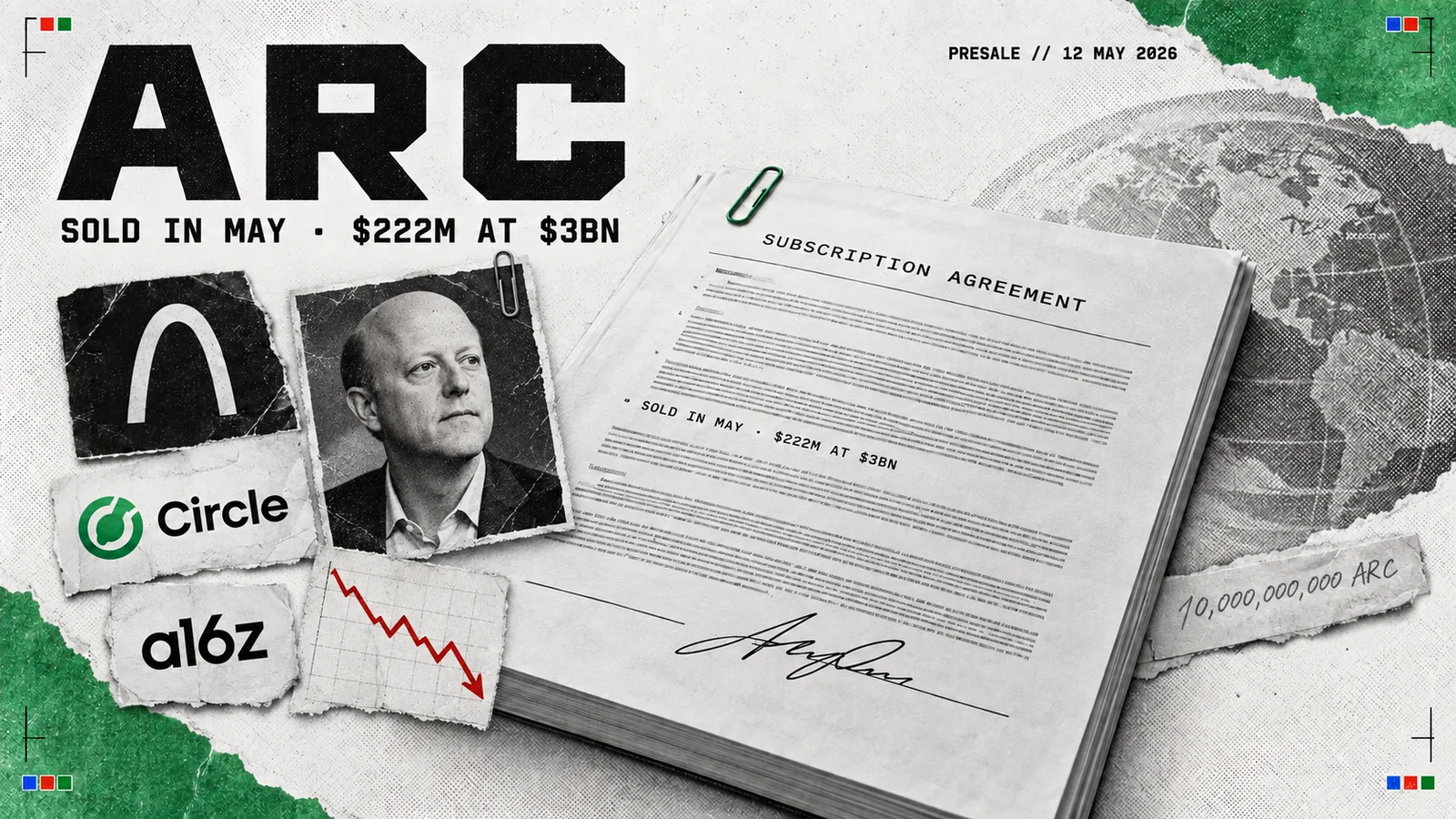
Circle minted 10 billion ARC this week
Alongside a network whose headline feature is that no volatile native token is required, Circle disclosed something that sits at an angle to it.
“Circle completed the genesis mint of ARC token this week in the U.S.,” the release says, “creating the full initial supply of 10 billion tokens”, which it describes as “making Circle the first publicly traded company to mint a network token for a new layer-one blockchain”. ARC “is designed to serve as a digital commodity intended to act as the native coordination mechanism for security, utility, and governance on Arc, with network fees remaining payable in USDC”.
Circle then draws the line itself: “This initial mint is not a commitment to publicly launch ARC, but an important technical milestone in the Arc roadmap as the network explores a future transition from Proof of Authority toward Proof of Stake in 2027.”
Two things follow from that sentence, and both are worth holding onto. Arc runs proof of authority today, which is what a permissioned validator set implies. And the token exists in full supply now, with its distribution and its public launch left open.
Eleven institutions run the network
The founding cohort Circle names is BlackRock, DTCC, Galaxy, ICE, Mastercard, MoneyGram, SBI Group, Standard Chartered, Sumitomo Corporation, Visa and “Worldpay (now Global Payments)”. They arrive in sequence rather than together: Circle writes that “Arc will have a phased rollout from the founding validator cohort”.
The legal framing in Circle’s own disclaimer is precise: “Arc is an open L1 blockchain launched by Arc Network Services LLC (“Arc LLC”) and operated by a permissioned validator set. Arc LLC provides software services only and does not offer regulated financial or advisory services. Arc has not been reviewed or approved by the New York State Department of Financial Services or any other regulatory authority.“
Yoshitaka Kitao, chairman and chief executive of SBI Holdings, described what being in that set means: “With Arc, we will not simply be a user of the network: as a founding validator, we will contribute to its operation and governance.”
For the banks, Circle frames the permissioning as the feature. The seven global banks Circle names, BNY, BTG Pactual, HSBC, Lead Bank, Societe Generale, Standard Chartered and State Street, “have access to a public blockchain designed to help meet bank regulatory demands, including a permissioned validator model and defined governance perimeter”.
Who turned up on day one
Circle counts more than 100 applications and more than 100 institutional and ecosystem builders. Aave and Morpho bring credit markets, with Stani Kulechov of Aave Labs saying the protocol is “doubling down on the Circle ecosystem with a new Aave V4 market on Arc”. Uniswap, Aero and fomo cover trading. Custody comes from Anchorage, BitGo, Copper, Fireblocks and Zodia, among others.
The product layer launched today carries its own names: Circle StableFX for 24/7 cross-currency settlement, the Circle Payments Network, Circle Agent Stack with Agent Wallets and an Agent Marketplace, Arc Studio as an onchain coding agent, and Arc App Kits as a unified SDK.
The numbers Circle is quoting
Circle puts USDC in circulation above $74 billion, and says USDC accounts for 98.8% of agent-driven transaction volume. It counts more than 75,000 active Arc House members and 10,000 ambassadors who have built more than 1,200 projects, on a testnet that processed more than 700 million transactions in under a year.
The roadmap items carry dates or conditions rather than availability: network sectors for privacy, payments at more than 100,000 transactions per second, and agent identity; post-quantum signatures supported today with broader protections in development; and the proof-of-stake transition described for 2027.
What this means for USDC
The reason to watch Arc is what it does to the dollar token rather than what it does to the layer-one league table. Every fee on this chain is a USDC payment, so network usage converts directly into demand for the asset Circle issues. A chain where the gas token is your own product is a different business from a chain where it is somebody else’s.
The measure that settles it is the daily transaction line over the coming weeks, against the 456,000 the explorer recorded on launch day. The chain publishes that number continuously, to anyone who asks it.
Sources
- Circle, 'Circle Launches Arc Mainnet, an Economic Operating System for the Internet', 16 September 2026circle.com
- Circle, 'Circle Announces Founding Validator Cohort and Major Integrations for Arc', 5 August 2026circle.com
- Arc, 'Arc Mainnet goes live on September 16, 2026'arc.io
- Arc Mainnet block explorer (Blockscout)explorer.arc.io
- Arc developer documentation, network endpointsdocs.arc.io
- Arc, network homearc.io
- Arc developer documentation, contract addressesdocs.arc.io
- Arc developer documentation indexdocs.arc.io
- Circle, Cross-Chain Transfer Protocol developer documentationdevelopers.circle.com
- Microsoft Threat Intelligence, 'Think before you Click(Fix): Analyzing the ClickFix social engineering technique', 21 August 2025microsoft.com
- Malwarebytes, 'Fake Google and Cloudflare verification pages spread multiple malware families', 2 July 2026malwarebytes.com