Circle sold $222m of ARC to institutions in May, four months before Arc opened

Circle raised $222 million selling ARC at a $3 billion network valuation, announced on 11 May 2026, with a16z crypto leading and BlackRock, Apollo and Intercontinental Exchange among the buyers. Arc opened to the public four months later, on 16 September.
Circle opened Arc to the public on 16 September and called it the largest thing the company has done since USDC. Jeremy Allaire, Circle’s co-founder, chairman and chief executive, put it in those terms in the release: “Arc is the single most significant launch in Circle’s history since USDC itself.”
The ARC token had already been sold by then. Circle raised $222 million for it in May, at a $3 billion fully diluted network valuation, in a private round that closed four months before the public could connect a wallet.
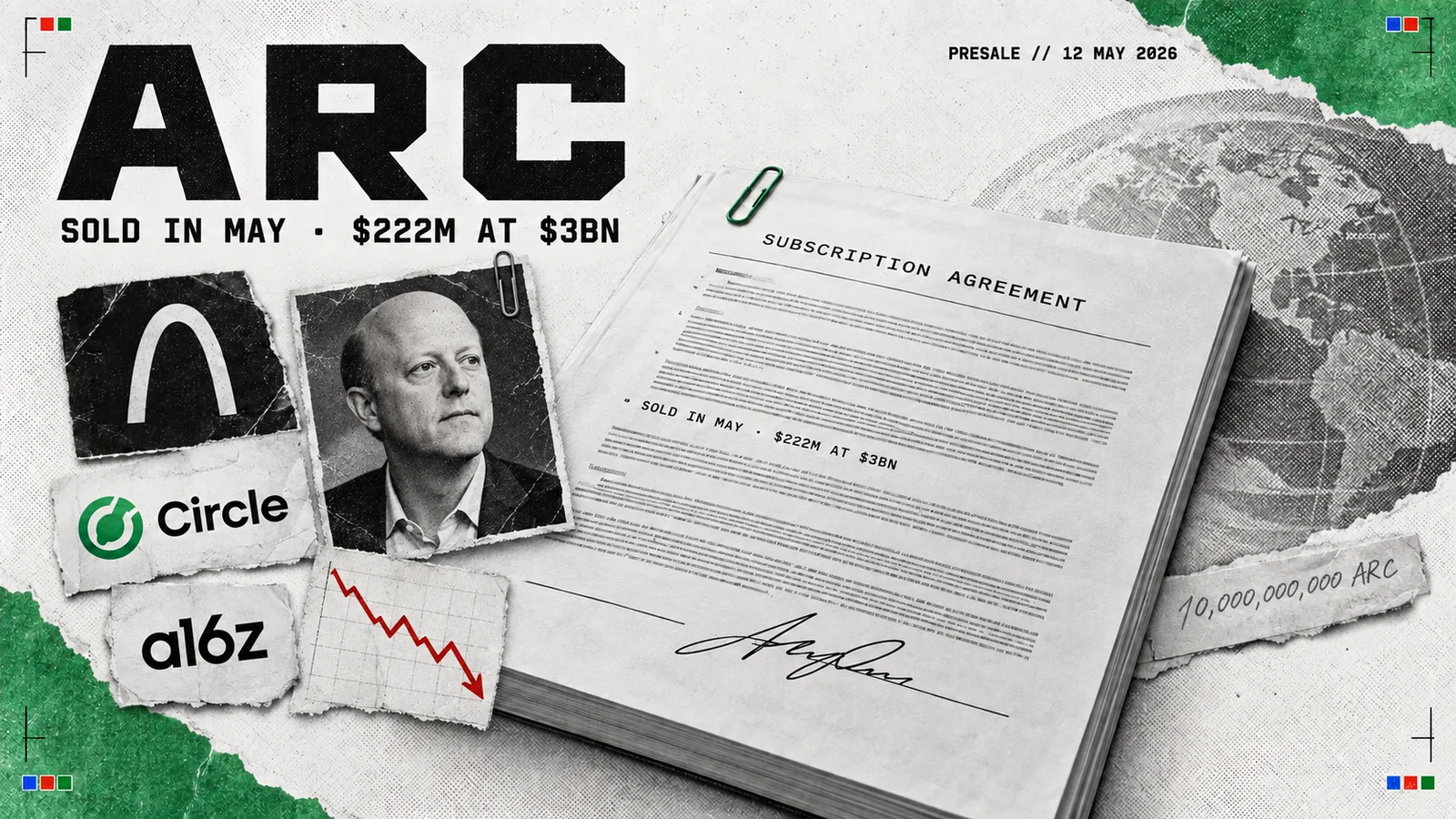
Circle sold ARC in May for $222m
Cooley, the law firm that advised Circle on the round, records the terms: a “$222 million presale of the ARC token” at “a $3 billion fully diluted network valuation”, on a page dated 12 May 2026. It calls the deal “the first ever token sale by an SEC-registered company”, which is the claim Circle has leaned on since.
a16z crypto “served as the lead purchaser”. The rest of the buyers Cooley names are Apollo Funds, ARK Invest, BlackRock, Bullish, General Catalyst, Haun Ventures, IDG Capital, Intercontinental Exchange, Janus Henderson Investors, Marshall Wace, SBI Group and Standard Chartered Ventures.
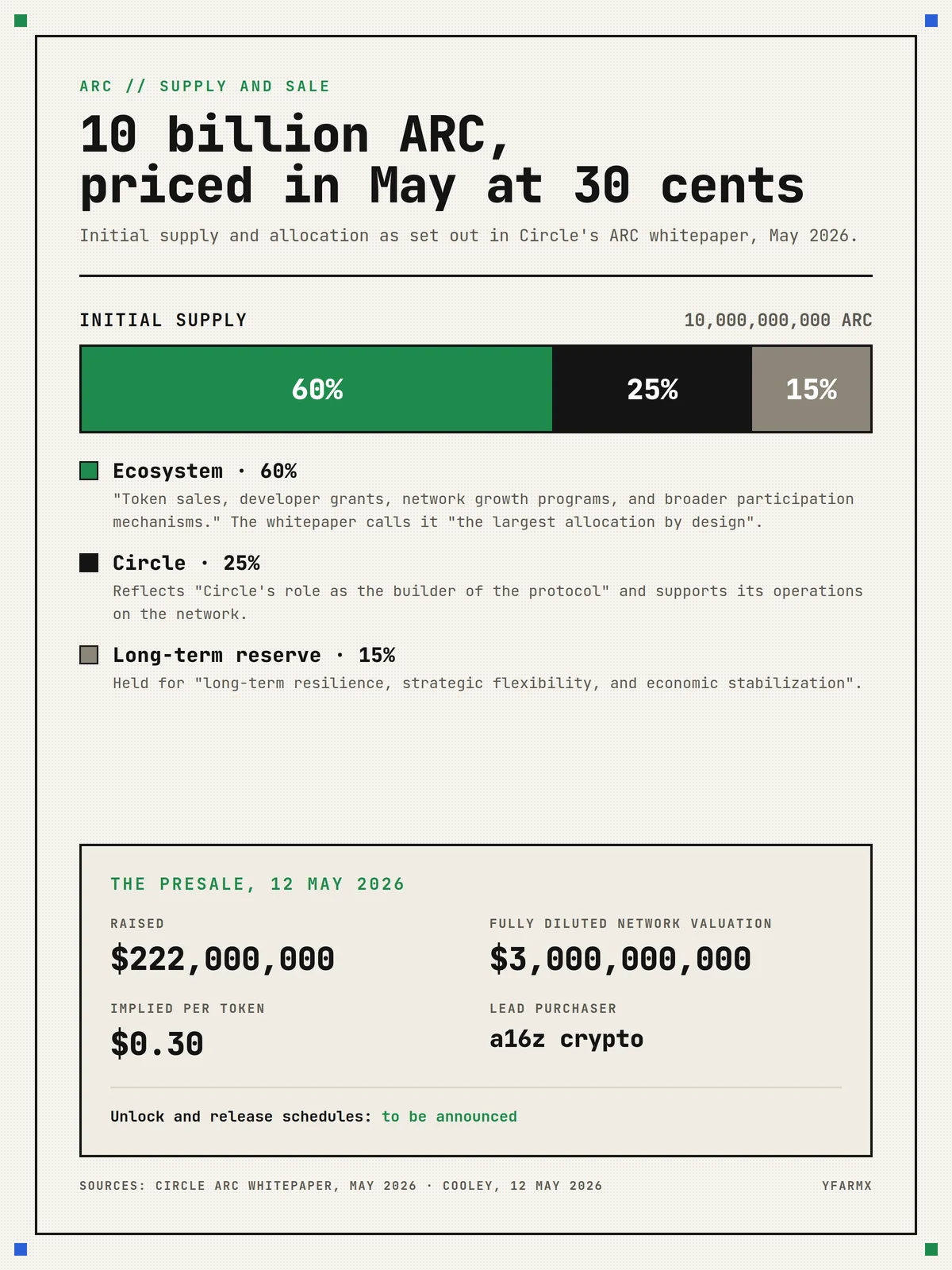
Set the two published figures against each other and the price follows. Circle’s own whitepaper, dated May 2026, fixes the initial supply at 10 billion ARC. A $3 billion valuation across 10 billion tokens is 30 cents a token. That arithmetic is ours; both inputs are Circle’s.
Three of the eleven validators bought in the presale
The founding validator cohort Circle named on 5 August runs to eleven institutions: BlackRock, DTCC, Galaxy, Intercontinental Exchange, Mastercard, MoneyGram, SBI Group, Standard Chartered, Sumitomo Corporation, Visa and Global Payments.
Read that list against Cooley’s and three names sit on both: BlackRock, Intercontinental Exchange and SBI Group. Standard Chartered makes a fourth overlap through its venture arm, since Standard Chartered Ventures bought in May and Standard Chartered validates.
So three of the eleven institutions that produce Arc’s blocks also hold a priced position in the asset that is meant to secure the network once it moves to proof of stake. Circle discloses both facts. It presents them separately.
Circle says one sentence about the token
Ahead of the launch Circle “completed the genesis mint of ARC token this week in the U.S., creating the full initial supply of 10 billion tokens”, which it describes as “making Circle the first publicly traded company to mint a network token for a new layer-one blockchain”.
Then comes the sentence that governs everything a reader might want to do about it:
“This initial mint is not a commitment to publicly launch ARC, but an important technical milestone in the Arc roadmap as the network explores a future transition from Proof of Authority toward Proof of Stake in 2027.”
The whitepaper sets out what the token is for. Sixty per cent of the supply goes to “Ecosystem”, which it says “encompasses token sales, developer grants, network growth programs, and broader participation mechanisms”, and which it calls “the largest allocation by design”. Twenty-five per cent goes to Circle, an allocation the whitepaper says “reflects Circle’s role as the builder of the protocol”. Fifteen per cent is a “Long-Term Reserve” for “long-term resilience, strategic flexibility, and economic stabilization”.
On when any of it moves, the whitepaper says: “Exact unlock and release schedules will be announced in the coming months.” That was May. The launch release of 16 September repeats the position and leaves the timing open.
What can a reader buy on Arc today?
USDC. That is the asset Circle has put in public hands on this chain, and it is the one the design is built around: fees are paid in USDC, and Circle’s release describes ARC in the same paragraph as the token “with network fees remaining payable in USDC”.
For Circle that is a coherent position. Every transaction on Arc is settled in the dollar token Circle issues, so usage converts into demand for its own product. A reader who wants exposure to that has two ways in that exist today: hold USDC, or buy the shares.
The shares fell on the day Arc opened
Circle Internet Group trades on the New York Stock Exchange as CRCL. Its closes through launch week, read from StockAnalysis on 18 September 2026:
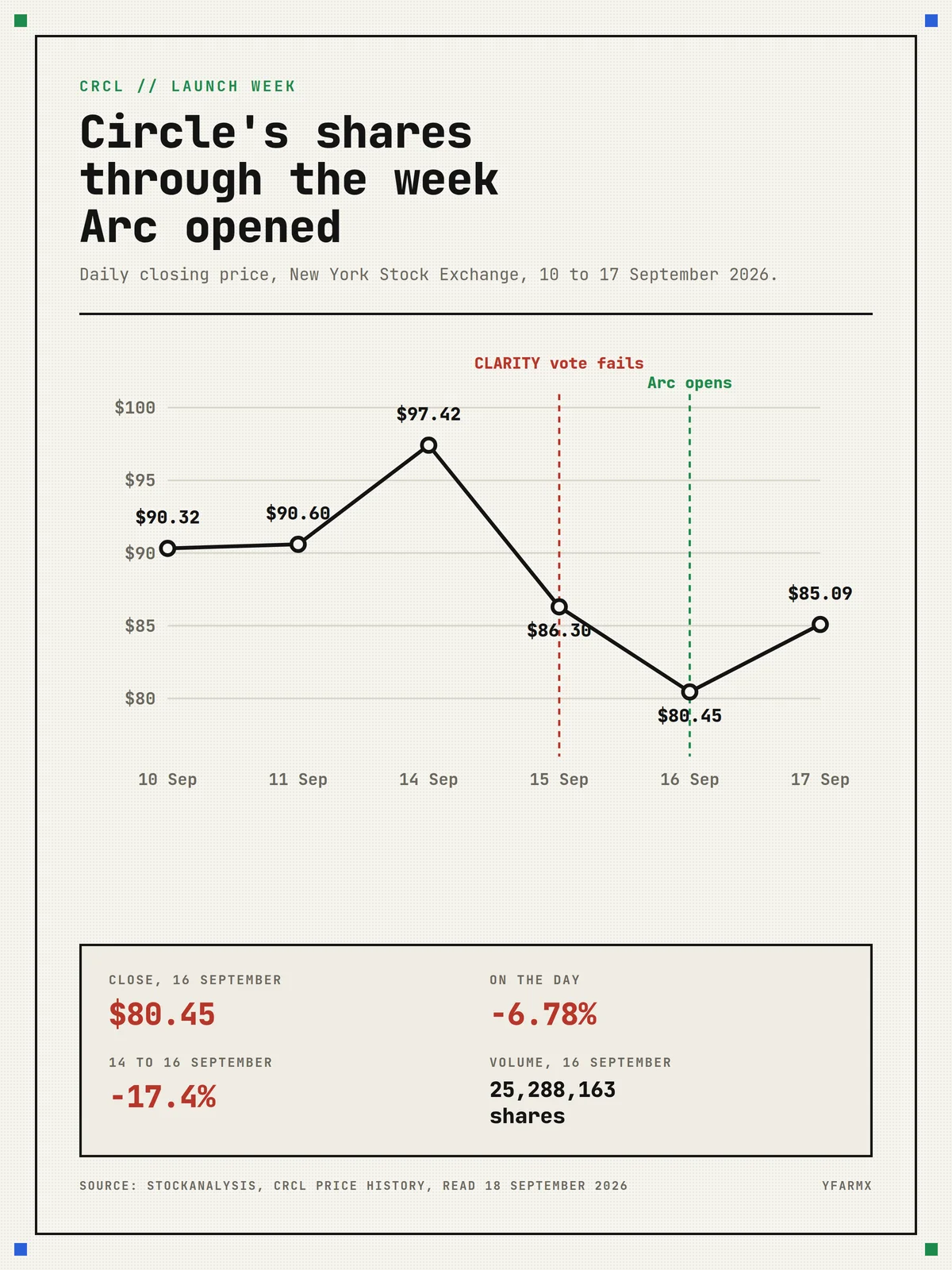
| Date | Close | Change | Volume |
|---|---|---|---|
| 10 September 2026 | $90.32 | -2.87% | 8,153,187 |
| 11 September 2026 | $90.60 | +0.31% | 10,268,768 |
| 14 September 2026 | $97.42 | +7.53% | 16,558,823 |
| 15 September 2026 | $86.30 | -11.41% | 22,329,088 |
| 16 September 2026 | $80.45 | -6.78% | 25,288,163 |
| 17 September 2026 | $85.09 | +5.77% | 13,955,198 |
Two events sit inside that. On 15 September the Senate took a cloture vote on the motion to proceed to H.R. 3633, the Digital Asset Market Clarity Act. The Senate’s own daily record states the outcome: “By a vote of 49-50, the Senate did not agree to the motion to invoke cloture on the motion to proceed to H.R.3633 – Digital Asset Market Clarity Act.” Circle closed down 11.41 per cent that day, and the market-structure bill the industry had spent the year on went down with it.
The next day was Arc’s. The stock closed at $80.45, down 6.78 per cent, on 25.3 million shares, the heaviest volume of the week. From the 14 September close of $97.42 to the 16 September close is a fall of 17.4 per cent across two sessions. It recovered 5.77 per cent on 17 September, leaving the shares below where they started the week.
The CLARITY vote moved CRCL on the 15th, and it carries most of that day. What the tape says about the 16th is narrower and still awkward for Circle: the most significant launch in the company’s history since USDC landed on a down day, on the week’s largest volume, and the decline ran on through it.
Where did the airdrop expectation come from?
From a programme Circle built and ran. Its own launch release counts “more than 75,000 active Arc House members”, “10,000 Architect ambassadors” who have built “more than 1,200 projects on Arc”, and a testnet that processed “more than 700 million transactions in under a year”.
Incentivised testnets, ambassador tiers and project counts are the standard apparatus of a token distribution, and Airdrops.io has read them that way for months: it has carried an Arc page throughout, and it now answers its own question with the position Circle has taken: “No. Circle has not announced any airdrop, and the ARC token was presold to institutions in May 2026.”
Sixty per cent of the supply is earmarked for an ecosystem, the ecosystem has been assembled and counted, the whole supply is minted, and the people who did the assembling have one sentence to go on. That is the launch’s real problem.
The next disclosure is the unlock schedule
One document would settle most of this, and Circle has already said it is coming: the unlock and release schedules the whitepaper promised in May. Until they are published, the price on the record for ARC is 30 cents, set in a private round, among buyers who include three of the network’s eleven validators.
Arc itself works. It has been producing blocks since May at roughly half a second each, it settles in USDC, and eleven of the largest institutions in finance have put their names on its validator set. The open question sits above the engineering: who the 10 billion tokens on it belong to, and on what timetable. Circle answers that one with a document, on a date of its choosing.
Sources
- Circle, 'Circle Launches Arc Mainnet, an Economic Operating System for the Internet', 16 September 2026circle.com
- Circle, 'Circle Launches Arc Mainnet' (newswire copy), 16 September 2026businesswire.com
- Arc, 'ARC: The Native Asset of the Economic OS' (ARC whitepaper), May 20266778953.fs1.hubspotusercontent-na1.net
- Arc, whitepaper libraryarc.io
- Cooley, 'Cooley Advised Circle in its $222 Million Presale of ARC Token', 12 May 2026cooley.com
- Circle, 'Circle Announces Founding Validator Cohort and Major Integrations for Arc', 5 August 2026circle.com
- United States Senate Daily Press, Tuesday 15 September 2026dailypress.senate.gov
- StockAnalysis, Circle Internet Group (CRCL) share price historystockanalysis.com
- Airdrops.io, Arc airdrop pageairdrops.io
- Arc, network homearc.io