OpenAI's Project Camellia: a 3.2GW data centre lands in coastal Georgia
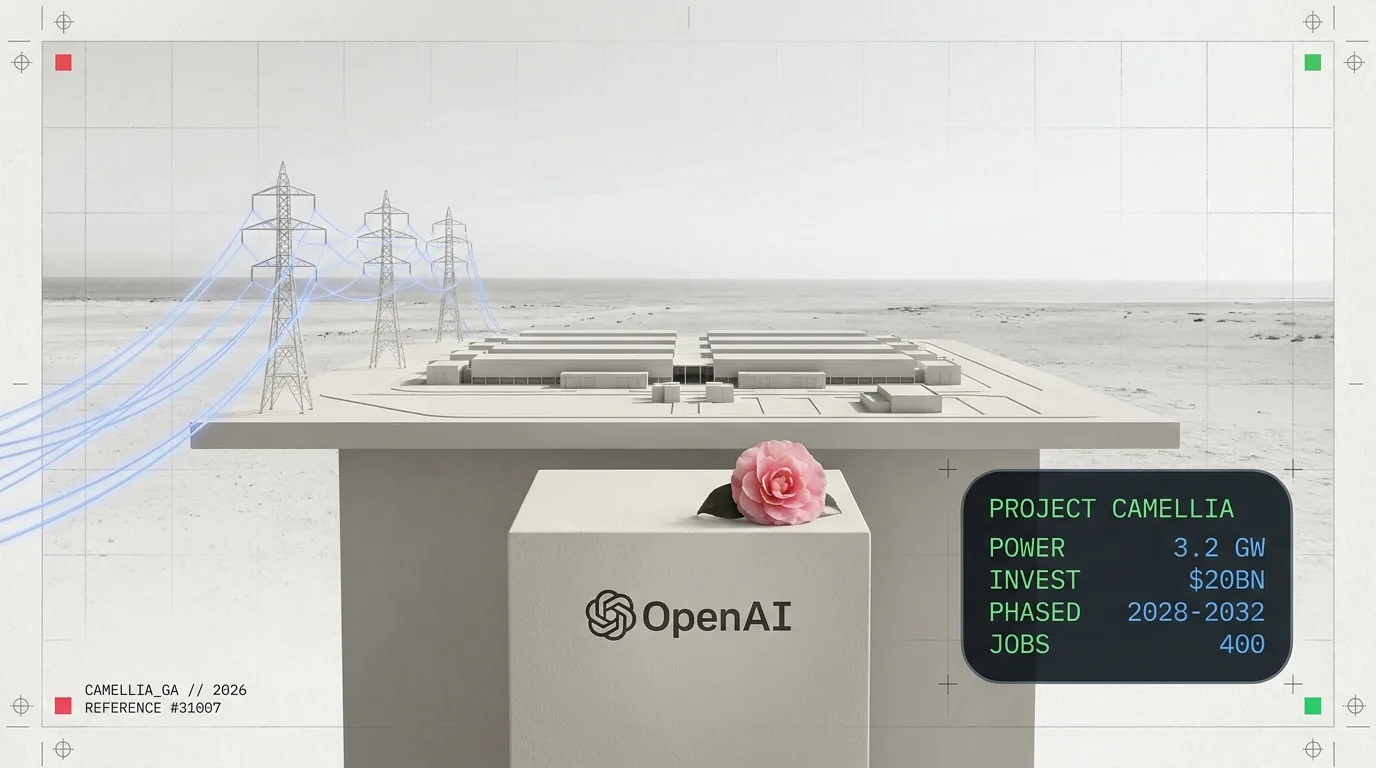
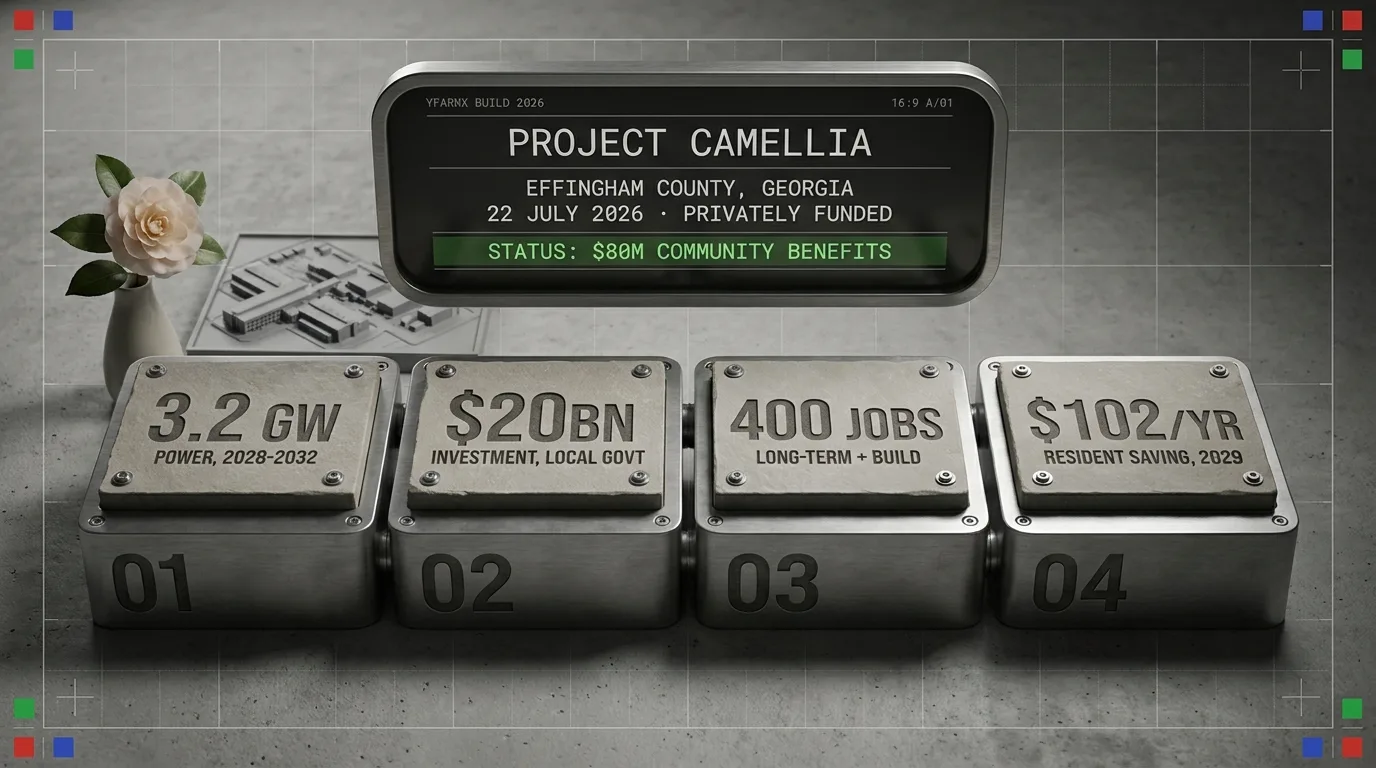
OpenAI has announced Project Camellia, a data-centre campus in Effingham County, Georgia, contracting 3.2 gigawatts from Georgia Power in phases from 2028 to 2032. Local government puts the investment at $20bn, and it is privately funded, with a pledge that residents' bills will not rise.
Listen to this articleListen
OpenAI is building one of its biggest data centres yet on the Georgia coast, and it has wrapped the announcement in promises to the people who will live next to it.
On 22 July 2026, OpenAI announced Project Camellia, a data-centre campus it is developing in Effingham County, Georgia, about 45 minutes from Savannah. The plans are large, the power figure is enormous, and the pitch leans hard on what the county gets in return.
The site and the power
The campus will sit inside the Savannah Gateway Industrial Hub, a 2,600-acre industrially-zoned logistics site near Rincon developed by The Broe Group. Building on already-zoned industrial land is part of OpenAI’s argument that this is lower-impact than starting from scratch.
The headline figure is electricity. OpenAI has contracted Georgia Power for 3.2 gigawatts, about 3,200 megawatts, delivered in phases between 2028 and 2032. That is the kind of load a mid-sized city draws. Unusually, OpenAI has agreed the site can shed up to 1,000 MW at peak demand, a flexibility pledge meant to stop the campus straining the grid when everyone else needs power too.
The money, and who is standing behind it
Local government puts the capital investment at $20bn and 400 long-term jobs, and calls it one of the largest private capital investments in the history of coastal Georgia. OpenAI’s own wording is broader, “thousands of construction and permanent on-site jobs”, and it does not put the $20bn figure in its own announcement, so that number belongs to the county, not the company. Both agree on one thing: the build is entirely privately funded.
That funding point is worth marking. OpenAI’s announcement does not tie Camellia to any national compute figure or to the Stargate programme; it presents the campus as privately funded and names its Abilene, Texas site as its first campus. Anything grander than that is context, not commitment.
What OpenAI is promising residents
This is where the announcement is unusual. OpenAI has built the pitch around the neighbours:
| Commitment | Detail |
|---|---|
| Power bills | OpenAI pays the full infrastructure and electric-service costs; under Georgia rules those costs cannot fall on existing ratepayers |
| Bill saving | Georgia Power projects a typical residential customer saves about $102 a year from 2029 |
| Community benefits | $80m over the life of the project, for schools, public safety, healthcare, workforce training and more |
| Student credits | up to $71m in Codex credits for eligible Georgia students, at $100 each |
| Water | a closed-loop cooling system that recirculates rather than continuously drawing water |
| Accountability | an annual, independent, publicly available audit of the commitments |
Local officials go further on tax. “This project has the potential to change the financial future of Effingham County in ways that will benefit our citizens for generations,” said Tim Callanan, the county manager, tying it to “Project Zero”, a plan to eliminate county homestead property taxes, with “the average homeowner” expected to “see a 40% reduction in property taxes”. Brandt Herndon, chief executive of the county’s development authority, called it “a major private investment that will generate substantial new tax revenue”. Aaron Mitchell, a senior vice president at Georgia Power, welcomed OpenAI bringing “significant investment and cutting-edge technology to Georgia”.
The template is the real news
Data centres have become politically charged in the places they land, because they draw power and water and hand the bill to locals. Camellia is OpenAI trying to write the opposite story: a privately funded build that lowers residents’ taxes, protects their power bills, recirculates its water and submits to an annual audit. Whether it delivers is a 2028-to-2032 question, and OpenAI is clear the design, financing and phasing are not final. But the template is the news here as much as the megawatts. If the community-first framing works in Effingham County, every hyperscaler chasing gigawatts will copy it.