OpenAI Jalapeno chip signals a full stack ambition
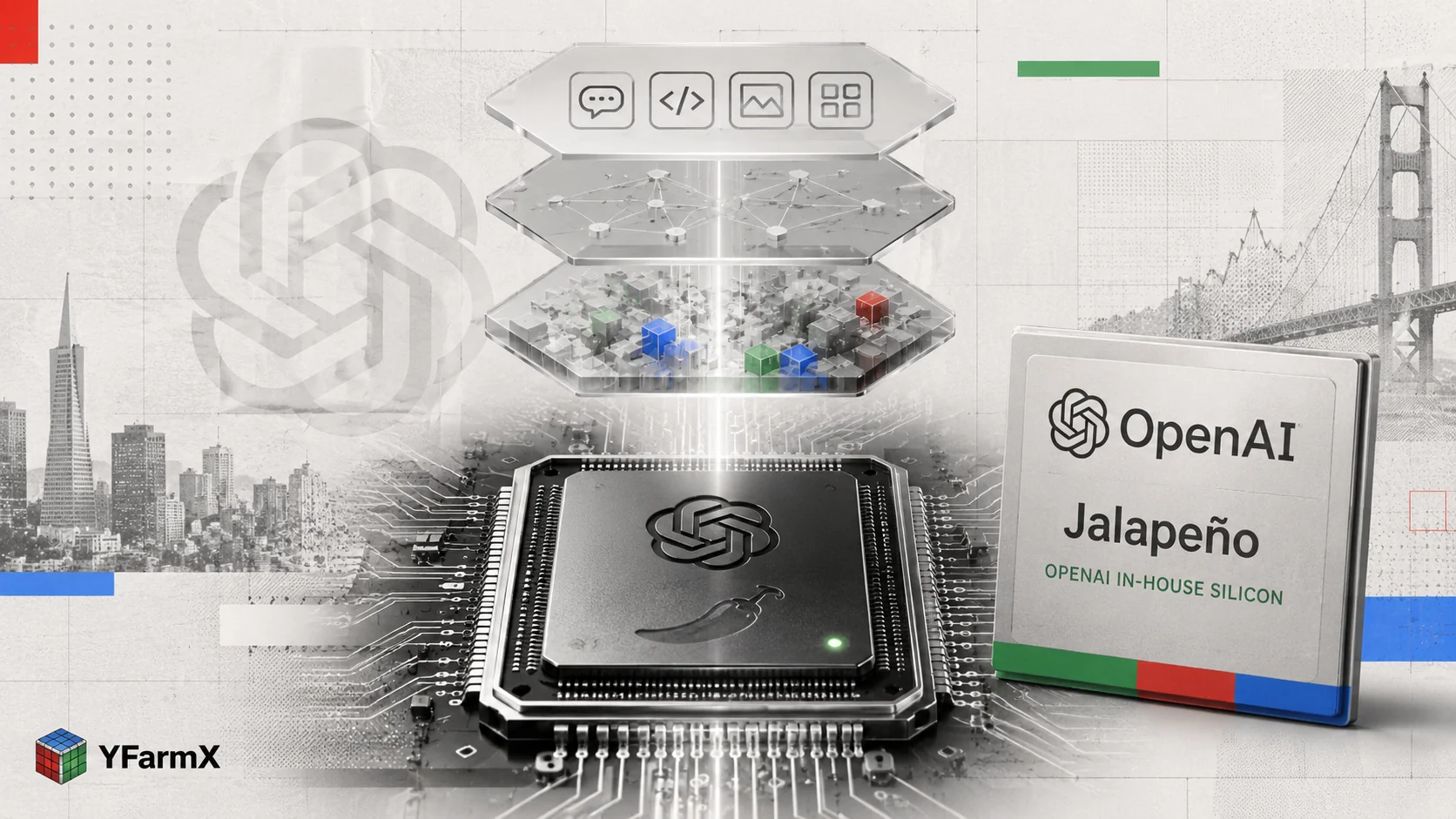
OpenAI unveiled Jalapeno on 25 June, its first custom inference accelerator, designed with Broadcom. The company claims nine months from design start to tape-out, a reduction of roughly 50 per cent in inference cost, and a planned deployment scale of 1.3 gigawatts.
Listen to this articleListen
OpenAI unveiled Jalapeno on 25 June, its first custom inference accelerator, designed with Broadcom. The company claims nine months from design start to tape-out, a reduction of roughly 50 per cent in inference cost, and a planned deployment scale of 1.3 gigawatts. The OpenAI Jalapeno chip is positioned as part of a full stack strategy covering ChatGPT, Codex, the API and agent workloads.
Nine months from design to tape-out is the number that should attract scrutiny. Custom silicon programmes at this complexity have historically run two to three years. If the figure holds, it reflects both Broadcom’s maturity as a design partner, having built Google’s TPU line, and the narrowness of the target. An inference accelerator built for one company’s known model architectures avoids the generality that makes a merchant GPU expensive to design and expensive to buy.
The economics behind the decision are straightforward. OpenAI’s cash burn was around $9 billion in 2025 and is expected to reach $17 billion in 2026, with inference the largest recurring component. A halving of inference cost across a fleet at that scale is worth billions annually and, more importantly, changes what the company can offer. Serving GPT-5.6 Luna at $1 per million input tokens, or bundling ChatGPT Work into paid plans with metered usage, requires a cost base that merchant silicon at current prices makes difficult.
The strategic pattern is now general across the sector. Google has run TPUs for a decade. Amazon builds Trainium and Inferentia. Meta has committed roughly $100 billion in a multi-year agreement with AMD for up to six gigawatts of infrastructure while developing its own accelerators. Anthropic runs across Google Cloud, AWS and Microsoft Foundry and took the available capacity at the Colossus 1 data centre, adding more than 300 megawatts and over 220,000 GPUs. Every laboratory operating at frontier scale is reducing its exposure to a single supplier, and the OpenAI Jalapeno chip is the clearest expression of that from the company with the most inference volume to defend.
There is a competitive subtlety in the timing. OpenAI is also serving GPT-5.6 Sol on Cerebras hardware at more than 700 tokens per second using identical weights to the API model, alongside a Sol Fast tier at $12.50 and $75 per million tokens. That is a second bet on specialised silicon from a different direction, buying speed as a premium product while Jalapeno buys cost reduction at volume. Both are attempts to break the dependence on general purpose accelerators, from opposite ends of the price curve.
Two caveats belong in any assessment. The 50 per cent inference cost reduction is a company claim with no published methodology and no independent verification, and comparisons of this kind depend heavily on the baseline chosen. And 1.3 gigawatts is a plan on paper. Tape-out is the beginning of a long path through bring-up, yield, software maturity and the unglamorous work of making a new accelerator behave predictably under production traffic, where custom silicon programmes usually encounter their real problems.
The wider significance is what it says about where the industry believes its costs will sit. The capital expenditure conversation has been dominated by training clusters, but the durable operating expense is inference, and inference scales with usage, which grows every time a product succeeds. OpenAI reports more than 150 million weekly voice users. ChatGPT Work runs agents for hours on a single task. Each of those products multiplies tokens served per user. A company that can serve those tokens at half the cost of its competitors has a structural advantage that no benchmark score confers.
For the wider market, the question raised by the OpenAI Jalapeno chip is what happens to merchant accelerator demand if the largest inference buyers substitute their own silicon over the next three years. Nvidia’s answer has been to move up the stack into systems and networking, and to expand into adjacent markets including quantum error correction. The arithmetic behind that strategy is visible in announcements like this one.