
IonQ
the revenue leader among the pure plays
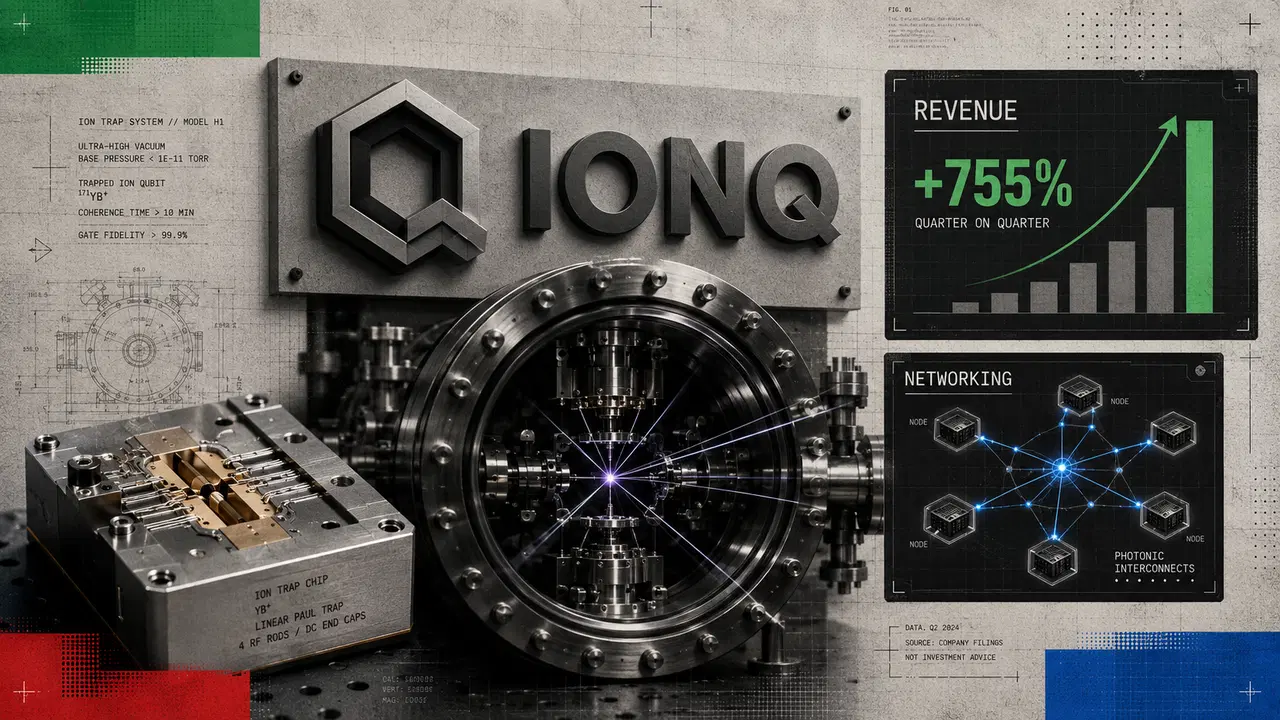
Key facts
- $80.1mup 287%
- Q2 revenue
- $450-460mfull-year, raised 8 Sep
- Guidance
- $3.0bn30 Jun 2026
- Cash
- $36.27close, 12 Oct 2026
- Share price
- $1,867.7mGAAP, mostly non-cash
- Q2 net loss
The quantum company that behaves like a business: record revenue, guidance raised, products shipping. IonQ computes with trapped atoms rather than frozen circuits, and its bet is that clean, careful qubits beat big, messy ones.
The revenue leader
Among the listed quantum pure plays, IonQ is the one that most resembles an operating business, and that is the frame through which the ionq stock is usually read. On 5 August 2026 the company reported record second-quarter revenue of $80.1m, up 287% year on year, and raised full-year guidance to between $280m and $290m. On 8 September 2026, the day of its investor day, it raised that again to between $450m and $460m, a range that folds in SkyWater Technology from the close of that acquisition on 31 July 2026 and strips out the revenue the two companies used to book with each other. Those are figures that stand out in a sector where most rivals book only a few million dollars a quarter. The loss line needs equal care: the quarter’s GAAP net loss was $1,867.7m, a figure dominated by non-cash items, while the adjusted EBITDA loss of $120.3m is the closer measure of what the business spends. It held $3.0bn in cash and investments at 30 June 2026, and the quarter’s highlights included progress toward a 256-qubit system, published error-correction results and 84 on-orbit optical terminals. For anyone weighing the ionq stock, the revenue line is the argument: it is the one pure play with sales that look like a company rather than a research grant.
What the share price says
IonQ shares closed at $36.27 on 12 October 2026, down 9.07% for the session, according to Nasdaq’s historical prices. A share price records what investors paid on that date; it changes independently of the company’s laboratory milestones.
The bet on networking
Behind the numbers sits a real product cadence. In June 2026 the company announced Clavis XG Multiplex, the latest in its line of systems. Just as telling is where IonQ is spending its acquisitions: it is building quantum networking through photonic interconnects, the use of light to carry quantum information between processors, and it strengthened that effort by acquiring Qubitekk. On 31 July 2026 it also completed its acquisition of the chip fabricator SkyWater Technology, having cleared the final regulatory approval days earlier, which takes the fabrication of its own trap chips in-house; SkyWater continues as a wholly owned subsidiary. The networking bet turned public in early August: on 3 August 2026 IonQ and EPB launched the Tennessee Quantum Communications Research Center, where IonQ claims the first commercial quantum memory operating in a live fibre network, and on 4 August it signed a memorandum of understanding with Sandia National Laboratories on quantum co-design for national security. Photons travel well and interact only weakly with their surroundings, which makes light a natural carrier for quantum information moving between machines, even if converting a processor’s qubits into photons and back again is itself a delicate piece of engineering. Networking is the discipline of linking separate quantum machines so they behave as one larger system, and it is widely seen as necessary if the technology is ever to scale beyond a single chip, since any one processor can hold only so many qubits before wiring and noise become unmanageable. The Qubitekk acquisition brings that connective expertise in-house rather than leaving it to be bought in later. By investing there, IonQ is positioning for a future in which quantum computers are wired together into larger systems.
Into applications
The company has also pushed into applications. It claimed a quantum advantage with the engineering-software firm Ansys on a medical-device simulation: a blood-pump fluid-dynamics workflow in Ansys LS-DYNA that ran up to 12% faster than classical methods on IonQ Forte, the kind of engineering problem where quantum methods are being tested earliest. As with all advantage claims, the careful reading is to note who made it and on what problem, and to wait for independent confirmation; our quantum explainers set out why these results are best treated as provisional.
What to watch
Put together, the pieces explain both the enthusiasm and the volatility around the ionq stock. On one side is a revenue line growing at triple digits, raised guidance, a deep cash reserve and a clear bet on networking as the next battleground. On the other is a share price well off its highs and a valuation that still rests on years of expected growth rather than present profit. What to watch is whether the twice-raised guidance holds through the year, whether the networking work, from Qubitekk to the new EPB centre, turns into shipped product, and whether the Ansys engineering result survives scrutiny. The investor day on 8 September 2026 brought the second raise, and the company had laid technical groundwork for it: on 25 August its researchers posted a paper on arXiv describing a complete real-time error-correction decoder for a future large trapped-ion machine, benchmarked to 408 logical qubits and up to a million T gates on a single laptop-class processor, an argument that its route to fault tolerance will not need custom decoding chips. IonQ announced the result on 22 September as what it calls the industry’s first end-to-end real-time error-correction decoder running on a single off-the-shelf CPU: in benchmark circuits of more than 31.5 million operations, decoding stretched run time by as little as 0.02%. The next day it said a Superion 256 will be the first quantum processor at Nvidia’s Accelerated Quantum Research Center in Boston, linked to a GB200 NVL72 system through NVQLink, with installation scheduled for 2027. If those land, the case that IonQ is the sector’s first genuine business strengthens; if they slip, the ionq stock will remain what it is today, a high-conviction wager on a field that has yet to prove its commercial worth.
IonQ enters DARPA’s final assessment stage
IonQ announced entry into Stage C of DARPA’s Quantum Benchmarking Initiative on 7 October 2026. DARPA will independently test and validate successive generations of its Superion systems through 2029. The agreement provides potential funding of up to $300m; amounts beyond the initial obligation depend on future appropriations and DARPA decisions. DARPA’s programme assesses whether a proposed machine can deliver useful work at an economic cost.
Linking a processor to quantum memory
On 9 October, IonQ announced an experimental link between a trapped barium ion and a silicon-vacancy quantum memory. The paper reports entanglement generation at about 1,030 entangled pairs per second, with 87.9% fidelity, a measure of how closely the shared state matches the intended state. This processor-memory experiment is a step towards connecting separate quantum systems. IonQ’s announcement and the research preprint describe the apparatus and measurements. The result concerns this laboratory link; a larger distributed computer also needs reliable operations across the connected systems.
IonQ agrees to acquire network-security company Elisity
IonQ agreed on 12 October to acquire Elisity, a network-security company, for up to $1.3bn in stock, including up to $150m tied to performance. Closing is expected in the fourth quarter of 2026, subject to approvals and other conditions. IonQ’s announcement describes the proposed deal and its conditions.
More Quantum
All Quantum →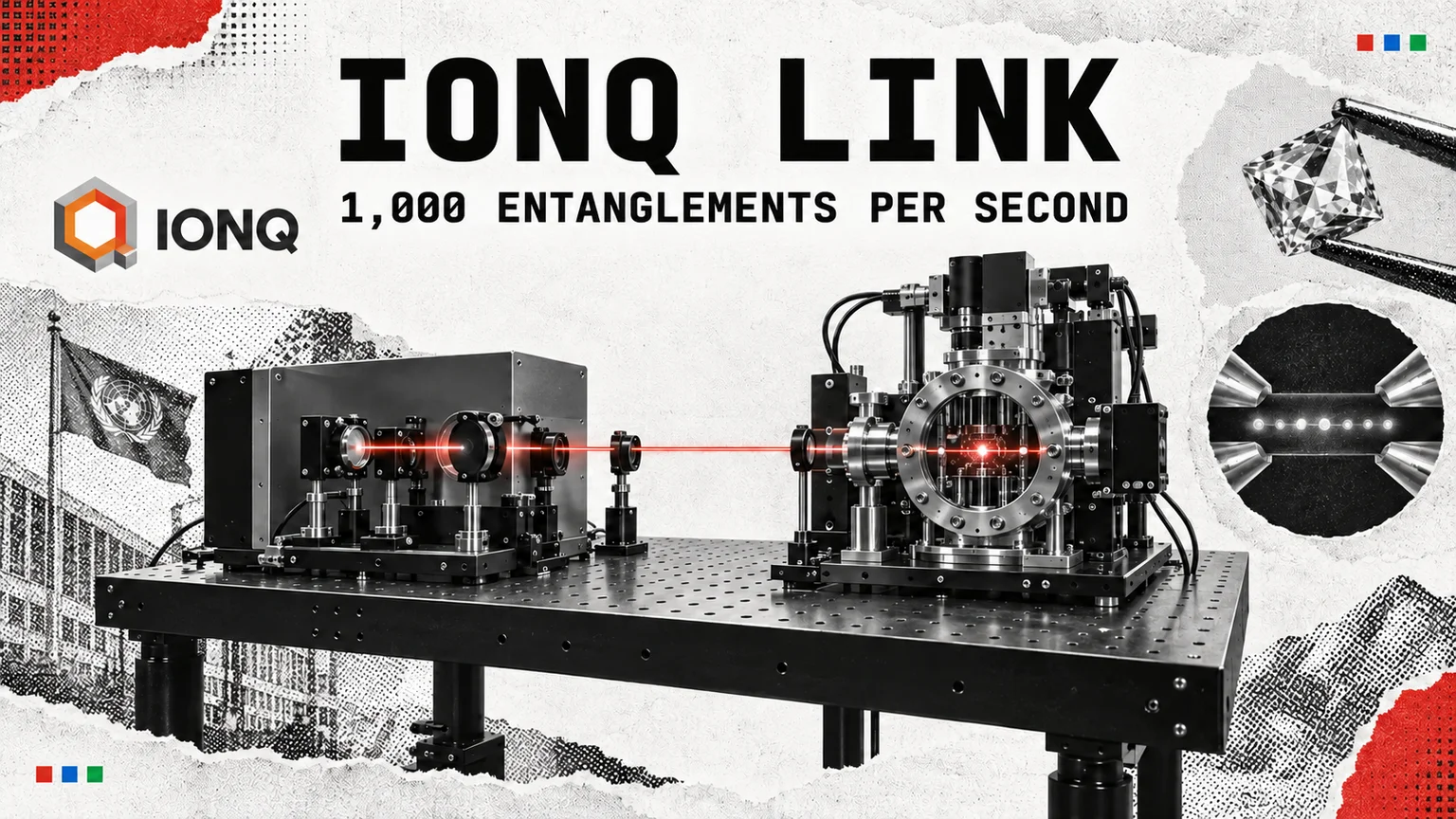
IonQ's quantum link creates 1,000 entangled pairs per second
IonQ reported a 1.03 kHz entanglement rate between a trapped-ion qubit and a silicon-vacancy memory. The preprint reports 87.9% Bell-state fidelity for the heterogeneous link.
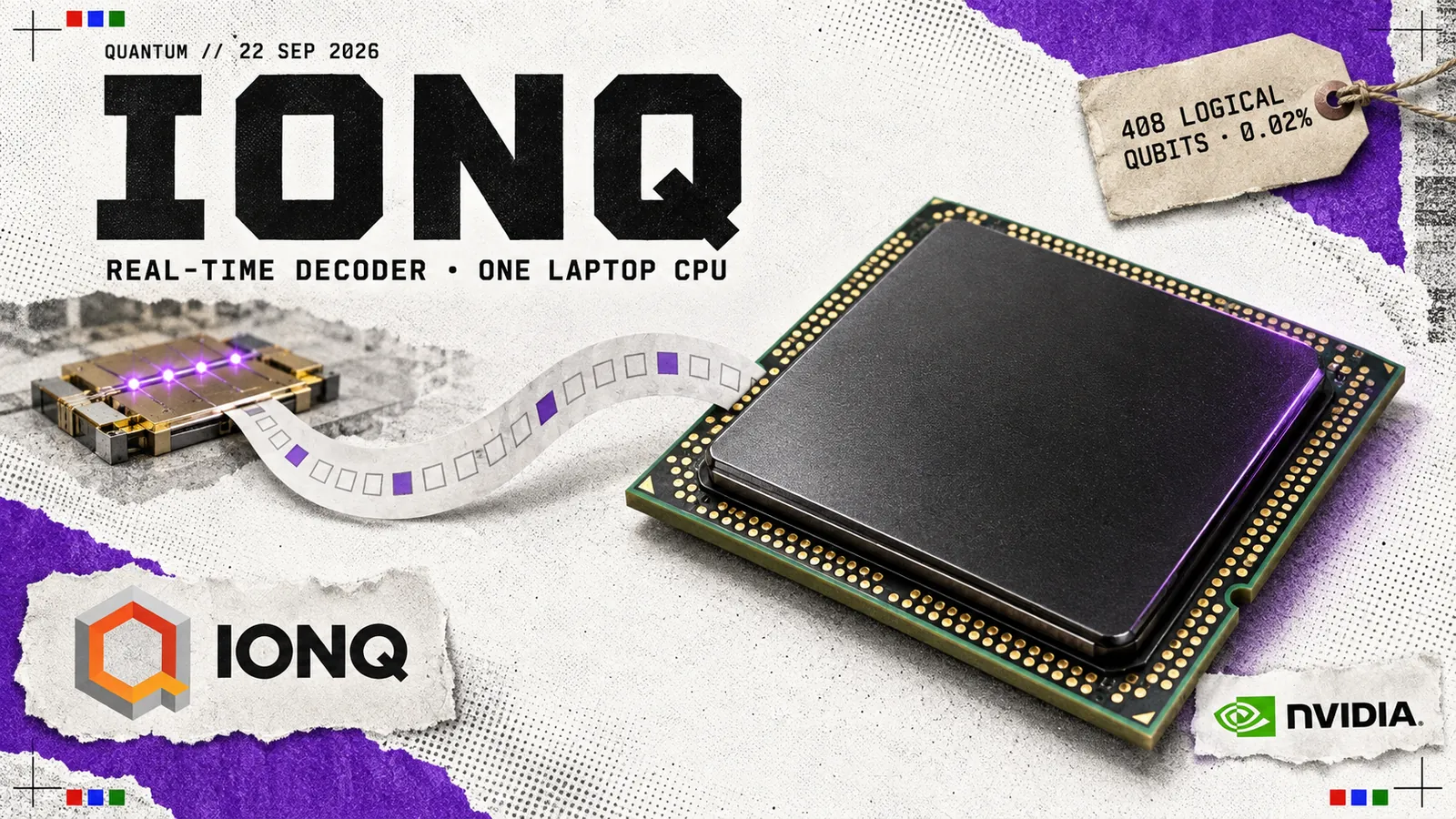
IonQ runs quantum error decoding on one Apple laptop chip
IonQ said on 22 September 2026 that its decoder kept pace with a simulated 408-logical-qubit machine on one Apple M4 Max chip, adding 0.02% to run time. On 23 September it said a Superion 256 will be installed at Nvidia's Boston quantum research centre in 2027.
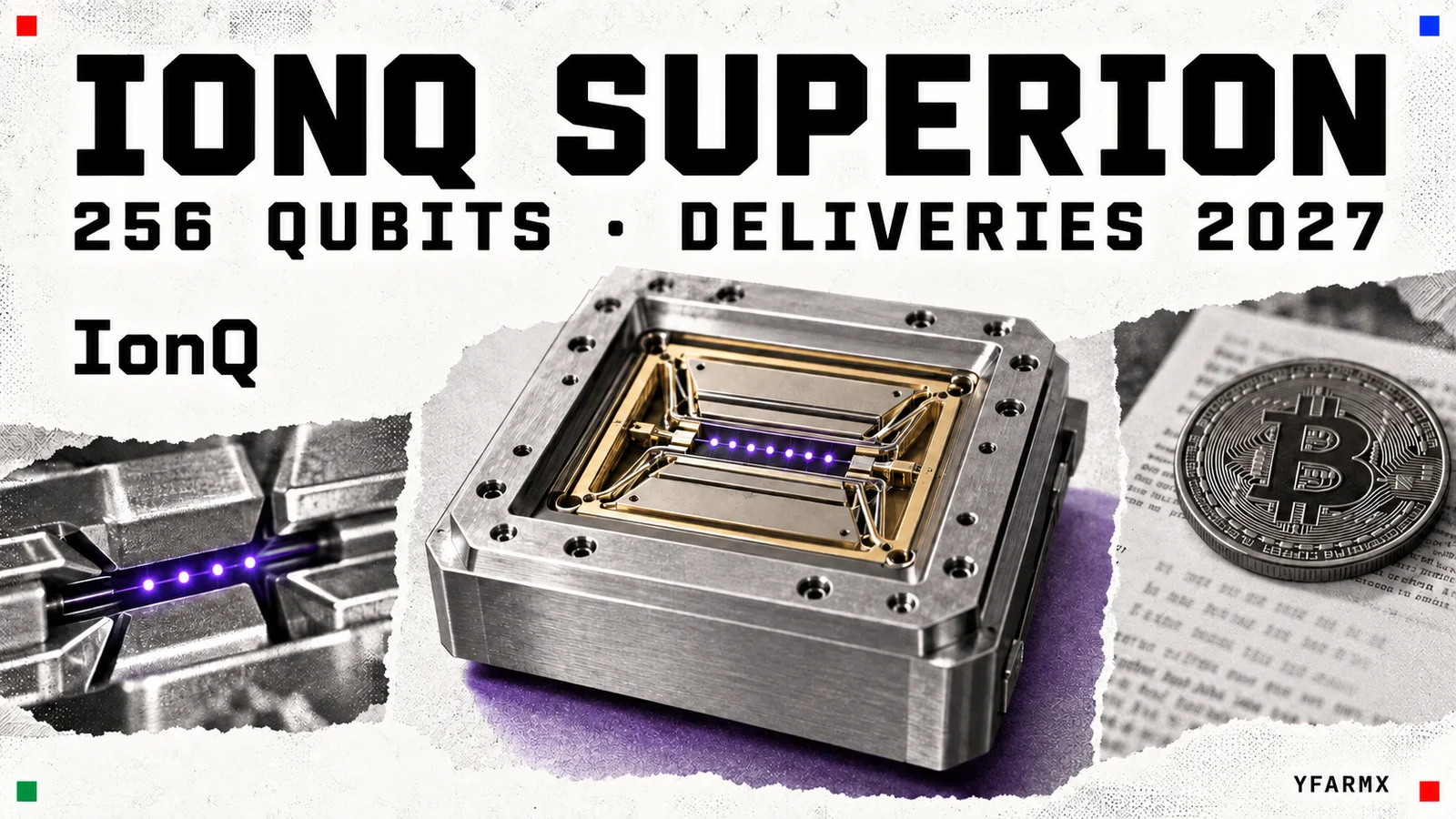
IonQ opens Superion 256 orders and estimates a 26-day quantum attack on Bitcoin signatures
Superion 256 deliveries are targeted for 2027. A separate IonQ study models a secp256k1 attack using 19,397 physical qubits with an estimated 63% success probability per attempt.