IonQ opens Superion 256 orders and estimates a 26-day quantum attack on Bitcoin signatures
Superion 256 deliveries are targeted for 2027. A separate IonQ study models a secp256k1 attack using 19,397 physical qubits with an estimated 63% success probability per attempt.
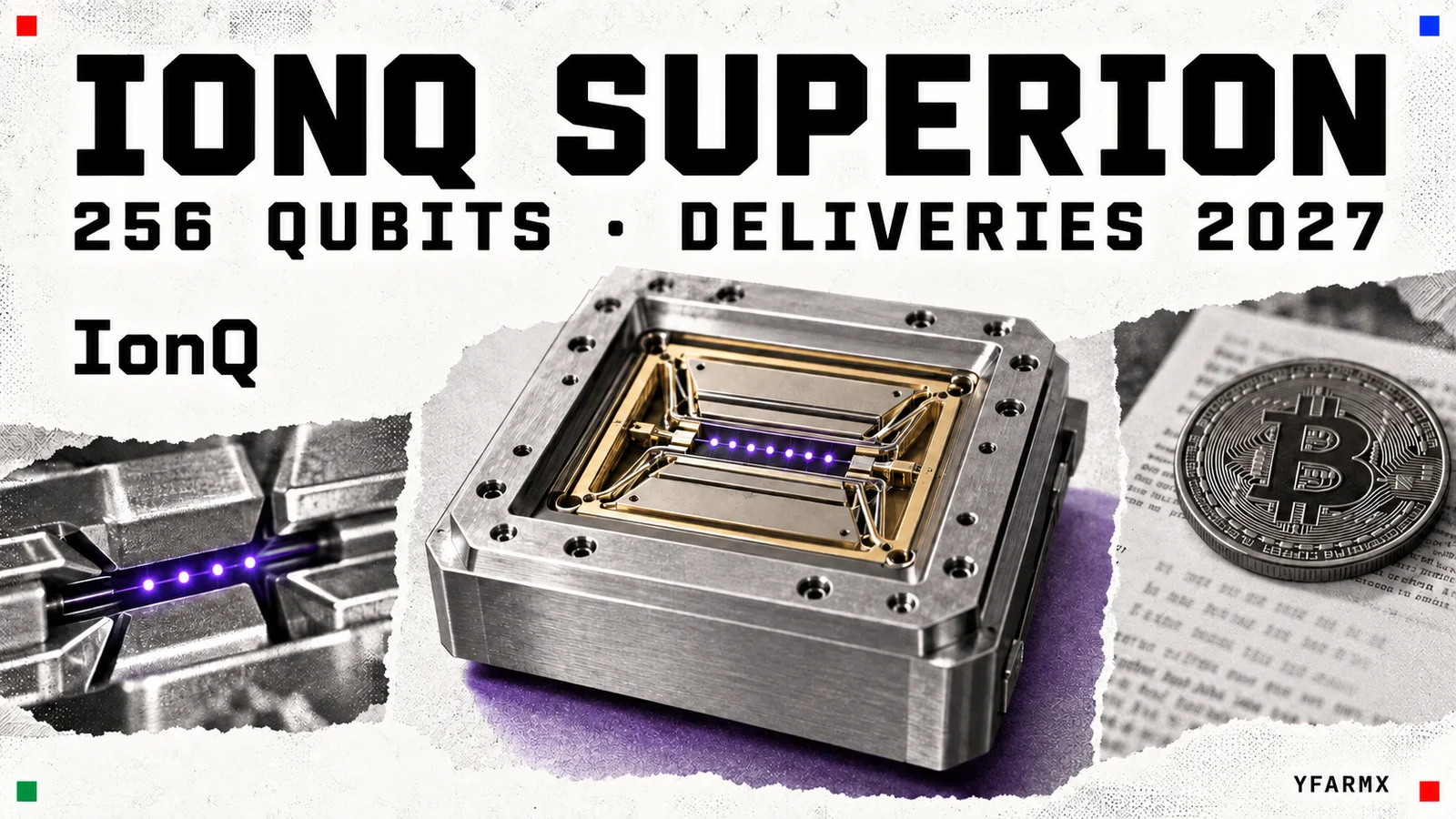
IonQ is accepting orders for Superion 256, its sixth-generation trapped-ion quantum platform, with customer deliveries targeted for 2027. Its 8 September announcement says the first integrated chips have been fabricated at SkyWater and the first ions trapped in prototype systems.
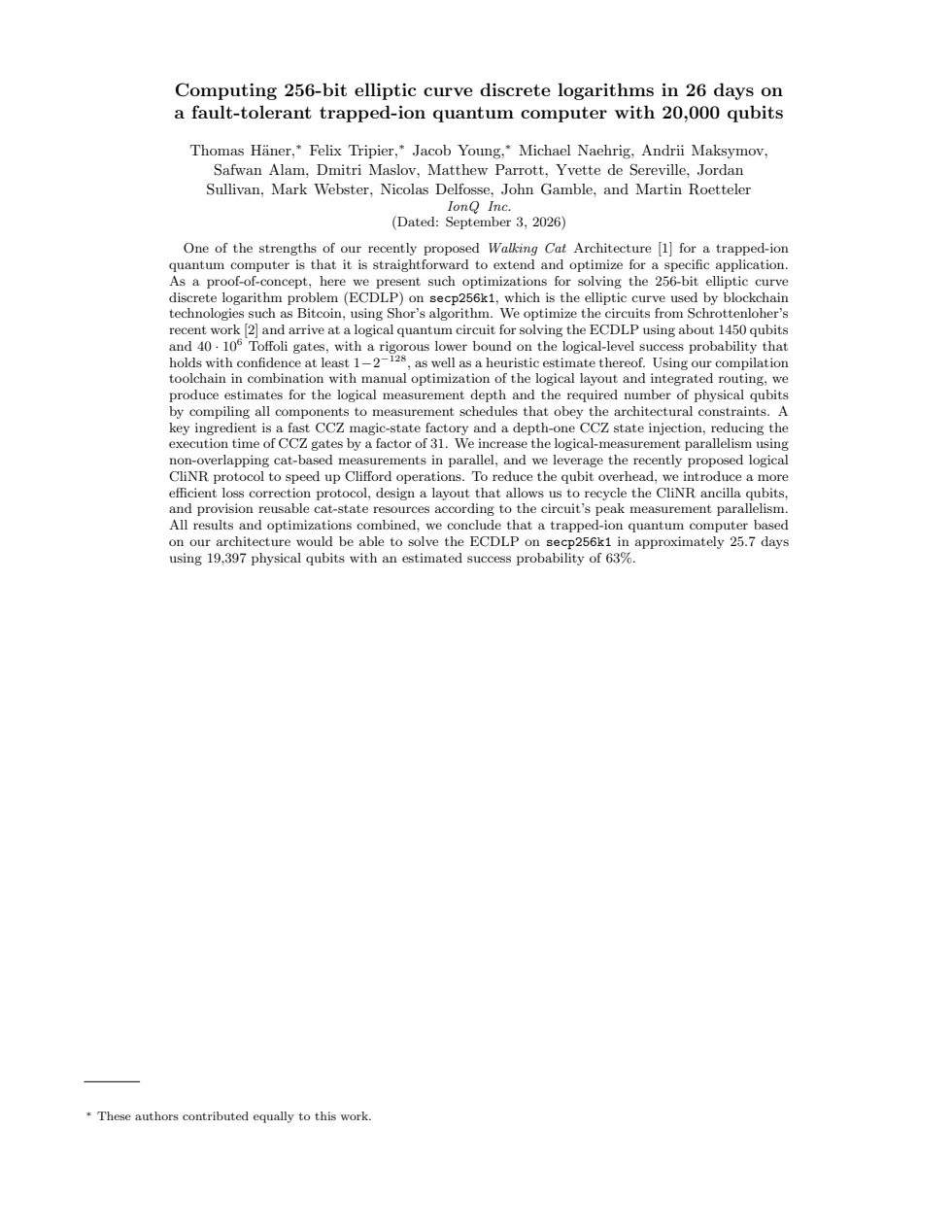
The same day, IonQ published a separate resource estimate for attacking the elliptic curve used in Bitcoin signatures. That calculation describes a future fault-tolerant machine containing 19,397 physical qubits, with an estimated 25.7 days per attempt.
What has Superion reached so far?
The product announcement describes a platform built around electronic control of trapped ions. IonQ combines technology acquired through Oxford Ionics with semiconductor fabrication at its SkyWater subsidiary.
The immediate milestone is manufacturing and prototype operation. IonQ says one Superion 256 system was pre-sold in the first quarter of 2026 and production systems will also be offered through its cloud.
Its roadmap develops larger machines alongside the 256-qubit generation. Those later systems are intended to run the company’s Walking Cat fault-tolerant architecture, which includes error correction and the movement of ions across a chip.

What would the 26-day calculation recover?
The research paper models solving the discrete-logarithm problem on secp256k1, the curve used by Bitcoin. Applied to an exposed public key, that would recover the corresponding private signing key.
The researchers compile a version of Shor’s algorithm into operations that fit their proposed trapped-ion architecture. Their accounting includes error correction, routing and the special resources needed for the computation.
| Quantity | Paper’s estimate |
|---|---|
| Physical qubits | 19,397 |
| Runtime per attempt | 25.7 days |
| Success probability | 63% |
The probability is essential: a single attempt can fail. The runtime is an estimate for one targeted calculation under the paper’s assumptions.
Hardware assumptions behind the estimate
The paper assumes two-qubit operation error rates of one in 10,000 and single-qubit error rates of one in 100,000, alongside its transport, measurement and error-correction model. Maintaining the required performance across a large machine and a long computation is part of the engineering challenge.
IonQ associates the relevant capabilities with its future roadmap. Superion 256’s prototype milestone and the cryptographic estimate therefore provide two separate checks on progress: physical hardware development and a detailed calculation of the resources an attack would consume.
Preparing signature systems for migration
NIST has already standardised post-quantum signature schemes, including ML-DSA and SLH-DSA. The practical security work is to identify exposed signing systems and plan how their keys, software and verification rules can migrate as quantum hardware advances.
Sources
- IonQ: Superion 256 announcementionq.com
- IonQ: end-to-end elliptic-curve resource estimateionq.com
- Häner and colleagues: full resource-estimation papercdn.prod.website-files.com
- NIST: finalised post-quantum standardsnist.gov