DARPA backs PsiQuantum with $125m to prove a useful quantum computer is buildable by 2033
DARPA has signed a $125m agreement with PsiQuantum, its largest US government award, to verify a path to a utility-scale quantum computer by 2033. What the money buys, and why that date belongs on a crypto and AI radar.
Listen to this articleListen
The US government has just made its biggest single bet yet on one company’s road to a useful quantum computer.
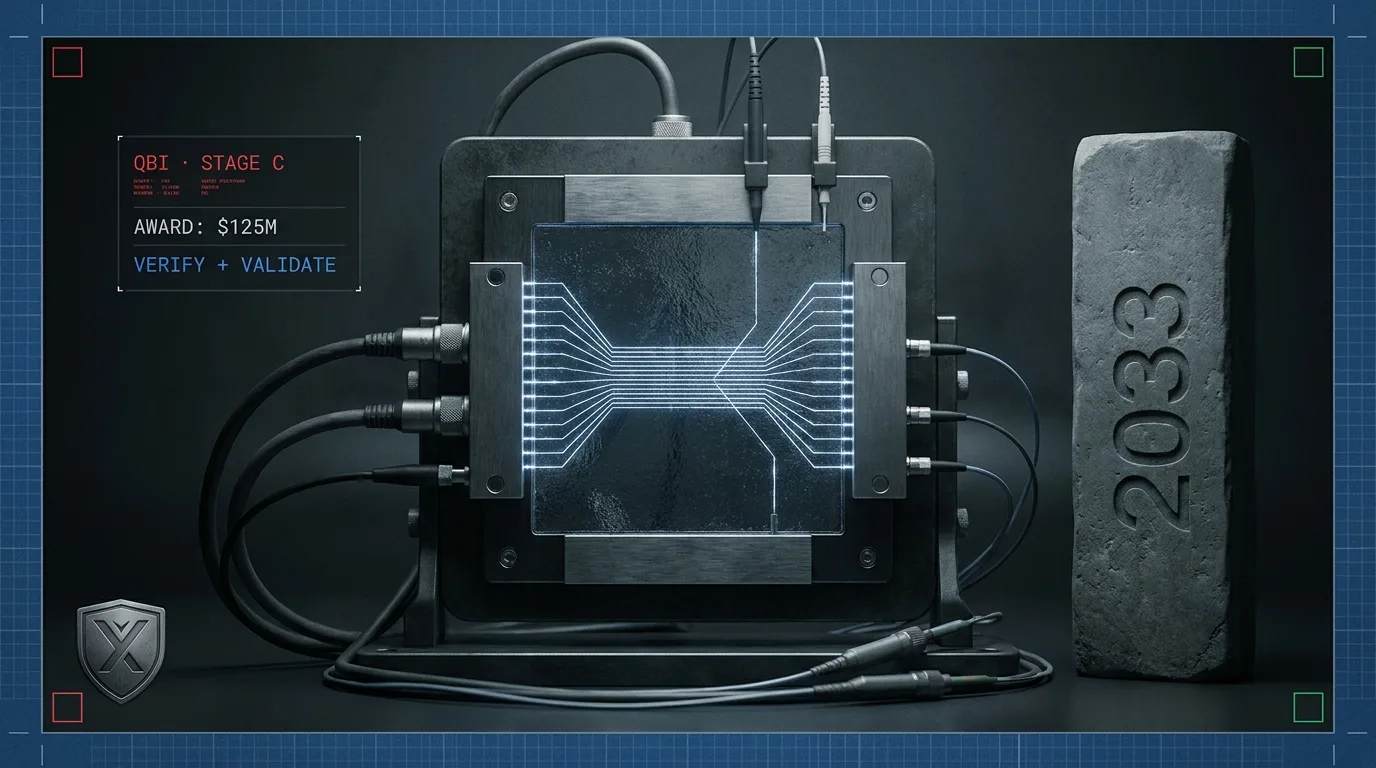
On 22 July 2026, PsiQuantum said it had signed a $125m agreement with DARPA under the Quantum Benchmarking Initiative (QBI). It is the company’s largest US government award to date, and it buys the firm deeper into the final stage of the programme Washington uses to separate real quantum progress from a good pitch deck.
What the money buys
The award is performance-based: PsiQuantum is paid as it clears agreed checks, not up front. It funds verification and validation of the company’s utility-scale hardware architecture and its manufacturing process, and expanded testing across hardware, software, system architecture and supporting infrastructure. The work lands at PsiQuantum’s sites in Milpitas, California and Chicago, Illinois.
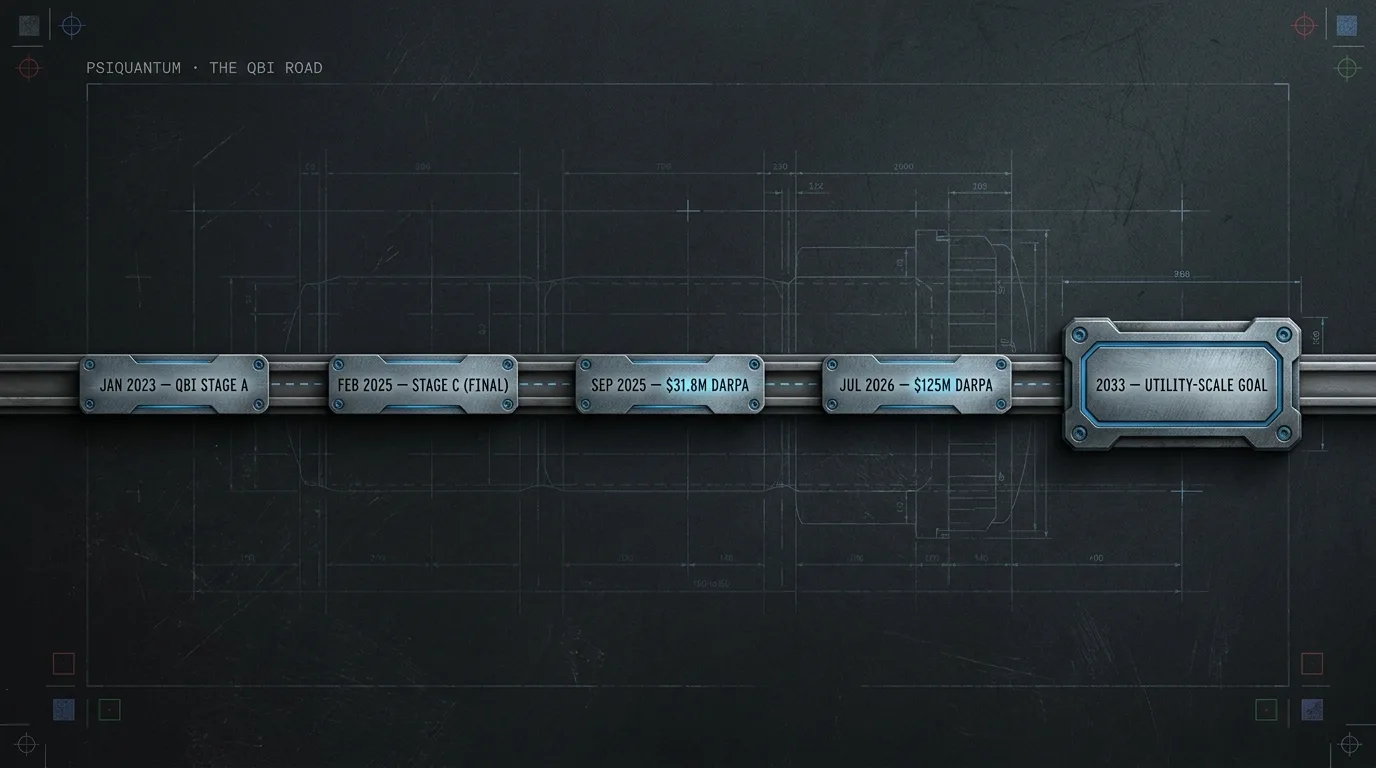
This $125m does not arrive alone. It follows a $31.8m DARPA agreement in September 2025 and a proposed $100m incentive under the CHIPS and Science Act announced in May 2026. The government is layering money onto the same company from three directions at once.
The programme that is hard to pass
QBI is DARPA’s most demanding quantum-evaluation effort, built to answer one question: can anyone build an industrially useful quantum computer by 2033, a machine whose computational value is worth more than it costs to run? It runs in three stages.
| Stage | What a company has to show |
|---|---|
| A | A credible concept for a utility-scale quantum computer with a plausible near-term path |
| B | A full research and development plan, with the risks and how they will be retired |
| C | Work with the government to verify and validate that the design can actually be built and run as intended |
PsiQuantum was selected in January 2023, advanced to the second stage in January 2024, and reached Stage C in February 2025. Stage C is the last stage, and only two companies are in it. That is the significance of this award: the government is paying to stress-test a design it already takes seriously.
DARPA is not shy about the scepticism. “The QBI program has been admirably skeptical by design,” said Dr Pete Shadbolt, PsiQuantum’s co-founder and chief scientific officer. Victor Peng, the company’s chief executive, called QBI “one of the most comprehensive and rigorous government programs for evaluating emerging technology”. The tell is in what DARPA’s own programme lead now says out loud: according to Micah Stoutimore, who runs QBI, “it now seems likely that someone will build a utility-scale quantum computer by 2033”.
Why a quantum date belongs on a crypto and AI site
Because 2033 is not only a quantum milestone. A utility-scale, fault-tolerant quantum computer is the same machine that can break the public-key cryptography (RSA and elliptic-curve) sitting under nearly every bank transfer, HTTPS session and blockchain signature today. That is why the post-quantum migration is already under way across finance and crypto, and why “harvest now, decrypt later”, the practice of stealing encrypted data today to open it once a quantum computer exists, is treated as a live risk rather than science fiction.
When the sceptics running the US government’s toughest quantum programme move from “if” to “it now seems likely, by 2033”, the migration clock gets easier to read. Two caveats hold, though. QBI is designed to test whether the machine is buildable, not to announce that it is built, and PsiQuantum’s photonic, light-based approach is one bet among several, alongside superconducting, trapped-ion and neutral-atom rivals. A Stage C cheque is validation of a path, not a finished computer. But it is the clearest signal yet of which paths the US government believes are real.