
US quantum export controls
the 34-qubit line, and the fifteen countries past it
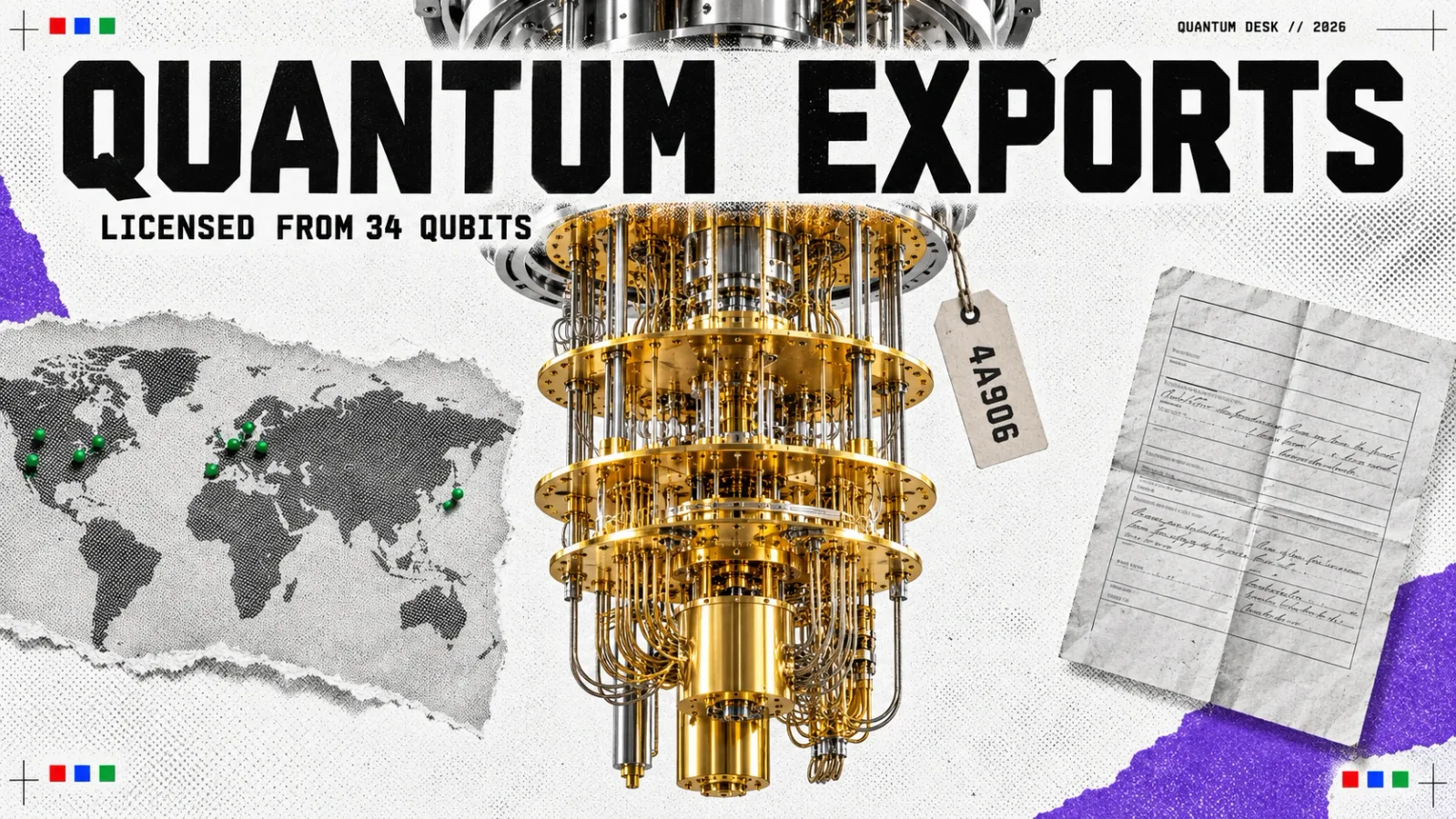
Key facts
- 6 Sep 2024interim final rule, 89 FR 72926
- In force
- 34 qubitsat 1e-4 C-NOT error
- Control starts
- 2,000+qubits, any error rate
- No ceiling
- 15 countrieslicence exception IEC
- Exception
- 7 entitiesquantum-linked, March 2025
- Entity List
A quantum computer of 34 or more working, connected qubits at stated error rates now needs a US export licence, under rules written in step with allied governments. Fifteen countries hold a blanket exception, the components and cryogenics are controlled alongside the machines, and the Entity List already names suppliers who fed China's programme.
Selling a capable quantum computer abroad has needed a US government licence since 6 September 2024. The rule that did it, an interim final Commerce Department regulation at 89 FR 72926, created a family of export control classifications for quantum machines, their components, their software and the know-how to build them, with the headline entry, ECCN 4A906, drawing the line at 34 qubits. The same rule shipped with a novelty: a licence exception for countries running equivalent controls, which is the mechanism that turned a national rule into an allied one. The thresholds, the exceptions, and what has happened under the rule, up to 18 September 2026.
The rule, and the number 34
The Bureau of Industry and Security published its reasoning with the thresholds: “BIS has determined that a near-term generation of quantum computers will support 34 or more ‘fully controlled’, ‘connected’ and ‘working’ ‘physical qubits’ at the specified error rates, and that this number of qubits and error rate represents a high level of technological sophistication warranting national security, regional stability, and anti-terrorism controls.”
The definitions do real work. A physical qubit must be fully controlled, meaning it “can be calibrated, initialized, gated, and read out”; connected, meaning two-qubit gates can run between any arbitrary pair; and working, meaning it performs to the system’s stated fidelity. The measured error is the C-NOT error, the average error of nearest-neighbour two-qubit gates. Gate-based and measurement-based machines are covered; annealing machines such as D-Wave’s are excluded by name, and a note catches photonic designs whose qubits exist only in flight.
More qubits buys a looser error rate
The control is a ladder rather than a single line: the more qubits a machine has, the worse its gates are allowed to be before it escapes control, until 2,000 qubits, past which any error rate is controlled.
| Qubits | C-NOT error ceiling |
|---|---|
| 34 to 99 | 1 in 10,000 |
| 100 to 199 | 1 in 1,000 |
| 200 to 349 | 2 in 1,000 |
| 350 to 499 | 3 in 1,000 |
| 500 to 699 | 4 in 1,000 |
| 700 to 1,099 | 5 in 1,000 |
| 1,100 to 1,999 | 6 in 1,000 |
| 2,000 or more | Any error rate |
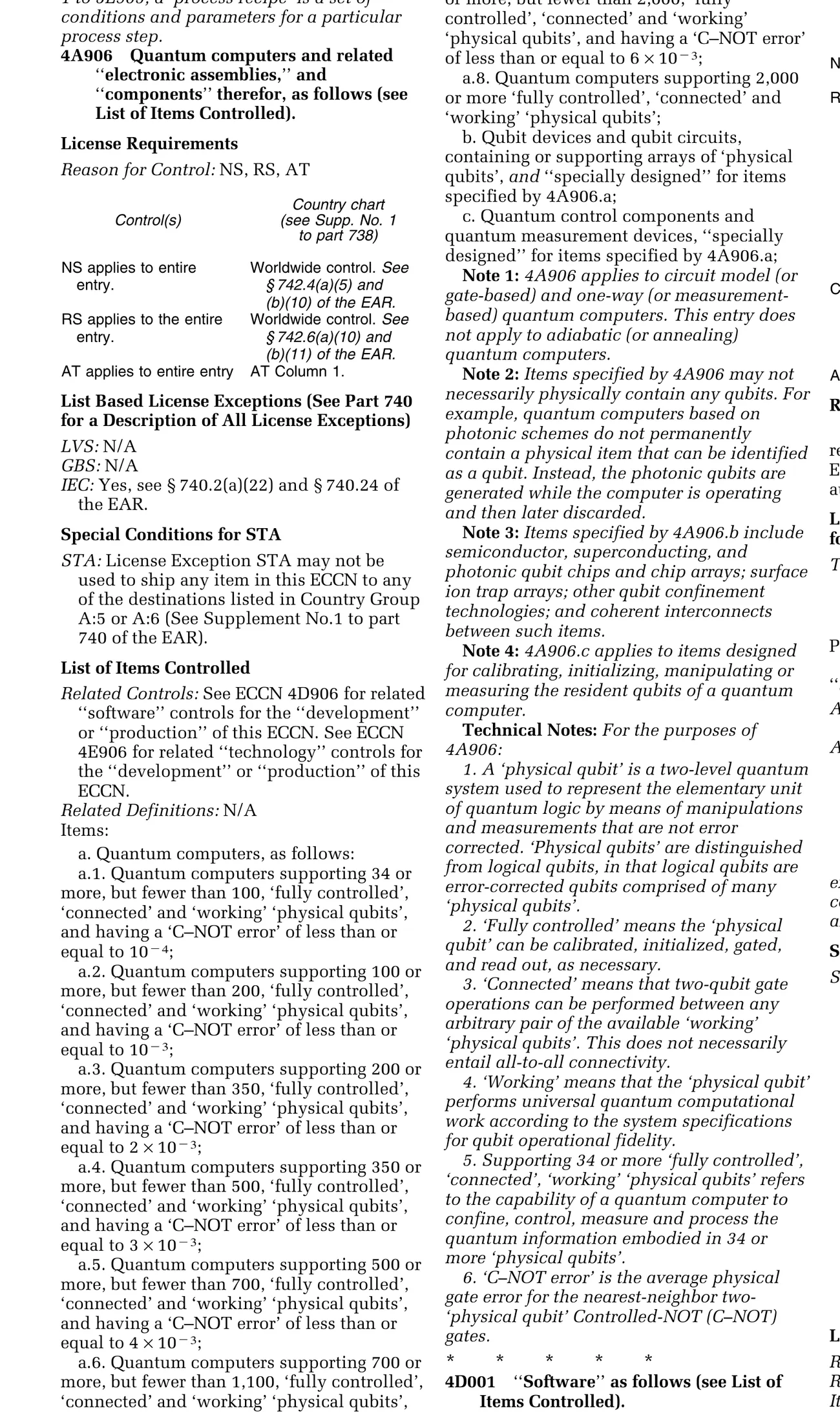
The logic of the shape is error correction. Useful fault-tolerant machines need both scale and quality, so the rule chases the combinations that could reach them; BIS’s preamble notes the physical error rate needed “plateaus around 2,000 qubits”, which is where the ladder stops bothering with quality at all. Our qubit approaches pages explain why those two numbers trade against each other.
Fifteen countries hold a pass
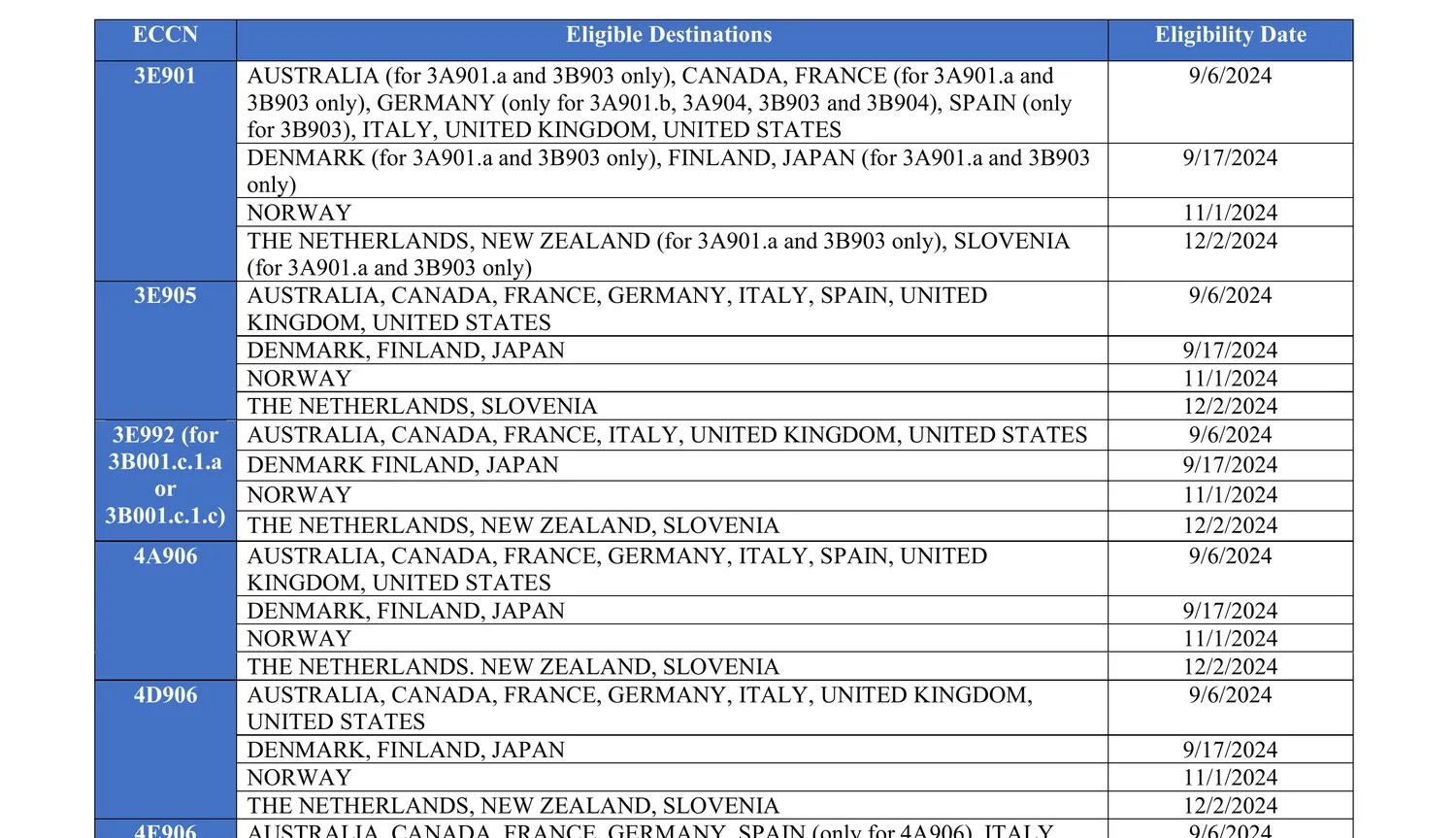
Licence exception IEC, created by the same rule, removes the licence requirement for countries that have “implemented equivalent national controls”. The list for quantum computers began with eight countries on day one, Australia, Canada, France, Germany, Italy, Spain, the UK and the US itself, and grew in three tranches to fifteen by 2 December 2024, adding Denmark, Finland, Japan, Norway, the Netherlands, New Zealand and Slovenia. It has been stable since.
The alignment is real rather than rhetorical. The UK controlled quantum computers from April 2024 under its own entry whose qubit and error-rate table is word for word identical to the American one, and folded it into its dual-use list as entry 4A506 at the end of 2025. The Netherlands controls quantum computers under the very same number, 4A906, in its national regulation. One set of thresholds now spans the western quantum industry, so a vendor asking whether a machine is controlled gets one answer across fifteen markets.
The kit around the machine is controlled too
The rule reaches well below the finished computer. Cryogenic control chips built to run at 4.5 kelvin or colder, parametric amplifiers, dilution-refrigeration systems delivering at least 600 microwatts of cooling at 0.1 kelvin or below for more than 48 hours, cryogenic wafer probers, and isotopically enriched silicon and germanium for spin qubits all carry their own new classifications. So do the software and technology for all of it, which is where the reach becomes personal: sharing controlled quantum know-how with a foreign national inside the US counts as a deemed export. Staff already employed on 6 September 2024 are grandfathered, with a licence still required where the employee’s most recent citizenship is in a country of concern, under a general licence with annual reporting.
Enforcement has already named names
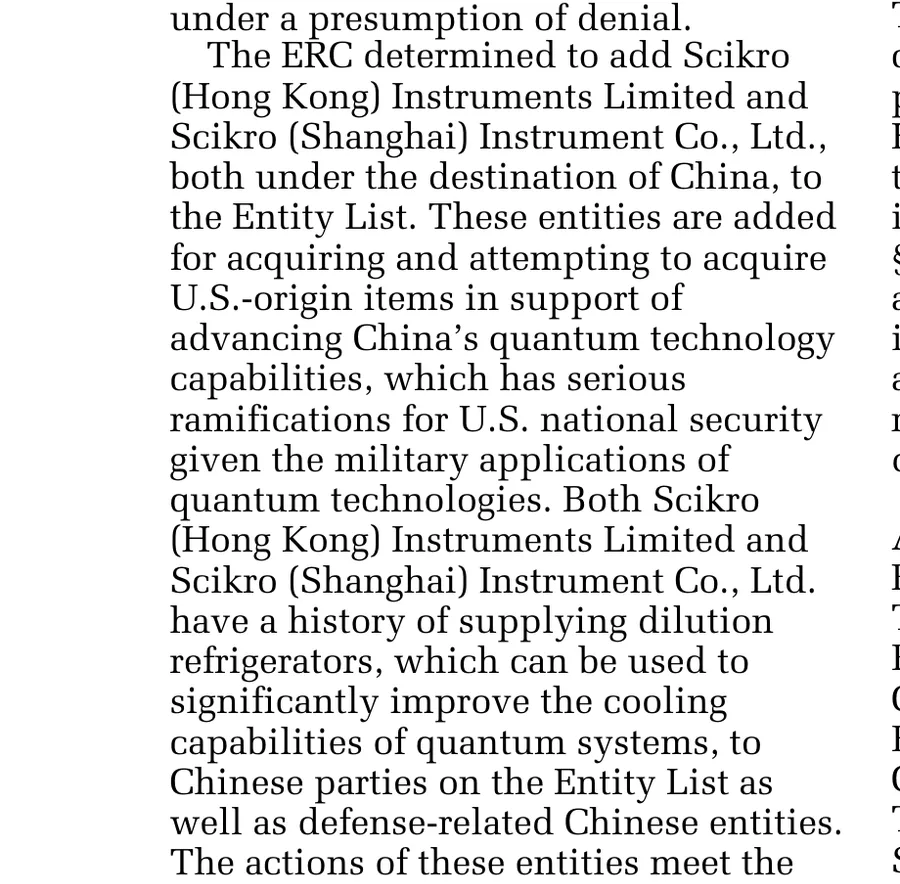
The first public enforcement shaped around the rule was announced on 25 March 2025, when BIS added seven entities to the Entity List for feeding China’s quantum programme, in a rule effective three days later. Two Scikro companies, in Hong Kong and Shanghai, were named for “acquiring and attempting to acquire U.S.-origin items in support of advancing China’s quantum technology capabilities”, with the rule noting a history of supplying dilution refrigerators to already-listed Chinese parties. Every listed entity faces a licence requirement for all US-origin items with a presumption of denial. The action reads as a statement about where BIS thinks the leakage is: the cryogenics and components, exactly the layer the 2024 rule swept in.
Still an interim rule, and the same numbers
The rule remains an interim final rule, with the thresholds unchanged since publication: a December 2024 correction fixed clerical errors elsewhere in the text and left the 4A906 ladder untouched, and the Federal Register shows no new BIS quantum rulemaking in the year to September 2026. Executive Order 14413 of June 2026, the innovation half of the White House’s quantum pair, points the policy forward in general terms, directing agencies to “prevent countries of concern from acquiring critical quantum-enabling technologies” by harmonising controls with allies, which is a description of the IEC structure already in place.
For the industry the practical edge of the rule is which machines sit under it. IonQ states on its own compliance page that its Forte Enterprise and Tempo systems are classified EAR99, the residual category outside the control list, a self-classification that says today’s commercial trapped-ion machines fall short of the controlled thresholds. The ladder was built for the machines the field is still climbing towards, and our US quantum policy page covers the money Washington is spending to make sure they are built inside the fence.
More Quantum
All Quantum →
US Reclassifies 18 Technologies Including Quantum Computing as Critical for National Advantage
The United States has reclassified 18 advanced technologies including quantum computing as critical to national security, granting the Commerce Department new authority to control exports.
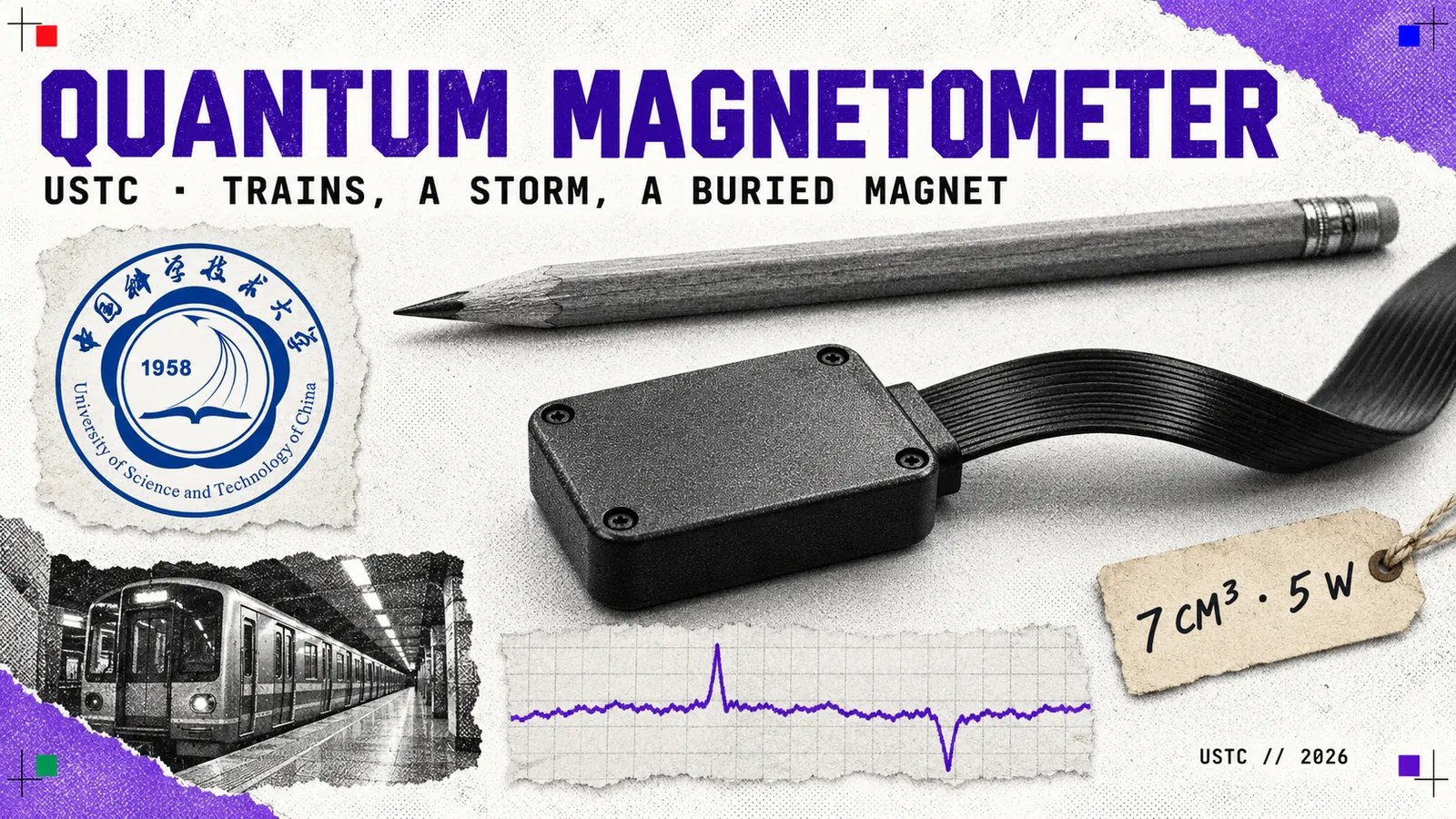
Thumb-sized Chinese quantum sensor detects metro trains from the street
Physicists at the University of Science and Technology of China, with a China State Shipbuilding Corporation laboratory, built a rubidium magnetometer with a 7 cm³ sensor head. Acta Physica Sinica posted their paper on 8 September 2026.