
Investing in quantum
the sector, the selloff and what to watch
Key facts
- $36.27close, 12 Oct 2026
- IonQ
- $13.25close, 12 Oct 2026
- Rigetti
- $13.74close, 12 Oct 2026
- D-Wave
- $39.5212 Oct close, IPO $60
- Quantinuum
- -11%July 2026 observation
- SOX index
- 2029fault-tolerant target
- IBM Starling
Quantum stocks can halve in a fortnight without a single qubit failing. Here is how to read the listed companies, what their milestones actually mean, and why the volatility comes from the physics timeline itself.
The selloff
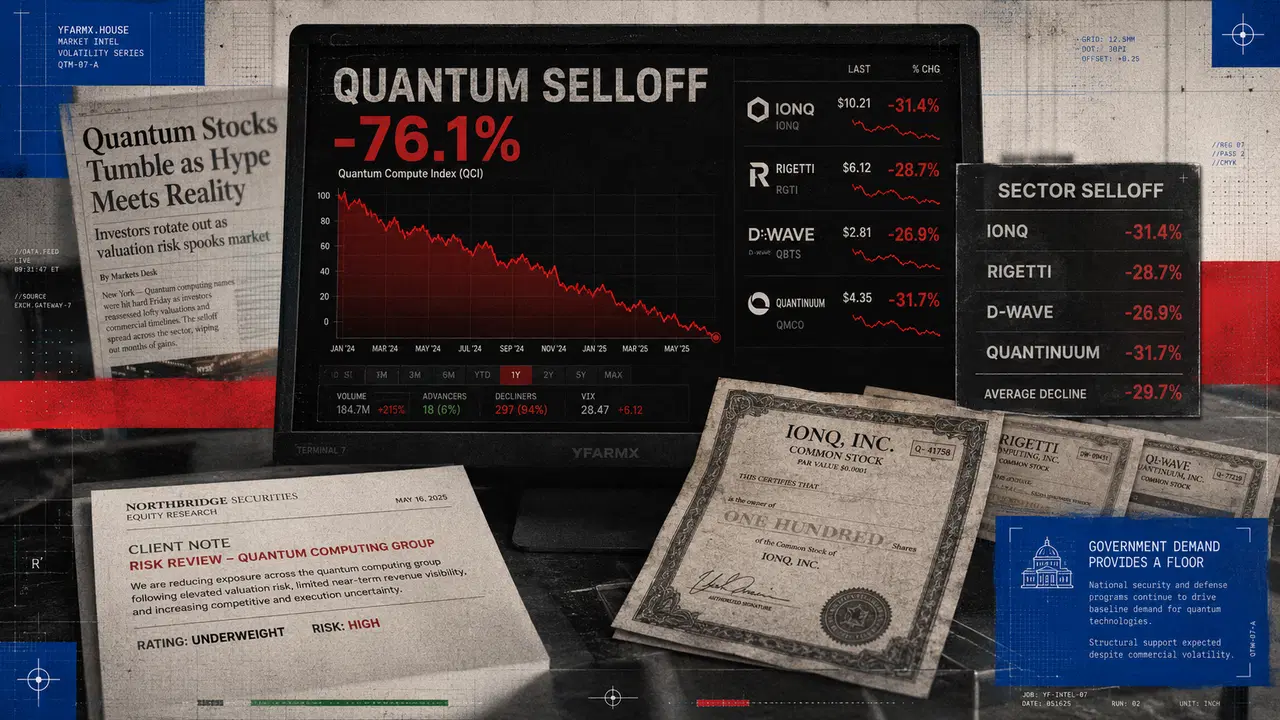
Quantum computing stocks had a bruising July 2026: at the depth of that month’s selloff IonQ sat 59.5 per cent below its 52-week high, Rigetti 76.1 per cent below and D-Wave 64.5 per cent below. None of it happened in isolation: the Philadelphia Semiconductor index had fallen more than 11 per cent from its June peak into bear-market territory, which amplified every move in the more speculative quantum computing stocks. The recovery that followed has since given much of itself back: in the week to 28 August 2026 the four pure plays fell between 12 and 17 per cent in a broad retreat from speculative, mostly pre-profit technology names. IonQ ended the 28 August session at $39.20, Rigetti at $15.59 and D-Wave at $16.99, each still above its mid-July trough, while Quantinuum closed at $49.92, further below the $60 at which it listed on 4 June 2026. IBM, the sector’s diversified anchor, slipped 1.34 per cent to $235.59 the same day. The listed field also widened that week: Pasqal completed its business combination with Bleichroeder Acquisition Corp. II on 27 August and began trading on Nasdaq as PSQL the next day, closing its first session at $19.11 with roughly $360m of cash at closing.
At the 12 October 2026 close, Nasdaq’s price history records IonQ at $36.27, Rigetti at $13.25, D-Wave at $13.74, Quantinuum at $39.52 and Pasqal at $6.40. Quantinuum was about 34% below its $60 offer price; Pasqal was about 67% below its $19.11 debut close. These are completed-session prices; the market strip can carry a later intraday quote.
Bull and bear
The sell-off has brought the two competing narratives about the sector into sharp relief. The bear case, argued forcefully by Bank of America, is straightforward: there are as yet no commercially relevant quantum algorithms, no fault-tolerant hardware in existence, and any real monetisation is still measured in years rather than quarters. On that reading, today’s quantum computing stocks are priced for a future that has not been proven and may arrive slowly. The bull case does not dispute the technical immaturity. It rests instead on demand that is largely indifferent to it: governments are buying regardless of near-term commercial returns, and the migration deadlines written into law give at least part of the sector a floor of guaranteed spending. That legally binding demand is what distinguishes quantum from a purely speculative technology wager: even if the science disappoints commercially for several more years, the migration mandates and public purchases keep money flowing to the firms positioned to serve them.
Milestones to watch
Because valuations are running so far ahead of revenue, the sensible way to follow quantum computing stocks is through concrete technical milestones rather than price alone. Several are worth marking on the calendar. IBM and its partners published three validated quantum-advantage claims on 30 July 2026, five months ahead of the company’s end-2026 target; the results stand open to classical challenge on IBM’s public tracker, and whether they survive that challenge is the marker to watch. Quantinuum’s Sol machine is expected at 192 qubits, and QuEra is targeting over 256 logical qubits in Libra for 2028, a figure that speaks to error-corrected rather than raw performance. Microsoft and Atom Computing have pointed to a 50-logical-qubit machine named Magne in 2027, and PsiQuantum is working to integrate its Brisbane and Chicago sites. Further out, IBM has set 2029 for Starling, its planned large fault-tolerant system.
The reporting calendar offers nearer-term fixtures. IonQ opened the second-quarter season on 5 August 2026 with record revenue of $80.1m, up 287 per cent year on year, raised full-year guidance to between $280m and $290m and reported $3.0bn of cash and investments; at its investor day on 8 September it raised the outlook again, to between $450m and $460m, with SkyWater included. Quantinuum’s first results as a listed company, published on 11 August, showed revenue of $8m, up 279 per cent year on year, a GAAP net loss of $597m that was largely non-cash, $2.1bn of cash and short-term investments at 30 June, and full-year guidance raised to between $28m and $32m. Rigetti, reporting on 6 August, posted revenue of $5.1m, a GAAP net loss of $52.6m, or $16.0m on the non-GAAP measure, and cash and investments of $541.3m.
Raw versus logical qubits
What ties the watch list together is the distinction between raw qubit counts and logical, error-corrected qubits, which is where the real difficulty lies. A jump to more physical qubits makes for an easy headline; a demonstration of a handful of reliable logical qubits, of the sort implied by the QuEra and Magne targets, is the harder and more meaningful achievement. Investors who follow only the largest number quoted will regularly be misled, because the quantum computing stocks that eventually reward patience are likely to be the ones that clear the error-correction bar rather than the qubit-count one.
The bottom line
The honest summary is that this is a sector where the science and the share prices are moving on very different clocks. The technology is advancing in steady, verifiable steps, while the stocks swing violently with sentiment and with the wider semiconductor market. A slow, verifiable technology priced by a fast and emotional market is where both the opportunity and the danger come from. For readers weighing it up, the disciplined approach is to watch the milestones above, treat any single week’s move with suspicion, and remember that this page is information and not investment advice. For the underlying technology, see our quantum explainers and the main quantum hub.