Thumb-sized Chinese quantum sensor detects metro trains from the street
Physicists at the University of Science and Technology of China, with a China State Shipbuilding Corporation laboratory, built a rubidium magnetometer with a 7 cm³ sensor head. Acta Physica Sinica posted their paper on 8 September 2026.
Listen to this articleListen
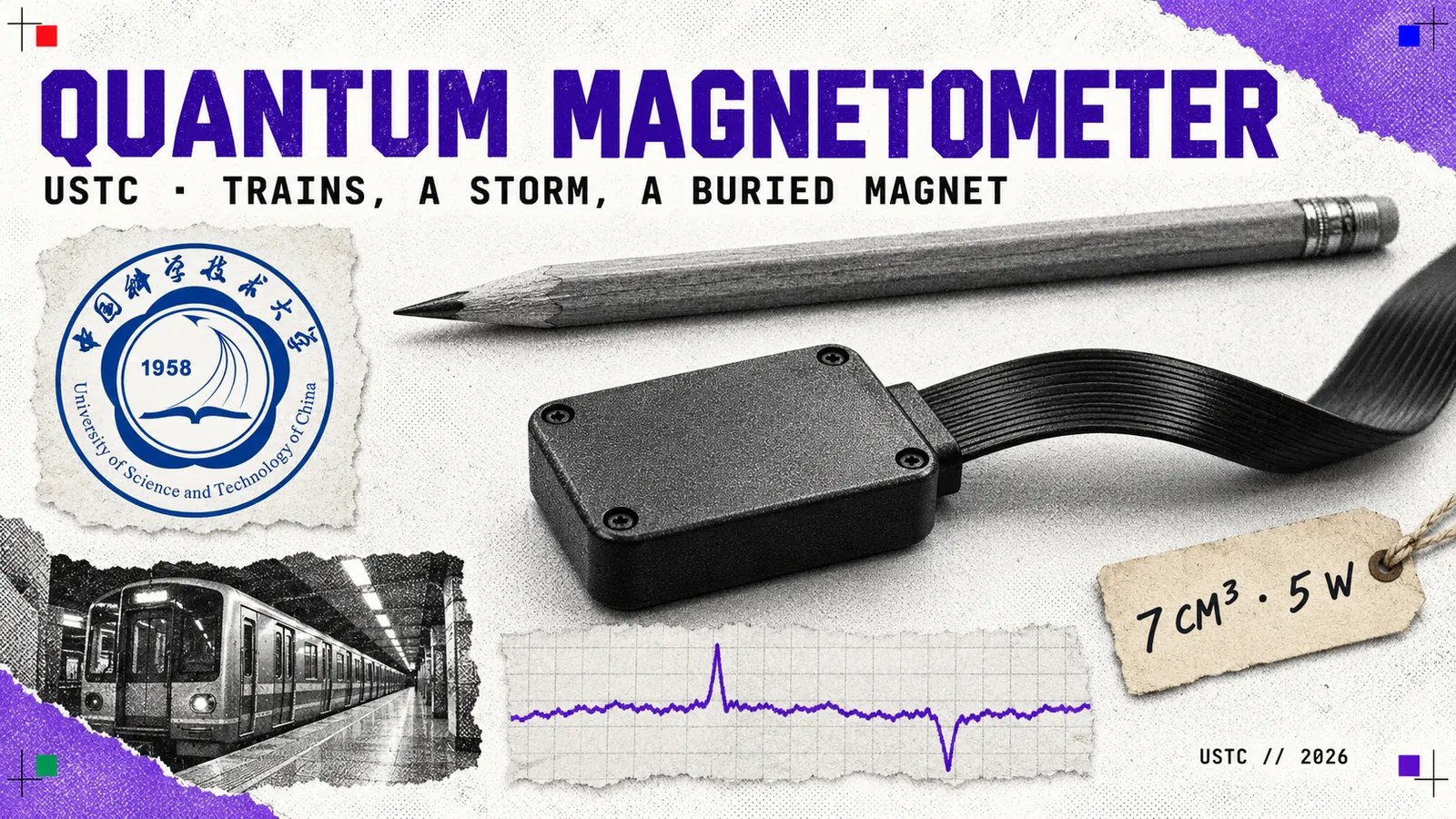
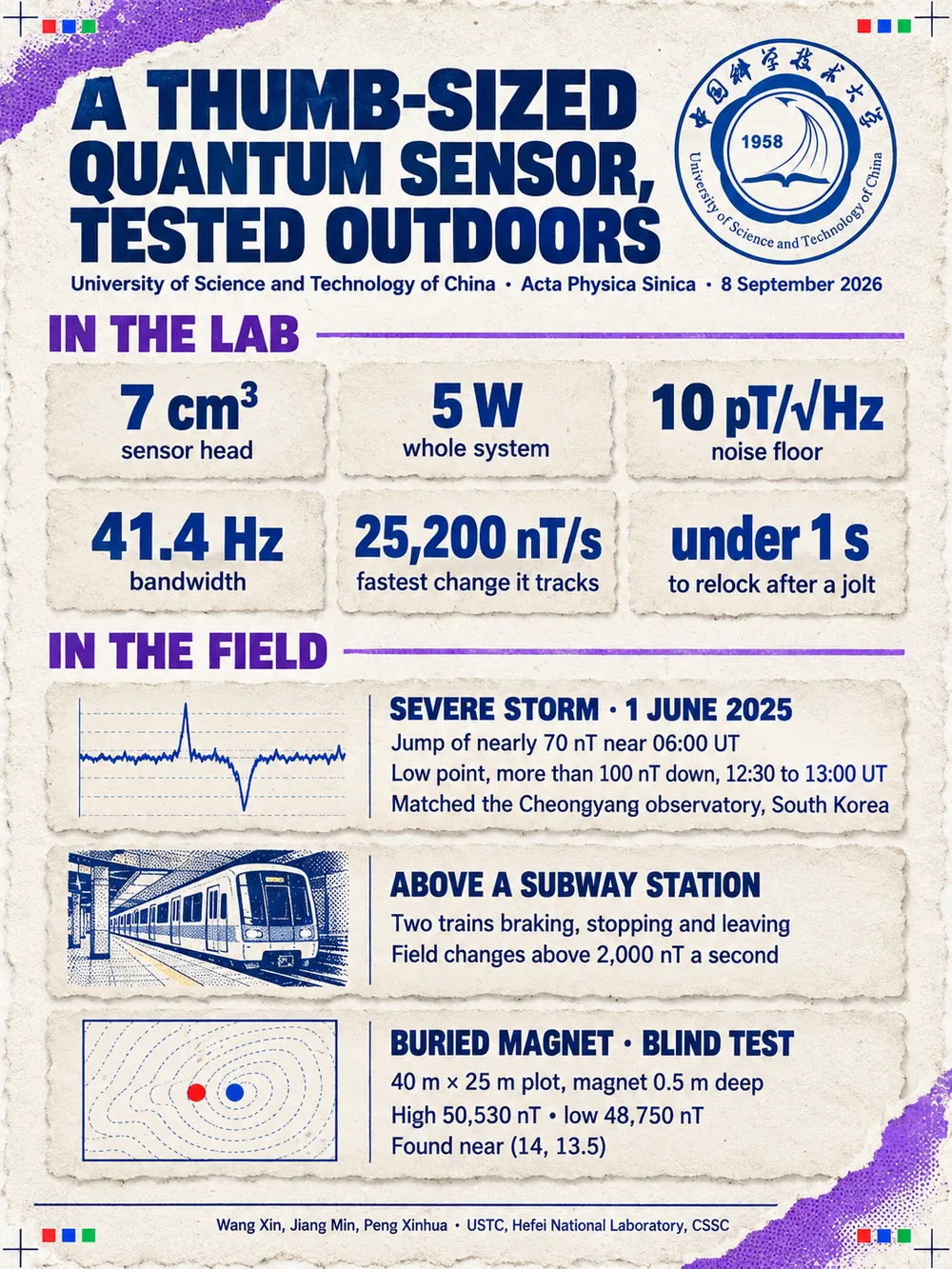
Physicists at the University of Science and Technology of China (USTC) have built a quantum magnetometer with a sensor head of 7 cubic centimetres and tested it outside the lab: it logged a severe geomagnetic storm, picked up subway trains from the street above a station and found a magnet buried in a field. Wang Xin, Jiang Min and Peng Xinhua describe it in a paper that Acta Physica Sinica, a Chinese Physical Society journal, posted online on 8 September 2026 as an accepted manuscript.
All three list USTC’s School of Physical Sciences in Hefei, and Wang and Peng also list the Hefei National Laboratory. Wang’s third affiliation is the Laboratory of Science and Technology on Marine Navigation and Control of the China State Shipbuilding Corporation (CSSC) in Tianjin, whose open fund helped pay for the work.
What is an atomic magnetometer?
An atomic magnetometer measures a magnetic field by timing how fast the spins of atoms in a vapour precess, or wobble, around it. The USTC sensor uses rubidium-87 sealed in a glass cell 4 mm on a side. A laser lines the atoms’ spins up, and in a magnetic field those spins precess at a frequency set by the field’s strength. A small radio-frequency coil drives them; when its frequency matches the precession, the atoms absorb more laser light and the light reaching the detector dips. The electronics lock the radio frequency onto that dip and convert it into field strength.
The reading is the total strength of the field at the sensor, in nanotesla (nT). The Earth supplies almost all of it: the background at the team’s farmland test site read 50,100 nT. Iron, electric currents and magnetised rock add small distortions on top, and catching those distortions is the job. The measurement rests on the quantum spin states of the atoms, which is why the paper calls the device a quantum magnetometer.
The head is 7 cm³ and the whole system runs on 5 watts
The USTC team fitted a laser, a vapour cell, a radio-frequency coil and a detector into a head measuring 3 × 1.5 × 1.5 cm. The light comes from a vertical-cavity surface-emitting laser (VCSEL) packaged at 2.5 × 2.5 × 1.6 mm. The rubidium cell, filled with 200 Torr of nitrogen, sits against a flexible thin-film coil, and a non-magnetic photodiode reads the light at the far end. The controller is two 8 × 2.5 cm circuit boards stacked on top of each other, running temperature control, laser locking and the tracking loop.
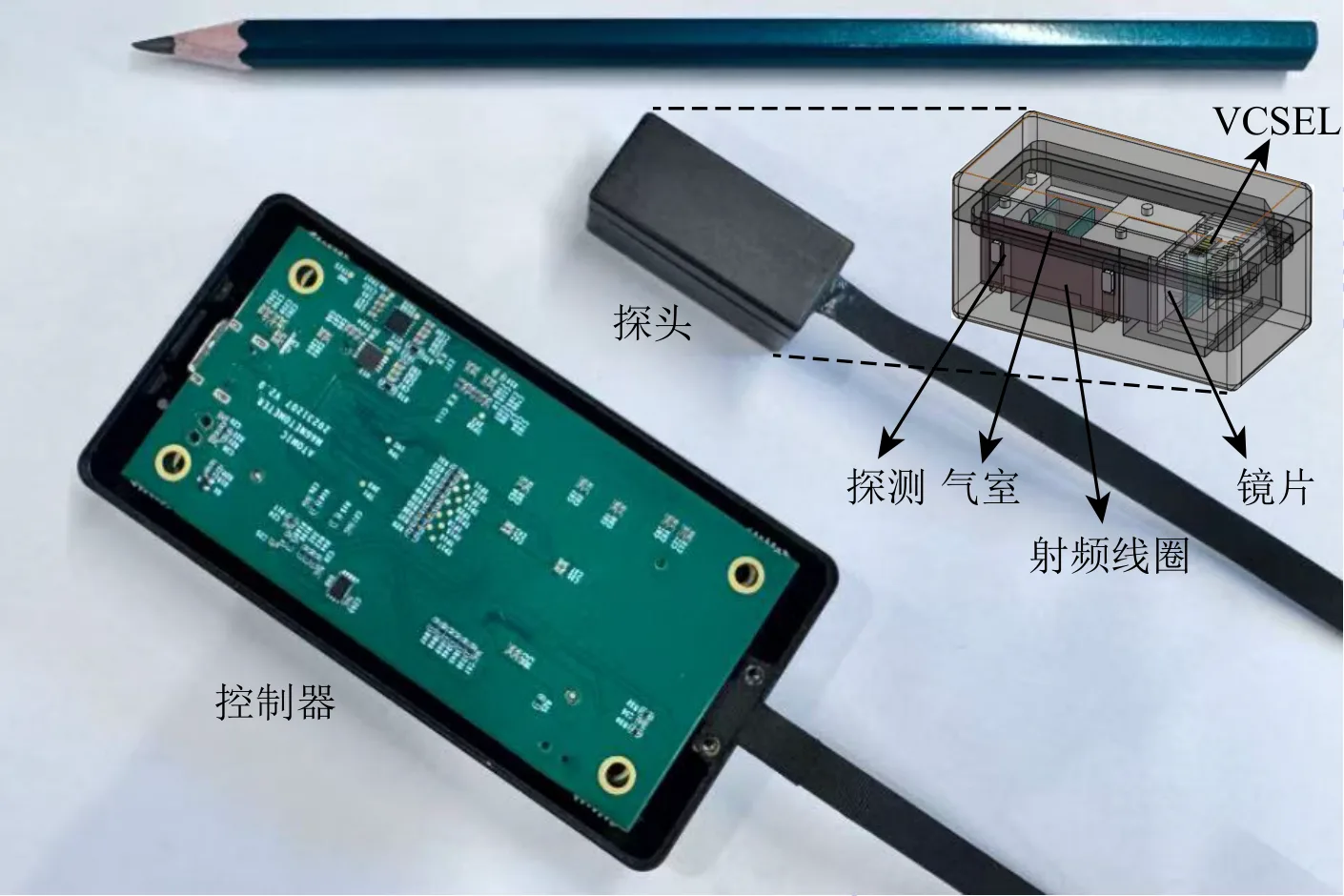
The team measured it inside a multilayer magnetic shield.
| Measure | USTC sensor |
|---|---|
| Sensor head volume | 7 cm³ |
| Power, whole system | 5 W |
| Noise floor, 0.1 to 10 Hz | 10 pT/√Hz |
| Bandwidth | 41.4 Hz |
| Fastest field change it tracks (slew rate) | 25,200 nT/s |
| Time to relock after losing the signal | under 1 second |
A picotesla (pT) is a thousandth of a nanotesla. At 25,200 nT a second, the slew rate covers about half the Earth’s total field every second, the paper notes.
It relocks itself in under a second
The USTC sensor watches a second signal that fades when it loses the resonance, then sweeps to find it again, and the whole recovery takes under a second. A magnetometer of this kind loses lock when the field changes faster than it can follow, when the head tilts, or when it enters a steep field gradient, and its output is invalid until it relocks.
The controller demodulates the light at twice its modulation frequency, and that second-harmonic signal peaks when the radio frequency sits on the resonance. When it falls below 10 per cent of its peak, the controller declares the lock lost, stops tracking and sweeps the full frequency band for the resonance. The check is borrowed from commercial atomic clocks.
The team tested it outside the shield by waving a hand-held magnet up and down near the probe. The output went invalid between the fifth and sixth seconds of the recording, and the sensor relocked within a fraction of a second of the magnet being taken away.
It logged the whole 1 June 2025 storm
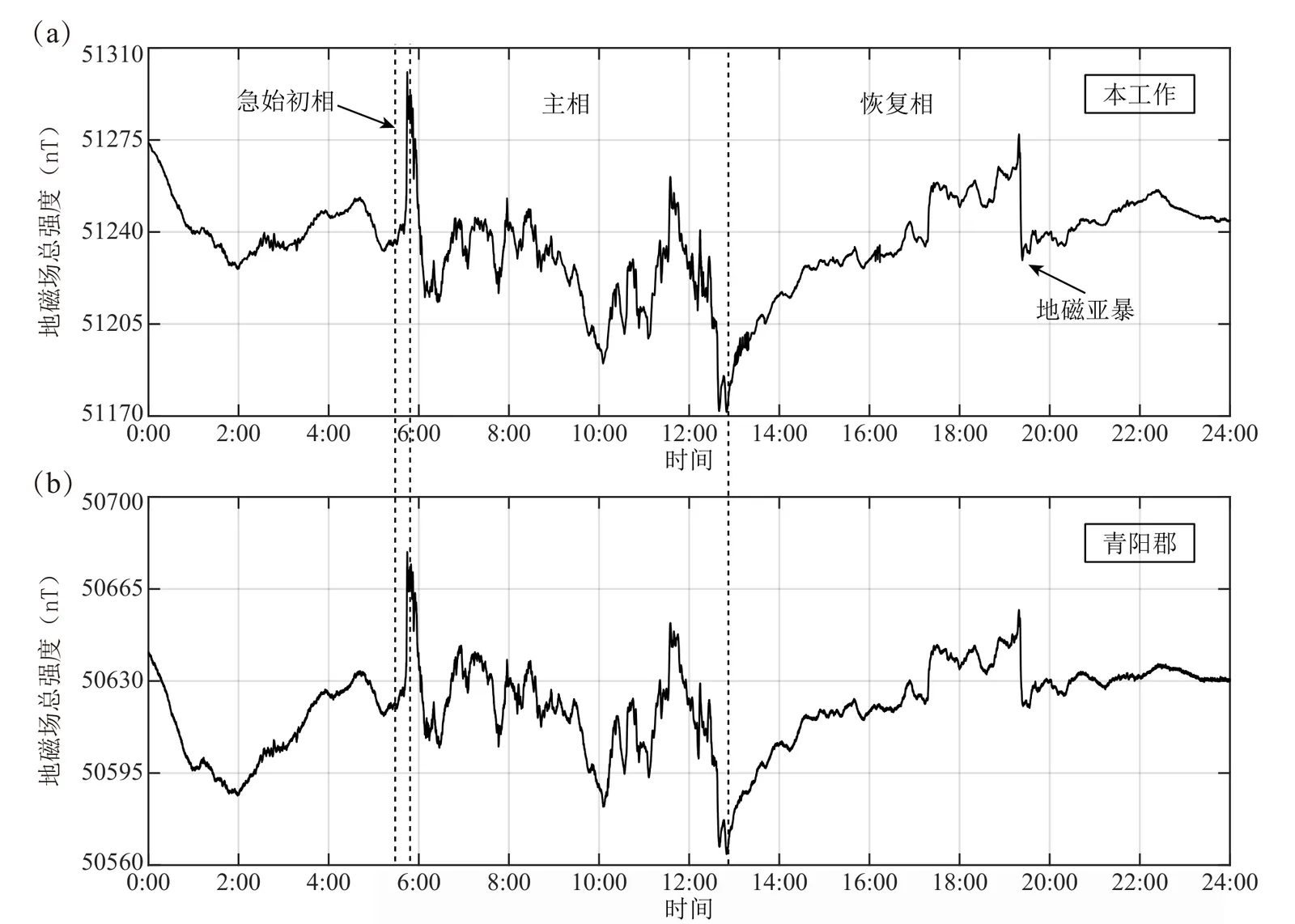
The USTC magnetometer recorded the whole G4 geomagnetic storm of 1 June 2025 continuously, holding its lock throughout, according to the paper. NOAA’s Space Weather Prediction Center rates G4 as severe, and posted at 08:40 UTC that day that G4 conditions had been observed. The sensor was running long-term at a suburban monitoring station, and the team set its record beside the same day’s data from the INTERMAGNET observatory at Cheongyang in South Korea. The two sites sit in different background fields, and the shape of the disturbance, the timing of its spikes and its overall course match closely.
| Time (UT), 1 June 2025 | What the USTC sensor recorded |
|---|---|
| About 06:00 | Sudden commencement: the field jumps by nearly 70 nT |
| 12:30 to 13:00 | Lowest point of the main phase, a fall of more than 100 nT |
| About 19:00 | A second steep drop, marked as a substorm |
What did it pick up above a subway station?
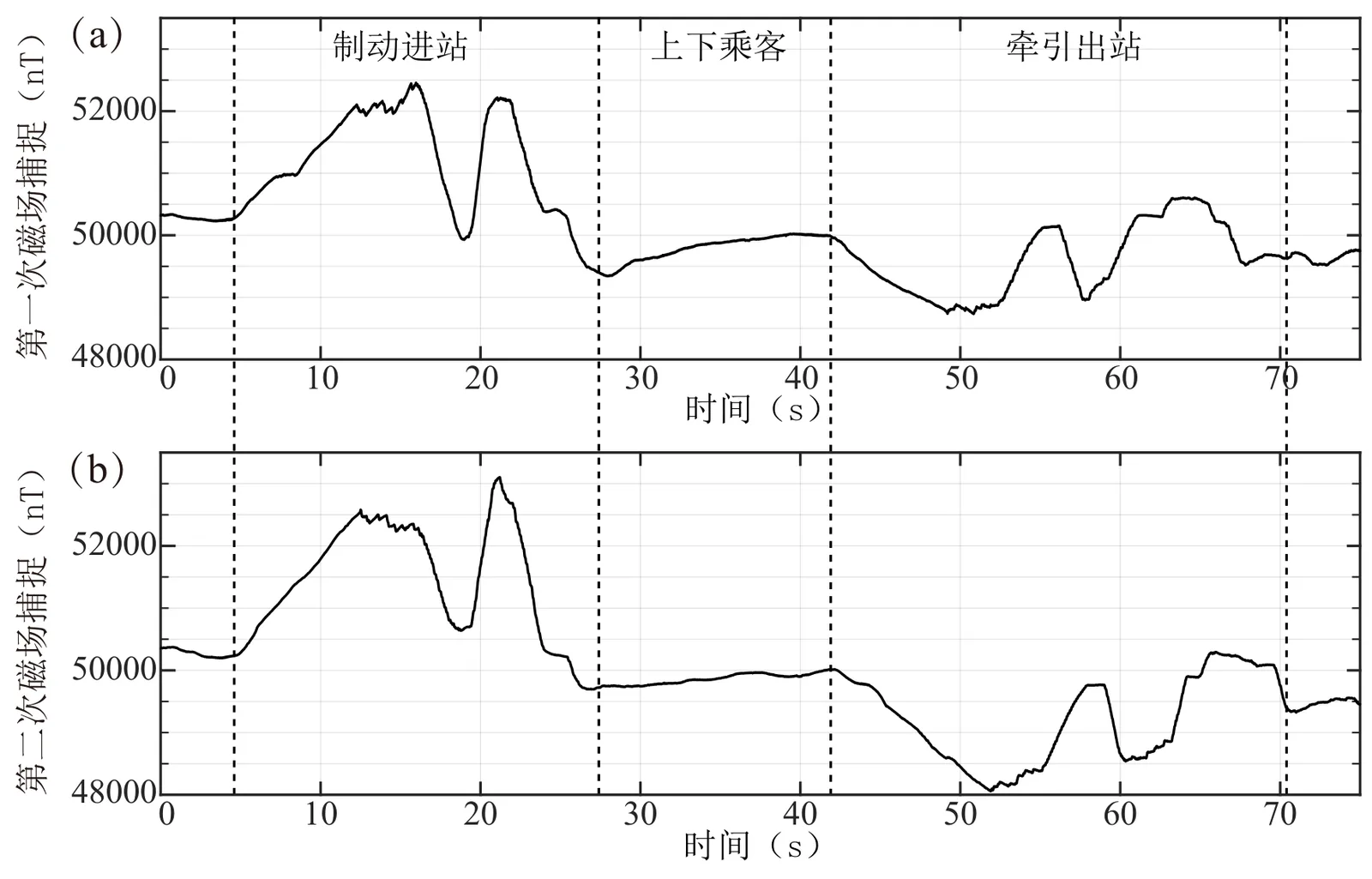
Set on the road above a subway station, the USTC sensor recorded two trains arriving, stopping and leaving, and the two records closely match. The paper ties the signal to the large currents the trains draw. As a train brakes in, the field climbs steeply from 4 to 16 seconds with heavy oscillation, then drops, rebounds and drops again from 16 to 28 seconds as the train switches between electric and mechanical braking and lines up with the platform doors. At its fastest the field changed by more than 2,000 nT a second, inside the sensor’s 25,200 nT/s limit.
While passengers get on and off, with the traction current cut, the field flattens. Pulling out under power sends it the opposite way, with sharp pulses as the train accelerates.
It found a magnet buried half a metre down

In a blind test on farmland, the handheld USTC sensor located a cylindrical permanent magnet buried about 0.5 m deep in a 40 m by 25 m plot, with its position kept from the survey team. The probe was fixed to the end of a 1 m non-magnetic carbon rod and carried 5 to 10 cm above the ground along a back-and-forth path, logging field strength and position.
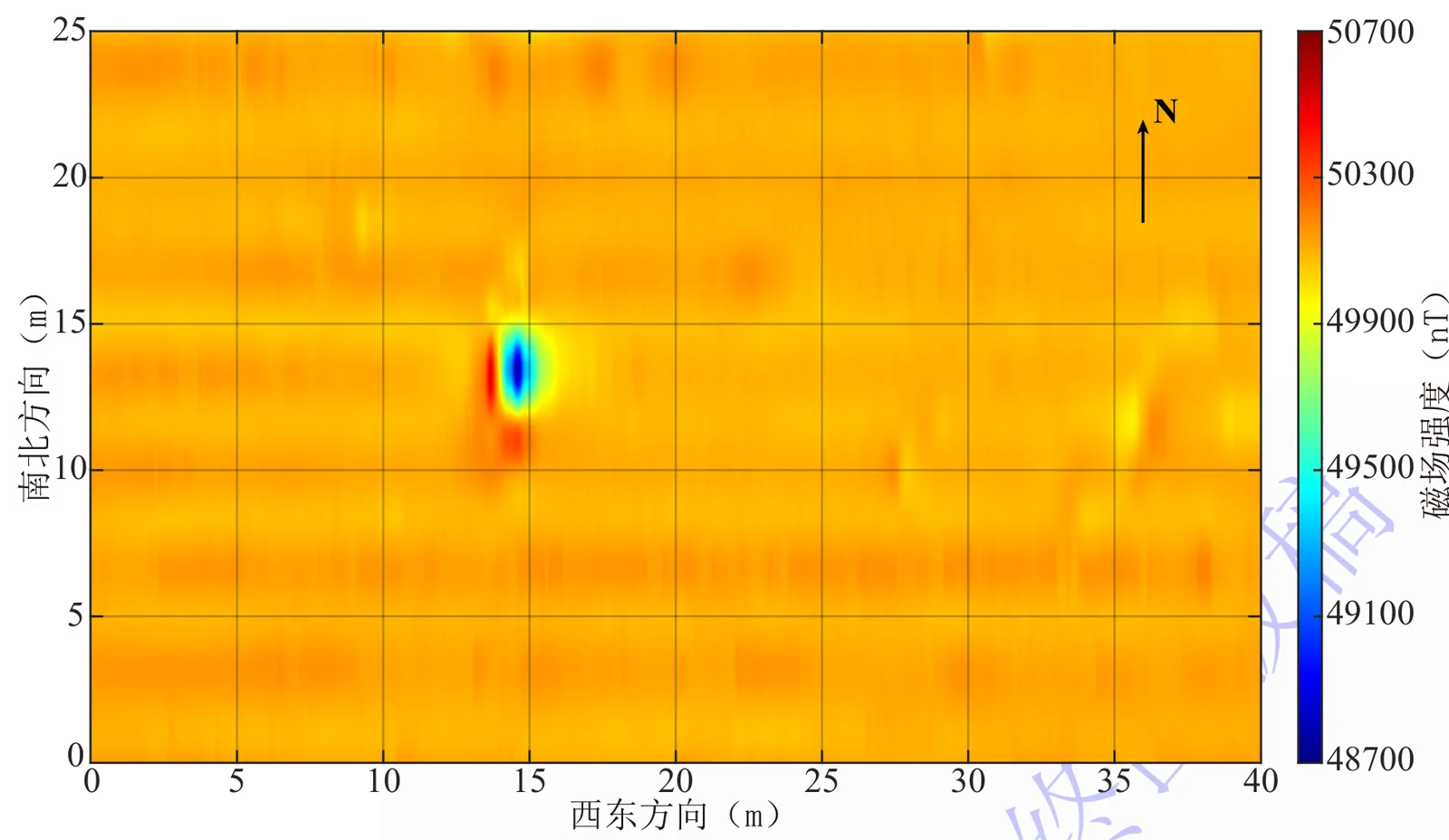
The mapped field held at 50,100 nT, give or take 50 nT, across the plot except near the coordinates (14, 13.5). There a paired high and low appeared, about 50,530 nT to the west and slightly south and about 48,750 nT to the east and slightly north, the two-pole pattern of a magnet. The centre fitted to that anomaly matched the spot where the magnet was buried.
Anti-submarine warfare is in the paper’s first line
Anti-submarine warfare appears in the paper’s first sentence, as one of the fields where weak-field magnetometry plays a critical role, alongside mineral exploration, geomagnetic monitoring, and navigation and positioning. Through Wang’s affiliation and its open fund, the CSSC laboratory ties the work to China’s state shipbuilder. The South China Morning Post, reporting the paper on 25 September 2026, called the device a handheld submarine detector.
The uses the authors propose for this sensor are on land: a low-cost network of geomagnetic observatories, contact-free sensing of city traffic, fault-finding in buried metal pipe networks, and a portable instrument for mineral prospecting and searches for unexploded ordnance.
How does it compare with a US-made sensor?
Against the rubidium magnetometers of the US company QuSpin, the USTC sensor has the smallest head and out-tracks QuSpin’s older model, while both QuSpin sensors are more sensitive and draw less power. The paper itself compares tracking with QuSpin’s sensor, putting it at about 10,000 nT a second, the figure QuSpin lists for its Gen-1 model.
| Measure | USTC sensor | QuSpin QTFM Gen-1 | QuSpin QTFM Gen-2 |
|---|---|---|---|
| Sensor head | 30 × 15 × 15 mm | 19 × 19 × 47 mm | 17.7 × 19.8 × 35.8 mm |
| Sensitivity | 10 pT/√Hz | under 1 pT/√Hz | under 5 pT/√Hz |
| Slew rate limit | 25,200 nT/s | 10,000 nT/s | none |
| Power | 5 W | 2 W | about 2.5 W |
QuSpin’s Gen-2 sensor measures by free induction decay, pulsing the atoms and timing the signal as it rings down, and QuSpin lists it with a bandwidth of up to 500 Hz. The USTC team names the same pulsed method as its next step, aiming for a bandwidth on the order of 100 Hz and full three-axis readings of the field’s direction as well as its strength.
Selling China a sensor this sensitive needs a US licence
US export rules control optically pumped magnetometers more sensitive than 20 pT/√Hz at 1 Hz, for national security reasons. The entry is ECCN 6A006.a.2 on the Commerce Control List, the same rulebook that carries the US export controls on quantum computers. QuSpin classes its standard sensor under that entry, and its Gen-1 page says a shipment to China needs a Commerce Department licence, a process that can take more than 8 to 12 weeks.
At 10 pT/√Hz, the USTC sensor is twice as sensitive as the line the US draws, and it has already worked through a severe storm, over a subway station and across a farm field.
Questions people ask
- What is an atomic magnetometer?
- An atomic magnetometer measures a magnetic field through the atoms in a vapour. A laser lines up the atoms' spins, the spins precess at a frequency set by the field's strength, and the instrument locks a radio signal onto that frequency and converts it into field strength. The sensor built at the University of Science and Technology of China, described in Acta Physica Sinica on 8 September 2026, uses rubidium-87 in a 4 mm glass cell and reports the total field in nanotesla.
- What did the Chinese quantum magnetometer detect in its field tests?
- The University of Science and Technology of China sensor logged the G4 geomagnetic storm of 1 June 2025 from start to finish, holding its lock throughout, matching the INTERMAGNET record from Cheongyang, South Korea. On the street above a subway station it recorded two trains braking, stopping and leaving, with field changes above 2,000 nT a second. In a blind test it found a magnet buried 0.5 m deep in a 40 m by 25 m field.
- Is the USTC magnetometer linked to submarine detection?
- The paper, posted by Acta Physica Sinica on 8 September 2026, lists anti-submarine warfare among the fields where weak-field magnetometry plays a critical role, and its first author also lists a China State Shipbuilding Corporation navigation laboratory in Tianjin that helped fund the work. The uses the authors propose for this sensor are geomagnetic observatory networks, city traffic sensing, buried pipe checks, mineral prospecting and searches for unexploded ordnance.
Sources
- Acta Physica Sinica: Wang, Jiang and Peng, Development of a highly robust miniaturized quantum magnetometer and its applications in geomagnetic environments, accepted manuscript PDF, 8 September 2026wulixb.iphy.ac.cn
- Acta Physica Sinica: article page and English abstract, DOI 10.7498/aps.76.20260845wulixb.iphy.ac.cn
- NOAA Space Weather Prediction Center: G4 (Severe) conditions observed, 1 June 2025spaceweather.gov
- South China Morning Post: China tested a handheld submarine detector. It tracked a subway train underground, 25 September 2026scmp.com
- QuSpin: QTFM Gen-2 total-field magnetometer specifications and export classificationquspin.com
- QuSpin: QTFM (Gen-1) specifications and export restrictions, archived product pagequspin.com
- eCFR: Commerce Control List, Supplement No. 1 to Part 774, ECCN 6A006 magnetometersecfr.gov