Nvidia Ising decoder cuts colour code error rates by 347 times
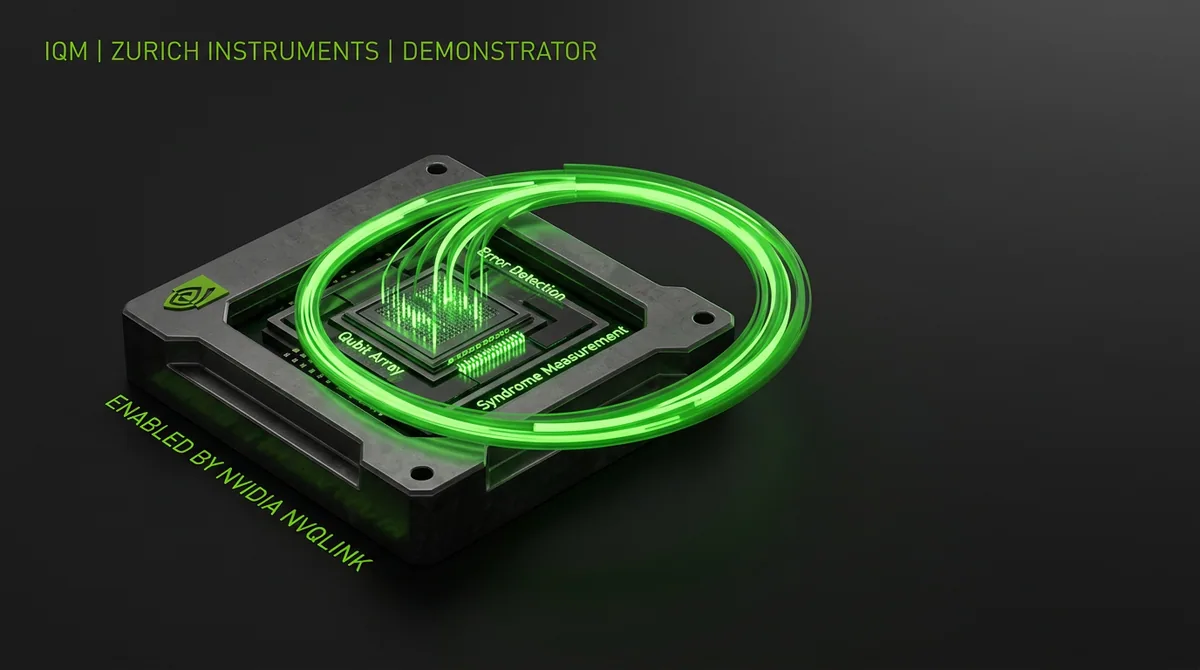
Nvidia's quantum computing division released the Nvidia Ising decoder on 13 July, an open source model family that applies neural networks to quantum error correction.
Listen to this articleListen
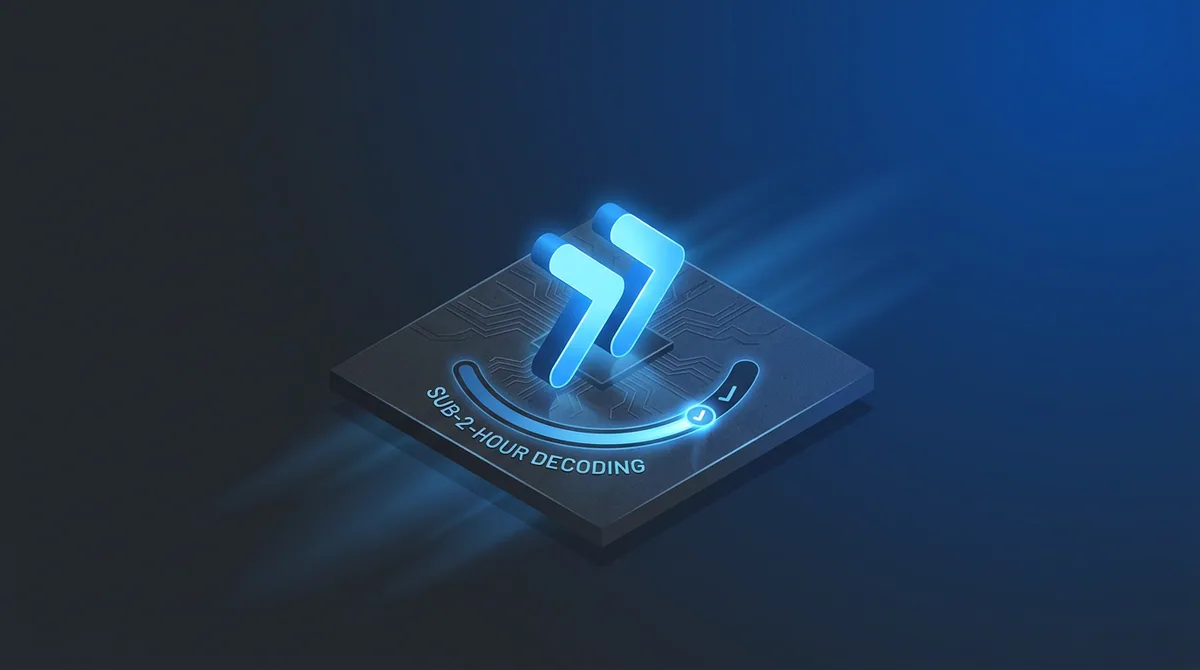
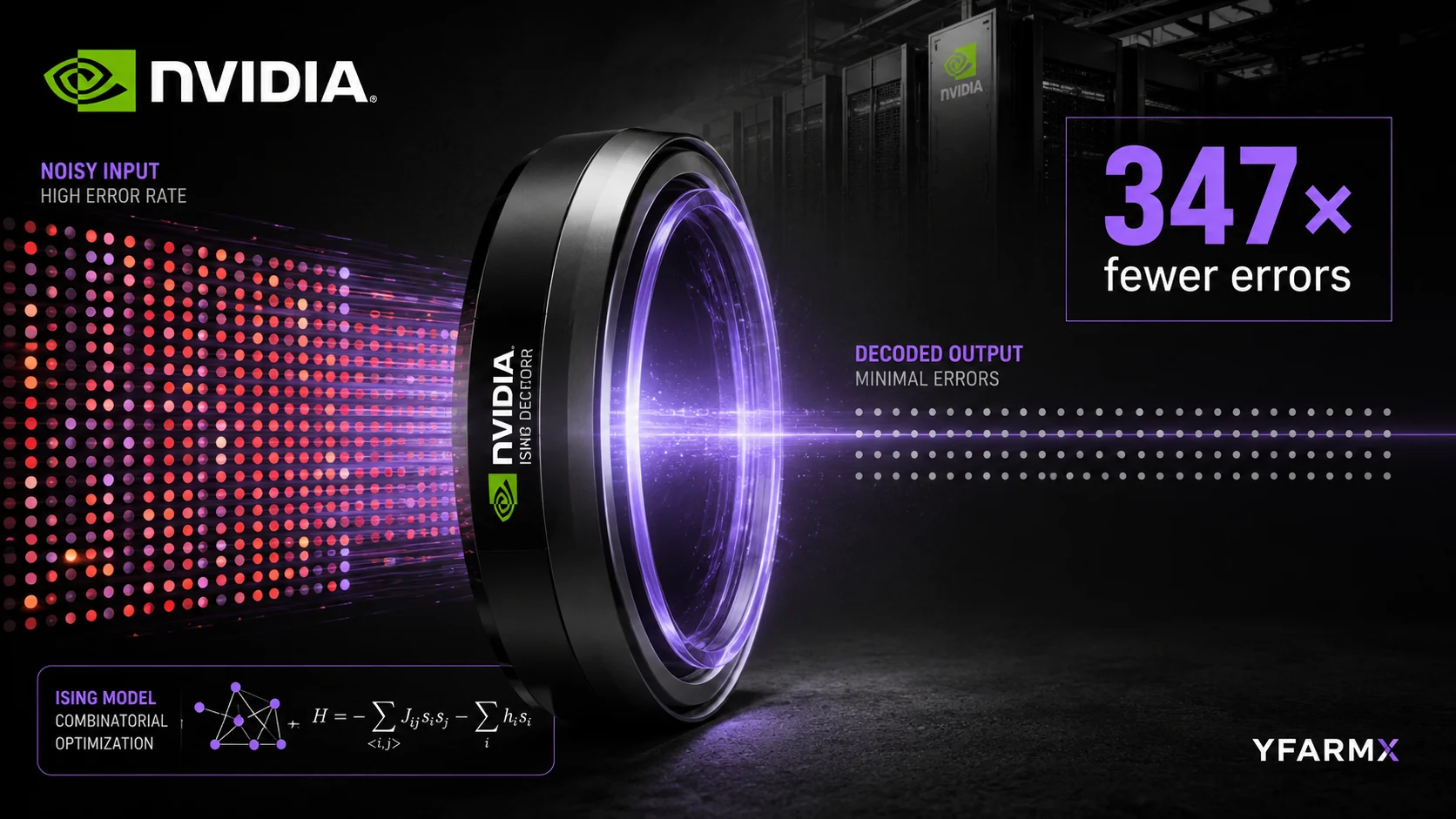
Nvidia’s quantum computing division released the Nvidia Ising decoder on 13 July, an open source model family that applies neural networks to quantum error correction. The headline result concerns colour codes, a family of topological codes that has been sidelined for years because decoding them in real time proved impractical. Against Chromobius, the leading colour code decoder to date, the Nvidia Ising decoder delivers a 347.7 fold reduction in logical error rate and runs 7.3 times faster at code distance 31 with a physical error rate of 0.3 per cent.
The Nvidia Ising decoder architecture is a pre-decoder. The Ising Decoder ColorCode 1 Fast is a seventeen layer three dimensional convolutional neural network that sits in front of a conventional topological solver. It processes localised syndrome volumes of size thirteen by thirteen by nineteen, resolving the large quantity of local errors on a GPU and passing a simplified syndrome map to the classical decoder behind it. Because the network predicts space-time corrections locally, its processing speed is decoupled from the overall system size or the lattice boundaries, which is the property that makes the approach scale.
Why this changes the calculation requires a short detour into code families. Surface codes dominate current fault tolerance work because they are relatively straightforward to implement on a two dimensional chip, and Google’s Willow results demonstrated below threshold error correction using them. Their weakness is qubit efficiency during logical computation. Quantum low density parity check codes need the fewest physical qubits for memory, but nobody has established how to perform both Clifford and non-Clifford gates efficiently at the logical level with them. Colour codes offer a middle path: all Clifford gates can be performed transversally, and their symmetry makes lattice surgery simpler. The obstacle has always been decoding complexity.
Removing that obstacle re-opens a design space. If colour codes can be decoded in real time within the latency budget required for lattice surgery on physical arrays, hardware architects gain an option that trades differently between qubit count and gate efficiency. For a field where the physical qubit overhead per logical qubit is the dominant engineering constraint, an alternative that reduces logical operation cost is worth serious study.
The decoder integrates with Nvidia’s existing quantum software stack, including the cuQuantum and cuStabilizer libraries, which generate synthetic training data for fine tuning. The open source release allows quantum processor developers to retrain for their own architectures and noise profiles, which is the practical point. A decoder trained on generic noise is far less useful than one tuned to the specific error signature of a particular chip.
The strategic reading concerns Nvidia’s position in the stack. The company launched the Ising framework in April and has been building toward a role as the classical control and decoding layer for other people’s quantum hardware. Error correction is fundamentally a classical computing problem sitting inside a quantum machine: syndromes are measured, decoded and corrected within a latency budget of microseconds, and that decoding runs on conventional processors. Whoever supplies that layer occupies a position in every quantum computer regardless of which qubit technology wins.
The caveats are the usual ones for simulation results. The 347.7 figure comes from a benchmark evaluation modelling a distance 31 colour code memory array, not from a physical device. Real hardware introduces correlated noise, leakage, crosstalk and drift that simulation captures imperfectly, and decoders that perform well on modelled noise routinely disappoint on silicon. The runtime improvement is arguably the more robust result, since latency is a property of the algorithm and the hardware it runs on.
Nvidia has published training pipelines alongside the models, so quantum processor builders can reproduce and adapt the work. Independent replication on physical devices is the test that counts, and the open release makes that possible.