StonkBrokers: the Robinhood Chain NFT that owns a share portfolio
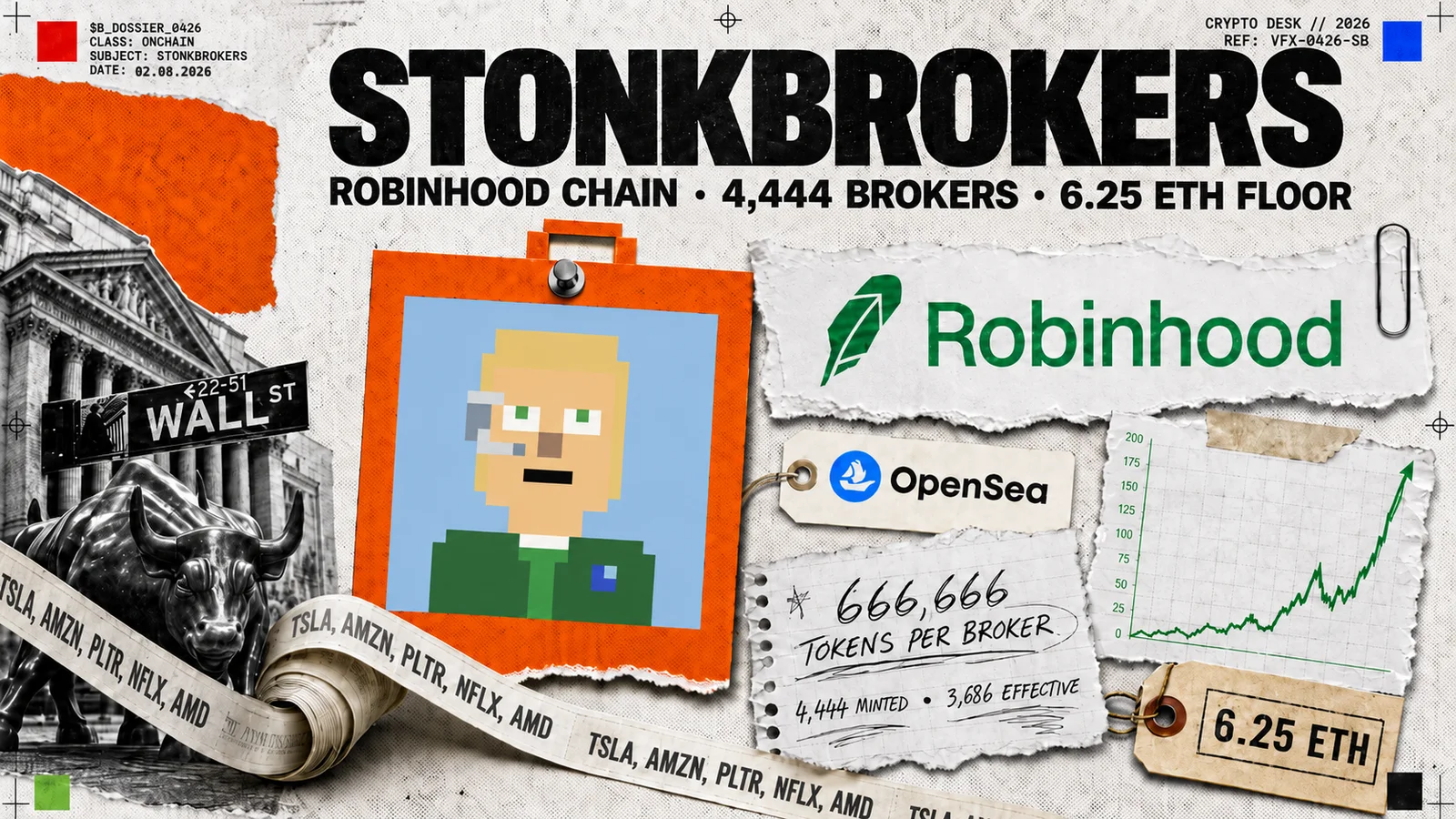
4,444 pixel stockbrokers on Robinhood Chain minted free on 17 July and now trade for the price of a used car. Each one owns an on-chain wallet holding tokenised shares its buyer may not be permitted to hold directly.
Listen to this articleListen
On the evening of 2 August, the cheapest StonkBrokers NFT listed on OpenSea was asking 6.25 ETH, about $11,742. Sixteen days earlier the same picture had been given away free.
The floor is an all-time high. It is up 32.7% in a day and 257.1% in a week. Thirty-seven brokers changed hands over twenty-four hours at an average of 5.23 ETH, and 561 wallets hold all 4,444 of them.
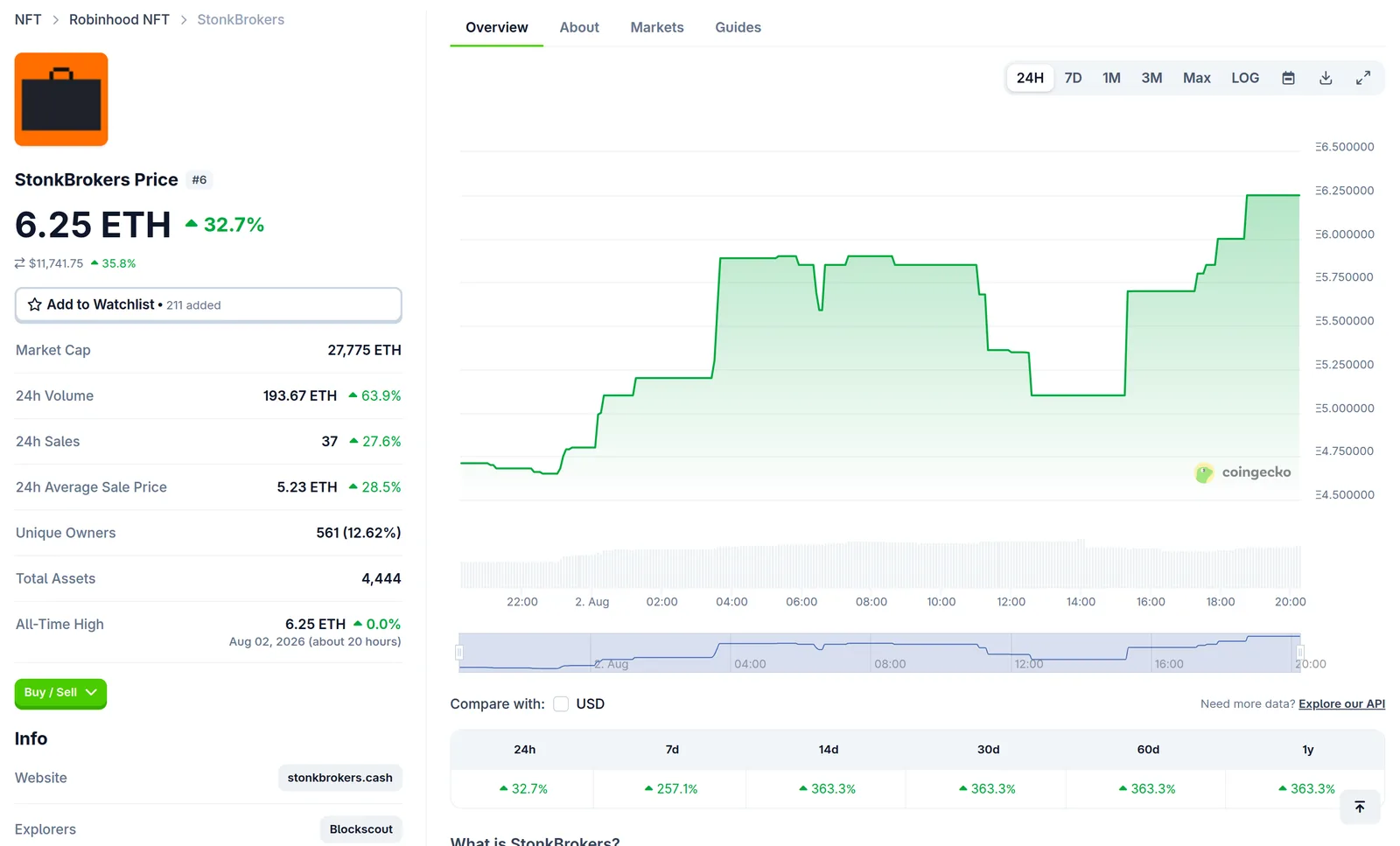
StonkBrokers on CoinGecko, 2 August 2026.
What Robinhood built, and where it built it
Robinhood Chain is a layer 2 blockchain built on the Arbitrum platform, with infrastructure from Alchemy, BitGo and Chainlink. It reached public mainnet on 1 July, announced from a stage at the Old Royal Naval College in Greenwich under the title Robinhood Presents: The World is Flat.
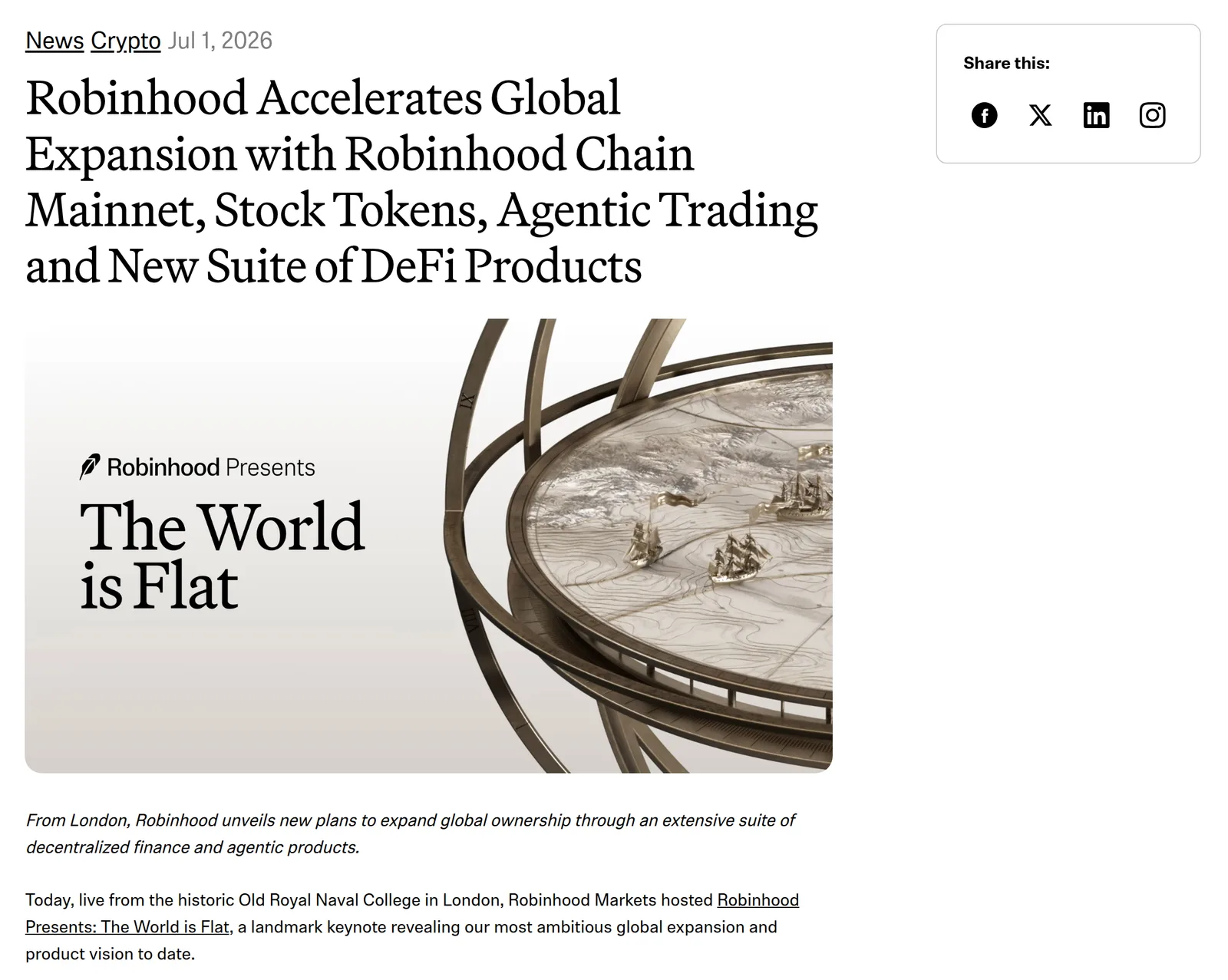
Robinhood’s own announcement, 1 July 2026. The keynote was staged in London.
The flagship product on it is the Stock Token: on-chain exposure to US shares and exchange-traded funds, offered in more than 120 countries and tradable around the clock. Johann Kerbrat, Robinhood’s senior vice-president and general manager for crypto and international, framed the launch this way:
Decentralized finance unlocks possibilities beyond what traditional finance can offer, but historically, it has required technical expertise to navigate. We’re bringing the best of traditional finance and DeFi together, and in doing so, expanding financial ownership to every corner of the globe.
OpenSea added support for the chain on 11 July, which put its tokens and its NFTs in front of the largest marketplace audience in the sector. Six days after that, StonkBrokers minted.
Each broker owns a wallet, and the wallet owns shares
StonkBrokers is 4,444 pixel portraits from Clutch Labs, the studio behind the earlier Clutch Puppies and Pup Cup collections. Holders of those two could burn them for a guaranteed mint. It cost nothing to claim.
The mechanism underneath is ERC-6551, the token bound account standard. An ordinary NFT is a numbered entry in a contract, and it can own nothing. ERC-6551 gives each numbered entry its own smart contract wallet, controlled by whoever currently holds the NFT. Sell the NFT and the wallet goes with it, along with everything in it.
At mint, each of those 4,444 wallets was seeded with Robinhood Stock Tokens. The opening tickers included Tesla, Amazon, Palantir, Netflix and AMD. Microsoft, Costco, Reddit and Meta have since been added to the reward distributions.
So the asset for sale is not a picture. It is a picture that owns a brokerage position, and the position transfers with the picture.
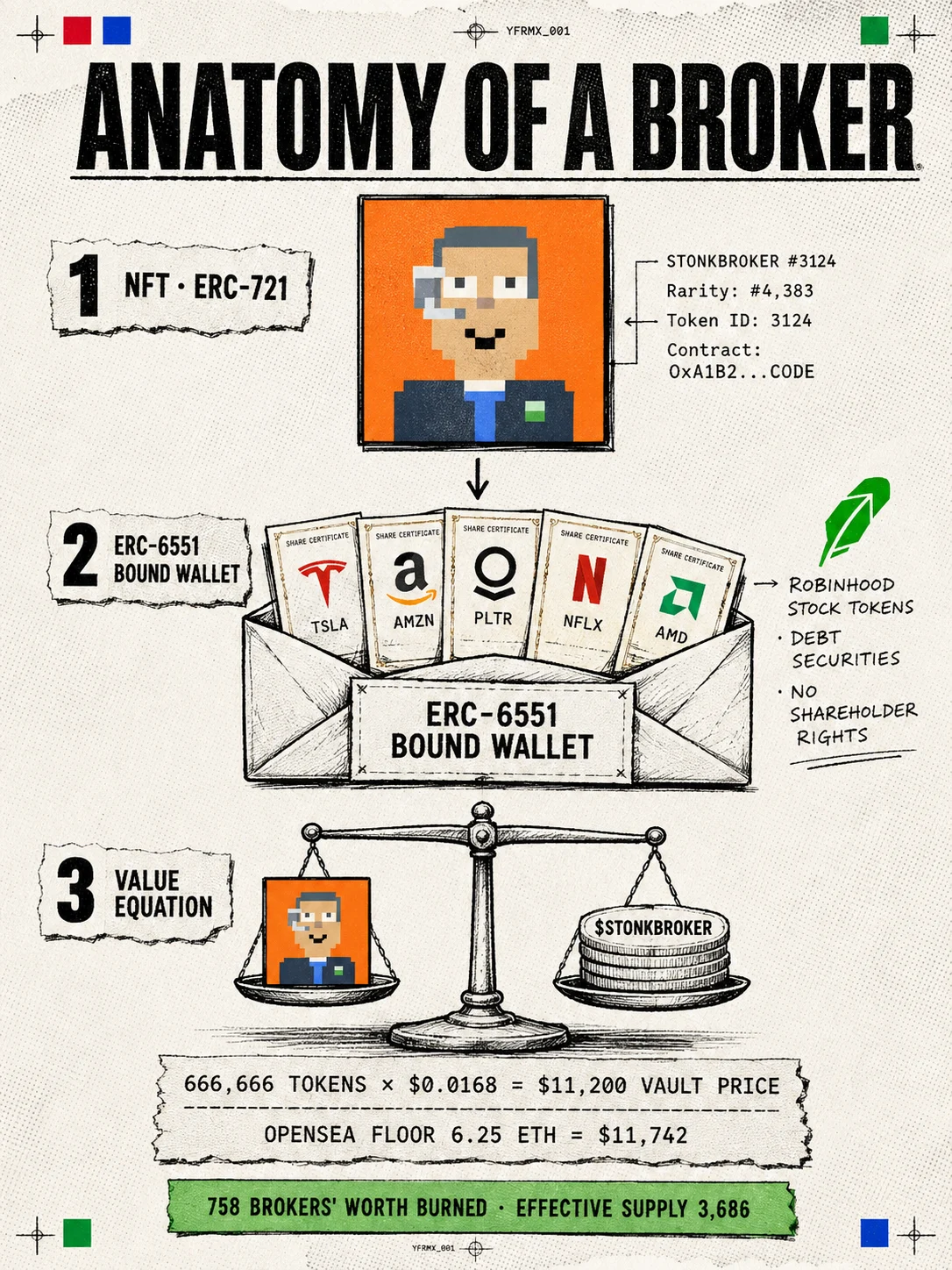
The three layers of a StonkBroker.
The floor price is arithmetic
StonkBrokers trades through Anvil, Clutch’s NFT automated market maker. The protocol’s documentation states the design in one sentence: “each market defines a fixed base exchange ratio (tokensPerNFT) between NFTs and its market token. The AMM quotes buys/sells around that base with fee logic.”
For StonkBrokers that ratio is 666,666 $STONKBROKER per broker, and it does not move. A vault holds an inventory of NFTs and a matching token balance. Pay in the tokens and a broker comes out. Deposit a broker and the tokens come back, “minus swap fees”. Buying at random takes the oldest NFT in the vault under first-in, first-out ordering, and choosing a specific broker costs more.
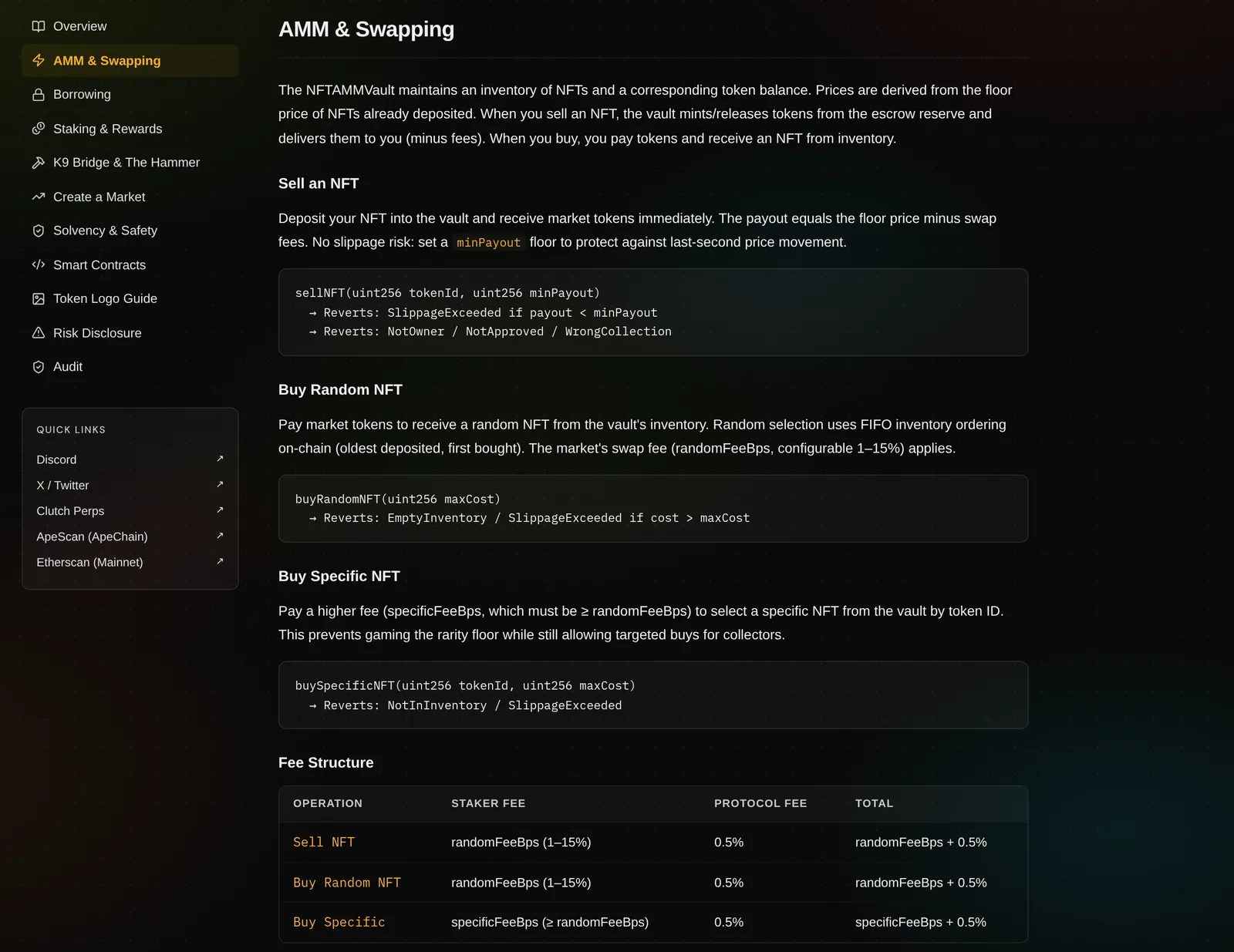
Clutch’s own protocol documentation. The swap fee is configurable between 1% and 15%, plus a flat 0.5% to the protocol.
Two things move the price, and neither is a collector deciding a picture has become more desirable. The first is the token, magnified 666,666 times. The second is supply, and supply only goes one way.
One transaction shows the whole machine
At about half past five on 2 August, someone bought a random broker out of the vault. The receipt reads: 666,666 STONK, worth $10,190, plus a fee of 0.547 ETH, worth $1,021. All in, $11,211 for Broker #312.
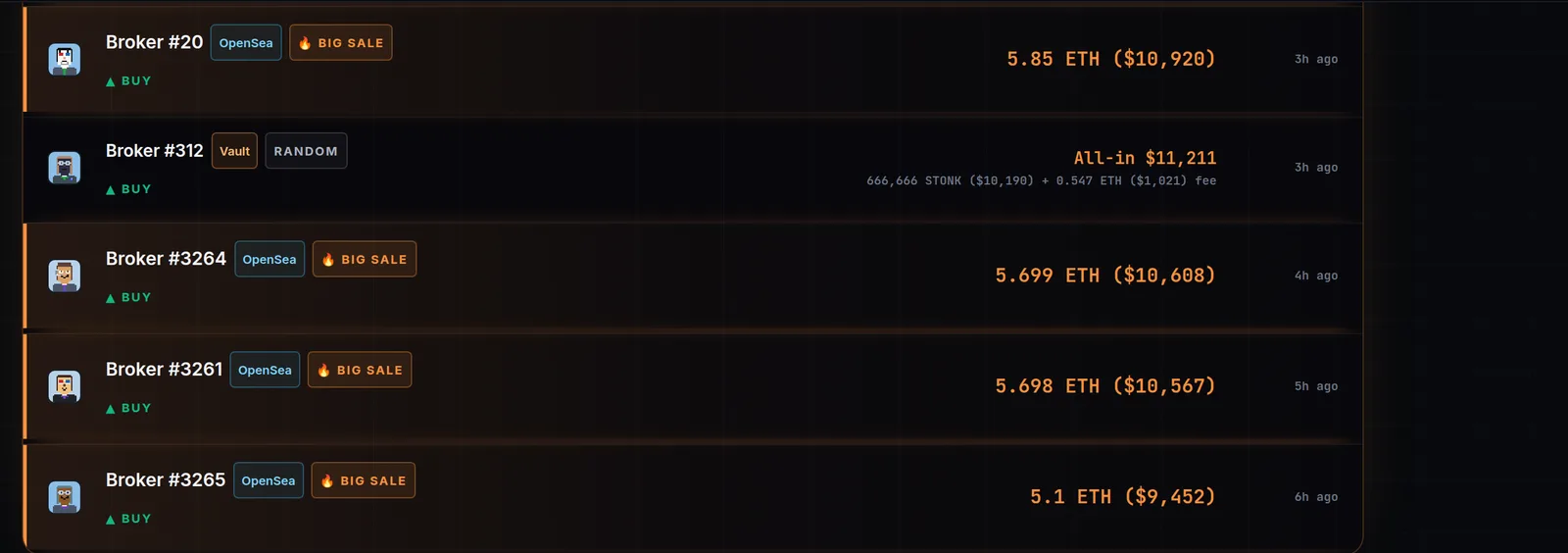
One vault purchase among four marketplace sales, 2 August 2026. The middle line is the formula executing.
In the same few hours either side of it, brokers sold on OpenSea at 5.85, 5.699, 5.698 and 5.1 ETH: between $9,452 and $10,920.
The vault is the ceiling. Anyone can always buy a broker there for the fixed token amount plus the fee, so no marketplace listing can hold above it for long, and the sales clear a little underneath. The two prices are welded together by a ratio that never changes, which is why an OpenSea floor chart for this collection is, in effect, a chart of $STONKBROKER.
The token kept climbing through the evening. At $0.0168, the bare 666,666 tokens came to $11,200 before any fee, against that 6.25 ETH listing of $11,742.
The supply only shrinks
Turning on a broker’s stock rewards costs an activation fee in $STONKBROKER, and half of every fee is destroyed.
The community dashboard tracking the collection measures the destruction in brokers rather than tokens, which is the clearest way to see it: 758 brokers’ worth of token backing burned against 4,444 minted, leaving an effective supply of 3,686. Divide the token’s $41.16m market capitalisation by 3,686 and a broker comes to $11,167, which is the same number from the other direction.
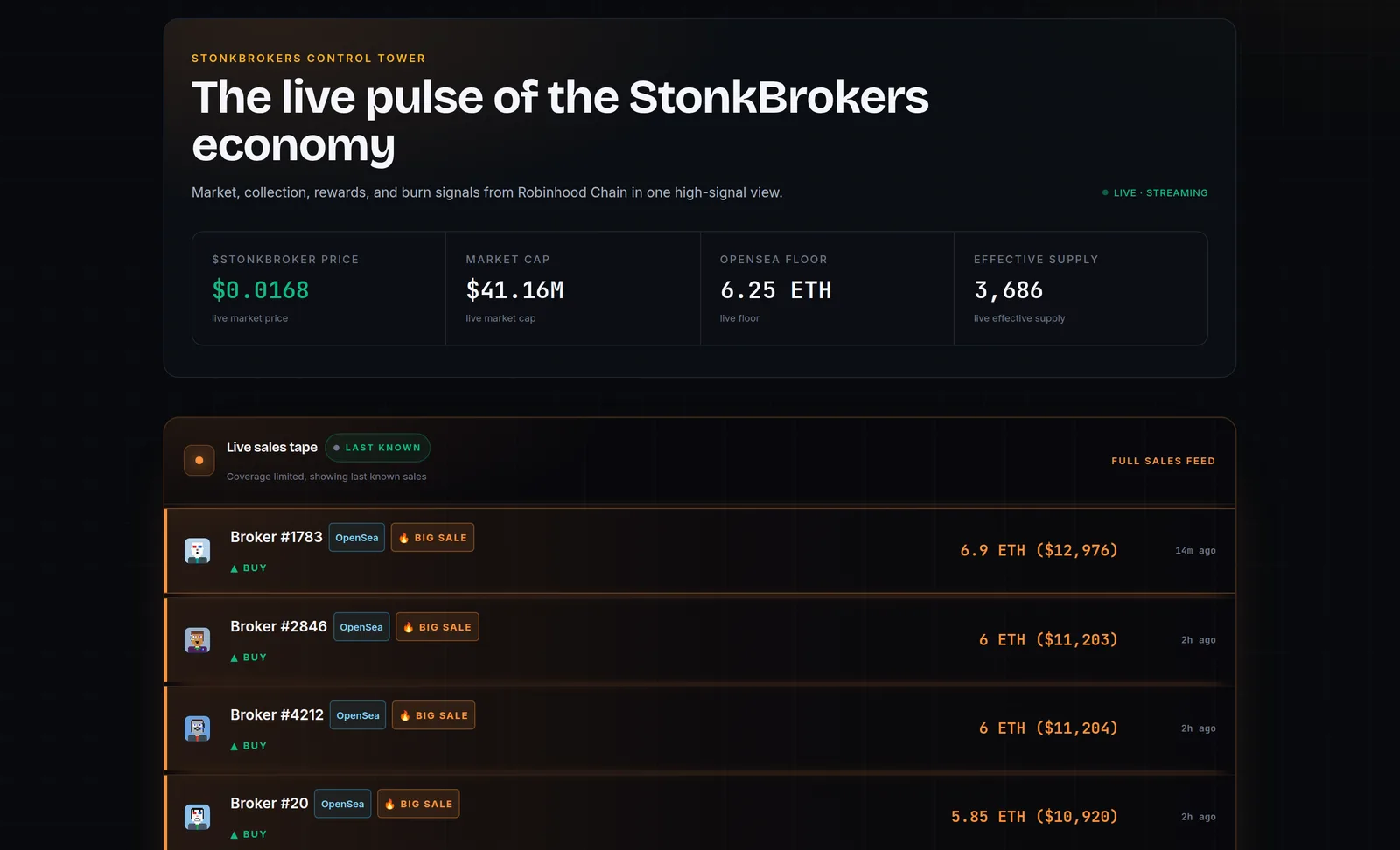
The community StonkScope dashboard. Effective supply of 3,686 is 4,444 minted less 758 brokers’ worth of backing burned.
Every activation therefore raises the price of every remaining broker, without a single buyer arriving. That is the engine, and it runs for exactly as long as people keep paying activation fees.
The mint was free, so a multiple from the mint price has no denominator. CoinGecko’s tracked floor history for the collection begins fourteen days ago at about 1.35 ETH and is up 363.3% since. Anything larger is measured from early secondary sales that no public tracker recorded.
One collection is the market
CoinGecko puts the entire Robinhood Chain NFT market at $54,389,061 of capitalisation and $410,208 of trading over twenty-four hours. StonkBrokers is $52,215,012 and $364,076 of it: 96% of the market cap, 89% of the volume.
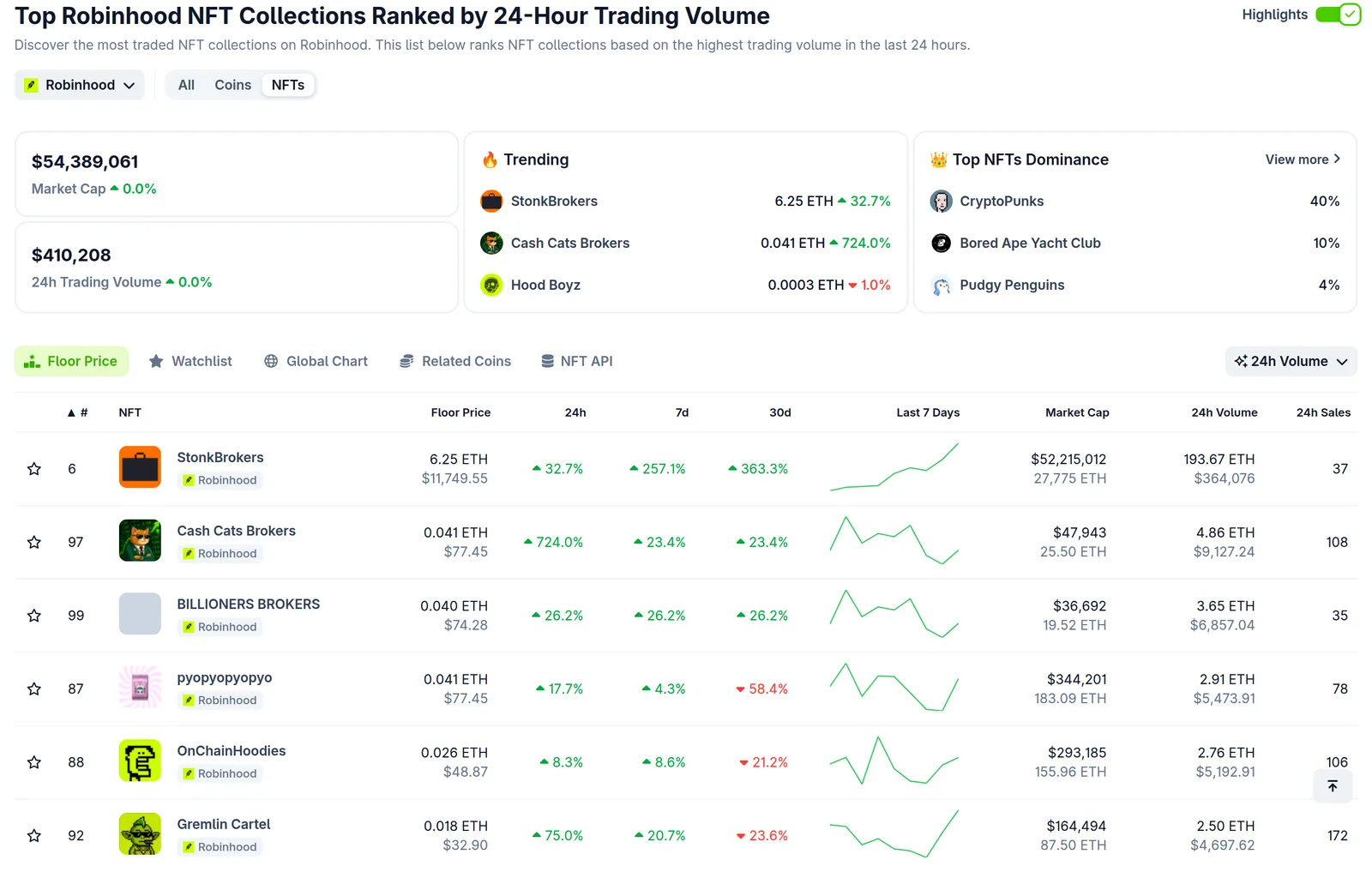
The whole Robinhood Chain NFT market, ranked. Second place has a floor of $77.
The distance between first and second is not a ranking. It is two orders of magnitude on the same page.
Did it flip Pudgy Penguins?
On floor price, yes. Pudgy Penguins traded at 3.90 ETH on 2 August against StonkBrokers’ 6.25.
On everything else, no. Pudgy Penguins carries a market capitalisation of $65.1m against $52.2m, across 8,888 items rather than 4,444, and it is held by 5,203 wallets rather than 561. Pudgy’s owners hold 58.5% of the supply between them. StonkBrokers’ hold 12.6%.
A floor price is the cheapest open listing. It reports what one seller will accept. It reports nothing about how many people own the thing.
What a Stock Token actually is
Robinhood’s documentation is direct about what a Stock Token is. They are “tokenised debt securities issued by Robinhood Assets (Jersey) Limited”, which “provide economic exposure to underlying securities like US shares and ETFs, but do not grant investors any legal or beneficial rights in, or against the issuer of, those underlying securities.”
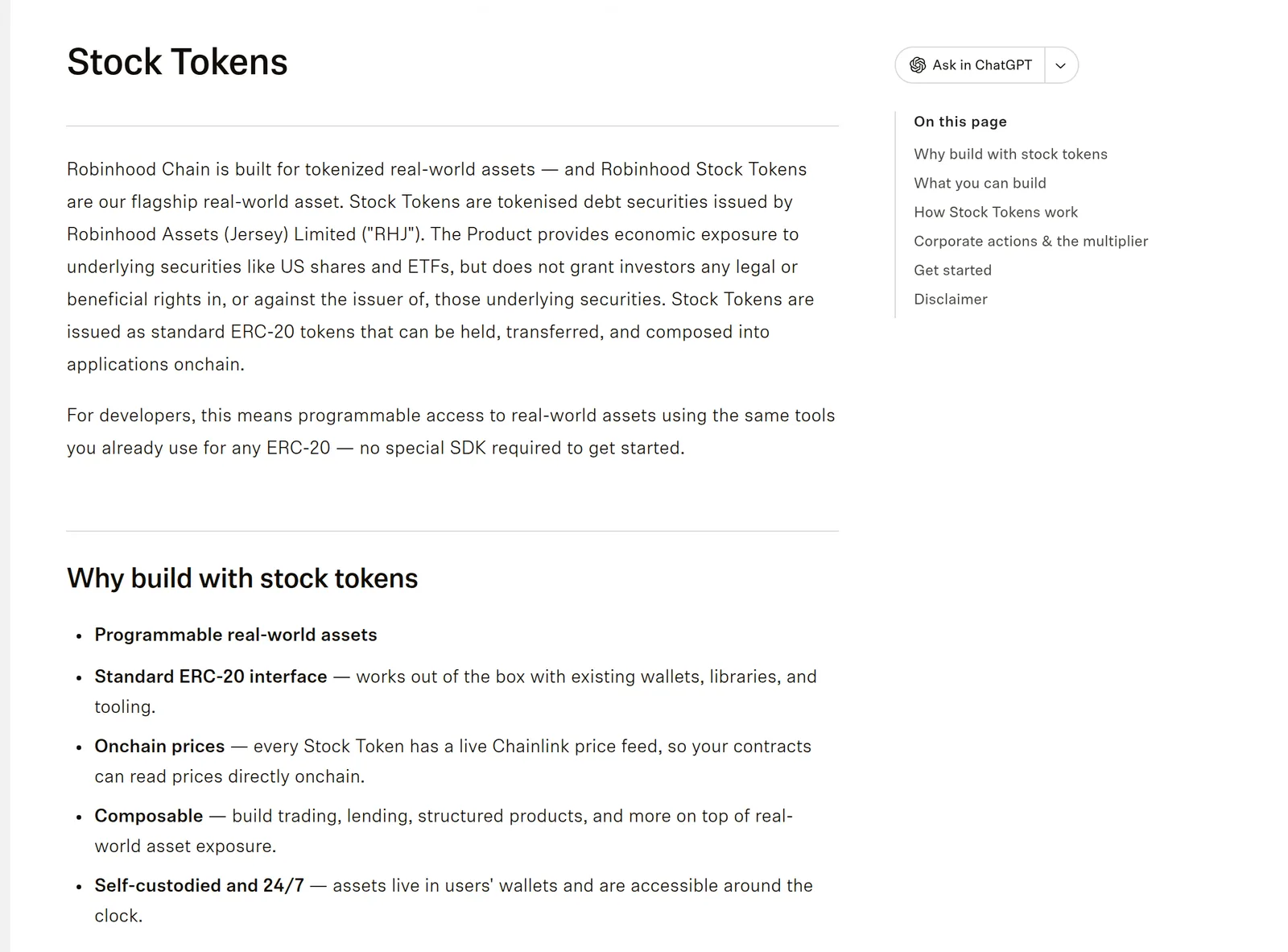
Robinhood’s own developer documentation.
They are also fenced by geography. Robinhood’s terms state that Stock Tokens “may not be offered, sold or delivered within the United States to, or for the account or benefit of U.S. Persons”, with further restrictions covering Canada, the United Kingdom, Switzerland and the UAE.
StonkBrokers restates the fence in its own words. A risk notice blocks the site before a wallet can connect.
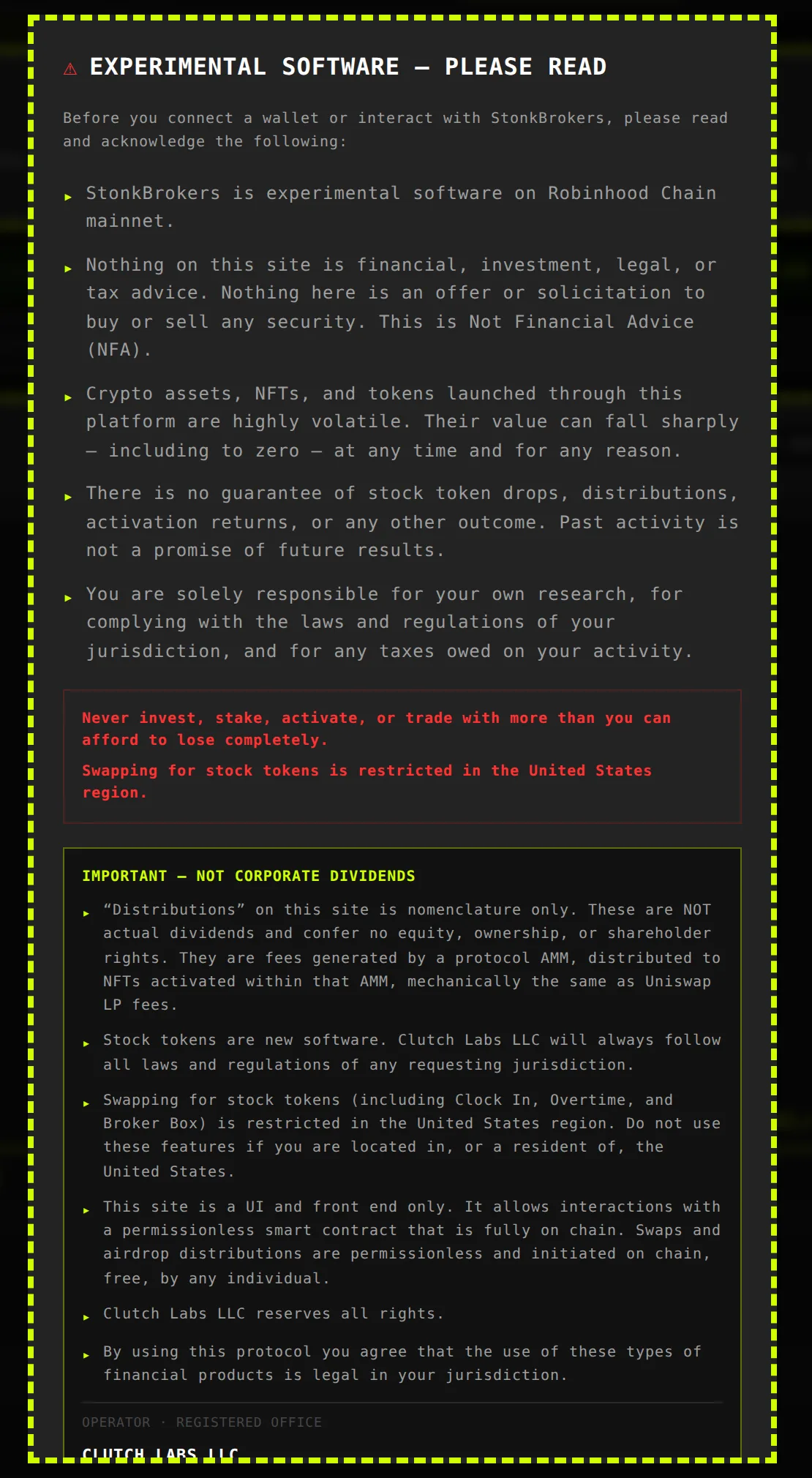
The notice every visitor acknowledges before connecting a wallet.
Three lines in it carry the structure of the whole project. The first is the fence: “Swapping for stock tokens is restricted in the United States region.”
The second is about what a holder is actually paid:
“Distributions” on this site is nomenclature only. These are NOT actual dividends and confer no equity, ownership, or shareholder rights. They are fees generated by a protocol AMM, distributed to NFTs activated within that AMM, mechanically the same as Uniswap LP fees.
A holder is buying trading fees, settled in tokenised shares. Nothing in the arrangement reaches the companies whose tickers appear on the drop.
The third is where responsibility sits. The notice describes the website as “a UI and front end only”, pointing at “a permissionless smart contract that is fully on chain”, and asks the visitor to agree “that the use of these types of financial products is legal in your jurisdiction”. The operator is named as Clutch Labs LLC.
Britain is outside the fence and inside the market
Robinhood offers Stock Tokens in more than 120 countries. Britain is not one of them, and neither are the United States, Canada, Switzerland or the UAE. A reader here cannot buy a Robinhood Stock Token from Robinhood, in a country where Robinhood staged the keynote that launched it.
The NFT is a different object under a different set of rules. It is a standard token on a public chain, listed on the largest NFT marketplace in the world, and anybody holding ETH on Robinhood Chain can bid on one. The wallet bolted to it holds securities its buyer has no route to acquire directly. Robinhood built Stock Tokens as standard ERC-20s so that other people’s contracts could hold them and compose with them, and this is what other people’s contracts did with that.
Britain’s own cryptoasset regime reaches conduct and promotion rather than what a public marketplace lists, and the eligibility question is handed to the user by the risk notice rather than answered by it. No UK regulator has published anything on this structure.
The public record stops at the wallet count
561 wallets hold the 4,444 brokers; how many of those wallets share an owner is undisclosed by the project and cannot be resolved from any public tracker. The total value of Stock Tokens sitting across the bound wallets is likewise unpublished, by the project’s dashboard and by every market tracker, so how much of an $11,000 broker is backed by shares, and how much by the 666,666 ratio, cannot be read off a public figure. Robinhood itself has made no public statement about StonkBrokers in either direction: the collection uses Robinhood’s chain and Robinhood’s securities product, and stands separately from Robinhood.
The formula runs both ways
A price fixed at 666,666 tokens per broker rises when the token rises and falls when the token falls, without anybody deciding a broker has become worth less. $STONKBROKER is sixteen days old, and its price is what holds up a $52m collection and, through the bound wallets, whatever tokenised Tesla is parked inside it.
The burn tightens supply for as long as activation fees keep being paid. On the day they stop, the ratio is still the ratio, and the only thing left holding the number up is the token.
Sources
- Robinhood, Robinhood Chain mainnet announcement (1 July 2026)robinhood.com
- Robinhood Chain documentation, Stock Tokensdocs.robinhood.com
- OpenSea, Robinhood Chain is live on OpenSeaopensea.io
- OpenSea, Robinhood Chain collectionsopensea.io
- StonkBrokers, official site and risk noticestonkbrokers.cash
- Clutch.AMM protocol documentationanvil.clutch.market
- StonkScope, community StonkBrokers dashboardstonkscope.founderfi.xyz
- CoinGecko, StonkBrokers NFT floor and volumecoingecko.com
- CoinGecko, Robinhood Chain NFT collections by volumecoingecko.com
- CoinGecko, Pudgy Penguins NFTcoingecko.com