Coldcard's seeds have been short of randomness since 2021, and 1,800 bitcoin have gone
A build flag set to zero in March 2021 replaced Coldcard's hardware random number generator with a software fallback. Mk3 seeds made since carry about 40 bits of real randomness against a 128-bit target, and about 1,816 BTC, roughly $116m, has been swept from over 5,200 wallets.
Listen to this articleListen
The theft now stands near 1,816 BTC, about $116m, across more than 5,200 addresses. TRM Labs published its own flow-of-funds analysis on 5 August, mapping at least four waves of sweeps between 30 July and 4 August, with the first wave alone taking about 594 BTC in 25 minutes. That makes this the largest hardware-wallet exploit of 2026 by TRM’s accounting, and its figures are preliminary: funds were still moving as it wrote. TRM also notes the transaction construction differs between waves, so there may be more than one attacker working from the same weakness.
The money has started to move at the edges. TRM reports 64.9 BTC deposited into the Wasabi coinjoin wallet and 200 ETH sent through Tornado Cash on 4 August. The addresses tracked in this article are not part of that: read directly off the chain this morning, bc1qq85v2c9...s3fcu9r still shows the 562.02 BTC that arrived on 30 July and zero outgoing transactions, and the consolidator behind it still holds its 32.45 BTC.
Coinkite has answered in deeds rather than words. On 1 August it updated both advisories with the full fixed-firmware list, adding Edge builds (6.6.0X and 6.6.0QX) beside the 4.2.0, 5.6.0 and 1.5.0Q releases, and confirmed the patch protects newly generated seeds only. On 2 August it said it had destroyed its remaining stock manufactured with vulnerable firmware and halted shipments, and told affected users to keep their devices, which “may become essential if funds are recovered”. On 4 August it opened a permanent disclosure record on its site, locating the bug “at a boundary between two unrelated submodules”, and noted that AI-assisted code review, tried before and after the incident, failed to catch it. TAPSIGNER, OPENDIME and SATSCARD are unaffected. There is still no attribution and no recovery.
The theft is much larger than this piece first reported. Galaxy Research has mapped the flow of funds and finds that the sweep of 30 July took 1,082.65 BTC from 1,196 addresses, running from 01:10:20 to 01:51:26 UTC, blocks 960,183 to 960,191. The 594.47723261 BTC and 501 outputs described below are one consolidating address inside that, not the whole of it. We have checked those block heights and timestamps against the chain and they match exactly.
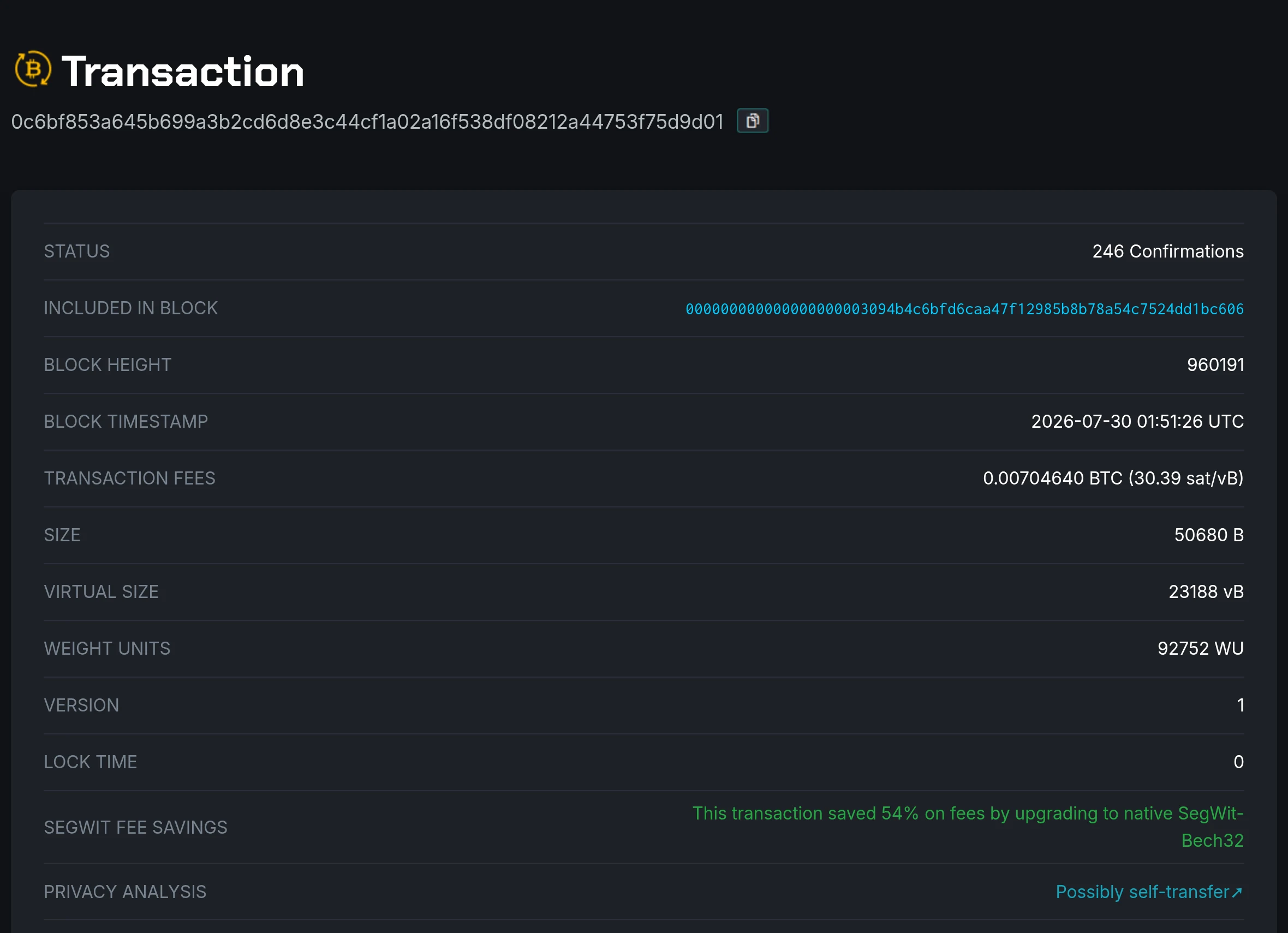
Galaxy’s fingerprint for the attack holds up too. It reports that every sweep paid an identical hardcoded fee of about 30 sat/vB, against a median of 0.4 to 1.0 that week. Each sweep into the address tracked here paid a flat 3,300 satoshis on a transaction of roughly 110 virtual bytes, which is 30.1 sat/vB.
Galaxy has since reported two further waves. Its running total is 1,367.05 BTC across 4,585 addresses, worth about $86m at this morning’s price of $63,111. It also says a review of every bitcoin transaction over the past thirty days found no other transactions matching the pattern.
None of it has been spent. The address holding the largest share, bc1qq85v2c9...s3fcu9r, shows the 562.01962301 BTC that arrived in the sweep and zero outgoing transactions as of 10:41 UTC today. A further 32.45056320 BTC sits untouched in the consolidator it came from. The only new activity is eleven dust payments of between 300 and 42,069 satoshis, the ordinary spam that lands on any famous address. Coinkite has published nothing since its two posts of 30 July.
A hardware wallet has one job that nothing else can do for it. It has to pick a number no one else can guess, and it has to do that inside a sealed device you are supposed to be able to distrust the rest of the world about. Coldcard, made by Toronto’s Coinkite, was one of the most respected devices in bitcoin for exactly that reason.
From March 2021, on the Mk3, it was picking that number with the wrong machine.
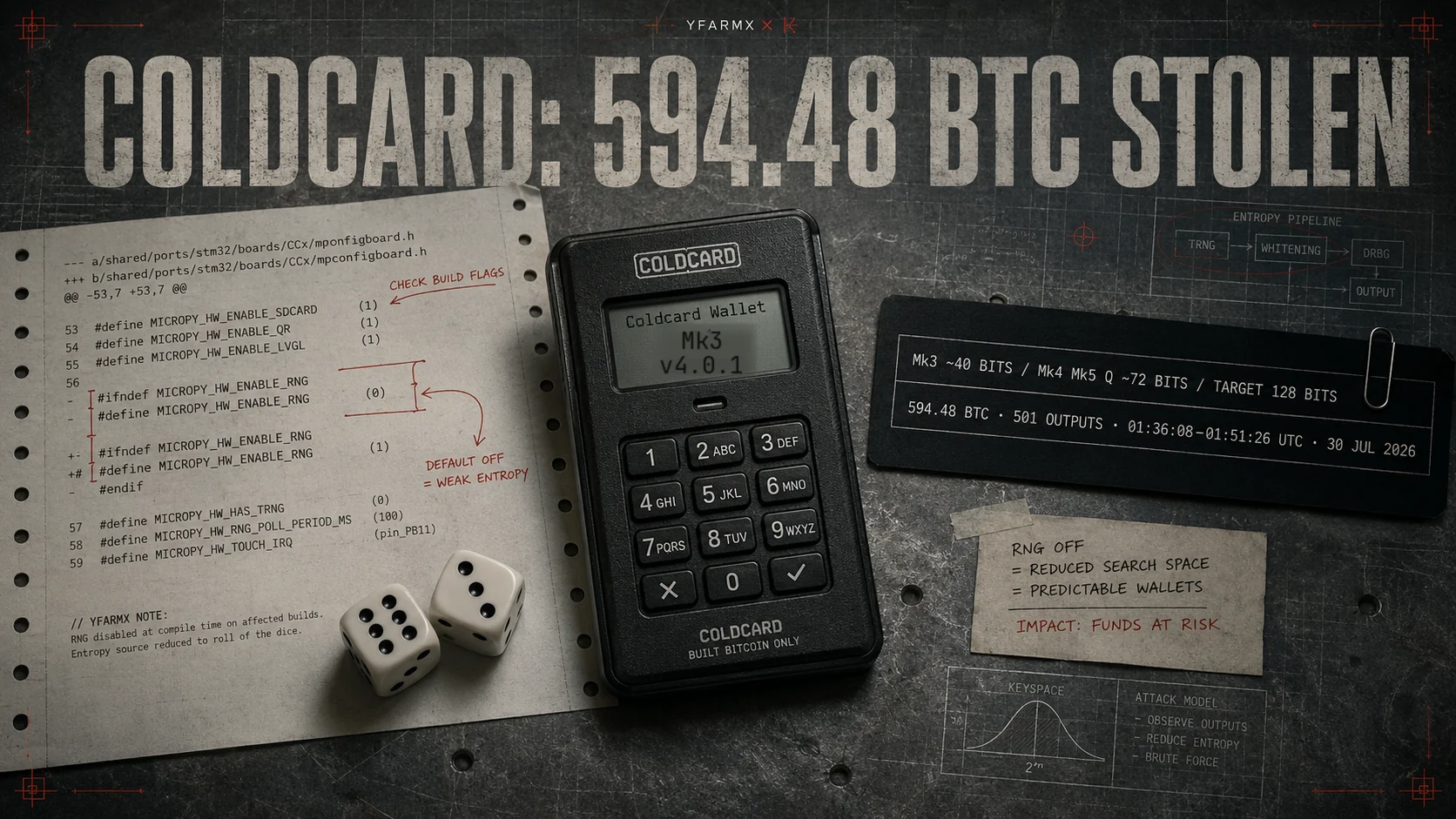
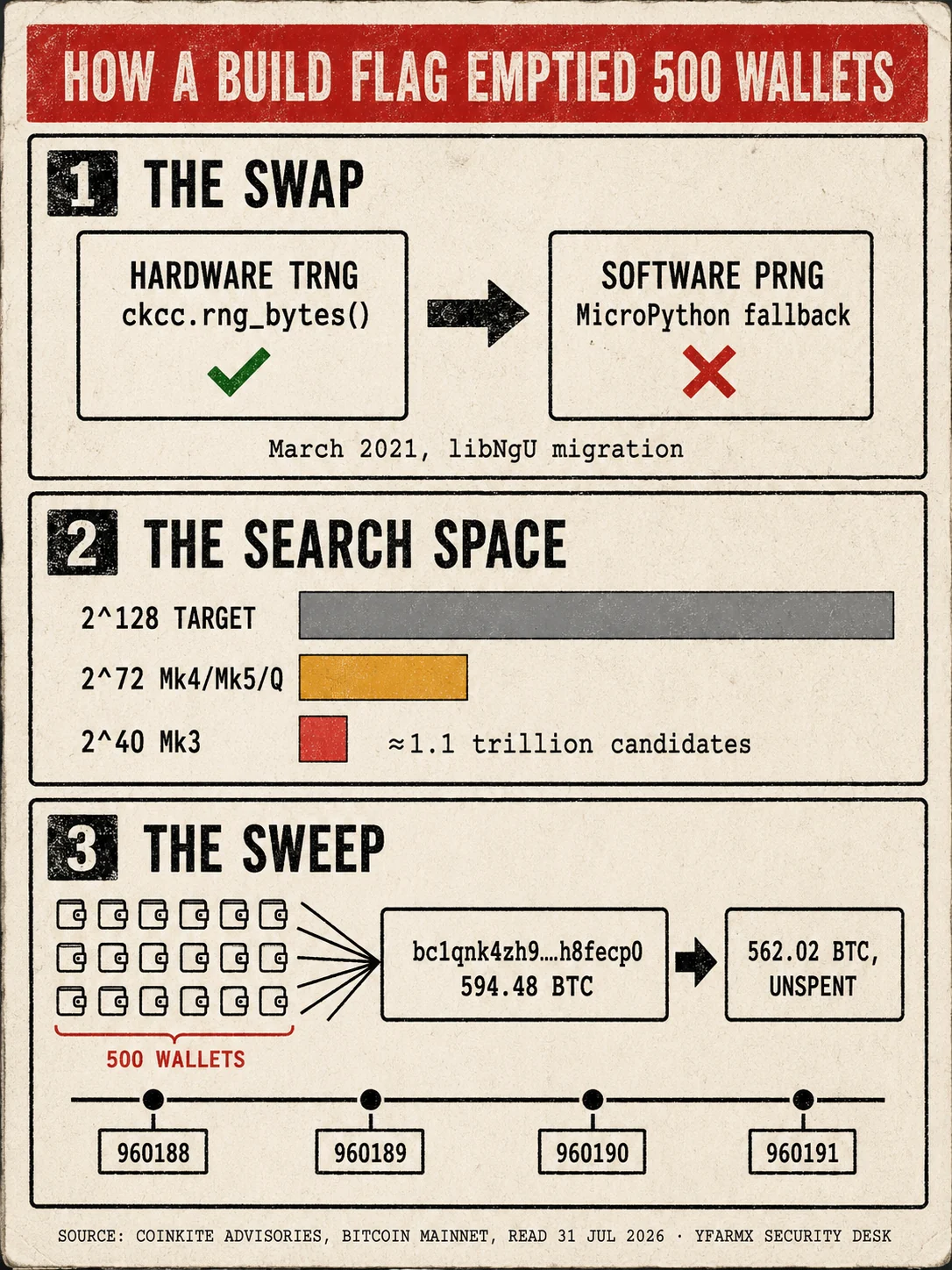
Coinkite published two posts on 30 July describing what went wrong. During a migration to a library called libNgU, seed generation moved from ckcc.rng_bytes() to ngu.random.bytes(). The new call, in Coinkite’s own words, “resolved rng_get() to MicroPython’s software fallback instead of COLDCARD’s hardware RNG implementation”. The device carried on reporting that it had made a seed. It had. The seed was drawn from a software pseudo-random generator rather than the true random number generator on the board.
The reason it went unnoticed for five years is one line of C.
#ifndef MICROPY_HW_ENABLE_RNG
  #error "hardware RNG required"
#endif
That guard asks whether the macro is defined, not whether it is on. The developers set it to 0. Zero is a definition, so the guard was satisfied, and per Coinkite “the #error did not stop the build”. The safety check written specifically to prevent this shipped the thing it was written to prevent.
Forty bits
The number that determines whether this is an inconvenience or a catastrophe is how much genuine randomness survived.
Coinkite puts the Mk3 “effective search space at about 40 bits”. For Mk4, Mk5 and Q it puts it at “about 72 bits”, because those boards mix entropy from their SE1 and SE2 secure elements into the generator’s state. The target, and what every buyer believed they had, was 128.
Those three numbers are not points on a line. 2^40 is about 1.1 trillion candidate seeds, which is a search an ordinary machine can finish. 2^72 is about 4.7 billion times larger, and remains out of reach. 2^128 is not a number anyone will ever search.
So the Mk3 sits on the wrong side of a threshold that the Mk4, Mk5 and Q sit on the right side of, by luck rather than by design, and only because two chips that were there for another purpose happened to stir the pot.
Fifteen minutes and eighteen seconds
Between 01:36:08 and 01:51:26 UTC on Thursday 30 July, 500 bitcoin wallets were swept into a single address.
Read directly off the chain this morning, bc1qnk4zh9qcnap2mycp56qjrgza3cc8ylrh8fecp0 has received 594.47723261 BTC across 501 outputs. Bitcoin traded between $63,866 and $64,238 through that window on Coinbase, so about $38m moved while it was moving.
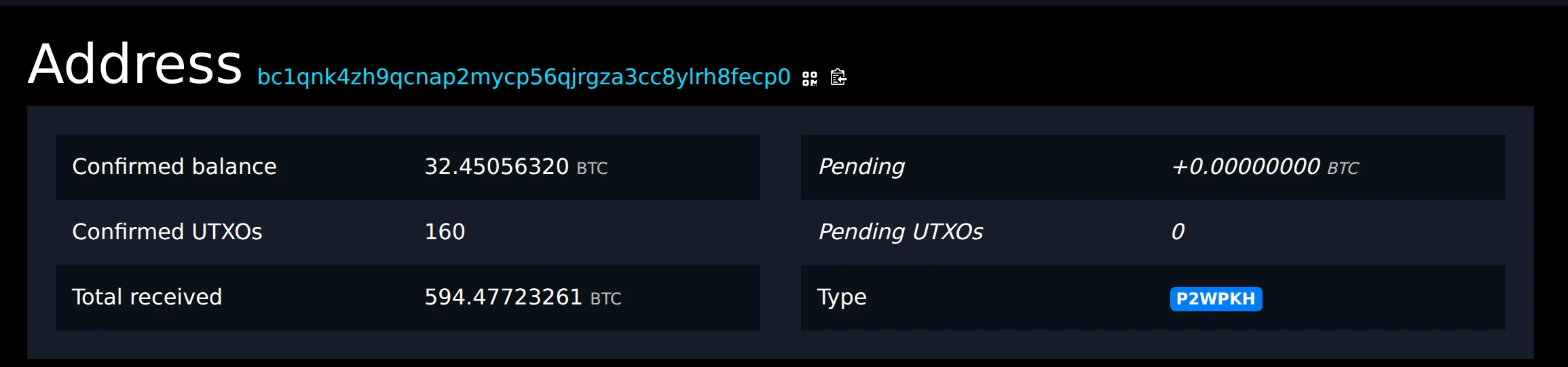
The sweeps landed in four consecutive blocks: 63 in block 960188, 110 in 960189, 168 in 960190 and 159 in 960191. The median wallet gave up 0.40876419 BTC. The largest gave up 29.89245121 BTC, close to $1.9m from one person. Only seven of the 501 held less than 0.15 BTC, which tells you the attacker was not sweeping everything they could reach, or was working from a list where small balances had already been filtered out.
Then, in block 960191, in the same block as the last of the sweeps, one transaction with 341 inputs and a single output moved 562.01962301 BTC onward for a fee of 704,640 satoshis. Fifteen minutes from the first sweep to consolidation.
That money has not moved since. It sits at bc1qq85v2c926eg6pgxhwp6q7lf6cnsz80qs3fcu9r, untouched, in full public view. The original address still holds the 32.45056320 BTC that arrived after the sweep transaction was already built. Onlookers have started sending dust to both addresses, including an unconfirmed 42,069 satoshis, which is the on-chain equivalent of a crowd gathering.
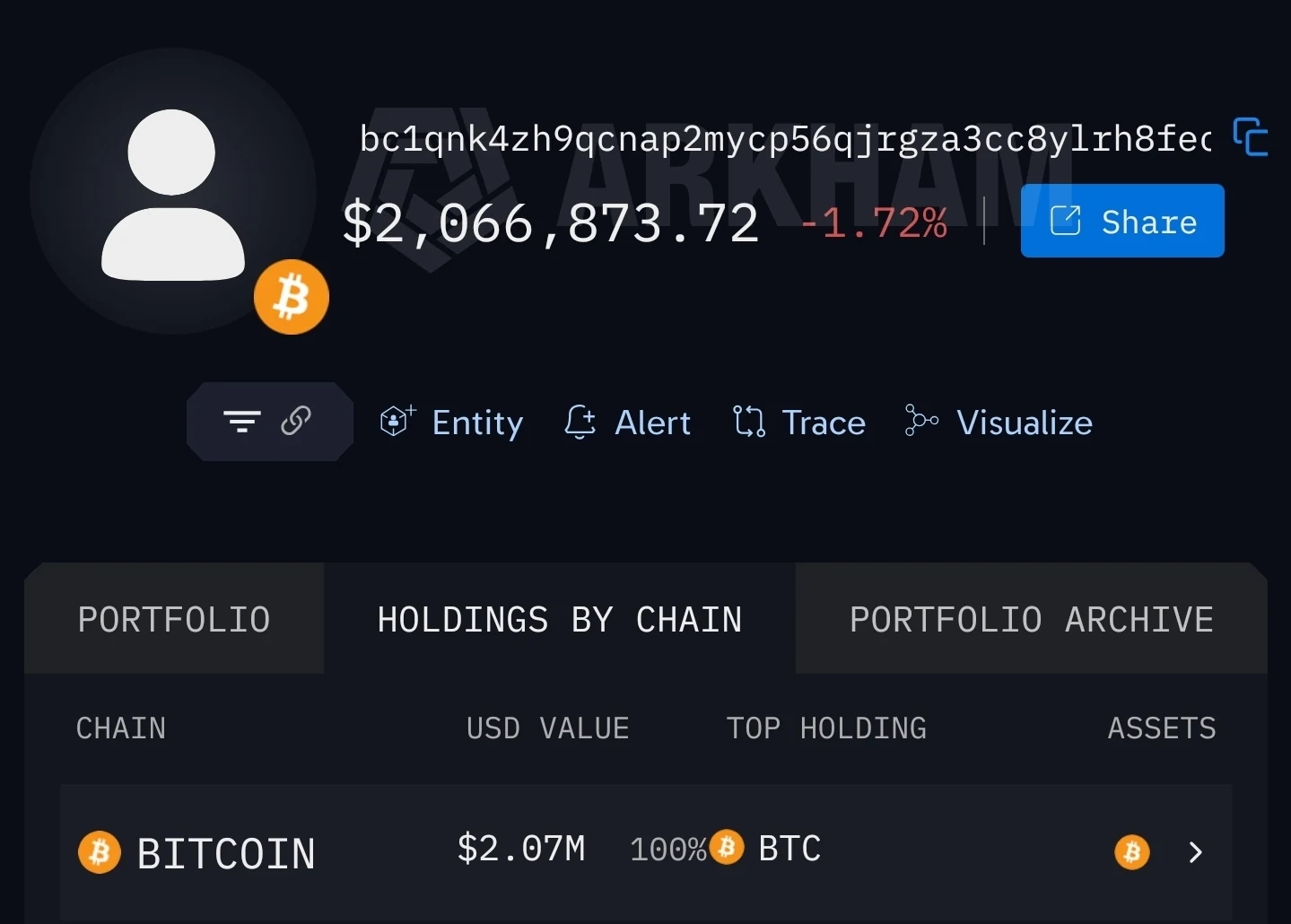
Nothing about this looks like laundering yet. Compare the Ostium attacker, who had 10,540 ETH inside Tornado Cash within days of taking $23.75m out of a liquidity vault. Whoever holds this bitcoin is sitting still with it.
What Coinkite has said
The advisory is careful. It says affected users’ “funds may be at risk”. It does not claim any theft has happened, and it does not connect itself to Thursday morning.
That reticence is defensible. Nobody has publicly demonstrated that the swept wallets were Coldcard wallets, and a correlation this strong is still a correlation.
The document’s own shape is worth reading, though. It is titled “Mk3 Security Advisory”, and its body says “seeds generated on Mk4, Q and Mk5 before the fixed firmware releases are also affected, with about 72 bits of entropy rather than the expected 128 bits”. The title names one discontinued model. The text covers the entire current range.
It also carries a timestamped amendment: “Updated July 31, 2026 at 9:33 a.m. EDT: Fixed firmware is now available. Mk4 and Mk5 users must update to version 5.6.0 or later. Q users must update to version 1.5.0Q or later. For Mk3, update to version 4.2.0 or later.” The warning went out on Thursday. The firmware that fixes it landed on Friday morning, roughly thirty hours later.
Who this reaches
Coinkite says “the issue is present on every Mk3 firmware version since 4.0.1”, which shipped in March 2021. Every Mk3 seed generated on the device since then is suspect. Mk4 and Mk5 seeds made before 5.6.0, and Q seeds made before 1.5.0Q, carry the weaker 72-bit version. Fixed builds now exist for all four: 4.2.0 for Mk3, 5.6.0 for Mk4 and Mk5, 1.5.0Q for Q.
There is one exemption, and it is the reason the dice feature exists. If you added your own dice rolls when you made the seed, your entropy came from the dice rather than from the broken generator. Coinkite’s wording: “If you entered at least 50 fair and independent rolls, and the rolls were not recorded or exposed, we do not consider the resulting seed at risk.”
The remediation is the unwelcome part. Updating the firmware fixes the generator for seeds you make in future. It cannot repair a seed that already exists, because the seed is already written down and already weak. Anyone affected has to generate a fresh seed on fixed firmware and move every coin to it, which means new backups, new descriptors, new everything, and an on-chain transaction for each wallet.
The part that should worry people who do not own a Coldcard
Coldcard is open source. The firmware is published, the builds are reproducible, and the device is scrutinised harder than almost anything in bitcoin. None of that caught this, because there was nothing to catch by reading the code: the code said #error and it looked correct. What failed was a build-time assumption about a macro, in a place where nobody thinks to look and no test could see the difference. A seed from a weak generator is a perfectly well-formed seed. It passes every check. It just happens to be guessable.
Randomness is the one property in this stack that cannot be verified after the fact by looking at the output. You can test a signature, you can test a derivation path, you can test a backup restores. You cannot test that a number was hard to guess, which is why the guard existed, and why the guard failing silently is worse than it never having been written.
Anyone holding bitcoin on a device whose entropy they cannot personally attest to has the same weekend job as everyone else: check the model, check the firmware version, check whether you rolled dice, and if in doubt, move.
Sources
- Coinkite, "Mk3 Security Advisory" (30 July 2026, updated 31 July)blog.coinkite.com
- Coinkite, "Technical Deep Dive into the Entropy Issue" (30 July 2026)blog.coinkite.com
- mempool.space, the consolidating address bc1qnk4zh9...h8fecp0mempool.space
- mempool.space, the 341-input onward transactionmempool.space
- mempool.space, the address now holding 562 BTCmempool.space
- Galaxy Research, flow-of-funds mapping for the Coldcard sweep (1 August 2026)x.com
- Galaxy Research, review of every bitcoin transaction over 30 days for the same patternx.com
- Coinbase Exchange, BTC-USD five-minute candles for 30 July 2026api.exchange.coinbase.com
- TRM Labs, inside the $116m Coldcard hack (5 August 2026)trmlabs.com
- Coinkite, update of Sunday 2 August 2026blog.coinkite.com
- Coinkite, "Adding to the Public Record on Our Ongoing Investigation" (4 August 2026)blog.coinkite.com