Gemini Robotics 2 takes a humanoid from feet to fingertips
Google DeepMind's new robot models control a full humanoid rather than its upper body, run three different machines from one checkpoint, and let two robots divide a job between them. The company's own results say fine multi-finger work is still the hard part.
Listen to this articleListen
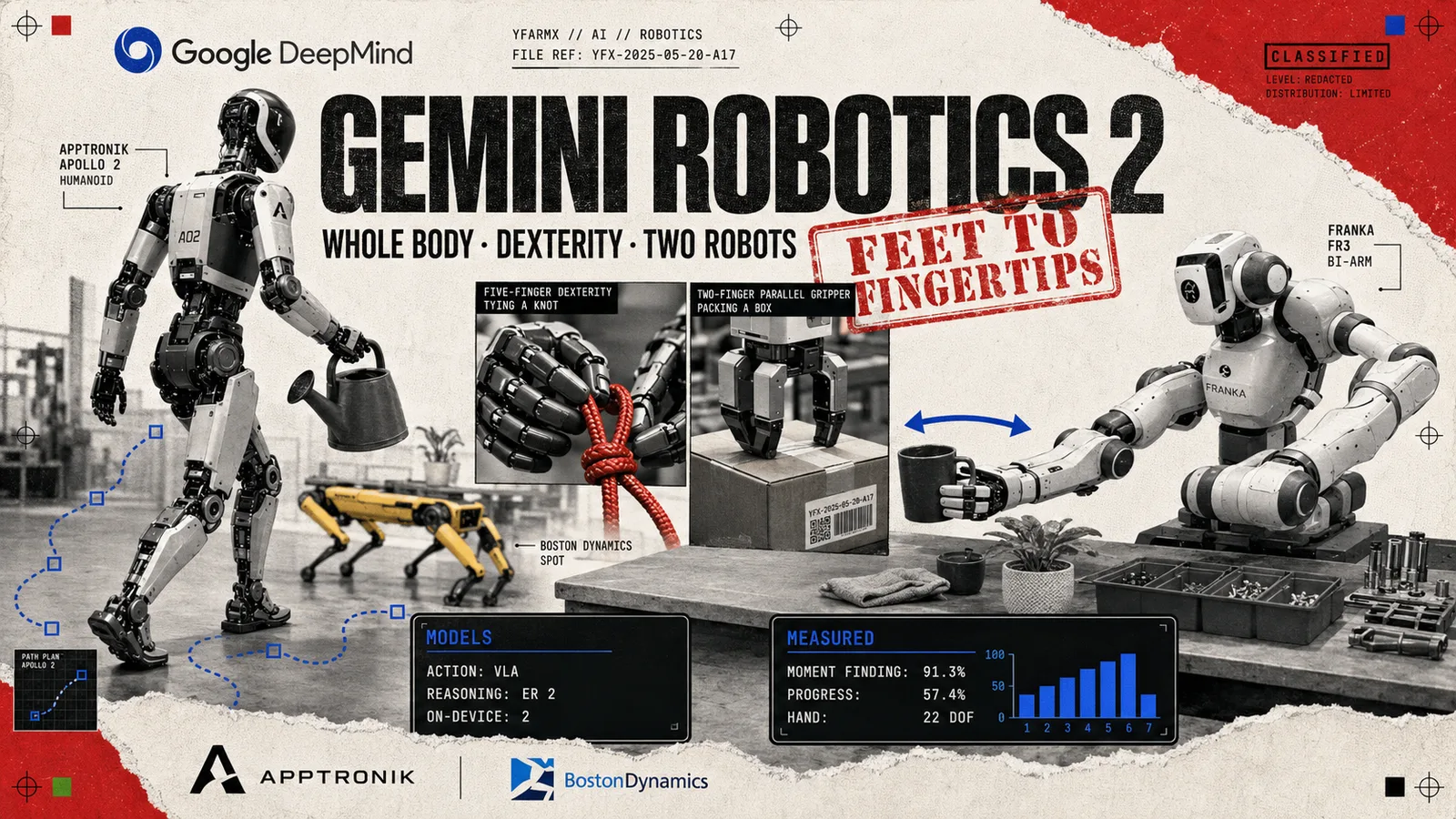
Google DeepMind’s previous robot models moved arms. The one it published on 30 July moves the whole machine. Gemini Robotics 2 controls a full humanoid, walking, crouching and reaching included, and the company demonstrated it on Apptronik’s Apollo 2 carrying a watering can across a room to a bottom shelf.
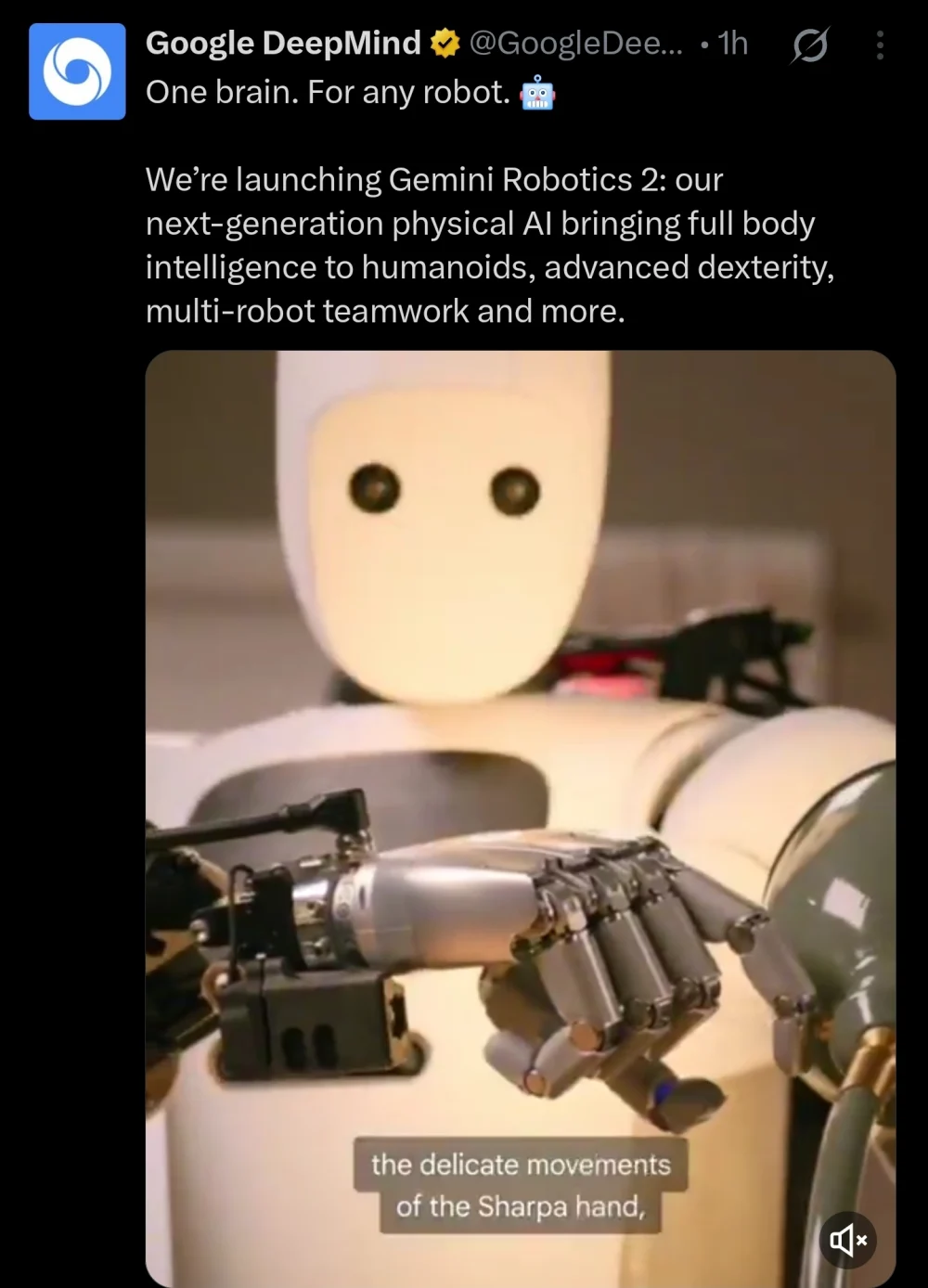
DeepMind’s own framing on the day: one brain, for any robot. The claim to test is the second half of that sentence.
The release is three models rather than one. Gemini Robotics 2 is the vision-language-action model that turns what the robot sees and is told into motor commands. Gemini Robotics ER 2 is the embodied reasoning model that sits above it, holding the conversation with the person, planning the steps and calling the action model as a tool. Gemini Robotics On-Device 2 is the compact version built to run on the robot itself, for jobs where waiting on a network is not an option.
| Model | What it does | Who can use it |
|---|---|---|
| Gemini Robotics 2 | Vision-language-action: turns what the robot sees and is told into motor commands | Early-access partners |
| Gemini Robotics ER 2 | Embodied reasoning: plans the steps, tracks progress, calls the action model | Public, via the Gemini API and AI Studio |
| Gemini Robotics On-Device 2 | The compact version, running on the robot with no network | Early-access partners |
One model, three bodies
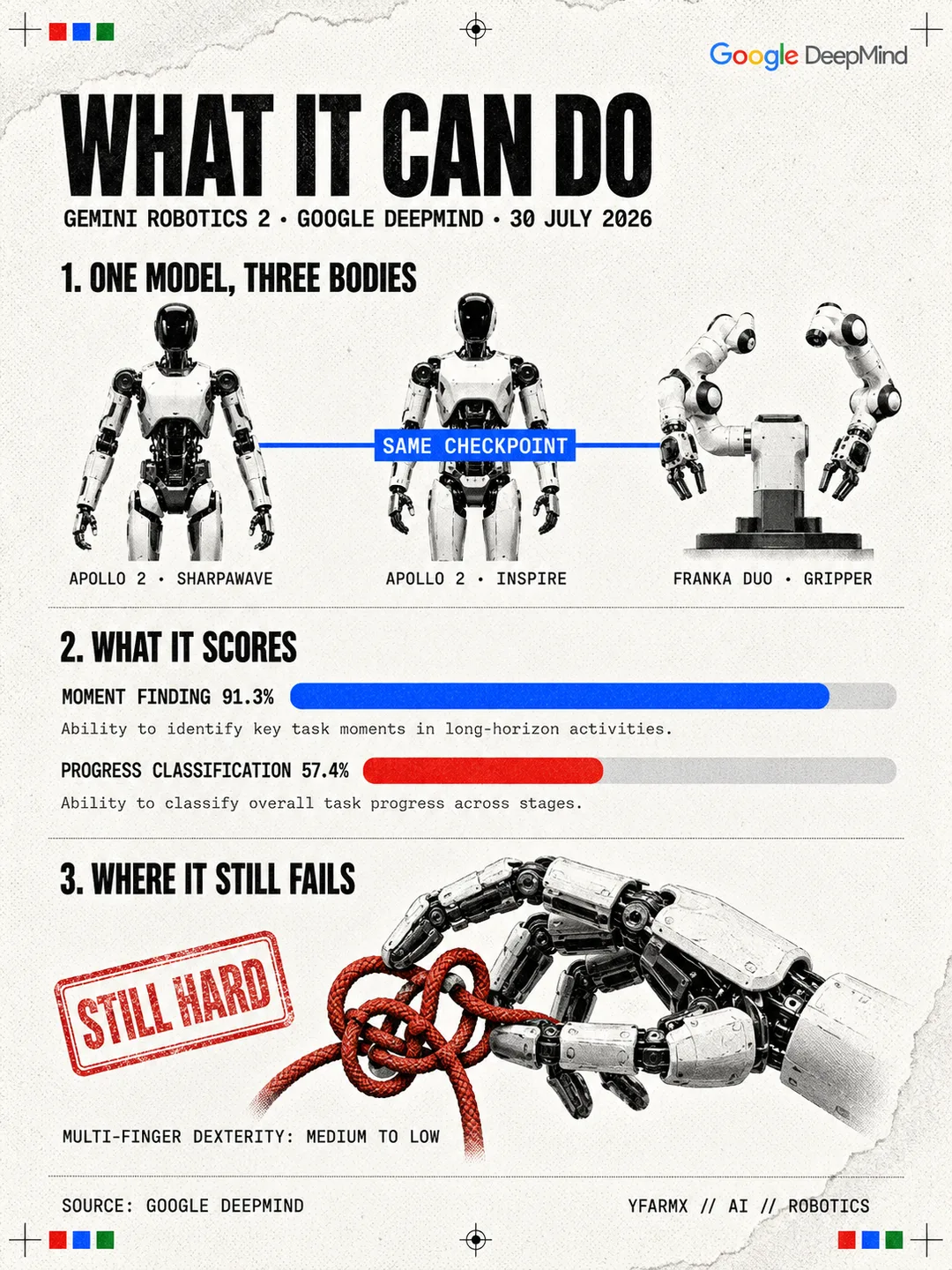
The claim worth examining is the one about transfer. DeepMind ran the same model checkpoint on three different machines: Apollo 2 fitted with SharpaWave hands, Apollo 2 fitted with Inspire hands, and a Franka Duo using a Robotiq gripper. Not three models trained per robot, one checkpoint across three sets of hardware.
Robotics has been stuck on this for years. A policy trained on one arm has historically been close to worthless on another, because the joints, the reach and the feedback all differ, so every new robot has meant collecting a new dataset and starting again. The on-device model pushes the same idea further: DeepMind says it adapts to a new bi-arm robot in a few hours, typically on fewer than 200 examples, across bodies with different shapes, sensors and degrees of freedom, naming the Dexmate, SO101 and Trossen platforms.
Not three models trained per robot. One checkpoint, three sets of hardware.
Where the results thin out
DeepMind’s own chart caption is the most useful sentence in the announcement. Whole-body tasks and gripper-based dexterous tasks reach what it calls a medium to high success rate. Multi-finger dexterous manipulation, in its words, remains challenging.
That is the honest shape of the field. The SharpaWave hand on Apollo 2 has five fingers and 22 degrees of freedom, and the demonstrations include tying a knot and sealing a ziplock bag, which are genuinely hard. But a two-fingered gripper doing tight packing is a solved-enough problem to report as a success rate, and a 22-joint hand doing fine work is not, and the company has published a chart that says so rather than a video that hides it.
The reasoning model is the part you can use today
Gemini Robotics ER 2 is available now through the Gemini API and Google AI Studio, with private preview on the Gemini Enterprise Agent Platform. The action models stay with early-access partners. So the piece a developer can build on is the brain, not the muscles.
What that brain does has been sharpened around time rather than space. Two capabilities carry the release. Progress classification sorts each frame of a live video feed into how far through a task the robot is, scored in five bands, where DeepMind reports 57.4 per cent accuracy. Moment finding identifies the exact frame where a critical event happens, the point where the cup is full and pouring should stop, where it reports 91.3 per cent accuracy with a mean absolute distance of 0.96 seconds, at four times the execution speed of larger models.
Knowing when a task is finished sounds like a small thing next to knowing how to do it. It is the difference between a robot that completes a sequence and one that stands over a full cup continuing to pour.
The model streams video, audio and text, calls tools including Google Search and any function a developer defines, and runs through the Gemini Live API’s bidirectional streaming endpoint so that it can think about the next step while the current one is still being carried out. DeepMind’s demonstration of the orchestration idea uses Boston Dynamics’ Spot, with ER 2 calling Spot’s own navigation and manipulator APIs to fetch a snack, and the example code is on GitHub.
Two robots, one job
The other new capability is collaboration. Different machines suit different parts of a task, a wheeled base indoors and legs on rough ground, and ER 2 now lets robots share a semantic understanding of the job so they can hand work between them. DeepMind shows Apollo 2 and a Franka F3 Duo splitting a single workflow.
Multi-robot coordination has usually meant a central scheduler assigning steps to machines that cannot describe what they are doing. Two robots reasoning about the same task in the same language is a different arrangement, and it is the one a warehouse full of mixed hardware would need.
Safety arrives as a benchmark
The safety work in this release is specific enough to check. DeepMind introduces ASIMOV-Agentic, a benchmark for the orchestration layer rather than the motion: whether the reasoning model refuses an unsafe tool call from the action model, whether it can predict that a task is not physically possible, and whether it asks a human for help when uncertain. Alongside it, the company reports gains on safety instruction following and human proximity, and says ER 2 halts a humanoid when a person comes close and resumes only once the area is clear.
A model that halts when a person comes close, and can be scored on it, is a model a safety assessor can argue with.
Stopping when a human approaches is not a research nicety. It is the behaviour that collaborative safety standards are written around, and the reason a humanoid can be near a person on a factory floor at all. A model that can be measured on it is a model that can be argued about with a safety assessor, which is where this technology has to end up.
The bottleneck moved from the brain to the hand
Two years ago the constraint on useful robots was understanding: machines could move well and had no idea what they were looking at. Read DeepMind’s own numbers and the constraint has swapped ends. The reasoning is good enough to plan a multi-minute job, track it frame by frame and call for help when it is stuck. The fingers are what will not close on a knot reliably enough to report a number anyone would stand behind.
For the underlying ideas, see the explainers on robot foundation models and embodied AI, and the research desk for continuing coverage.
Sources
- Google DeepMind, Gemini Robotics 2 brings whole body intelligence to robots (30 July 2026)deepmind.google
- Google DeepMind, Introducing Gemini Robotics ER 2 (30 July 2026)deepmind.google
- Apptronik, Apollo 2apptronik.com
- Boston Dynamics, Spotbostondynamics.com