Europe gives robot makers two more years on its AI rules
The AI Omnibus entered into force on 27 July, six days before the AI Act's high-risk duties were due to apply. For AI built into machines, including industrial and humanoid robots, those duties now start on 2 August 2028.
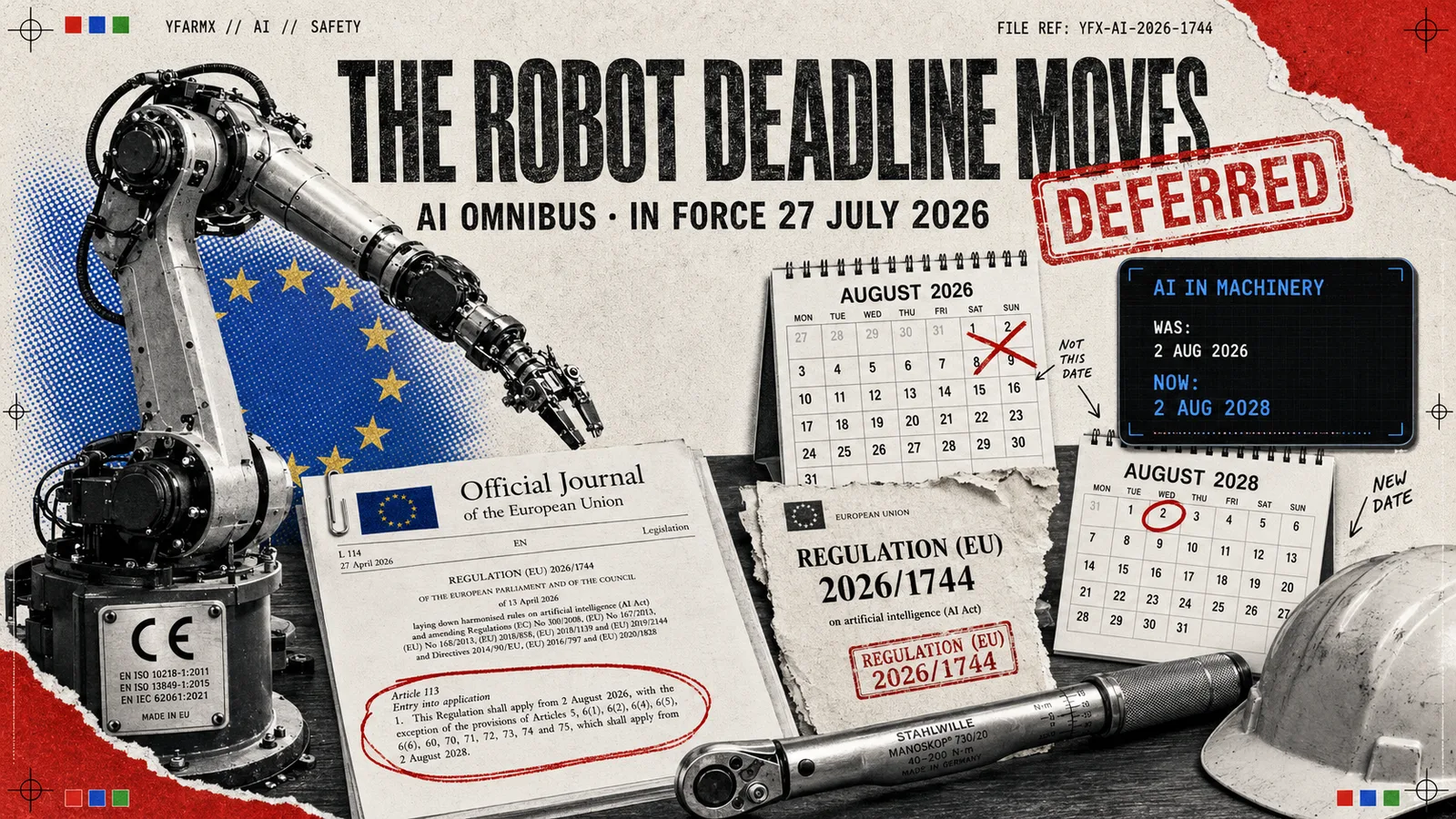
A company selling a robot arm, a warehouse fleet or a humanoid into the European Union was, until this week, six days away from a new set of legal duties. On 27 July the AI Omnibus entered into force and moved them to 2 August 2028.
The European Commission’s own note on the day gives the two dates cleanly. Rules for high-risk AI embedded in physical products under Annex I, the list that carries machinery, lifts and toys, now apply from 2 August 2028. Rules for stand-alone high-risk systems under Annex III, the list that carries hiring, credit scoring and exam marking, apply from 2 December 2027. Both were due on 2 August 2026. The instrument is Regulation (EU) 2026/1744, which amends the AI Act, the civil aviation regulation and the Machinery Regulation together, and which was published in the Official Journal three days before it took effect.
The general shape of the delay was settled in June and reported here when the Council signed it off. What became concrete this week is the position robot makers are actually in.
Two years is the longest extension in the package
The machinery route got more time than anything else, and the reason is structural rather than political. A robot placed on the European market is already a regulated product. It goes through conformity assessment under the Machinery Regulation, it carries a CE mark, and a notified body may be involved. Layering the AI Act’s high-risk duties on top means one product satisfying two conformity regimes at once, assessed against harmonised standards that do not yet exist for the AI half.
The Commission has said the overlap between the AI Act and product safety law, the Machinery Regulation in particular, is now clarified so the two do not duplicate each other. For anyone who has read both instruments side by side, this is the more useful half of the announcement. The delay buys time; the clarification decides what the work will look like when the time runs out.
What did not move
Three things are unchanged, and they are the ones most likely to be misread this week.
The Machinery Regulation itself is untouched by the delay. It applies from 20 January 2027, and it already treats safety functions built on machine learning as something a manufacturer must assess and document. A robot maker who reads a 2028 date as two clear years has the wrong instrument in hand: machinery law arrives first, and for most robots on a factory floor it is the one that decides whether the product can be sold.
The AI Act’s banned practices have applied since February 2025 and the obligations on general-purpose models since August 2025. Neither moved. A robotics company fine-tuning a foundation model for embodied control sits inside the general-purpose regime today, not in 2028.
And the transparency duties largely stayed where they were, alongside a new prohibition on AI systems generating non-consensual intimate imagery, which the Omnibus added rather than deferred.
The standards problem the delay is really about
The honest reading of a two-year extension is that the compliance machinery was not built. High-risk conformity under the AI Act depends on harmonised standards, on notified bodies competent to assess AI systems, and on national authorities that in several member states had not been designated. None of those arrive because a date arrives.
The same is true on the robotics side. ISO 10218 was revised in 2025 for industrial robots, and the standard written for machines whose stability is actively controlled, which is where legged humanoids sit, is still in development. A humanoid maker aiming at a European factory floor in 2027 is building against a standards landscape that is being drafted underneath it. Two more years is not generosity, it is the schedule catching up with the work.
The unhelpful side of a longer runway
A deferral costs something. The original 2 August 2026 date was doing real work inside companies, funding the inventory and classification exercises that AI Act compliance actually consists of. Those exercises are slow, unglamorous and largely independent of what the final standards say, and the first casualty of a moved deadline is usually the budget for them.
There is also a signal to the wider field, and it is not the one Brussels intends. Europe’s flagship technology law has been amended within two years of adoption, before its central obligations ever applied, on the ground that they could not be met. That is a defensible thing to do and an awkward thing to have done.
The date that binds is January 2027, not August 2028
For a robot maker the practical calendar is now upside down from the way it is being reported. The AI duties are distant. The machinery duties are eighteen months out, they cover the same product, and they were never part of this week’s change. The companies that treat the extension as breathing space for their AI documentation, while the CE work sits where it was, will meet the harder deadline first and be surprised by it.
For the standards themselves, see the explainer on robot safety standards, and the safety desk for continuing coverage of the rules, the standards and the labour question.
Sources
- European Commission, AI Omnibus enters into force (27 July 2026)digital-strategy.ec.europa.eu
- European Commission, AI Act policy page and application timelinedigital-strategy.ec.europa.eu
- Regulation (EU) 2024/1689 (the AI Act)eur-lex.europa.eu
- Regulation (EU) 2023/1230 (the Machinery Regulation)eur-lex.europa.eu