
Robot safety standards
the rules that decide what can be sold
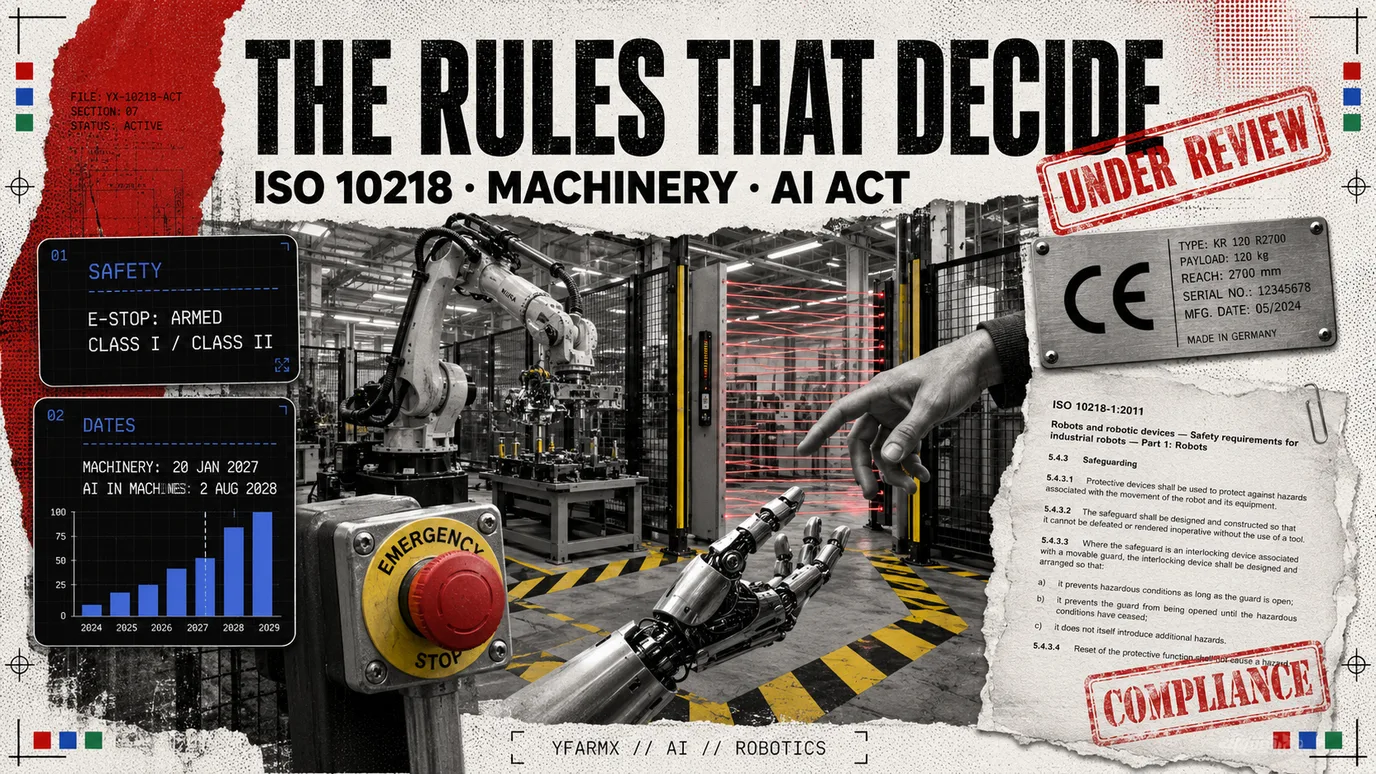
Key facts
- ISO 10218revised 2025
- Core standard
- Class I/IIby risk
- New split
- 20 Jan 2027EU applies
- Machinery law
- 2 Aug 2028moved July 2026
- AI Act, machines
Robots are regulated as machinery first and as AI second, and the machinery deadline is the one that arrives first.
A robot is not primarily an AI product in the eyes of the law. It is machinery: a physical thing that can crush, cut, trap or knock someone over, and it is regulated on that basis first. Anyone building a robot to sell in Europe meets the machinery rules before they meet anything written about artificial intelligence.
ISO 10218, and what the 2025 revision changed
ISO 10218 is the international standard for industrial robot safety, in two parts: part 1 covers the robot itself, part 2 covers the integrated system, the cell, the guarding and the application. Its 2025 revision was the first substantial one in more than a decade, after roughly seven years of work.
Two changes carry the weight.
Class I and Class II. The revision introduces a formal classification separating lower-risk robots from those that are higher risk by design, capability or intended environment. Before, a small arm and a large one lived under the same requirements, with the difference handled by the integrator’s risk assessment.
Collaborative operation folded in. The material that lived in the technical specification ISO/TS 15066, which covered speed and separation monitoring and the force limits for permissible contact with a person, was absorbed into the main standard. The category “collaborative robot” was retired as a description of a machine. Safety is a property of an application: this robot, this tool, this speed, this workspace, this person.
The practical effect is that buying a robot advertised as collaborative does not produce a safe cell. The assessment still has to be done, and the standard is now clearer that it must be done on the whole application.
The four things a safety assessment is actually made of
How a robot cell is made safe
The gap where humanoids sit
Existing robot safety standards assume a machine bolted to a floor with a known reach envelope. A legged robot has no envelope, moves through the building, and can fall over, which is a hazard class of its own.
ISO is drafting a standard for exactly these machines. ISO/CD 25785-1 sets safety requirements for dynamically stable industrial mobile robots, whether they move on legs, wheels or some other way. Its scope covers robots “with actively controlled stability”, which ISO says are “sometimes referred to as ‘self-balancing’”, and that is the category legged humanoids fall into. The draft sits at the committee draft stage in ISO/TC 299, ISO’s robotics committee, which reviews the text before it goes out as a draft international standard (ISO). Until it publishes, a manufacturer selling a humanoid into a workplace demonstrates compliance using the standards that do exist, ISO 10218 and the functional safety standards underneath it, plus its own risk assessment. That is legally workable and is not the same as having a standard written for the machine.
The European timetable, which changed in July 2026
Two instruments, two dates, and they are easy to confuse.
The Machinery Regulation, (EU) 2023/1230, replaces the old Machinery Directive and applies from 20 January 2027. It already contemplates safety functions that use machine learning, and it is the regime that decides whether a robot can be placed on the market at all.
The AI Act, (EU) 2024/1689, adds duties for high-risk AI. For AI built into products covered by existing product safety law, machinery included, those duties were originally due on 2 August 2027. The AI Omnibus, Regulation (EU) 2026/1744, entered into force on 27 July 2026 and moved them to 2 August 2028, with stand-alone high-risk systems moving to 2 December 2027. The Commission also says the interplay between the AI Act and product safety law, the Machinery Regulation in particular, has been clarified to avoid duplication. For machinery that clarification is a change of route: the Omnibus moves the Machinery Regulation to Section B of the AI Act’s Annex I, so the AI duties for machines arrive through delegated acts that add AI health and safety requirements to the Machinery Regulation’s own Annex III, and those acts are to apply by 2 August 2028 (EUR-Lex).
The order of those two dates is what a robot maker should take away. January 2027 is under four months away and covers the whole product. August 2028 covers the AI part and is now distant. A company that spends the next year on AI Act documentation and leaves its CE work will meet the wrong deadline first.
Why standards decide the industry
Standards look like paperwork and function as market access. A robot that cannot be certified cannot be sold into a factory, whatever it can do in a video. The absence of a standard for legged machines is one of the real reasons humanoid deployments are pilots at named customers rather than fleets: a pilot can be run under a bespoke risk assessment, and a fleet needs something a safety assessor can sign against.
For the machines these rules were written for, see industrial robots and cobots.
More AI
All AI →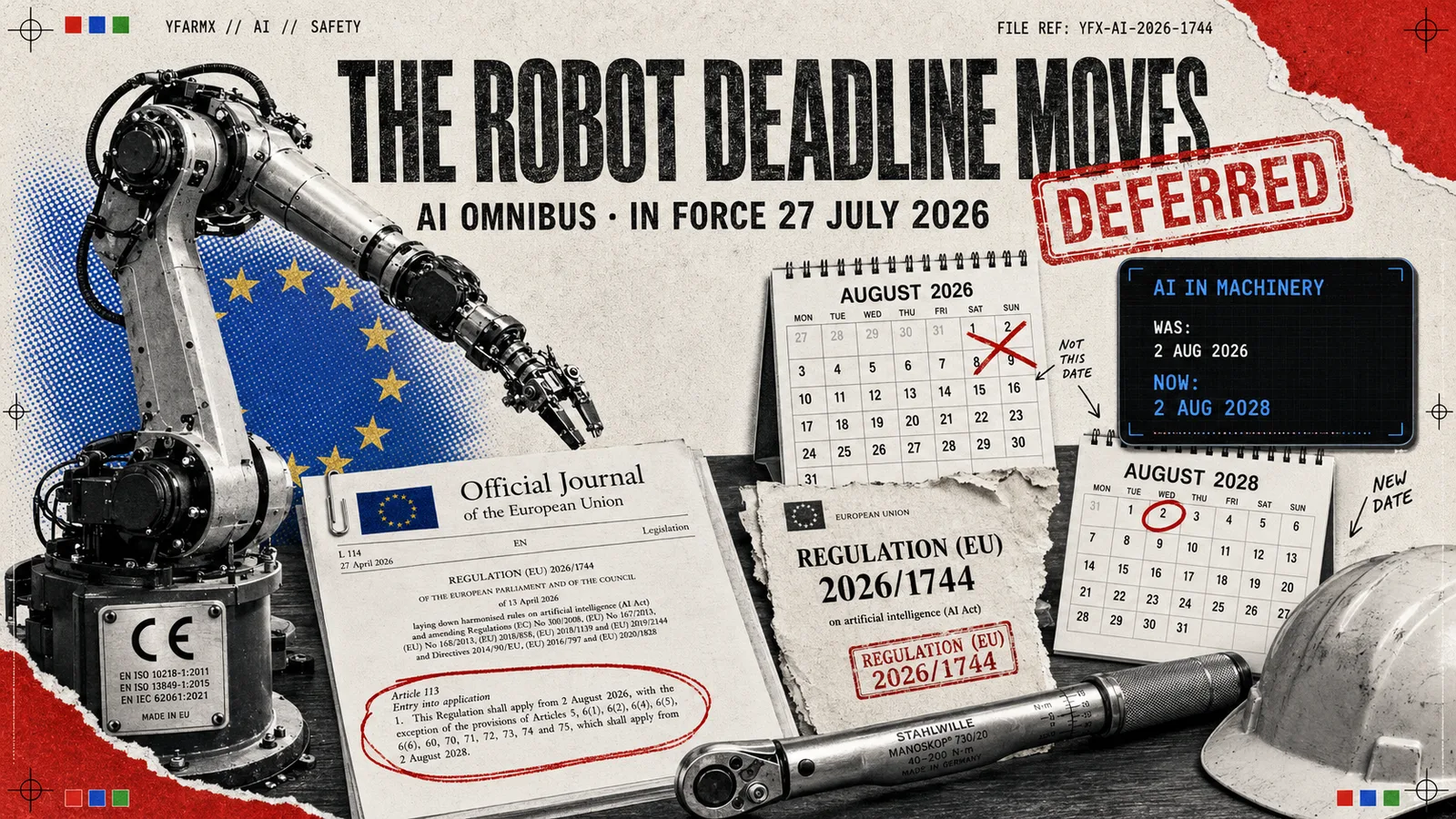
Europe gives robot makers two more years on its AI rules
The AI Omnibus entered into force on 27 July, six days before the AI Act's high-risk duties were due to apply. For AI built into machines, including industrial and humanoid robots, those duties now start on 2 August 2028.
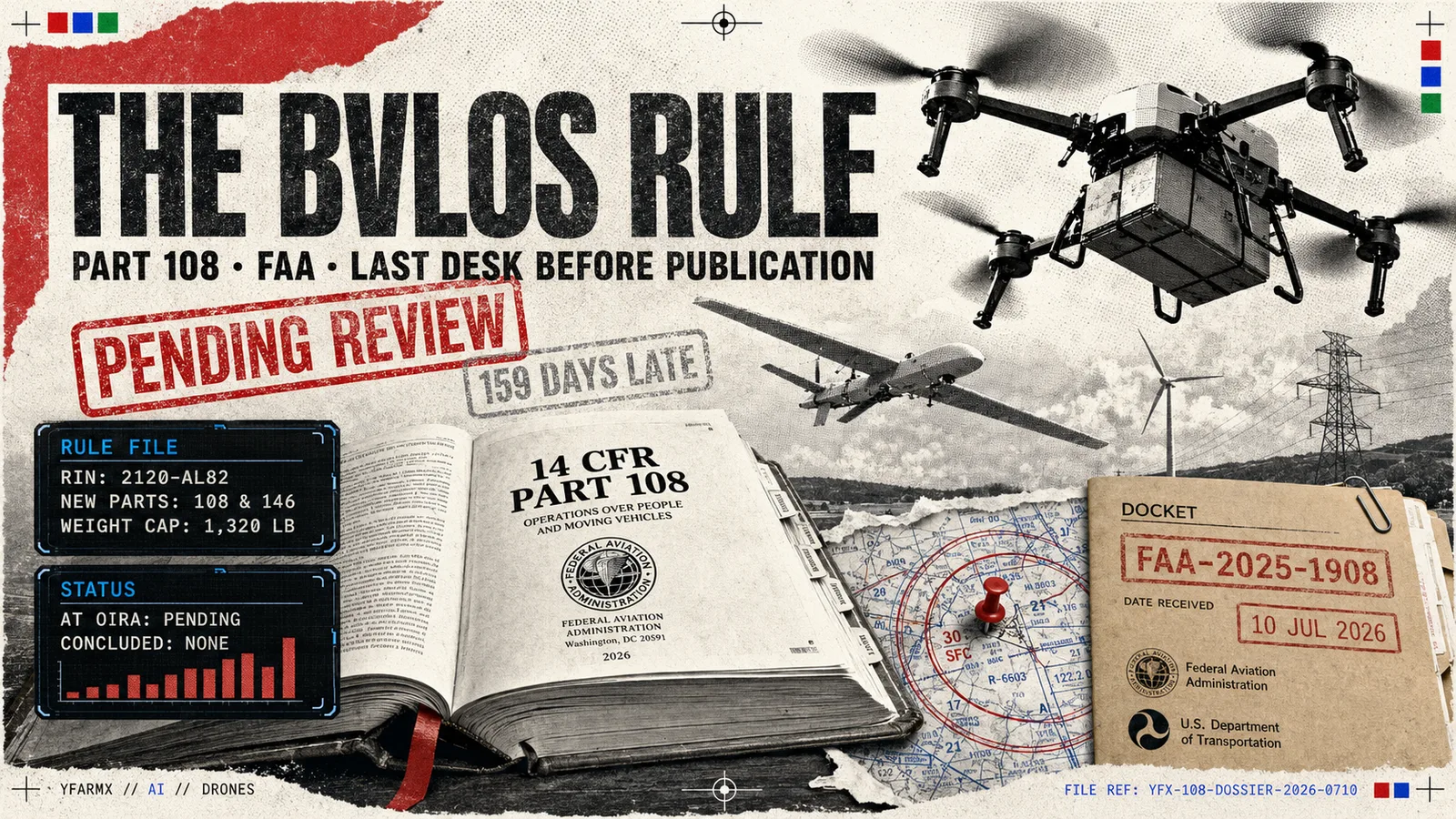
America's beyond-line-of-sight drone rule reaches its last desk
The FAA's final rule for routine drone flights beyond visual line of sight arrived at the White House regulatory review office on 10 July, 159 days after the deadline set for it by executive order and eleven months after the proposal was published.
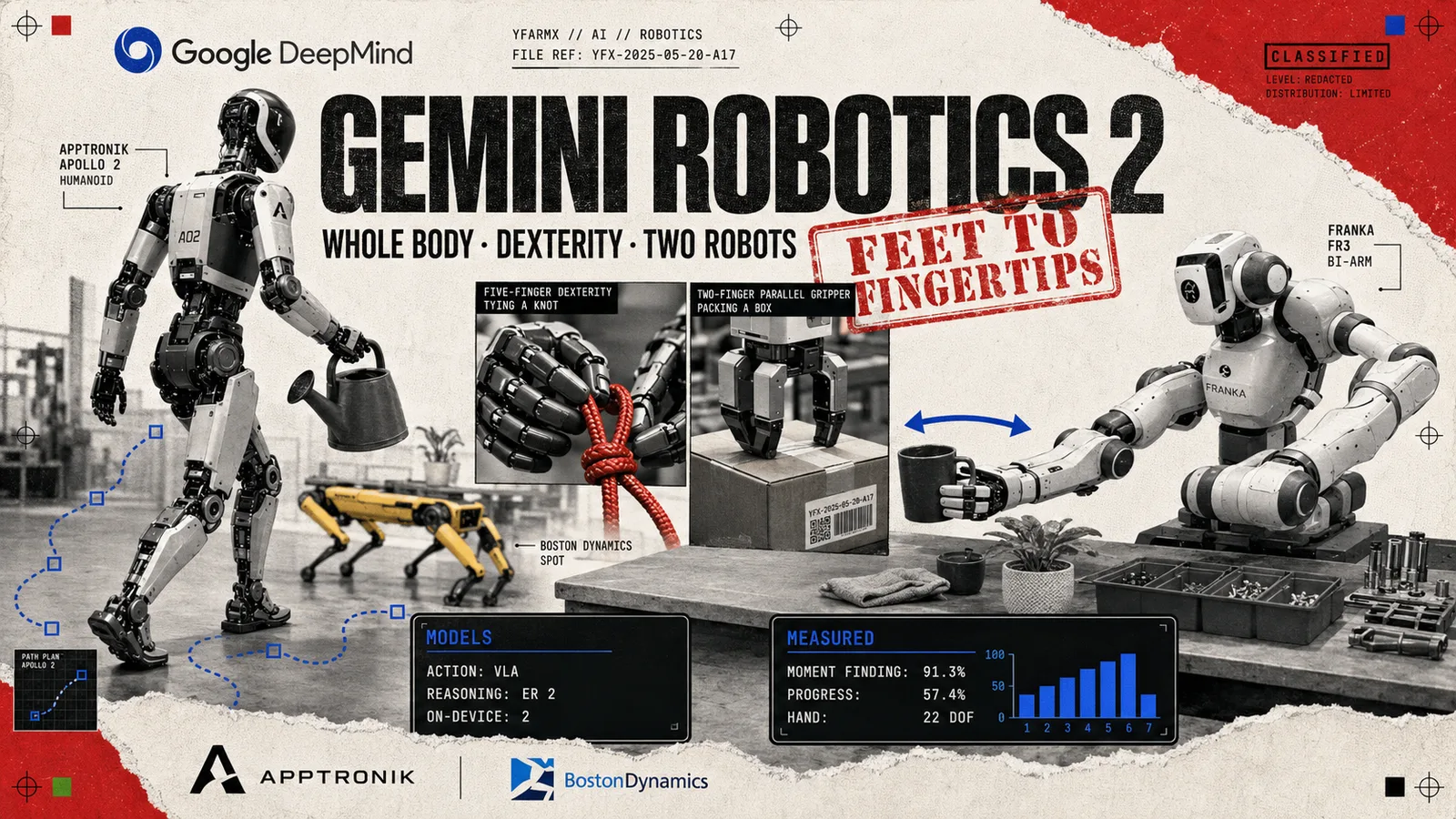
Gemini Robotics 2 takes a humanoid from feet to fingertips
Google DeepMind's new robot models control a full humanoid rather than its upper body, run three different machines from one checkpoint, and let two robots divide a job between them. The company's own results say fine multi-finger work is still the hard part.
More in Robotics
All Robotics →- Industrial robots and cobotsthe five million machines already at work
- Humanoid robotsthe human template, and why every lab is copying it
- Automation and jobswhat the numbers actually support
- Robot foundation modelsone brain, many bodies
- Embodied AIintelligence with something to lose
- Warehouse automationwhere robots already outnumber the pilots