
Automation and jobs
what the numbers actually support
Key facts
- 1,220robots per 10,000
- Korea
- 1322024 data
- Global average
- 54%of 2024 installs
- China share
- +11%installations
- US 2025
Robots replace tasks rather than jobs, and the countries with the most robots are not the ones with the least work.
Every wave of robotics arrives with the same two claims attached: that it will take the jobs, and that it will create more than it takes. Both are asserted with more confidence than the evidence supports. What can be said precisely is what has been counted.
What has been counted
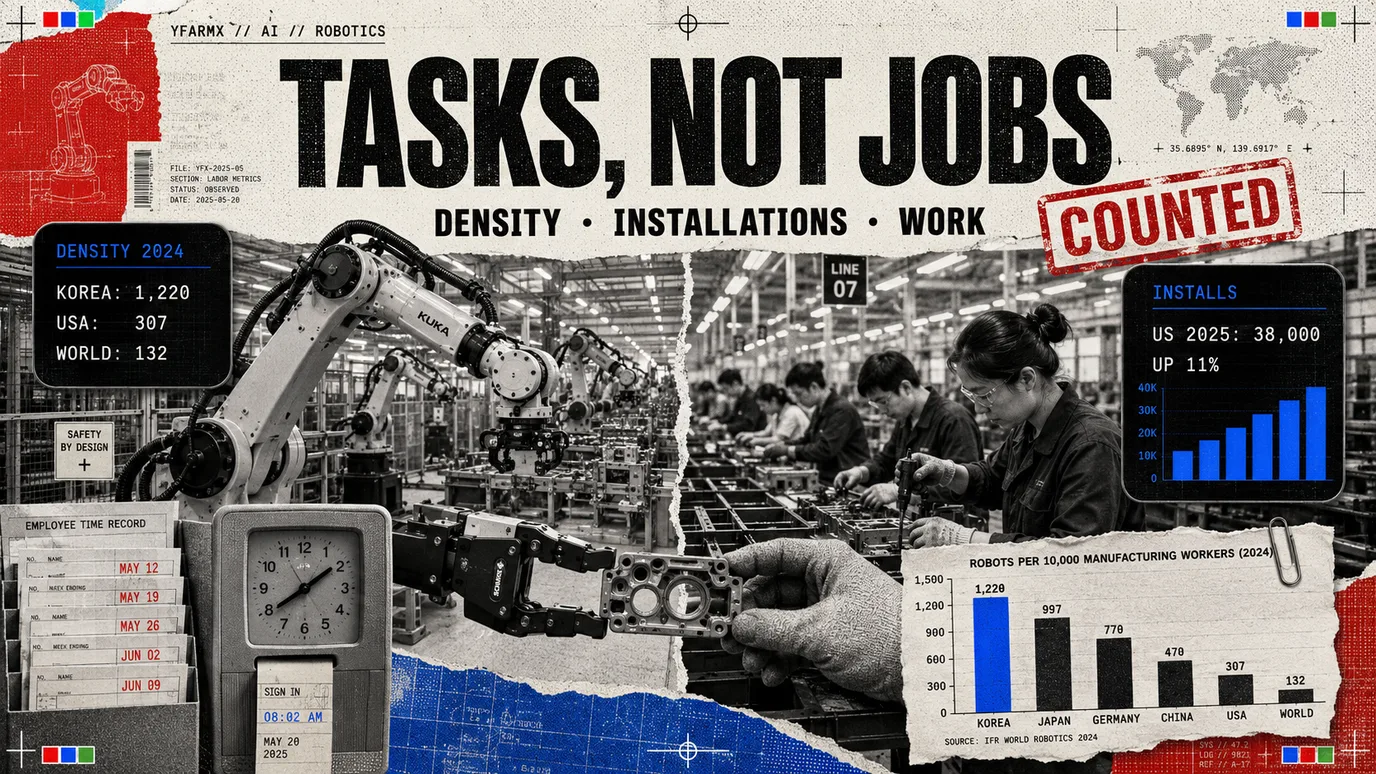
The International Federation of Robotics publishes the reference series. Its April 2026 release, covering 2024, gives a global average robot density of 132 industrial robots per 10,000 manufacturing employees.
By region: Western Europe reached a record 267, up 3 per cent. North America rose 4 per cent to 204. Asia averaged 131, up 11 per cent. The EU-27 sits at 231.
By country: Korea leads the world at 1,220 units per 10,000 employees, growing about 7 per cent a year since 2019. The United States is eighth at 307, Canada 241, Mexico 62. China’s density of 166 puts it 22nd, up 17 per cent year on year, on a manufacturing workforce so large that its 2 million installed robots, four and a half times Japan’s total, still produce a middling ratio. China took 54 per cent of all industrial robots installed worldwide in 2024, some 295,000 units.
The IFR’s final figures, published on 24 September 2026, put US industrial-robot installations at 38,400 in 2025, up 12%. Automotive remained the largest buyer with 13,500 units, down 1%; food manufacturing installed 2,900, up 30%.
Robot density against the argument that robots destroy work
Automation changes the tasks inside a job
The finding that survives across decades of this research is that automation takes tasks rather than occupations. A job is a bundle of tasks, some of them routine and physically predictable, most of them not, and machines take the predictable ones first.
So a warehouse operative stops walking eleven miles a day fetching items and starts working at a pick station where the inventory is brought to them. The occupation persists, the content changes, the number employed depends on whether cheaper fulfilment grows the volume enough to need the same number of people.
Which tasks go first is predictable: repetitive, physically consistent, indoors, high volume, low tolerance for variation, and unpleasant enough that recruitment is hard. Which resist is equally predictable: unstructured environments, fine manipulation, judgement, dealing with people, and anything where the cost of an error is high.
Why the shape of automation is changing
For thirty years automation concentrated where volumes justified the integration cost. A robot cell only pays back if a million identical parts run through it, which is why car plants are dense with robots and small manufacturers have almost none.
Robot foundation models and general-purpose machines attack the integration cost rather than the hardware cost. If a robot can be shown a task rather than programmed for one, high-mix low-volume work comes into range, and that is where most employment actually sits.
This is the mechanism worth watching. Not humanoids replacing people at a stroke, but the threshold falling to the point where automating a 200-unit production run stops being absurd.
Reading the claims
Three habits help.
Check what is being counted. Density is robots against manufacturing employment. A country that offshored its factories has both fewer robots and fewer manufacturing jobs, and the ratio can move in either direction for reasons unrelated to automation.
Distrust job-loss totals derived from task lists. The widely quoted forecasts of a given percentage of jobs at risk are usually computed by scoring occupations against a list of automatable tasks. That produces a measure of exposure, not of outcome, and it says nothing about whether firms adopt, whether demand rises, or whether the work is reorganised.
Notice who is speaking. Robot makers forecast a labour shortage that only their product can solve. Unions forecast displacement. Both may be right about the direction and are not disinterested about the size.
Humanoid deployment varies by task
Nobody knows whether the humanoid wave changes the pattern. Every previous generation of automation needed the workplace redesigned around it, which slowed adoption and gave labour markets time to adjust. A machine that works in an unmodified building removes that friction, and the adjustment period with it.
Deployment varies by machine and task. Agility’s Digit 4 is already doing warehouse work, while Digit 5 is scheduled for 2027. Boston Dynamics is developing more capable hands for Atlas. The useful employment question is which tasks a particular installation can perform reliably, how much supervision it needs and how the employer reorganises the work.
More in Robotics
All Robotics →- Industrial robots and cobotsthe five million machines already at work
- Warehouse automationwhere robots already outnumber the pilots
- Humanoid robotsthe human template, and why every lab is copying it
- Robot foundation modelsone brain, many bodies
- Embodied AIintelligence with something to lose
- Robotaxis and self-drivingthe largest robot fleet on earth