
Warehouse automation
where robots already outnumber the pilots
Key facts
- ~75%of item types
- Vulcan reach
- 2Spokane, Hamburg
- First sites
- 14 kginspection robot
- Spot payload
- Deployedmaker's own word
- Digit status
The one part of robotics that scaled: machines that move shelves, sort parcels and, recently, pick things they have never seen.
If you want to see robotics at scale rather than in a video, look at a distribution centre. Warehouses solved the deployment problem that the rest of the field is still arguing about, and they did it by changing the building rather than by building a better robot.
The four layers of a modern warehouse
Fixed automation came first: conveyors, sorters, cross-belt loops. No intelligence, enormous throughput, and it defines the shape of the building.
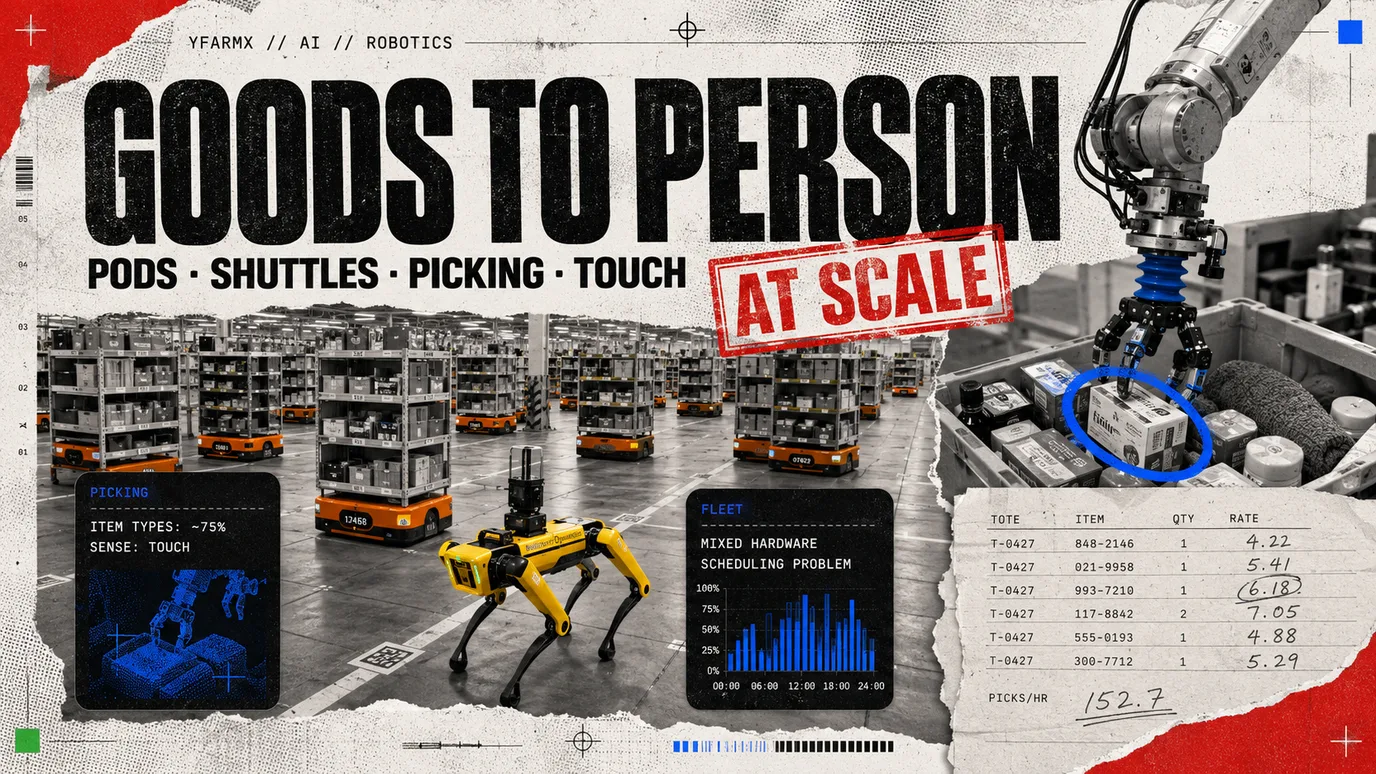
Goods-to-person turned the picking problem around. Instead of a person walking miles of aisle, a low mobile robot drives under a mobile shelving unit, lifts it and brings it to a picking station. The person stands still and the inventory moves. This is the single largest change in warehouse work in thirty years, and it is a logistics idea rather than an AI one: the robot navigates a floor marked out for it, and the software decides which pod to fetch.
Autonomous mobile robots are the newer, less structured version: machines that navigate by sensors rather than by floor markers, carrying totes or towing carts through a building that also contains people, forklifts and pallets left in the wrong place.
Robotic picking is the layer that resisted. Grasping an arbitrary object out of a cluttered container is the hard problem of manipulation, and until recently every attempt met the same wall: you can grip a rigid box, and you cannot reliably grip a bag of screws, a bottle, a shrink-wrapped multipack and a paperback with the same end effector.
Touch is what changed
Amazon’s Vulcan is the clearest example of the change. Amazon describes it as its first robot with a sense of touch, using force feedback to pick and stow items in fulfilment centres, and says it handles approximately 75 per cent of the item types those centres hold. It first ran at Spokane in Washington and in Hamburg, with a wider rollout planned across sites in Europe and the United States.
Why touch changes the picking problem
The insight is old and the engineering is new. A camera cannot tell you whether a thing is rigid, slippery or fragile. Contact can. A gripper that senses force as it closes can back off before it crushes, adjust when it slips and know it has hold of something, which is how a person picks up an unfamiliar object without thinking about it.
Humanoids are trying to enter here first
Warehouses are also where humanoids are making their first commercial claims, for a specific reason: the building is already full of machines and the tasks are already measured. Agility Robotics describes Digit as commercially deployed, moving totes on facility floors, run by its Arc platform, with Schaeffler, GXO and Toyota Motor Manufacturing Canada among the named customers on its own site.
The argument for a legged robot in a building that could have been designed around conveyors is not efficiency. It is flexibility and capital: a humanoid can be redeployed to a different task next quarter and does not require the building to be rebuilt, which suits a third-party logistics operator whose contracts turn over.
The argument against is that a purpose-built machine will beat a general one at any fixed task, at lower cost, and warehouses are the natural home of fixed tasks. Both arguments are correct, which is why the question is being settled by pilots rather than by reasoning.
Inspection is where these robots earn their keep
Away from picking, the four-legged robot found a real job. Boston Dynamics describes Spot as an agile robot for automated sensing and inspection that operates without interventions, charges itself and carries a 14 kg payload, with over 1,500 robots in customer hands.
Inspection suits robots because the task is repetitive, the route is fixed, the environment is hostile or dull, and nothing has to be grasped. A machine that walks a substation, a refinery or a construction site on a schedule, photographing gauges and listening for the wrong sound, does not need dexterity at all.
Where this goes next
Three things are moving at once. Picking is becoming general rather than catalogue-specific, which removes the main reason a warehouse still needs people at the pick face. General-purpose machines are being trialled where purpose-built ones already work, which is a commercial experiment rather than a technical one. And the software layer that decides what should move where is becoming the valuable part with little fanfare, because a fleet of mixed robots is a scheduling problem before it is a robotics one.
The labour question that sits under all of it is dealt with in the automation and jobs explainer, and the safety rules for machines sharing a floor with people are in robot safety standards.
More in Robotics
All Robotics →- Industrial robots and cobotsthe five million machines already at work
- Humanoid robotsthe human template, and why every lab is copying it
- Automation and jobswhat the numbers actually support
- Robot foundation modelsone brain, many bodies
- Embodied AIintelligence with something to lose
- Robotaxis and self-drivingthe largest robot fleet on earth