
Robot foundation models
one brain, many bodies
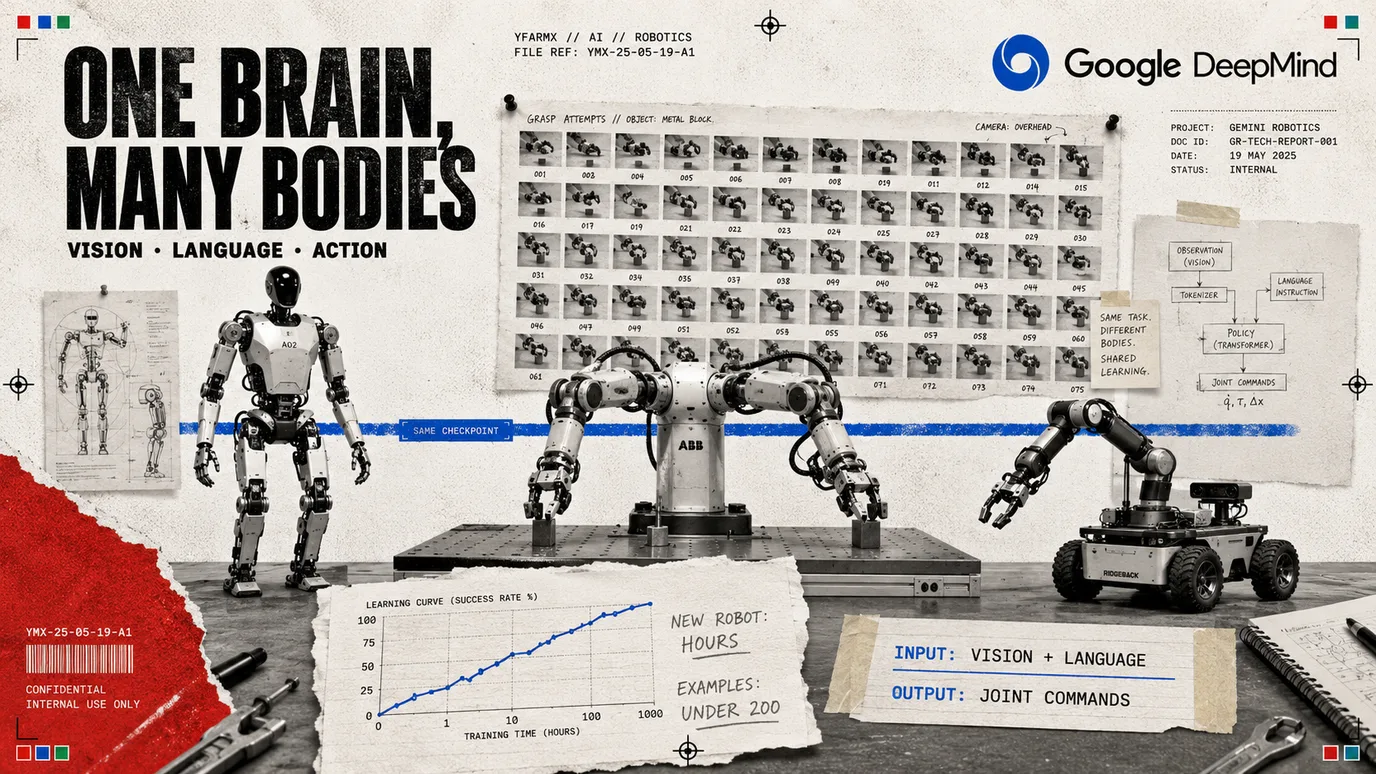
Key facts
- VLAvision, language, action
- Model type
- Hoursnot months
- Adapt to a new robot
- <200Gemini On-Device 2
- Examples needed
- Yesπ0, GR00T
- Open weights
A single model trained across many robots and tasks, then adapted to a specific machine, instead of a program written for one robot and one job.
A robot foundation model turns camera images and instructions into actions. Developers train or adapt it with demonstrations so it can control a particular robot, such as an arm sorting objects or a mobile machine moving materials.
Models can be adapted through hosted services
Physical Intelligence launched the Pi API beta on 13 October 2026. Developers upload robot data, run fine-tuning on the company’s infrastructure and use the resulting model through hosted inference. Access starts through the beta programme, and deployment still needs testing on the intended hardware.
Google’s 13 October Argon robotics examples use the existing Gemini 4 Argon model for control, simulation and video labelling. These are applications of a general model; the Gemini Robotics family remains a separate set of robot models.
What VLA stands for
The family name is vision-language-action. The model takes camera images and an instruction in ordinary words, and outputs actions: joint positions, gripper commands, the small continuous numbers that actually move a machine.
Where a robot foundation model sits
The reason the field split into two models is timing. Reasoning about a ten-minute task is slow and can afford to be. Keeping a limb stable is fast and cannot wait for a thought. So the reasoning model plans, watches and calls the action model as a tool, and the action model runs the body at a much higher rate.
Who is building them
Google DeepMind publishes the Gemini Robotics family. Its July 2026 release runs to three models: an action model that controls a full humanoid from feet to fingertips, an embodied reasoning model that plans and orchestrates and is available through the Gemini API, and an on-device model built to run on the robot without a network. DeepMind reported driving three different robot bodies from a single model checkpoint.
Physical Intelligence works in the open more than most. It released π0 in October 2024 as its first generalist policy and open-sourced the weights and code in February 2025. π0.5 followed in April 2025 with open-world generalisation, demonstrated on a mobile manipulator tidying a kitchen it had never seen. π*0.6 in November 2025 added reinforcement learning from the model’s own experience, and π0.7 in April 2026 is described by the company as steerable, with a step change in generalisation.
NVIDIA publishes Isaac GR00T, an open foundation model family for humanoid reasoning and skills, trained on a mixture of real captured data, synthetic data and internet-scale video, and designed to be post-trained for a specific robot. NVIDIA’s angle is the whole stack: simulation for generating training data, and the on-robot compute to run the result.
Several robot makers train their own. Figure has Helix. The distinction that separates the two groups is whether the model is meant to run one company’s machine or anybody’s.
The transfer problem, which is the whole problem
A policy trained on one robot arm has historically been worthless on a different one. The joints differ, the reach differs, the camera sits somewhere else, and the model has learned the relationship between what it saw and what it did on that specific body.
This is why robotics has no equivalent of the internet-sized text corpus. Every new robot has meant a new dataset, collected by hand, mostly by teleoperation.
The current generation attacks it from two directions. Cross-embodiment training mixes data from many robot types so the model learns the task rather than the machine. Fast adaptation then tunes the trained model onto a new body with a small amount of data: DeepMind says its on-device model reaches a new bi-arm robot in a few hours, typically on fewer than 200 examples, across bodies with different shapes, sensors and degrees of freedom.
If that holds up outside the labs that publish it, the economics change. A robot maker stops needing a machine-learning team and starts needing a driver.
The missing corpus is now being built on purpose. On 25 August 2026 Figure launched Index, a mobile app that pays contributors for first-person video of everyday physical tasks to train its Helix model. Figure’s launch figures, all the company’s own: 264,000 downloads across more than 100 countries, 44,000 weekly active users, 16 million videos uploaded, $15m paid to contributors, and a plan to spend over $1bn on data and compute in the next 12 months.
Figure put that corpus to the test on 17 September 2026. Helix 2.5, pretrained on Index and then taught three household jobs, completed 237 of 420 trials (56%) at tidying toys into a basket, folding towels and making a bed in 30 Bay Area homes new to the robot, using each home’s own couches, beds and folding surfaces. A trial counted only when the whole job was finished. The same architecture, trained from scratch on the same task data without Index, completed 35 of 420, and Figure says Helix 2.5 matched an earlier Helix 02 policy, trained in the home it was tested in, on half the task-specific data. All the figures come from Figure’s own evaluation (figure.ai).
What these models are still bad at
Fine manipulation. DeepMind’s own July 2026 results put whole-body and gripper tasks at medium to high success and multi-finger dexterous manipulation at challenging. Everyone’s charts have the same shape.
Long tasks. Reasoning models now track jobs lasting minutes and hundreds of decisions, and the honest framing is that this is recent. Physical Intelligence published work in March 2026 on giving models long and short-term memory specifically to get past ten minutes.
Knowing they have failed. A model that has never seen a failure does not recognise one. Progress tracking, where DeepMind reported 57.4 per cent accuracy at classifying how far through a task a robot is, is a low number for something that sounds basic, and it is the number that decides whether a robot recovers or carries on pouring.
Speed. Correct and slow is the normal state of a demonstration.
Why this is the most important thing in robotics right now
Hardware has not been the constraint for years. You can buy a capable arm, and a competent humanoid now costs less than a car. Since 27 August 2026 Hugging Face’s Pollen Robotics has been taking $399 pre-orders for Microduck, a 25 cm biped you retrain yourself: the whole software stack, from MuJoCo simulation and PPO training to ONNX policy export, is published under Apache-2.0, every move it ships with can be retrained on a personal machine, and the hardware design stays proprietary. What has been missing is a way to make a machine do a job nobody wrote down for it.
If foundation models deliver on transfer, the bottleneck moves to hands and data, and robotics starts to look like software: a general capability that improves for everybody at once, rather than an integration project rebuilt per site. That has not happened yet. It is the bet the entire field is currently placing.
More AI
All AI →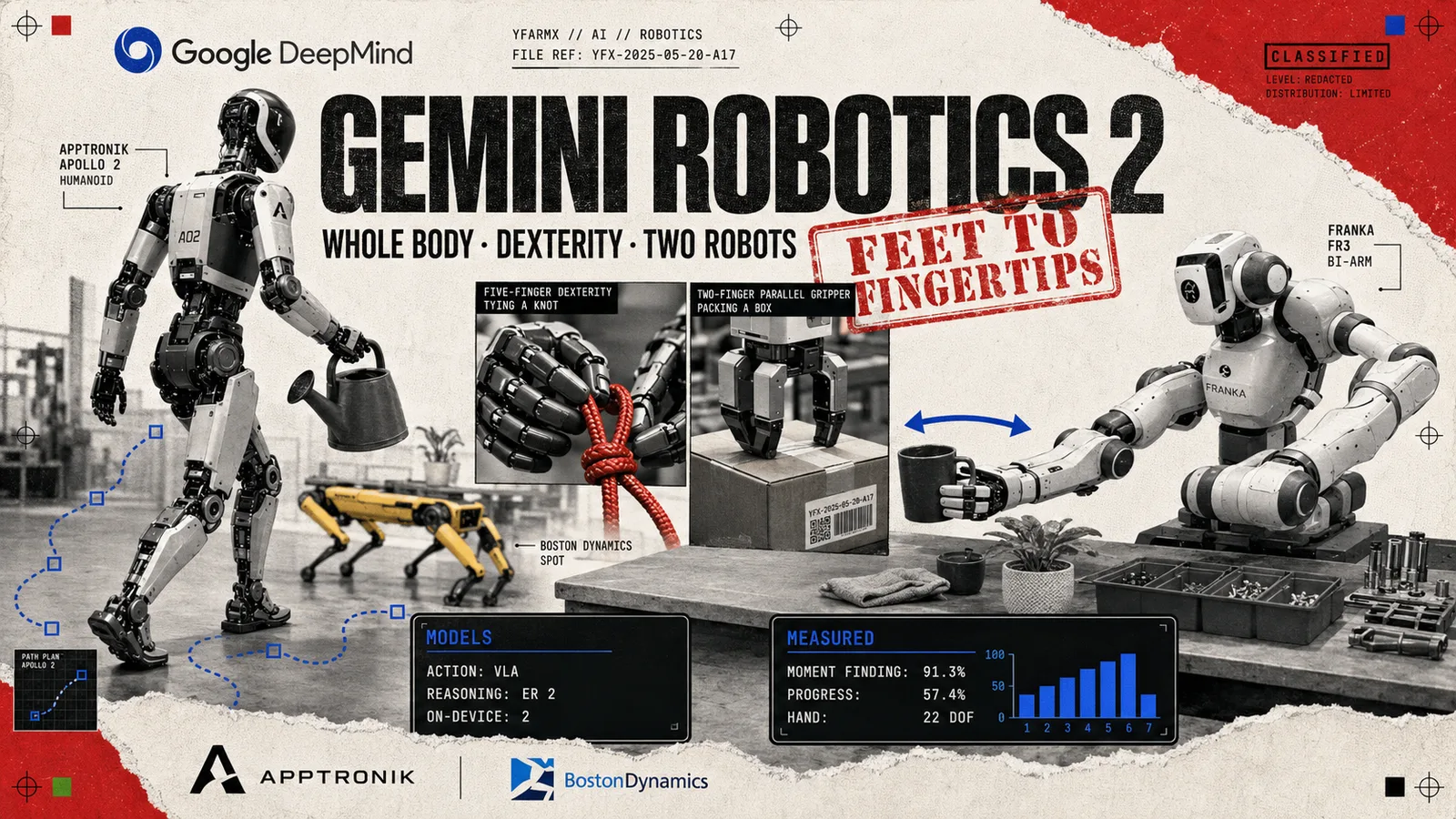
Gemini Robotics 2 takes a humanoid from feet to fingertips
Google DeepMind's new robot models control a full humanoid rather than its upper body, run three different machines from one checkpoint, and let two robots divide a job between them. The company's own results say fine multi-finger work is still the hard part.
More in Robotics
All Robotics →- Embodied AIintelligence with something to lose
- Humanoid robotsthe human template, and why every lab is copying it
- Teleoperation and robot datathe person inside the demonstration
- Industrial robots and cobotsthe five million machines already at work
- Warehouse automationwhere robots already outnumber the pilots
- Robotaxis and self-drivingthe largest robot fleet on earth