
Teleoperation and robot data
the person inside the demonstration
Key facts
- 1 personper robot hour
- Cost
- Labelledactions included
- Data type
- Robot ParksApptronik's term
- Where
- <200examples, best case
- Adaptation
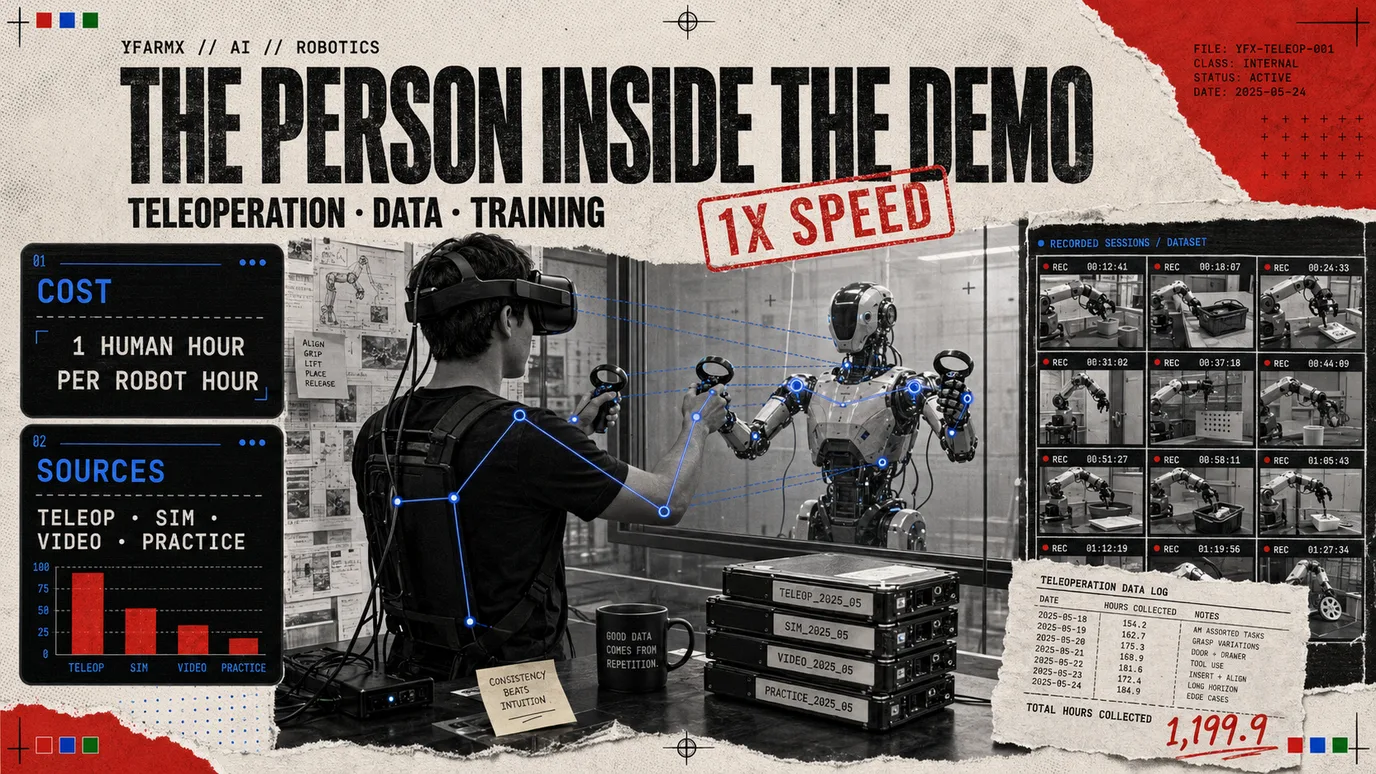
Someone drives the robot, the model watches, and the recording becomes training data. It is how most robot skills are still learned.
Teleoperation means a person controlling a robot remotely: through a joystick, a motion-capture rig, a pair of hand controllers, or a VR headset that puts the operator behind the robot’s eyes. It is old technology, used for decades in bomb disposal, subsea work and nuclear decommissioning, and it is having a second life for an unexpected reason.
It is where the training data comes from.
Why robot learning has a data problem
Language models were trained on text that already existed. Nothing equivalent exists for physical action. Video of people doing things is abundant, and it carries no record of the forces, the joint angles or the corrections, which are the parts a robot needs.
So the field manufactures its data. A person teleoperates a robot through a task, the system records what the cameras saw and what the joints did, and that pairing, observation and action, is exactly the format a vision-language-action model trains on.
The cost structure follows immediately: roughly one human hour per robot hour of data. Nobody has found a way around it that produces data of the same quality.
What an hour of each kind of data costs, and what it is worth
Where it happens
Apptronik describes sites it calls Robot Parks, where Apollo robots generate training data through a combination of teleoperation and autonomous execution, and says similar data-collection workflows run at a growing network of them, including at its research partner Google DeepMind and at customers such as Mercedes-Benz and GXO.
Read that arrangement carefully, because it is the business model of humanoid robotics at the moment. The customer gets some work done. The robot maker gets hours of task data from a real environment with real objects and real mess, which is worth more than the same hours in a lab. Both sides describe it as a deployment.
How to tell teleoperation from autonomy
This is the single most useful skill for reading robotics announcements.
- Look for the label. Serious labs now caption clips with the control mode. “Autonomous 1x” in the corner means no human driving and no speed-up. Its absence is informative.
- Watch the hesitation. Autonomous systems pause at decision points, then move at a constant rate. Teleoperated ones move in the fluid, slightly overshooting way a human hand does, and recover from mistakes too gracefully.
- Ask how many attempts. A success rate over dozens of runs is autonomy. One clean take is a performance.
- Check the environment. A tidy, fixed scene with the same objects in the same places is a rehearsed demonstration whichever way it is driven.
None of this makes teleoperation dishonest. It is a legitimate way to do useful work and the only practical way to collect the data. It becomes dishonest when a video of a person driving is presented as a machine thinking.
The ways out
Three approaches are being tried, and all three are partial.
Simulation generates unlimited data, and a policy trained purely in simulation tends to fail on contact, friction and soft objects, so it is used for the parts of a task where physics is well modelled and topped up with real data for the rest.
Learning from human video avoids the robot entirely, at the price of not knowing what the joints did. Physical Intelligence published work in December 2025 on how transfer from human video to robot tasks emerges as models scale, which is the optimistic reading of the same problem.
Learning from the robot’s own experience is the one that would break the dependency, because the robot generates its own data by practising. Physical Intelligence’s π*0.6 in November 2025 used reinforcement learning on its own attempts to improve success rate and throughput, and the company published further online reinforcement learning work in March 2026.
Cross-embodiment transfer attacks the cost from the other end: if data collected on one robot is usable on another, the same hours buy more. Google DeepMind reported adapting to a new bi-arm robot in a few hours on typically fewer than 200 examples in July 2026, which is the number to watch. If it holds outside the lab that published it, the data problem stops being the field’s central constraint.
Why this shapes everything
The reason humanoid robotics is capital intensive is not the hardware. It is that every skill currently costs human hours to teach, one robot at a time. Whichever company breaks that relationship first gets a compounding advantage, because its fleet starts producing its own training data faster than its rivals can pay people to produce theirs.
More in Robotics
All Robotics →- Robot foundation modelsone brain, many bodies
- Embodied AIintelligence with something to lose
- Humanoid robotsthe human template, and why every lab is copying it
- Industrial robots and cobotsthe five million machines already at work
- Warehouse automationwhere robots already outnumber the pilots
- Robotaxis and self-drivingthe largest robot fleet on earth