
Humanoid robots
the human template, and why every lab is copying it
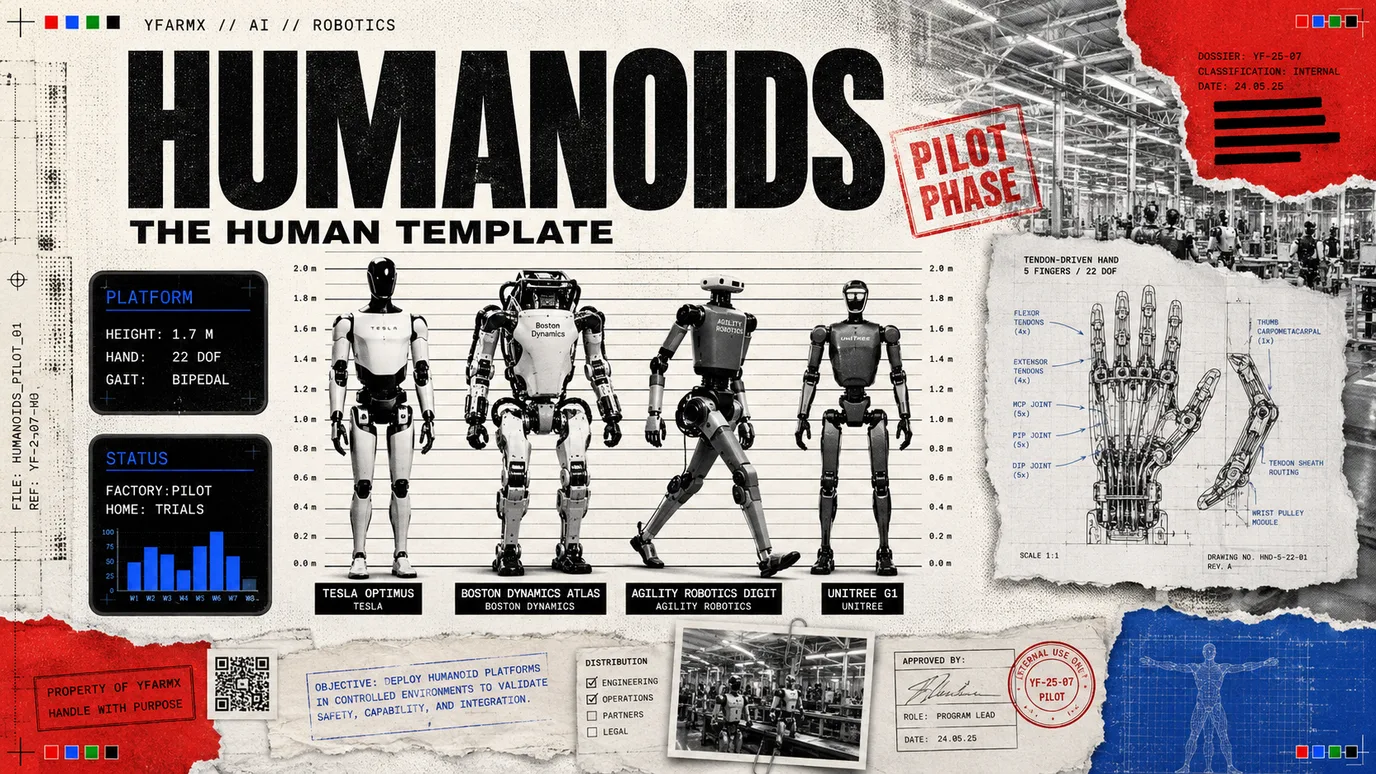
Key facts
- 1.7 mtypical build
- Tallest claim
- $13.5KUnitree G1
- Cheapest
- 22SharpaWave
- Hand joints
- Pilotsnot fleets
- In factories
A robot built on the human template so it can work in rooms designed for people, without rebuilding the room.
A humanoid robot is a machine built roughly to the proportions of a person: two legs or a wheeled base, two arms, hands or grippers, a head carrying cameras, and a centre of mass it has to keep over its feet. The definition sounds like a design choice. It is really an economic argument.
Why the human shape at all
Wheels are more efficient than legs. A robot arm bolted to a bench is cheaper, faster and far more reliable than an arm attached to a swaying torso. Nobody builds a humanoid because the shape is good engineering.
They build it because the world is already built. Doorways, stairs, shelf heights, tool handles, vehicle cabs, light switches and packing boxes were all sized for a body about 1.7 metres tall with two hands at the end of jointed arms. A machine with that body can be dropped into a workplace without redesigning the workplace. Every other robot form asks the building to change first.
The counter-argument, made by people who have automated factories for thirty years, is that changing the building is usually cheaper than building a humanoid. That is why warehouse automation went to conveyors and shuttles rather than androids, and it stays true wherever the task is repetitive and the layout is yours to control. The humanoid case is strongest exactly where it is not: an existing building, a changing task, and a job description written for a person.
The machines that exist
The field, by how far it has actually got
Atlas from Boston Dynamics is the all-electric successor to the hydraulic machine from the viral videos. Boston Dynamics calls it “our electric humanoid platform currently in development”, built for material handling: it navigates to a charging station and swaps its own battery, and a skill one robot learns transfers across the fleet. On 21 September 2026 Boston Dynamics opened a training centre for Atlas at Hyundai Motor Group Metaplant America outside Savannah, Georgia, where the robots are learning to sequence car parts for assembly. Hyundai Motor Group plans 25,000 Atlas units across Hyundai Motor and Kia plants over the next few years, and a US factory able to build 30,000 robots a year (bostondynamics.com).
Digit from Agility Robotics is the one the company calls commercially deployed, run by a cloud platform it calls Arc, with Schaeffler, GXO and Toyota Motor Manufacturing Canada among the names on its own customer wall. On 15 September 2026 Agility unveiled Digit 5, presented as Agility’s first humanoid engineered for cooperatively safe work at scale, with early access planned for the first half of 2027 (agilityrobotics.com) and commercial availability expected in the second half of 2027. Agility is going public by merging with Churchill Capital Corp XI, a special purpose acquisition company, at a $2.5bn pre-money equity value, with the combined company to trade on Nasdaq as AGLT (merger release). The $300m of Digit 5 orders behind the deal comes from one customer, committed to deploy 1,000 robots on a three-year robots-as-a-service contract subject to contractual milestones, according to the merger filing of 30 September 2026 (SEC).
Figure 03 is described by Figure as a general-purpose humanoid for every day, driven by its Helix model, and demonstrated in June 2026 performing a logistics sequencing workflow in Hall 52 at BMW Group Plant Spartanburg. On 25 August 2026 Figure launched Index, a mobile app that pays contributors for first-person video of everyday tasks to feed Helix, and put its own launch numbers at 264,000 downloads, 44,000 weekly active users and 16 million videos uploaded, with over $1bn planned on data and compute in the next 12 months. On 17 September 2026 Figure reported that Helix 2.5, pretrained on Index, completed 237 of 420 trials (56%) at tidying toys, folding towels and making beds in 30 Bay Area homes new to the robot, by Figure’s own evaluation (figure.ai).
Apollo 2 from Apptronik comes in bipedal and wheeled configurations, with swappable batteries the company says enable 7x22 operation, and it is the machine Google DeepMind used to demonstrate whole-body control in July 2026.
Optimus is Tesla’s, described on Tesla’s own AI page as a goal rather than a product: a general-purpose, bipedal, autonomous humanoid for unsafe, repetitive or boring tasks.
G1 from Unitree is the one you can buy. Unitree markets it as a humanoid agent with 23 to 43 joint motors depending on configuration, an optional force-control dexterous hand, and a price from US$13,500, which is roughly two orders of magnitude below where humanoids sat five years ago. The Shanghai Stock Exchange confirmed the company’s STAR Market flotation on 31 July 2026, with a planned raise of about US$623m, 85 per cent of it earmarked for research and development. Unitree listed on 19 August 2026 at an issue price of 150.8 yuan. The stock opened at 1,100 yuan, its high for the day, and finished the morning session at 883.87 yuan, valuing the company at around US$50bn on an offering that raised roughly US$900m for about a tenth of the equity, according to Reuters. A humanoid maker now carries a public price, and it trades well below the debut. The stock closed at 427.80 yuan on 8 October 2026, down 5.02% from the 30 September close of 450.40 yuan, according to Yahoo Finance’s dated market record. That was the first session after Shanghai’s National Day holiday. The share price measures the market’s valuation of the company; the G1’s purchase price is a separate figure.
NEO from 1X is aimed at the house rather than the factory, sold on a $200 deposit under an early-access programme, with the company saying it is built for full autonomy and that capabilities unlock as it learns.
What they can do, and where the demonstrations stop
Walking is solved well enough to be boring. Balance, stairs, uneven ground, recovering from a shove: all of that works, and has for several years.
Manipulation is where the field actually is. Picking up a rigid box with a two-fingered gripper is reliable. Tying a knot, sealing a bag, threading a cable or handling something floppy with five fingers is not. When Google DeepMind published its whole-body control results in July 2026, its own chart put whole-body and gripper tasks at a medium to high success rate and said multi-finger dexterous manipulation remained challenging. That single sentence is the most accurate summary of humanoid capability available.
Speed is the other limit. A humanoid that completes a task correctly at a third of human pace is a research success and a commercial problem, because the business case is priced against a wage.
What has to happen next
Three things stand between the current pilots and anything resembling a workforce.
Hands have to become both dexterous and durable, which are opposing requirements: more joints means more to break. Models have to reach fine manipulation, which is where robot foundation models are aimed. And the safety standards have to arrive, because a legged machine that can fall over is a hazard class that existing industrial robot standards were not written for, which is what the safety standards work is now dealing with.
None of those is a research mystery. All of them are years of engineering, and the field is currently spending its credibility ahead of them.
Atlas gets new hands for tool use
Boston Dynamics described Atlas’s GR3 hands on 1 October 2026. Each has four fingers, 13 degrees of freedom and pressure sensing in the fingertips and palm. The aim is to handle tools and varied objects while measuring contact, which helps the robot adjust its grip.
Agility and FORT Robotics announced a safety-development agreement on 1 October. It covers communications, monitoring and operator controls outside the robot, as Agility prepares Digit 5 for 2027.
More AI
All AI →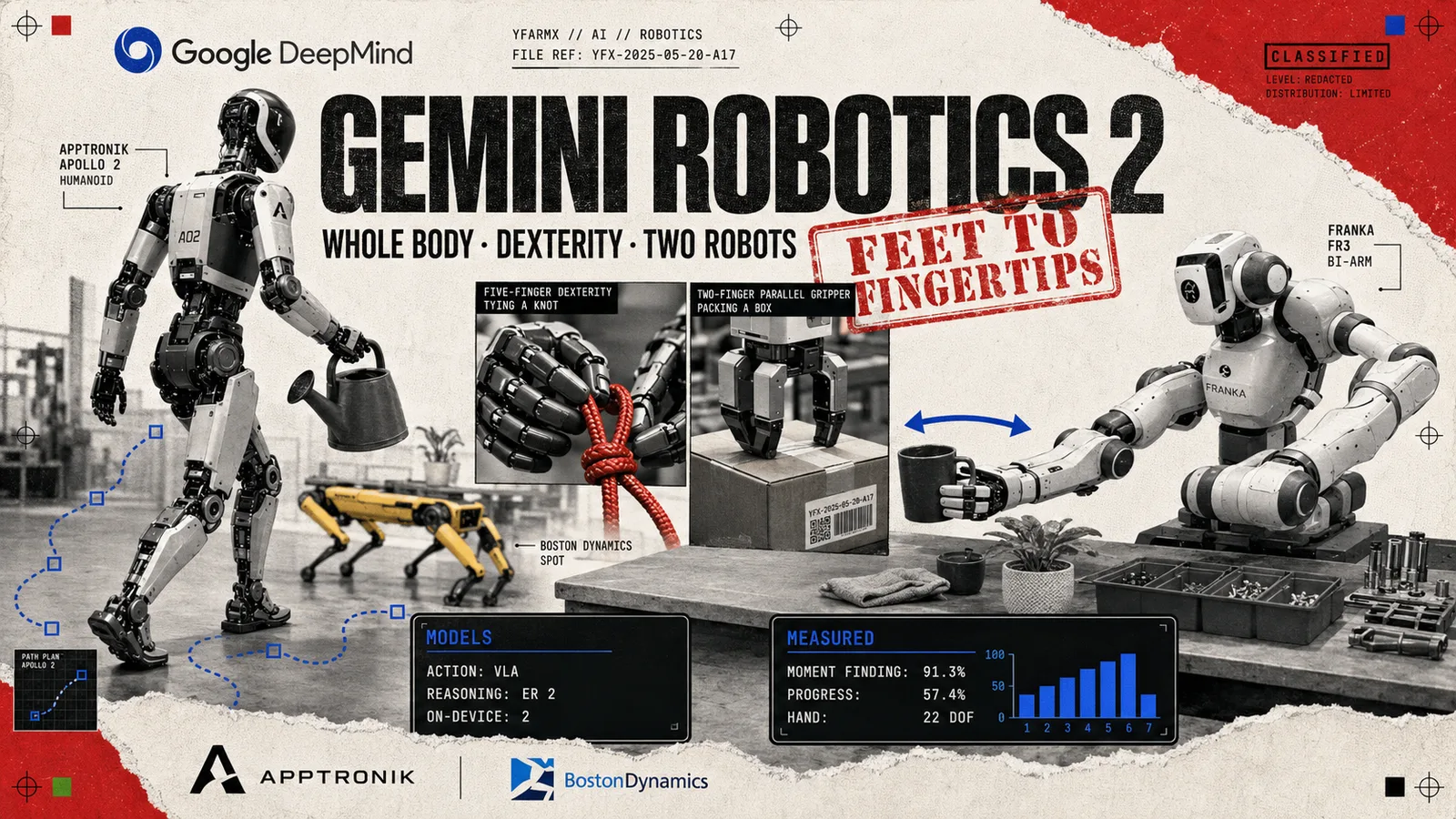
Gemini Robotics 2 takes a humanoid from feet to fingertips
Google DeepMind's new robot models control a full humanoid rather than its upper body, run three different machines from one checkpoint, and let two robots divide a job between them. The company's own results say fine multi-finger work is still the hard part.
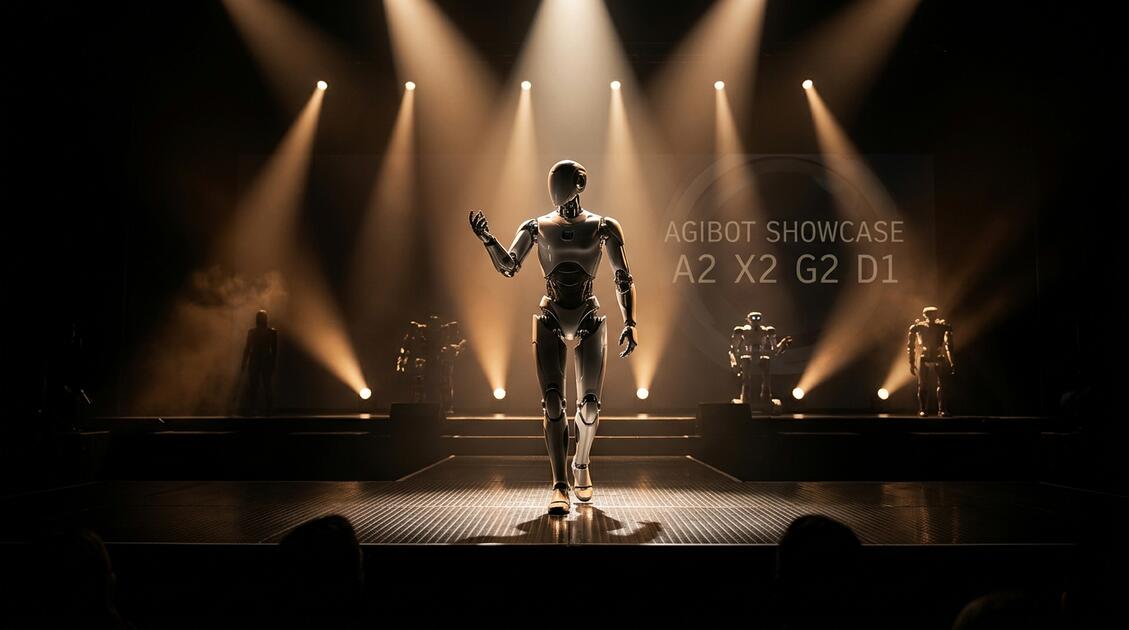
Agibot Stages Live Robot-Led Show Demonstrating Full Humanoid Portfolio at Scale
Chinese startup Agibot staged a live robot-led show featuring over 200 humanoids from its A2, X2, G2, and D1 series performing autonomously under broadcast conditions.

A robotics firm pitched humanoid border patrols. Homeland Security says it has no agreement with them
Foundation's chief executive told Fox News a humanoid robot pilot on the southern border could start tomorrow. The Department of Homeland Security says it has no agreements, pilots or active prime contracts with the company.
More in Robotics
All Robotics →- Actuators and robot handswhy hands are the hard part
- Robot foundation modelsone brain, many bodies
- Robot safety standardsthe rules that decide what can be sold
- Embodied AIintelligence with something to lose
- Industrial robots and cobotsthe five million machines already at work
- Warehouse automationwhere robots already outnumber the pilots