Actuators and robot hands
why hands are the hard part
Key facts
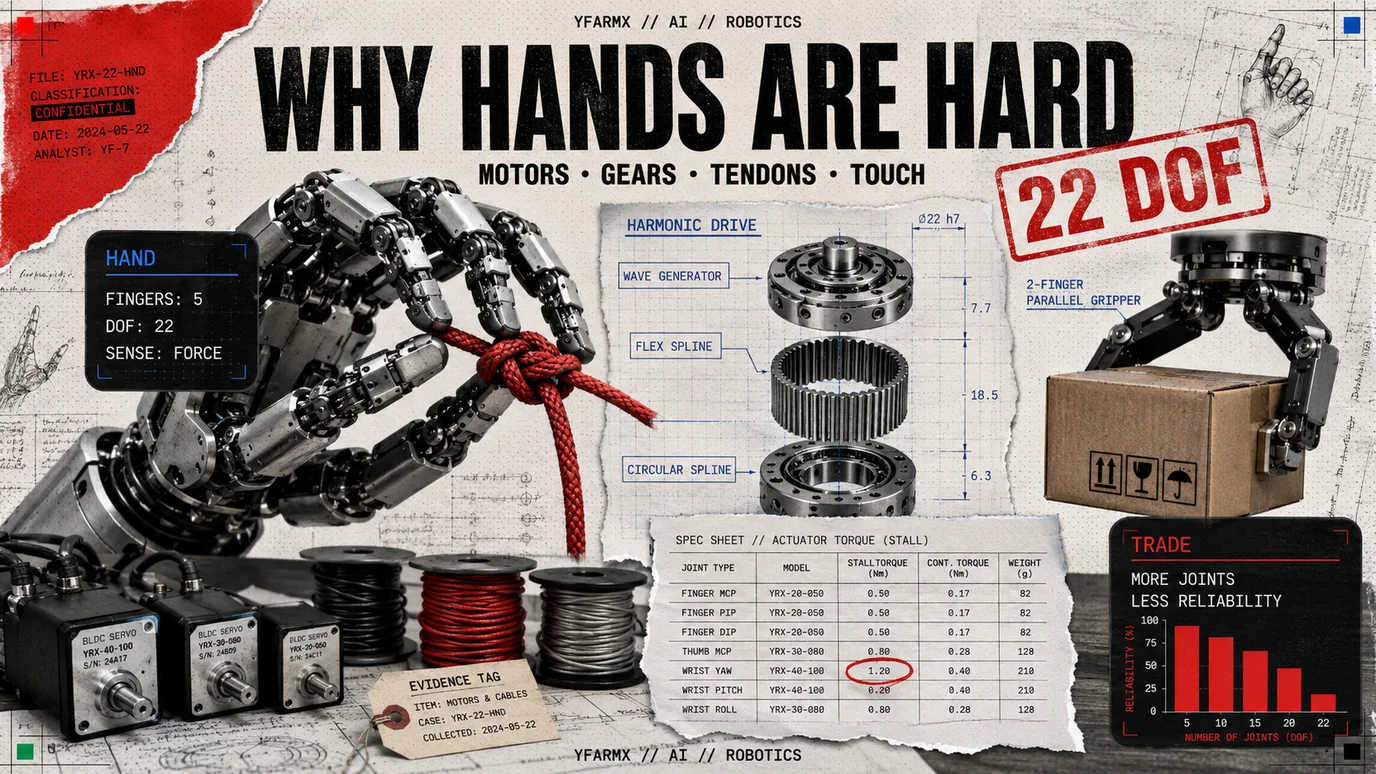
- 22 DoFfive fingers
- SharpaWave
- 23–43joint motors
- Unitree G1
- ~27degrees of freedom
- Human hand
- 1 DoFand mostly enough
- Gripper
Every joint needs a motor, a gearbox and a sensor, and the more joints you add the more there is to break.
Software gets the attention and hardware sets the ceiling. A model that knows exactly how to tie a knot cannot tie one with fingers that lack the strength, the precision or the sense of touch, and that is roughly where robotics is.
Degrees of freedom, the number that explains the field
A degree of freedom is one independent way a thing can move. A door hinge has one. A human shoulder has three. A human hand has around 27, which is why it can do what it does.
Every degree of freedom on a robot needs a motor, a gearbox, a position sensor, wiring, and space to put all of it. So degrees of freedom are not a specification, they are a cost, a weight, a failure rate and a control problem, all at once.
That is why a warehouse robot uses a two-fingered gripper with a single degree of freedom and gets on with the job, and why a research hand with 22 is a research hand.
Actuators: how joints are driven
Electric motors with gearboxes are the standard. The motor spins fast with little torque; the gearbox trades speed for force. The gearbox is where the engineering happens.
- A harmonic drive, or strain wave gearing, gets a very high reduction ratio in a compact package with almost no backlash, which is why it appears at the shoulders and knees of most humanoids. It is precise, expensive, and not very backdriveable, meaning the joint resists being pushed.
- A cycloidal drive handles shock loads better and is used where forces are large.
- A planetary gearbox is cheaper and less precise.
- A quasi-direct drive uses a large motor with a small reduction, which sacrifices peak torque for backdriveability: you can push the joint and it gives. That property is what makes legged robots able to absorb impact and makes an arm safe to be near.
Hydraulics deliver enormous force and were what made the original Atlas leap. They also leak, need a pump, and are noisy, which is why the electric generation replaced them.
Tendon drives put the motors in the forearm and pull the fingers with cables, which is exactly the arrangement in a human hand. The fingers become light and slim; the cables stretch, wear and complicate control.
Series elastic actuators deliberately put a spring between motor and joint, which lets the controller measure force from the spring’s deflection and protects the gearbox against impact.
Why a hand is harder than an arm
The trade every gripper design makes
Four things make hands hard.
Packaging. Twenty-odd actuators have to fit inside something the size of a hand, or sit in the forearm and pull cables through a wrist that also moves.
Force control. Gripping is not a position problem. It is a force problem, and the right force differs for an egg, a spanner and a cardboard box. Without force sensing a hand either drops things or crushes them.
Touch. Human fingertips carry thousands of receptors reporting pressure, slip, texture and temperature. Robot tactile sensing is improving and remains far behind, which is why contact-rich tasks are where models fail. Amazon’s Vulcan, its first robot with a sense of touch, handles roughly 75 per cent of the item types in a fulfilment centre, and getting to that number was news.
Durability. A hand takes impacts continuously. Every joint is a bearing, a cable or a gear that wears, and a hand that needs servicing weekly cannot be deployed.
Where the hardware is now
Unitree sells the G1 with 23 to 43 joint motors depending on configuration and offers an optional force-control dexterous hand. Apptronik’s Apollo 2 has been demonstrated with a five-fingered, 22 degree-of-freedom SharpaWave hand, doing tasks including tying a knot and sealing a bag, and with simpler Inspire hands.
When Google DeepMind published results across those hands in July 2026, whole-body and gripper tasks reached a medium to high success rate, and multi-finger dexterous manipulation remained challenging. That is the state of the art stated by the people with the best model and the best hardware access.
Why this decides the humanoid timeline
The case for a humanoid rests on it doing the jobs a person does in a building built for people. Most of those jobs involve a tool, a fastener, a cable, a fabric or a container, and every one is a fine manipulation problem.
Legs are solved. Perception is good. Planning is improving quickly. The hand is the component holding the schedule, and hands improve at the speed of mechanical engineering rather than the speed of model training, which is a much slower clock than the field’s funding assumes.
Atlas gets new hands for tool use
Boston Dynamics described Atlas’s GR3 hands on 1 October 2026. Each has four fingers, 13 degrees of freedom and pressure sensing in the fingertips and palm. The aim is to handle tools and varied objects while measuring contact, which helps the robot adjust its grip.
More in Robotics
All Robotics →- Humanoid robotsthe human template, and why every lab is copying it
- Robot foundation modelsone brain, many bodies
- Warehouse automationwhere robots already outnumber the pilots
- Embodied AIintelligence with something to lose
- Industrial robots and cobotsthe five million machines already at work
- Robotaxis and self-drivingthe largest robot fleet on earth