
Embodied AI
intelligence with something to lose
Key facts
- Nonephysics is final
- Retries
- Scarceno internet of actions
- Training data
- 50–200 Hztypical arm
- Control rate
- Physical AIsame idea
- Other name
AI that has to act in the world rather than answer about it, which changes what counts as a mistake and what counts as data.
Embodied AI is the branch of artificial intelligence that has a body. Not a metaphorical one: cameras that see a specific room, motors that move a specific arm, and a task that is finished only when something in the world has changed. The alternative name, physical AI, is the one chip companies prefer, and it means the same thing.
The distinction is worth drawing carefully, because it is not about robots being harder. It is about four things being different.
Mistakes are not free
A language model that gets a paragraph wrong produces a bad paragraph. You read it, dislike it and ask again. The cost of the error is a few seconds.
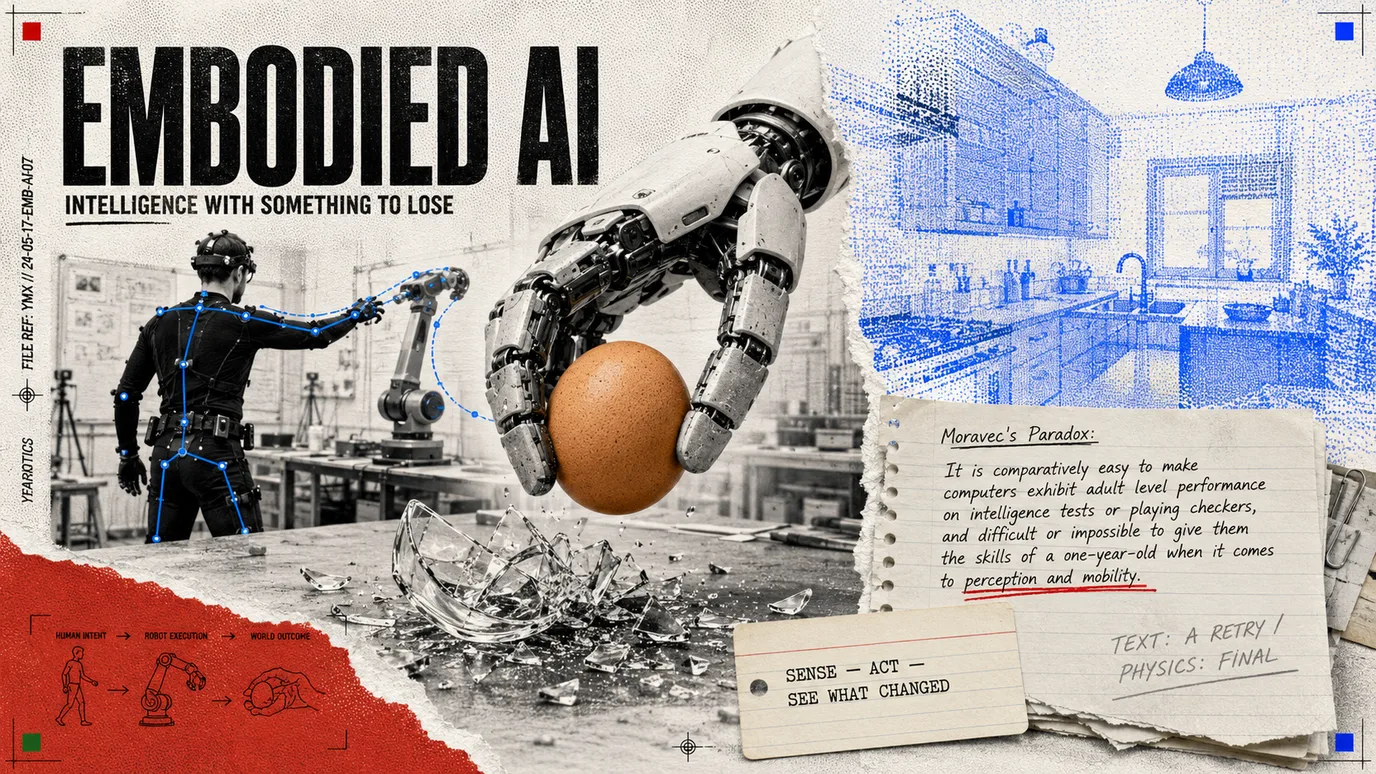
A robot that gets a movement wrong drops the glass, dents the panel or hits the person. There is no regenerate button, the environment has changed as a result of the error, and the next attempt starts from the new state. Everything about how embodied systems are built follows from this: the caution, the safety stops, the human-in-the-loop, the willingness to run at a third of human speed.
Data does not exist in the quantities the method wants
Language models were trained on a corpus humanity had already written. Nobody has written the equivalent for actions. There is no internet-sized archive of “how a hand closes around a mug at the right pressure”, because that data was never recorded; it lived in people’s motor cortex and nowhere else.
Where robot training data comes from, and what each source costs
Each source has a failure mode. Teleoperation gives clean, labelled actions and costs a human hour per robot hour. Simulation is unlimited and free and does not quite match reality, so a policy trained purely in simulation often fails on contact, friction and soft objects. Human video is abundant and carries no joint angles, so the model has to infer what the hands did. Learning from the robot’s own attempts is the most honest and the slowest, which is why reinforcement learning on real hardware was for years a research curiosity rather than a method.
The hard part is the part nobody notices
Moravec’s paradox is the observation that the things humans find hard, chess and algebra, turned out to be easy for computers, and the things humans find trivial, walking across a room and picking up a sock, turned out to be brutally difficult. Thirty years on it still holds. A model can pass a professional exam and cannot fold a towel.
The reason is that human motor skill is the product of a very long training run with a very good body. Perception, balance, grip force and correction happen below the level anyone can introspect, so none of it was ever written down, and it is exactly the part a robot needs.
Closing the loop is what makes it embodied
The property that separates embodied AI from a model that happens to output motor commands is feedback. The system acts, the world changes, the system sees the change and decides what to do next.
That loop is why progress tracking has become a research topic in its own right, and why the numbers are lower than you would expect: Google DeepMind reported 57.4 per cent accuracy for classifying how far through a task a robot is, on live video, in July 2026. Without that, a robot cannot tell the difference between a job done and a job that failed in a way it did not notice.
What it is used for now
Embodied AI is in production in a narrow band: warehouse picking and stowing, inspection by quadrupeds and drones, agricultural machines, surgical assistance under close supervision, and driving, where robotaxis are the largest deployed embodied AI system in the world by a wide margin.
It is in pilots almost everywhere else, and the gap between those two words is where the whole argument sits.
Why the term keeps appearing now
Two things converged. Large multimodal models arrived that can already recognise objects and follow instructions, which removed the perception and language problem robotics had been stuck on. And robot foundation models gave a way to reuse one model across many machines rather than programming each one.
What has not arrived is the data, the hands, or the reliability. Embodied AI is the name for the attempt, not for a solved thing.
More AI
All AI →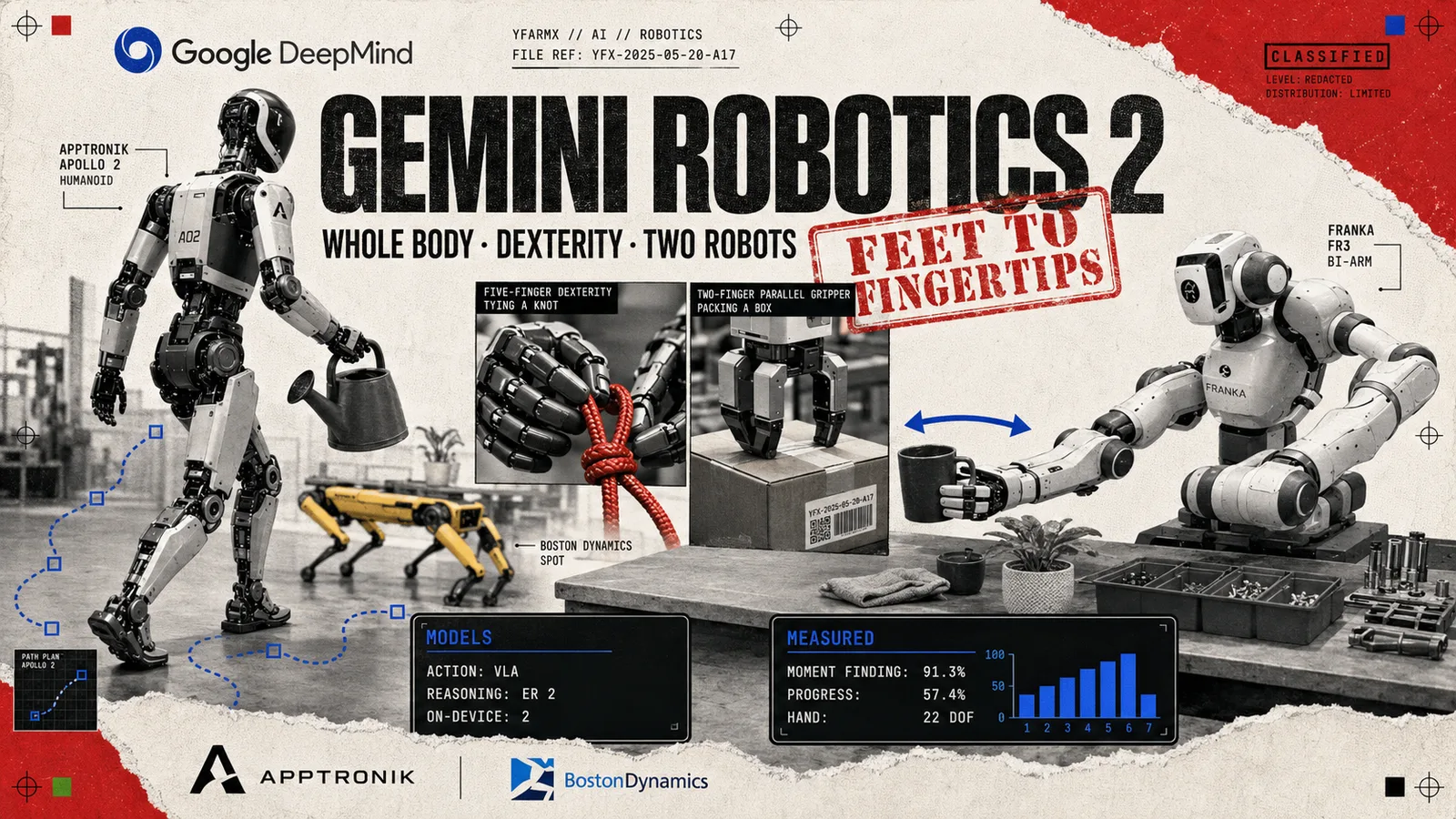
Gemini Robotics 2 takes a humanoid from feet to fingertips
Google DeepMind's new robot models control a full humanoid rather than its upper body, run three different machines from one checkpoint, and let two robots divide a job between them. The company's own results say fine multi-finger work is still the hard part.
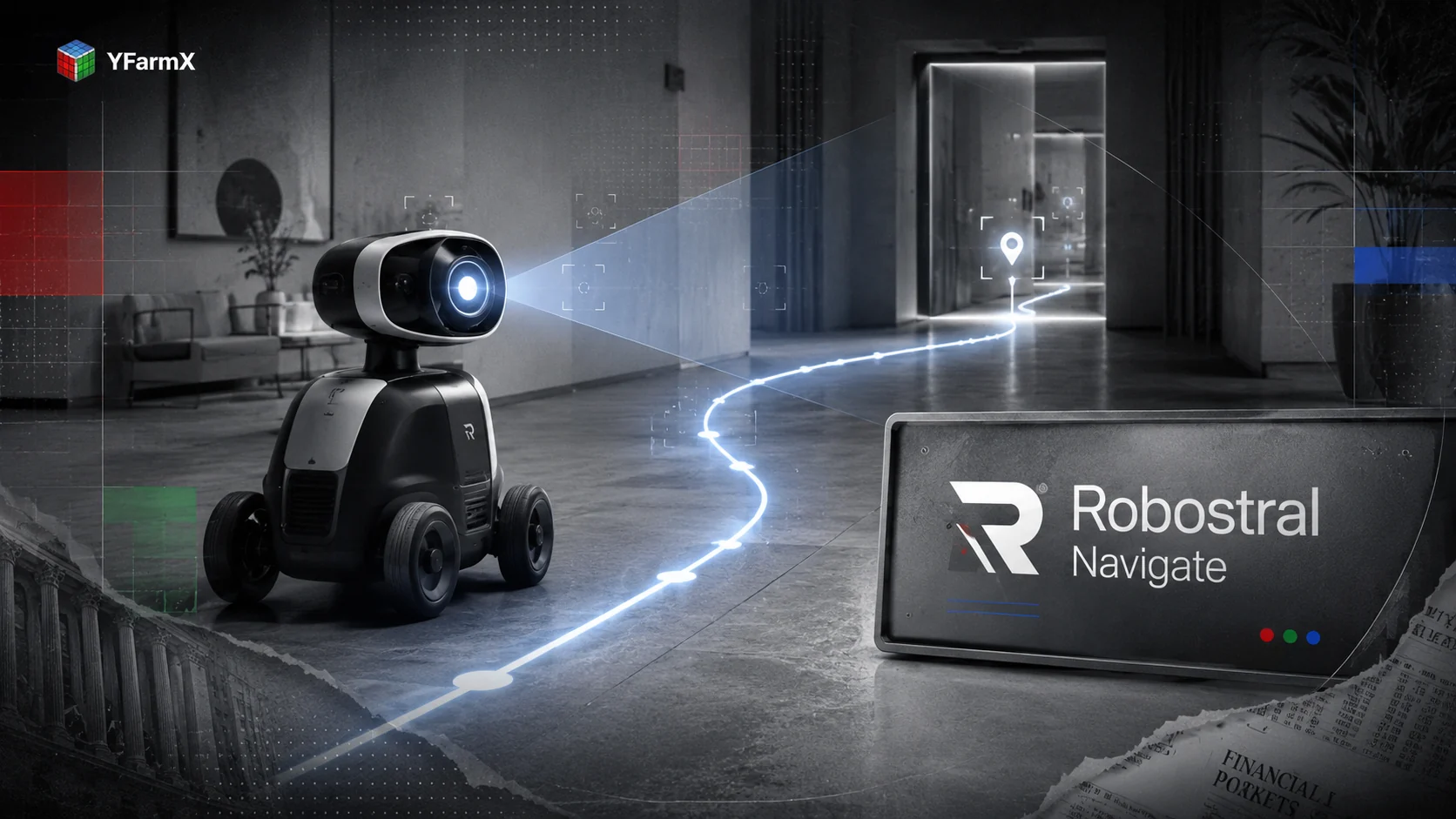
Robostral Navigate marks Mistral's move into embodied AI
Mistral AI released Robostral Navigate on 8 July, an eight billion parameter model that guides robots through natural language task instructions using a single RGB camera.
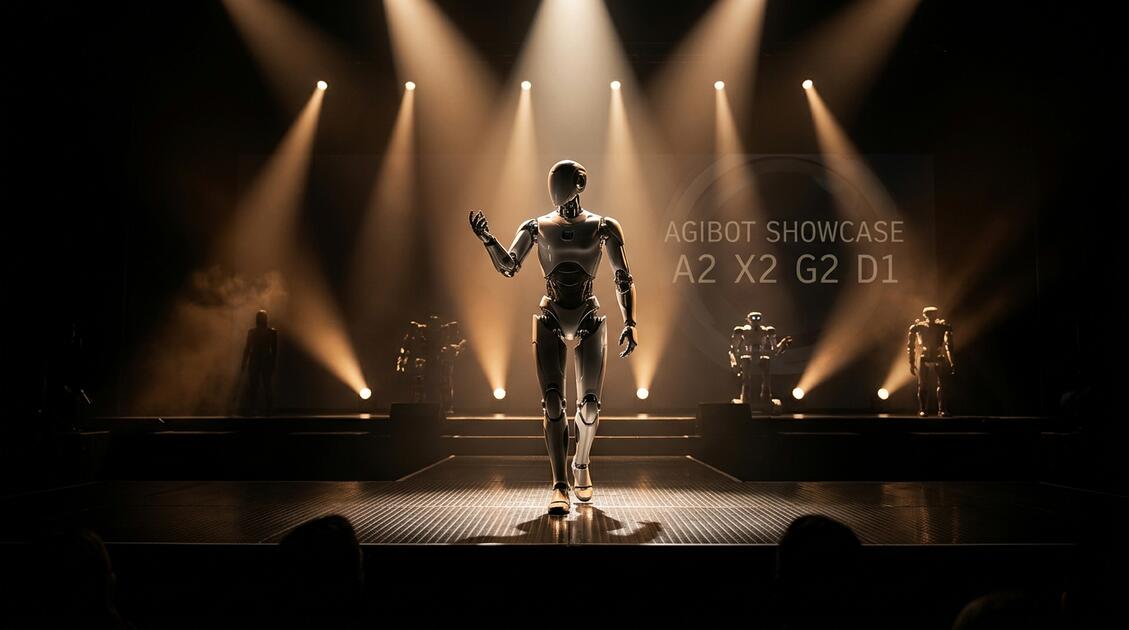
Agibot Stages Live Robot-Led Show Demonstrating Full Humanoid Portfolio at Scale
Chinese startup Agibot staged a live robot-led show featuring over 200 humanoids from its A2, X2, G2, and D1 series performing autonomously under broadcast conditions.
More in Robotics
All Robotics →- Robot foundation modelsone brain, many bodies
- Machine vision and SLAMhow a robot knows where it is
- Teleoperation and robot datathe person inside the demonstration
- Humanoid robotsthe human template, and why every lab is copying it
- Industrial robots and cobotsthe five million machines already at work
- Warehouse automationwhere robots already outnumber the pilots