Robostral Navigate marks Mistral's move into embodied AI
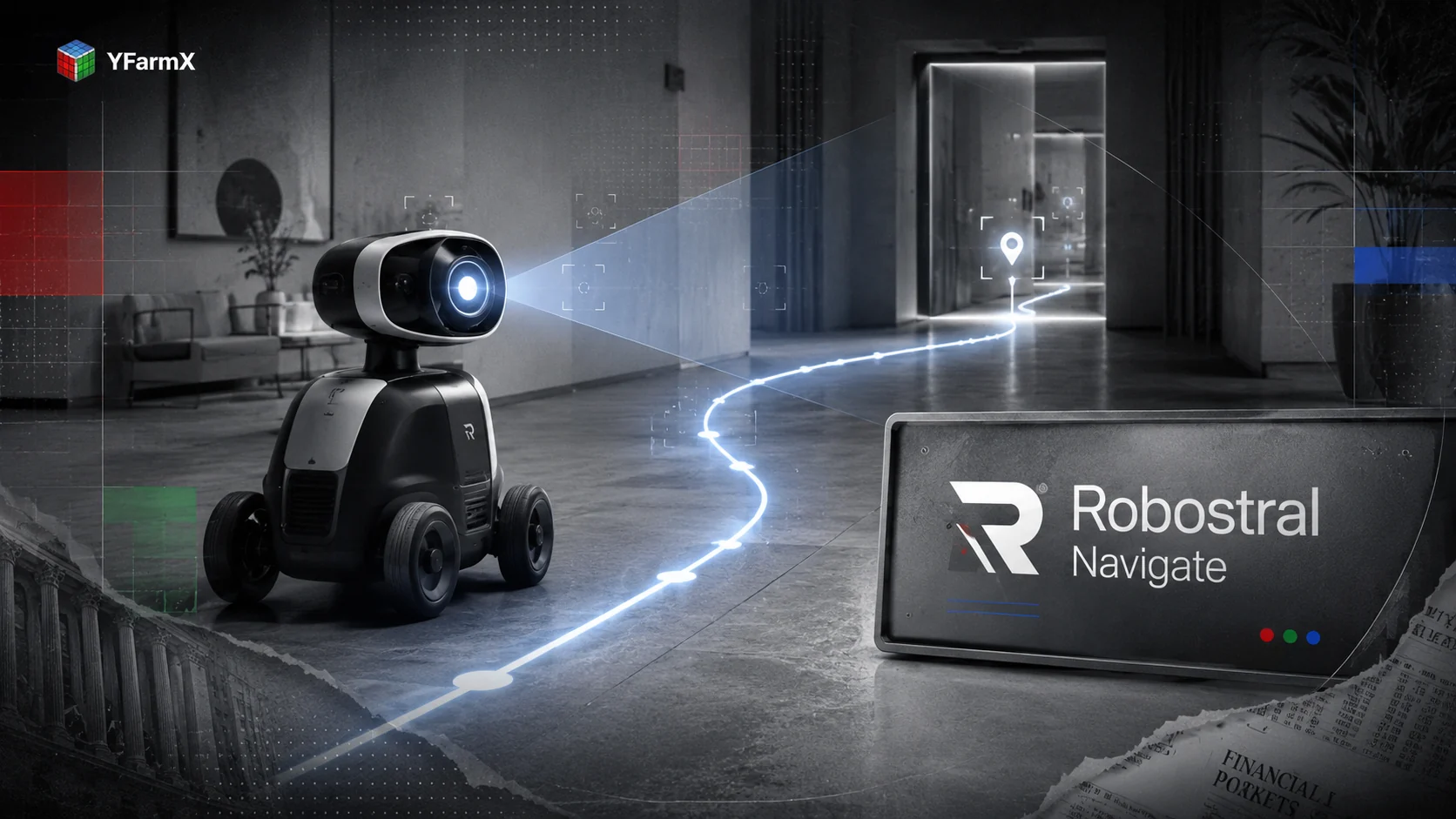
Mistral AI released Robostral Navigate on 8 July, an eight billion parameter model that guides robots through natural language task instructions using a single RGB camera.
Listen to this articleListen
Mistral AI released Robostral Navigate on 8 July, an eight billion parameter model that guides robots through natural language task instructions using a single RGB camera. The company claims leading results on the R2R-CE benchmark, which measures vision and language navigation in continuous environments. Robostral Navigate is Mistral’s first move into embodied AI, and it arrives with open weights.
The technical choice that stands out is the single camera. Much of the robotics field has approached navigation through sensor abundance, combining lidar, depth cameras, inertial measurement and pre-built maps. Robostral Navigate works from one ordinary colour camera and a spoken or written instruction, which removes the sensor cost that keeps most navigation stacks out of low margin deployments. At eight billion parameters it is small enough to run on hardware a robot can carry.
The commercial logic is easier to see than the research logic. Europe has a substantial industrial robotics base, in warehouse automation, agricultural equipment, inspection and logistics, and very little of it is built on American foundation models. A European laboratory shipping an open weight navigation model gives European integrators something they can deploy without exporting operational data or accepting a licence they cannot audit. That argument carries particular weight in France, where the government has pushed a sovereign AI agenda and where SoftBank committed up to 75 billion euros in May to build five gigawatts of AI data centre capacity.
The release was among the most discussed of its week on Hacker News, which for a robotics model from a company best known for language models is a reasonable indicator that the approach is credible to practitioners.
Context helps here. Embodied AI has become an active front across several laboratories in the space of a month. H Company released Holo 3.1 in June, a family of local computer use agent models from 0.8 billion to 35 billion parameters with quantised checkpoints, aimed at screen driving agents running on local hardware. In China, BrainCo unveiled what it describes as the first integrated brain to robot platform, allowing users to control robots through an EEG headset. NVIDIA’s RTX Spark platform, announced at Computex, pairs an Arm processor with a Blackwell GPU and 128 gigabytes of unified memory to target local inference at the edge, which is exactly the deployment envelope a navigation model of this size needs.
The gap between language models and physical systems has been the field’s most persistent disappointment. Models that write competent code have consistently struggled to reason reliably about the physical world, where errors are expensive, feedback is noisy and there is no undo. Benchmarks such as R2R-CE measure progress on a narrow slice of that problem, following a route description through an environment the model has not seen before. Leading it is a meaningful result and not a solution.
For Mistral the release also answers a strategic question about positioning. The company cannot outspend OpenAI, Anthropic, Google or Meta on frontier scale pre-training, and its open weight strategy has been squeezed from below by Chinese laboratories shipping larger models on more permissive terms. Moving into embodied AI, where model size counts for less than latency, sensor economics and deployment constraints, is a sensible use of a smaller balance sheet. It also aligns with a customer base that owns physical assets.
Robostral Navigate should be understood as a first entry, with a great deal still to build around it. A navigation model is one component of a robotics stack, and the difficult parts sit around it: manipulation, safety certification, failure recovery and the unglamorous work of integrating with controllers designed decades ago. What the release establishes is that Mistral intends to compete in a category where European industry already has customers, which is a more defensible position than competing for the top of a chat leaderboard.
The weights being open means independent researchers can verify the R2R-CE claim, which is more than can be said for most robotics announcements this year.
Sources
- Mistral AImistral.ai
- Mistral AImistral.ai
- Xx.com