
Drones and airspace rules
the sky is the regulated part
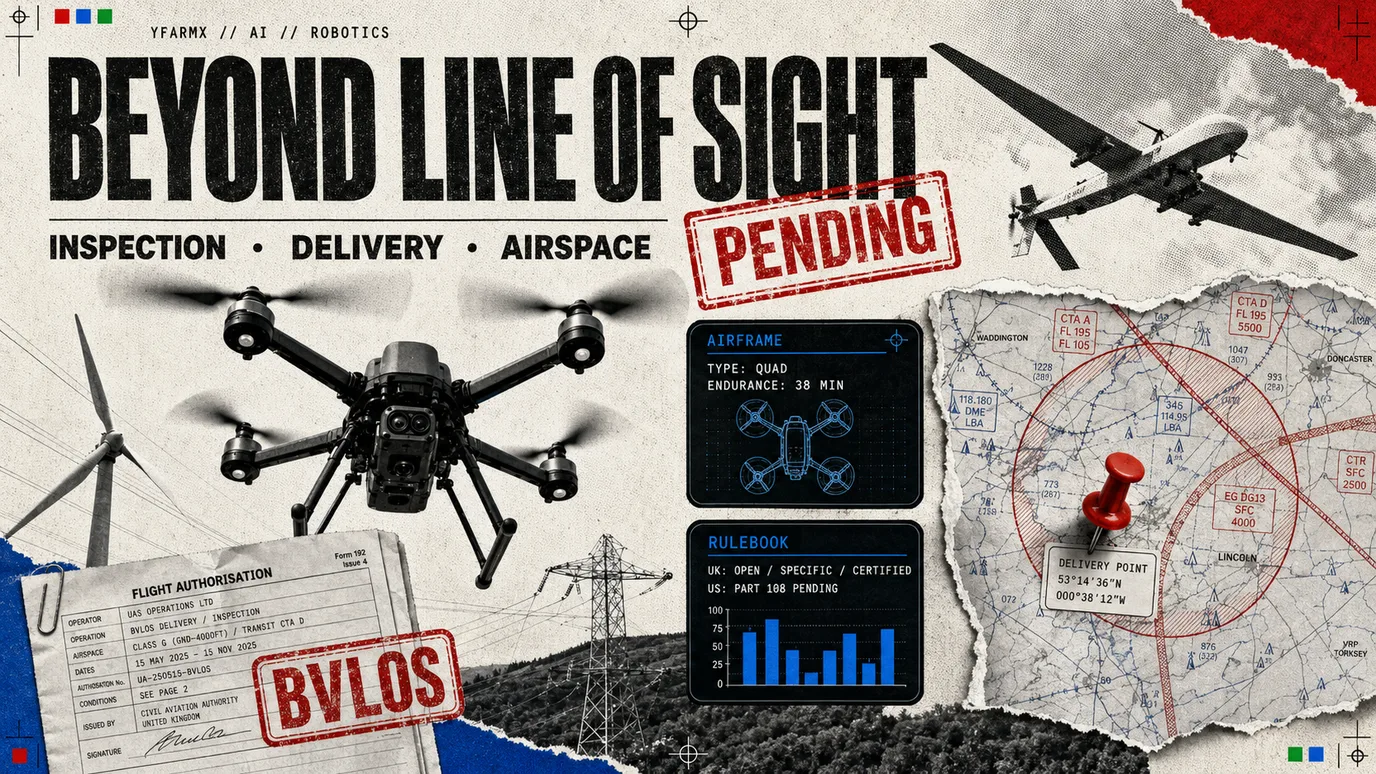
Key facts
- 3 tiersopen, specific, certified
- UK rulebook
- 108at OIRA July 2026
- US new part
- 1,320 lbproposed part 108
- Weight cap
- 2027routine BVLOS
- UK target
The technology is ready and the airspace is not. Everything about the drone industry turns on one phrase: beyond visual line of sight.
A drone is the most capable robot an ordinary person can buy. It navigates, stabilises itself in wind, follows a subject, returns home on low battery and lands on a spot it chose. It is also the most tightly constrained robot in existence, because it operates in airspace, and airspace has been regulated for a century by authorities whose first duty is to the aircraft with people inside them.
Everything interesting about the drone industry is downstream of one phrase.
Beyond visual line of sight
Fly a drone while you can see it and you are the safety system: you notice the helicopter, you see the tree, you keep clear of the crowd. Fly it beyond the point where you can see it, and something else has to do that job.
That is why BVLOS is the whole argument. Inspecting a 40-mile pipeline, delivering to a village, surveying a coastline or covering a large farm all require it, and none of them are possible if the operator has to stand within sight of the aircraft.
What has to be solved to allow it:
- Detect and avoid. The aircraft must sense other traffic and get out of the way, using onboard sensors, ground radar, or electronic conspicuity where every aircraft broadcasts its position.
- Command and control reliability. The link has to be good enough that losing it is rare and handled safely.
- Traffic management. Something has to deconflict many uncrewed aircraft sharing low airspace, which is what unmanned traffic management systems are for.
- Risk assessment. A regulator has to be satisfied that the whole arrangement is safe over the specific ground it flies across.
Three rulebooks
Where each regulator has got to
The UK runs a three-tier system: an open category for low-risk flying with no authorisation, a specific category where an operator gets authorisation after a risk assessment, and a certified category for the highest-risk operations, which is closest to how crewed aviation is regulated. The Civil Aviation Authority’s route to routine BVLOS runs through demonstrations first, with routine operations targeted for 2027, and its atypical air environment policy already permits some BVLOS work close to infrastructure such as power lines and wind turbines, where the airspace is unlikely to contain anything else.
The EU uses the same three categories, harmonised across member states through EASA, with the specific category reached via standard scenarios, predefined risk assessments or a full specific operations risk assessment. Doing the risk assessment properly is the work.
The US has run on part 107 with waivers for years. The proposed part 108, published on 7 August 2025, would create a standing framework for BVLOS covering aircraft up to 1,320 pounds, together with a new part 146 for the third parties providing traffic services. The final rule reached the White House regulatory review office on 10 July 2026 and is pending review; nothing changes until it publishes and takes effect.
What drones are actually used for
Under the current rules, the working applications are the ones where the flight is short, visible or over ground nobody is standing on: infrastructure inspection, surveying and mapping, agriculture, filming, search and rescue, and police work. Delivery exists, and it exists inside specific approvals in specific corridors, which is why it appears as a service in a named suburb rather than as a national option.
Defence is the other half of the field and follows a separate rulebook entirely, which is why capability there ran ahead of anything civil aviation would permit.
The technology is not the hold-up
A modern drone already does the hard robotics: visual-inertial odometry to know where it is, obstacle avoidance, path planning, autonomous return. The constraint is a regulator’s duty to everything else in the sky, plus a public that gets a vote on machines flying over their houses.
That is worth stating clearly, because it is the opposite of the position humanoids are in. Humanoid robots have permission and lack capability. Drones have capability and lack permission.
More in Robotics
All Robotics →- Machine vision and SLAMhow a robot knows where it is
- Robot safety standardsthe rules that decide what can be sold
- Embodied AIintelligence with something to lose
- Humanoid robotsthe human template, and why every lab is copying it
- Robot foundation modelsone brain, many bodies
- Industrial robots and cobotsthe five million machines already at work