
Industrial robots and cobots
the five million machines already at work
Key facts
- 132robots per 10,000
- Global density
- 1,220world's highest
- Korea
- ~2 munits in service
- China stock
- 38,400+12% · 2025 final
- US installs 2025
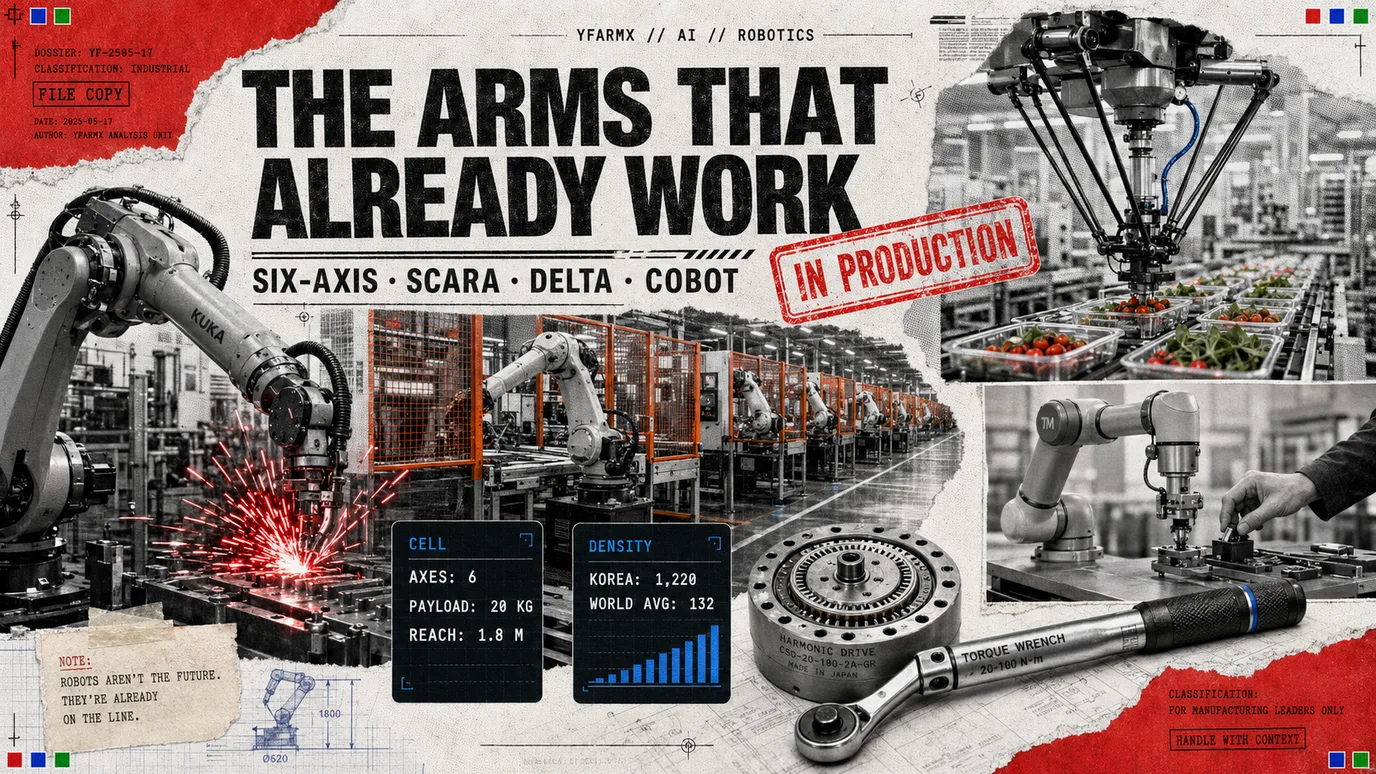
The arms and cells that already do the work: high-speed machines behind fences, and slower collaborative ones that share a bench with people.
While the humanoid field runs demonstrations, industrial robots do the work. They are the least glamorous part of robotics and by a very long way the largest: millions of arms welding, painting, packing and placing components, most of them installed before anyone used the phrase embodied AI.
The forms, and what each is for
An articulated arm is the classic six-axis robot, a shoulder, elbow and wrist that can reach any position and orientation inside its envelope. It is what a car body is welded by.
A SCARA arm is stiff vertically and compliant horizontally, which makes it fast and precise at putting things into other things: electronics assembly, screwdriving, pick and place.
A delta robot hangs from above on three arms and moves very light objects very quickly, which is why it is over a food packing line.
A cartesian or gantry robot moves along straight rails and scales to whatever size the rails are, from a bench to a shipyard.
A cobot, in the everyday sense, is a smaller, slower arm designed to work next to a person without a cage, using force limits and sensing so that contact does not injure. The word is doing less technical work than it looks: safety comes from the application and the risk assessment, not from a label on the box.
How big is the field, really
The International Federation of Robotics is the trade body that counts, and its World Robotics data is the reference series. Its figures published in April 2026, covering 2024, put global robot density at 132 units per 10,000 manufacturing employees.
Robot density, units per 10,000 manufacturing employees
The distribution says more than the average. Korea leads on 1,220 units per 10,000 employees, growing about 7 per cent a year since 2019 on the back of its electronics and car industries. The United States sits eighth at 307. Western Europe reached a record 267, up 3 per cent, with eight countries in the global top 20. Asia averages 131, up 11 per cent.
China is the outlier that the density figure hides. Its density of 166 puts it 22nd in the world, because its manufacturing workforce is enormous. Its operational stock is about 2 million units, roughly four and a half times Japan’s, and 54 per cent of every industrial robot installed worldwide in 2024, some 295,000 units, went to China.
The IFR’s final 2025 figures, published on 24 September 2026, put US installations at 38,400, up 12%. Automotive bought 13,500, down 1%; food manufacturing bought 2,900, up 30%. Worldwide, the IFR reports more than 600,000 new industrial robots in 2025, up 11%, taking the installed fleet to about five million.
What changed in the safety standard
ISO 10218 is the flagship safety standard for industrial robots, and its 2025 revision was the first substantial one in more than a decade. Two changes are worth knowing.
It introduced a formal classification of robots into Class I and Class II, splitting lower-risk machines from those that are higher risk by design, capability or intended environment. And it absorbed the collaborative-operation material that had lived in the technical specification ISO/TS 15066, folding collaborative applications into the main standard rather than treating them as a bolt-on.
The practical effect is that “collaborative robot” stopped being a product category and became a property of an application. A small arm can be unsafe with a sharp tool at speed; a large arm can be safe if it is properly guarded, sensed and speed-limited for the job. The safety standards explainer goes through the machinery of how that is assessed.
Where AI is actually entering
Very little of the installed base runs a neural network for motion. The arm follows a program, because the program is deterministic, certifiable and fast, and there is no business reason to replace it.
AI is arriving around the edges. Vision systems that locate a part that arrived at the wrong angle. Bin picking, where the contents are unpredictable by definition. Quality inspection. Predictive maintenance on the drives. Programming by demonstration, where a person moves the arm through a task instead of writing coordinates.
The interesting frontier is the one Figure demonstrated at BMW Group Plant Spartanburg in June 2026: sequencing, meaning selecting and presenting parts in the right order for an assembly line, which is the kind of job that defeats a fixed program because the parts do not arrive in perfect orientation. That is the wedge a general-purpose machine gets into a factory through, and it is not the welding cell.
The economics that decide everything
An industrial robot is bought against a payback period. The arm is often the cheaper half: integration, tooling, guarding, programming and commissioning routinely cost more than the machine. That total is why automation concentrates in high-volume, low-mix production, where the cost is amortised across millions of identical parts.
Every attempt to widen robotics beyond that, warehouses, humanoids, foundation models, is an attempt to attack the integration cost rather than the hardware cost. If a robot can be shown a job instead of programmed for it, the calculation changes for every small manufacturer who could never justify the engineering.
More AI
All AI →
Europe gives robot makers two more years on its AI rules
The AI Omnibus entered into force on 27 July, six days before the AI Act's high-risk duties were due to apply. For AI built into machines, including industrial and humanoid robots, those duties now start on 2 August 2028.
More in Robotics
All Robotics →- Warehouse automationwhere robots already outnumber the pilots
- Robot safety standardsthe rules that decide what can be sold
- Automation and jobswhat the numbers actually support
- Humanoid robotsthe human template, and why every lab is copying it
- Robot foundation modelsone brain, many bodies
- Embodied AIintelligence with something to lose