
America's beyond-line-of-sight drone rule reaches its last desk
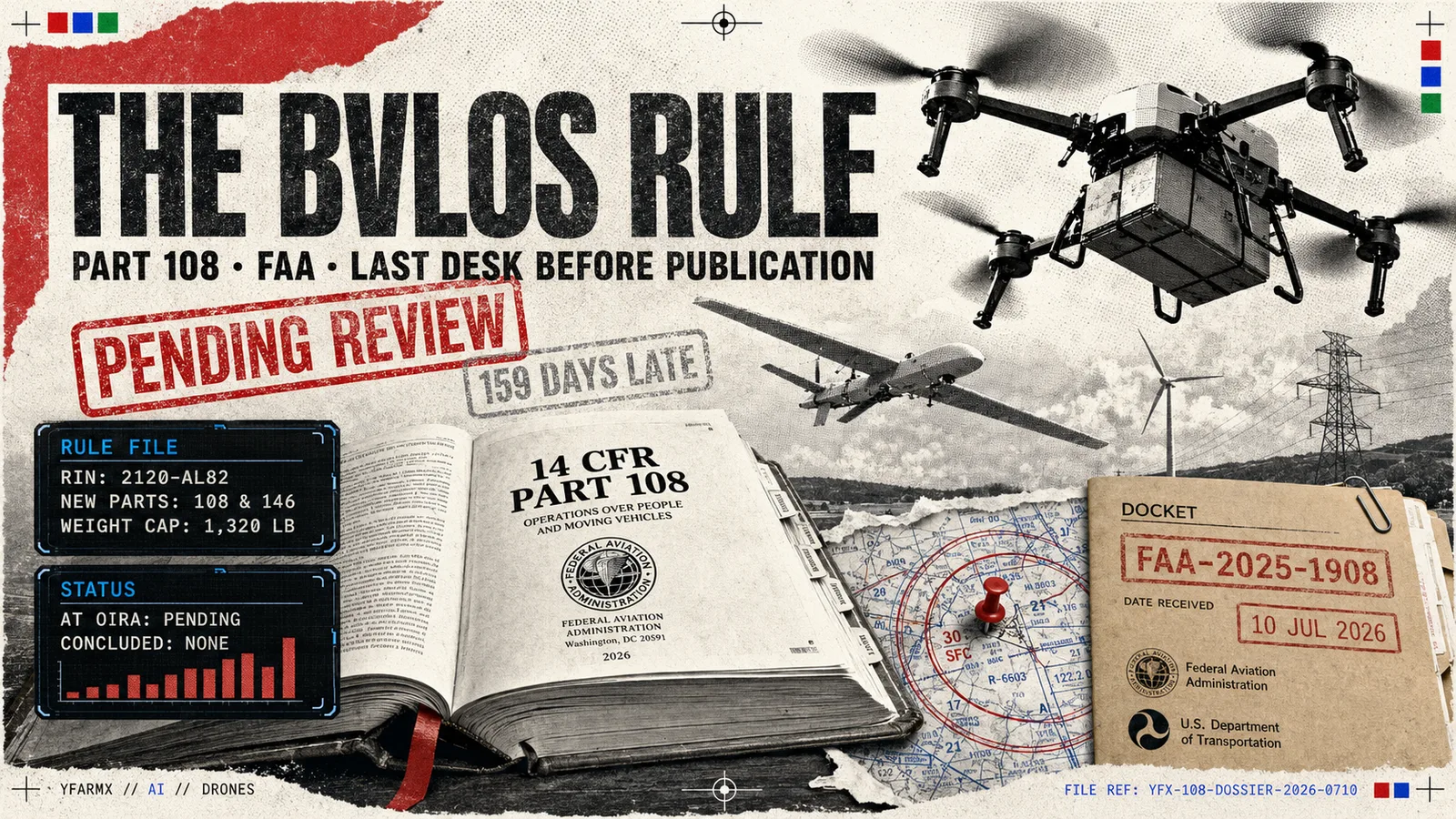
The FAA's final rule for routine drone flights beyond visual line of sight arrived at the White House regulatory review office on 10 July, 159 days after the deadline set for it by executive order and eleven months after the proposal was published.
Listen to this articleListen
Almost every drone doing useful work in American airspace today is flying under an exception. Inspecting a pipeline, surveying a roof, delivering a prescription: if the aircraft goes further than the operator can see, somebody has applied for a waiver, and the Federal Aviation Administration has granted it one flight profile at a time. On 10 July the rule written to end that arrangement reached the last office it has to pass through before it can be published.
The Office of Information and Regulatory Affairs, the White House unit that reviews significant federal rules, recorded the FAA’s final rule on beyond visual line of sight operations as received on 10 July 2026 and pending review. Its own record shows no conclusion date yet, which is the ordinary state of a rule that has just arrived.
What part 108 would do
The proposal, published on 7 August 2025 and running to 180 pages of the Federal Register, does something more structural than loosening a restriction. It creates a new part 108 of the air rules covering the flights themselves, and a new part 146 covering the third parties that would provide traffic services to them, including the traffic management systems that keep uncrewed aircraft apart from each other at low altitude.
The aircraft in scope are those weighing up to 1,320 pounds including anything attached or carried, a threshold that takes in far more than camera quadcopters. Instead of a waiver per operation, an operator holding an airworthiness acceptance and the right approval would fly beyond visual line of sight routinely, under performance-based rules rather than case-by-case permission. The Transportation Security Administration is proposing parallel changes so that moving these flights into part 108 does not leave a security gap in its own regulations.
Eleven months, two comment windows, one missed deadline
The timetable is the part worth following, because it says something about how hard the drafting has been.
Executive order 14307, signed on 6 June 2025, told the Secretary of Transportation to issue a proposed rule within 30 days and directed that “a final rule shall be published within 240 days of the date of this order, as appropriate”. Two hundred and forty days from 6 June 2025 is 1 February 2026. The FAA hit the first instruction and published its proposal on 7 August 2025. It missed the second.
The first comment window closed on 6 October 2025. Then, on 28 January 2026, the agency reopened comments on two specific topics: electronic conspicuity, meaning how an uncrewed aircraft makes itself visible to everything else in the sky, and right of way, meaning who yields to whom when they meet. That window closed on 11 February 2026. Reopening a comment period on two narrow questions five months after the main one closed is the sign of a rule whose hardest problems were the ones about sharing airspace with crewed aviation, not the ones about the drones.
From the executive order to the rule landing at OIRA is 399 days. From the deadline to the rule landing at OIRA is 159.
What happens next, and what does not
OIRA review is not a formality, but it is also not a rewrite. The office can conclude the review consistent with the agency’s submission, ask for changes, or return the rule. Nothing publishes until the review concludes, and OIRA’s review clock for a significant rule can run to 90 days, with extensions available. A published final rule normally then carries its own effective date some months later, and the airworthiness acceptance process it sets up has to be stood up before any operator can use it. The practical effect on flights is a 2027 story even on a clean run from here.
Britain is taking a different road to the same place
The UK has no equivalent in force either, and the Civil Aviation Authority has been open that its own path runs through demonstrations first. Its published work on beyond visual line of sight operations sets out a delivery model with routine operations targeted for 2027, and its atypical air environment policy has already carved out the easier cases, where a drone flies close to infrastructure such as a power line or a wind turbine and the airspace around it is unlikely to hold anything else.
The two regulators are solving the same problem in a different order. The FAA has written one large horizontal rule and is now discovering how long a large horizontal rule takes to clear review. The CAA is enabling narrow categories where the risk case is easy, then widening. Neither approach has yet produced a country where a delivery company can fly out of sight without asking first.
The rule is not the bottleneck the industry thinks it is
Operators have spent three years describing the waiver system as the thing holding drone logistics back, and the arrival of a final rule at OIRA will be read as the end of that. It is worth being precise about what is being unblocked. Part 108 replaces permission with standards, and standards have to be met: detect-and-avoid equipment that works, an operational approval, and traffic services that exist as businesses under part 146. The waiting has been for a rulebook. The next wait is for the equipment and the services the rulebook will require, and that one nobody can shorten by signing a document.
For how uncrewed aircraft are built and regulated, see the explainer on drones and the airspace rules, and the drones desk for continuing coverage.