China has started issuing skill certificates to robots
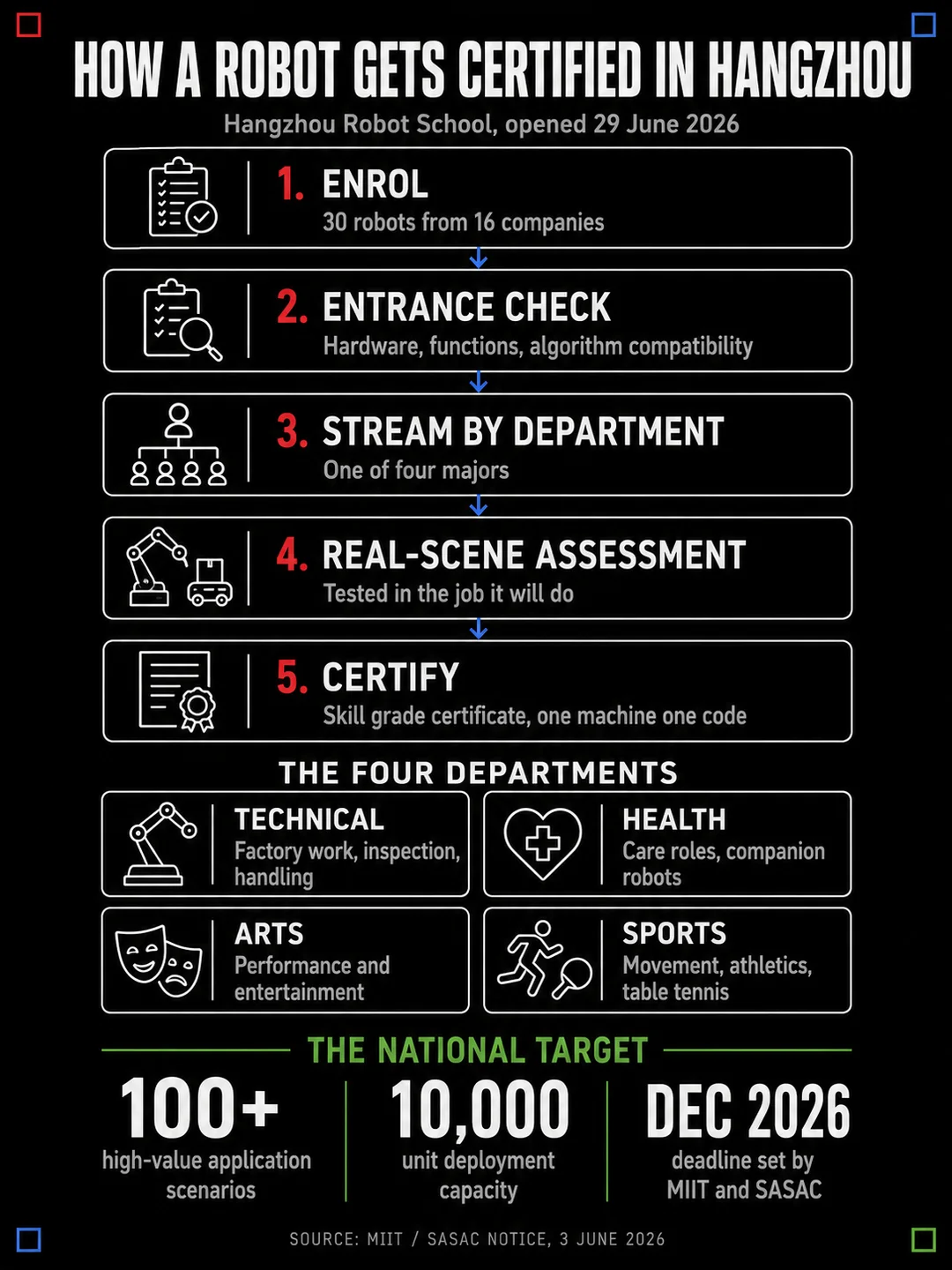
Thirty machines from 16 companies enrolled at the Hangzhou Robot School on 29 June. They sit an entrance check, train in one of four departments, take a real-scene assessment, and leave with a graded certificate and a code tied to the individual machine.
Listen to this articleListen
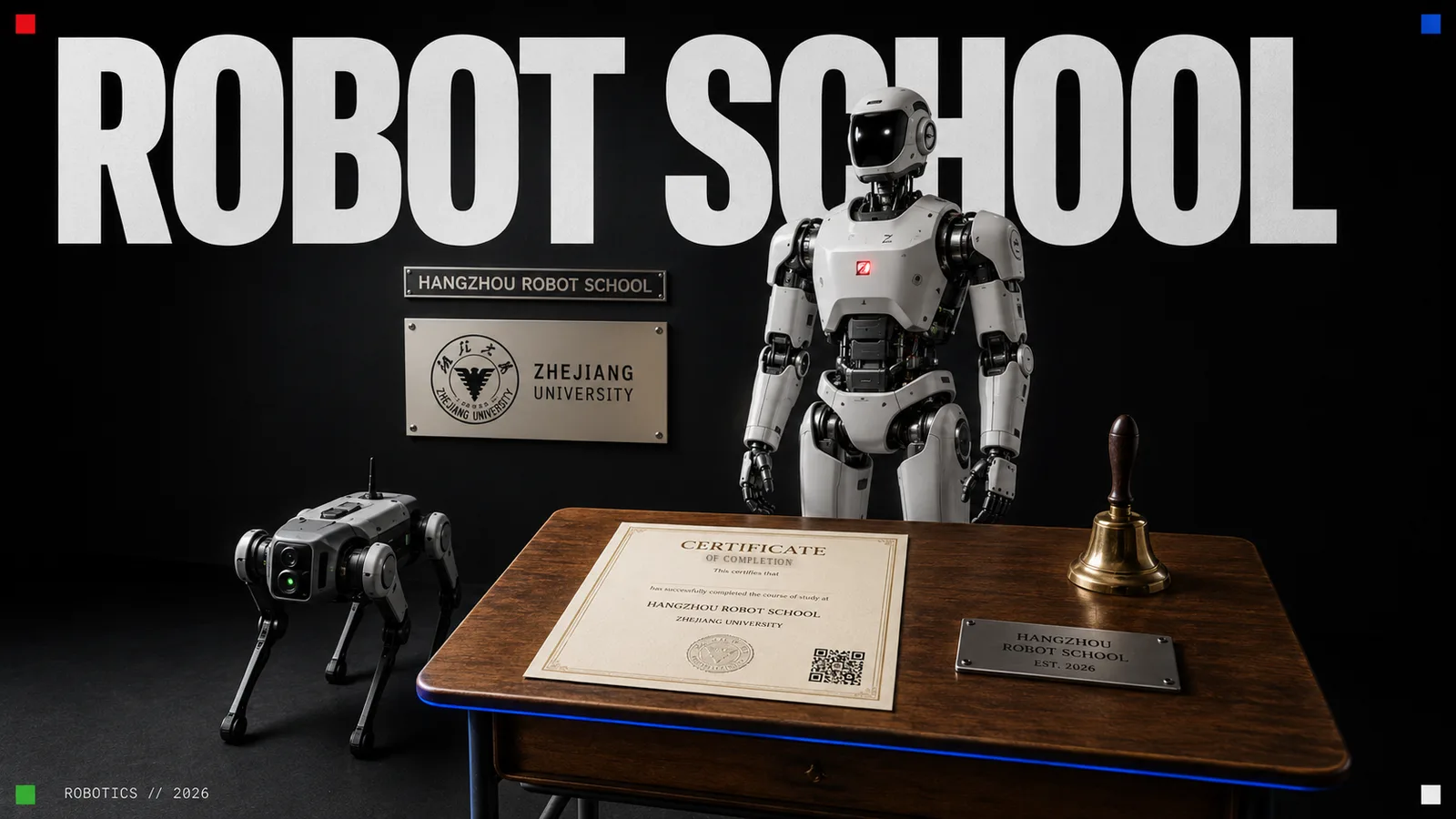
On 29 June, thirty robots reported for their first day at a school on Fangyun Street in Yuhang district, Hangzhou. Sixteen companies sent them. There are no human students on the roll.
The Hangzhou Robot School is led by the Zhejiang University Robotics Institute, working with the Zhejiang Institute of Quality Science and the Hangzhou Chengxi Sci-Tech Innovation Corridor. The second of those names is the one to read twice. A quality science institute is a standards and testing body, and its presence tells you what the school is for. This is not a research lab teaching robots to be cleverer. It is an assessment centre, built to decide which machines are fit to be put to work and to write that decision down.
The intake is mixed. The thirty machines include humanoid robots and quadrupeds, drawn from industrial, service, security and entertainment work. Each one goes through what the school calls an entrance physical, covering hardware performance, functional completeness and the compatibility of its algorithms with the training stack. Only then is it streamed into a department.
Four departments, borrowed wholesale from the vocational system
The structure copies China’s own further education vocabulary rather than inventing a new one, which is a deliberate choice: an employer already knows what these words mean.
The four are 技校, the trade school, for factory work, inspection and handling; 卫校, the nursing school, for care roles and companion machines; 艺校, the arts school, for performance and live shows; and 体校, the sports school, for movement quality and athletics.
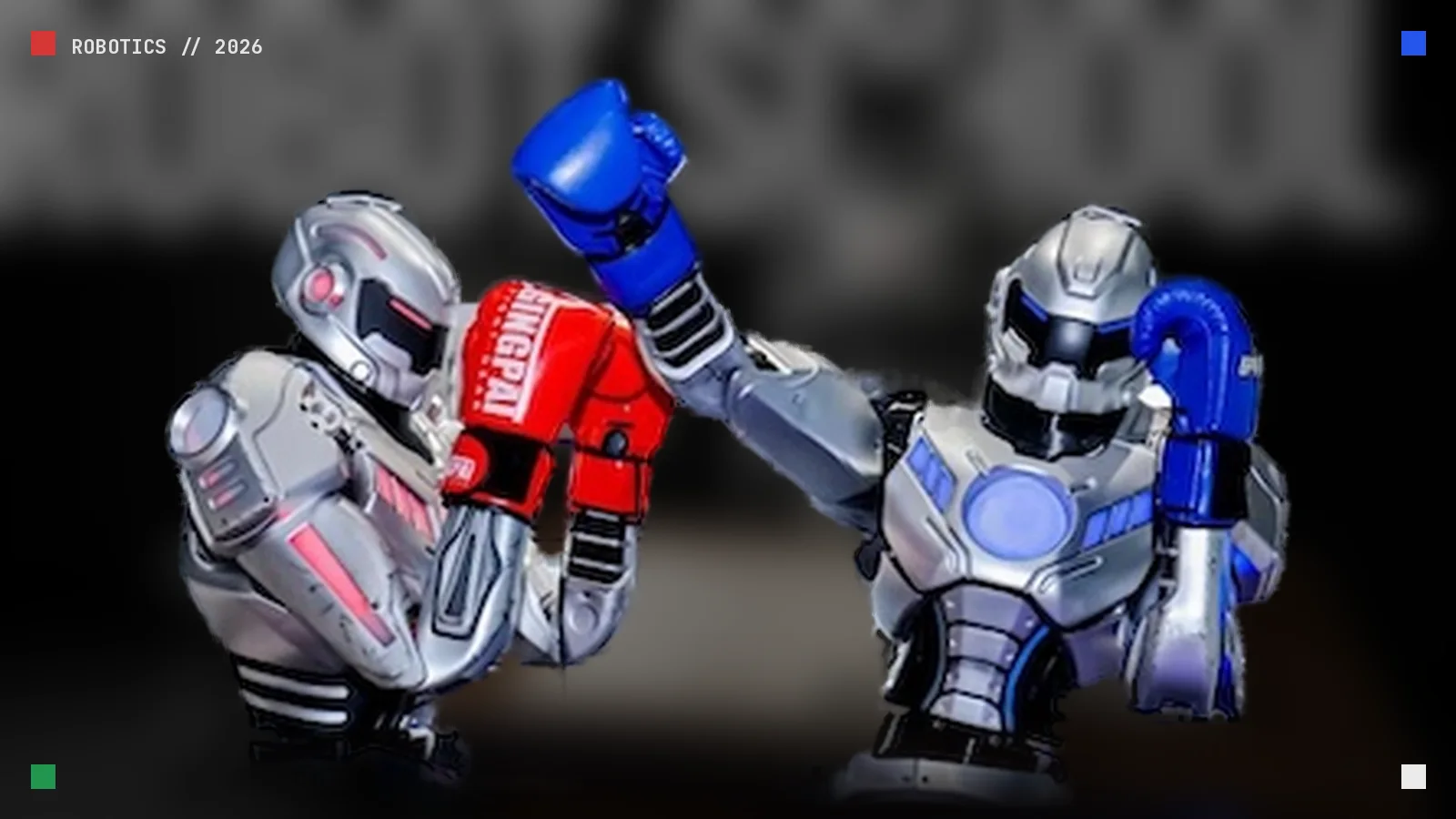
The sports department is not a joke. Combat and athletics machines are a real category of Chinese robot, and they train on movement quality the way the trade school trains on handling.
Reported examples give the flavour. A table tennis robot works on reading ball trajectory and executing a stroke. A companion machine works on recognising when a person is distressed and responding to it. A guide robot works on navigation and adapting to a building it has not seen before. A dancing robot arrives with the moves already in it and is trained to make them cleaner.
The sequence at the end is where the school differs from every robotics demonstration of the past two years. A machine that passes its real-scene assessment receives a Specialised Skill Grade Certificate, and the certificate is bound to a per-machine identifier under a scheme the school describes as one machine, one code. The certificate follows the individual robot rather than the model line, so a fleet operator can point at a specific serial number and say what it was assessed to do, and when.
The brain that made the school possible
The teaching is not fine-tuning in the ordinary sense. Zhu Shiqiang’s team at the Zhejiang University Robotics Institute disclosed a system called WJ-Brain (无际大脑) in May, and the school is built around it. It takes the standard vision-language-action stack and inserts a logical reasoning layer, producing a longer loop: perception, interaction, understanding, cognition, reasoning, instruction, execution. On top of that sits a framework the institute calls VL2A, used to build what it terms a logical brain for a specific job.
The claim is that a robot can work out physical constraints and anticipate the consequence of an action before committing to it, rather than replaying a memorised response. Zhu put it as a line from classical Chinese: 知其然,更要知其所以然。这个“所以然”,就是大脑的核心。Knowing that something is so is not enough, you have to know why it is so, and the “why” is the core of the brain. His institute frames the shift as moving from reciting the answer to solving the problem.
Whether the reasoning layer delivers that is an empirical question the school has not answered in public. What it has built is the assessment scaffolding around the claim, which is the harder half.
Beijing set the deadline three weeks before the school opened
The timing is not a coincidence. On 3 June the Ministry of Industry and Information Technology and the State-owned Assets Supervision and Administration Commission issued a joint notice launching a 2026 special action on real-scene training for humanoid robots and embodied AI. The targets are specific: over 100 high-value application scenarios refined by the end of 2026, and the capacity to deploy at ten-thousand-unit scale.
The notice covers three domains, industrial, service and special operations, and names the work it wants covered inside them: production and manufacturing, inspection and analysis, maintenance and repair, warehousing and logistics, catering and retail, medical care, workplace safety, emergency rescue and disaster response. Provincial industry departments in Beijing, Tianjin, Shanghai, Jiangsu, Zhejiang, Shandong, Hubei, Hunan, Guangdong and Sichuan, along with named central state-owned enterprises, were told to nominate at least twenty real-scene units each, covering a minimum of two of the three domains. Work plans were due by 30 June. Summaries of what actually happened are due by 30 November.
It also asks for something the labs find harder than the demonstrations: high-quality embodied AI datasets covering motion trajectories, force-position control curves and task execution sequences. The training data problem, written into a government document as a deliverable.
The school is one building in a much larger estate
Hangzhou already runs the National Pilot Base for Embodied AI Applications, which opened for trial operation on 16 May. It houses more than 140 robots working across over 40 job-shaped scenarios, including smart kitchens, warehouses, farms and a mock mine, with nearly 40 embodied AI companies and more than ten universities and research institutes on site. Robots there learn partly by being teleoperated by technicians wearing motion-capture suits and data gloves, with successful movements recorded by sensors and kept as teaching material.
The operational numbers coming out of it are modest and real, which makes them more useful than a launch video. A fifteen-robot traffic squadron deployed since 1 May has delivered more than 3,500 voice reminders a day and logged over 10,000 operating hours. A robotic hand from DexRobot completed one million full-load cycles in durability testing. Zhou Chen, DexRobot’s chief executive, described the base as a library for robotics, where you go because everything you need is on the shelves.
Beijing runs a comparable programme through its Innovation Centre of Humanoid Robotics, covering chip assembly, laboratory work and household tasks, and Shanghai’s Zhangjiang Robot Valley opened a 10,000 square metre training facility in mid-2026.
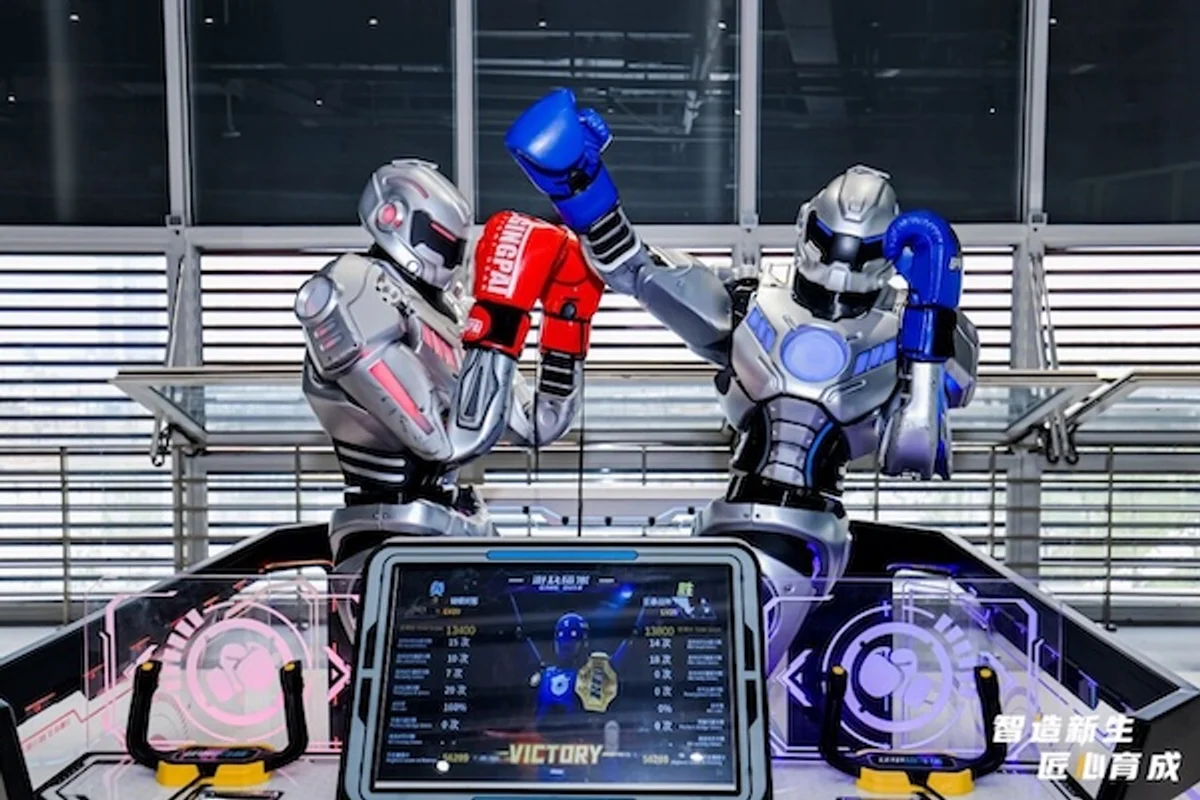
The exhibition circuit these machines come from. Scoring, ranking and a printed result are already normal in Chinese robotics; the school applies the same habit to work rather than to a bout.
What the certificate does not carry
The Specialised Skill Grade Certificate is a scheme document issued by a provincial institute and a university. It is not a national occupational licence, it appears in no published national standard, and no legal duty attaches to holding one. No pass rate has been released from the first cohort, the assessment criteria for the four departments are unpublished, and the sixteen supplying companies have not been named as a group.
There is also a distance between the language and the engineering. Streaming a machine into an arts department or a health department is a naming convention laid over what is still job-specific adaptation of a model. Calling it a curriculum makes it legible to a factory manager. It does not make the underlying capability different from what any lab does when it specialises a policy for a task.
A certificate is an insurance question wearing a school uniform
The interesting part of Hangzhou is administrative, and administration is exactly what has been missing. Every humanoid programme of the past three years has been able to produce a video of a machine doing a task once. None has been able to hand a factory manager a document saying this specific unit was assessed against these tasks on this date, by a body that is not the manufacturer, with an identifier that survives the machine changing owner.
That document is what an insurer asks for, what a health and safety inspector asks for, and what a procurement officer needs before signing. China has now started producing it, and has bound its production to a December target measured in units deployed rather than papers published. Robot safety standards in Europe and the United States still assume a machine that is fenced off from people and does one thing. The first country to write a competence certificate for a general-purpose machine gets to decide what the certificate says.
Sources
- MIIT and SASAC, Notice on jointly conducting the 2026 humanoid robot and embodied intelligence real-scene training special action (3 June 2026)miit.gov.cn
- Xinhua, MIIT and SASAC launch the 2026 humanoid robot and embodied intelligence real-scene training special actionnews.cn
- China News Service, China's first robot school opens in Hangzhou (1 July 2026)ecns.cn
- Yicai, Zhejiang's first robot school opens, streaming intelligent brains by department (29 June 2026)yicai.com
- People's Daily Online, Lab meets real world at China's robot vocational school (1 August 2026)en.people.cn
- Global Times, China's robot academies turn showbots into industrial workersglobaltimes.cn