
Solana's upgrade makes transactions final 20 times faster in testing
Solana's devnet switched from TowerBFT to the Alpenglow consensus protocol on 25 September 2026, a day after testnet, Anza confirmed. Validators now send votes directly to each other, and Solana targets finality of about 150 milliseconds against 12.8 seconds under TowerBFT.

Listen to this articleListen
Anza, the company behind Solana’s Agave validator software, confirmed at 20:01 UTC on 25 September 2026 that Solana’s developer network had switched to Alpenglow, a new consensus protocol, at slot 504,148,999. TowerBFT, the system Solana’s validators have used to vote on blocks, is retired on that network. Solana’s official account posted at 21:09 UTC: “Alpenglow is live on devnet”.
Devnet is the public network where app developers test their programs before they reach mainnet-beta, the network that carries real SOL. It is the second of Solana’s three public networks to switch, a day after testnet. Alpenglow’s voting protocol, Votor, has validators send votes straight to each other, and Solana’s upgrade page targets finality, the point at which a transaction can no longer be reversed, of roughly 150 milliseconds, down from about 12.8 seconds.
How did devnet make the switch?
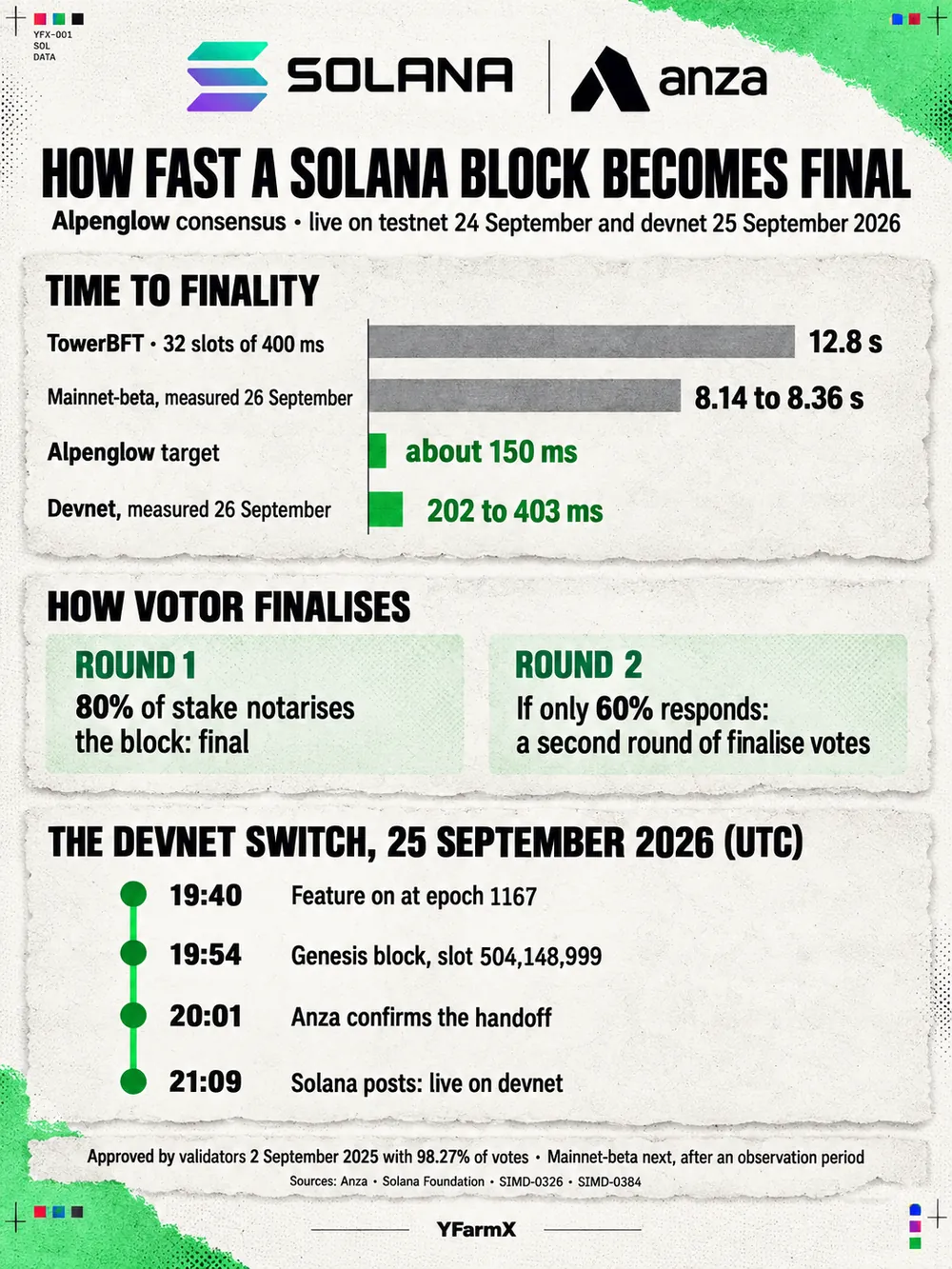
Devnet went from TowerBFT to Alpenglow blocks in about 14 minutes on 25 September 2026, following the migration rules in SIMD-0384. The Alpenglow feature switched on at the start of epoch 1167, slot 504,144,000, at 19:40:38 UTC by the network’s own block times. The rules then count 5,000 slots to a migration boundary and have each validator sign a “genesis vote” for the last TowerBFT block before it. Once genesis votes from 82 per cent of stake arrive, that block becomes the Alpenglow genesis block and Votor takes over.
Devnet’s genesis block is slot 504,148,999, stamped 19:54:25 UTC, and the first Alpenglow blocks follow within seconds. Anza told app developers to “test your programs and integrations now during our observation period leading up to mainnet-beta migration.” Devnet’s public RPC node reports Agave 4.3.0, the release Anza marks as “suitable for Testnet, Devnet and Mainnet Beta”.
| Network | Anza confirmed the switch (UTC) | Genesis slot | Certificate signers, per the Foundation dashboard |
|---|---|---|---|
| Testnet | 24 September 2026, 18:12 | 444,625,255 | 363 |
| Devnet | 25 September 2026, 20:01 | 504,148,999 | 13 |
Why is Alpenglow so much faster?

Alpenglow can finalise a block after a single round of votes, where TowerBFT waits for votes to stack up over 32 slots: a target of roughly 150 milliseconds against about 12.8 seconds. Under TowerBFT each vote is a transaction that lands in a later block, and 32 slots of 400 milliseconds is where the 12.8-second figure comes from. Under Votor, validators send votes directly to one another and aggregate them into certificates with BLS signatures. SIMD-0326, the Alpenglow proposal, runs two paths at once: a block is final after one round if 80 per cent of stake votes to notarise it, and after two rounds if 60 per cent of stake responds.
Quentin Kniep, Kobi Sliwinski and Roger Wattenhofer, the protocol’s designers, put the median at about 150 milliseconds and the fastest cases near 100 in an Anza post of 19 May 2025. Those figures come from simulations with the mainnet stake distribution, before computation overhead. The design tolerates 20 per cent of stake acting maliciously plus another 20 per cent offline, which the proposal calls its “20+20” model.
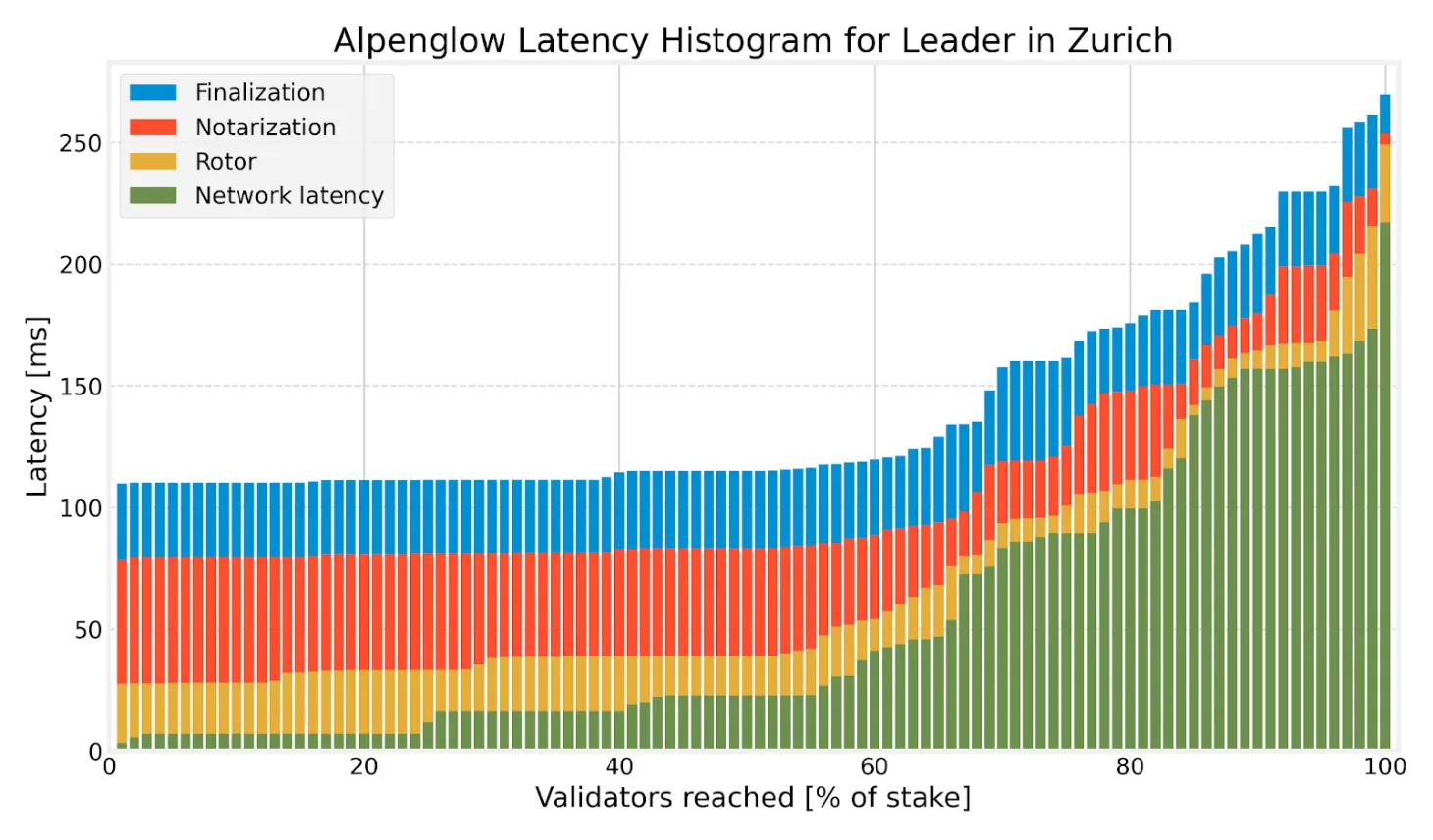
This first phase is Votor alone. Turbine still carries each block across the network; Rotor, Alpenglow’s single-layer relay that replaces it, is planned for a later release under its own proposal.
How fast is devnet in practice?
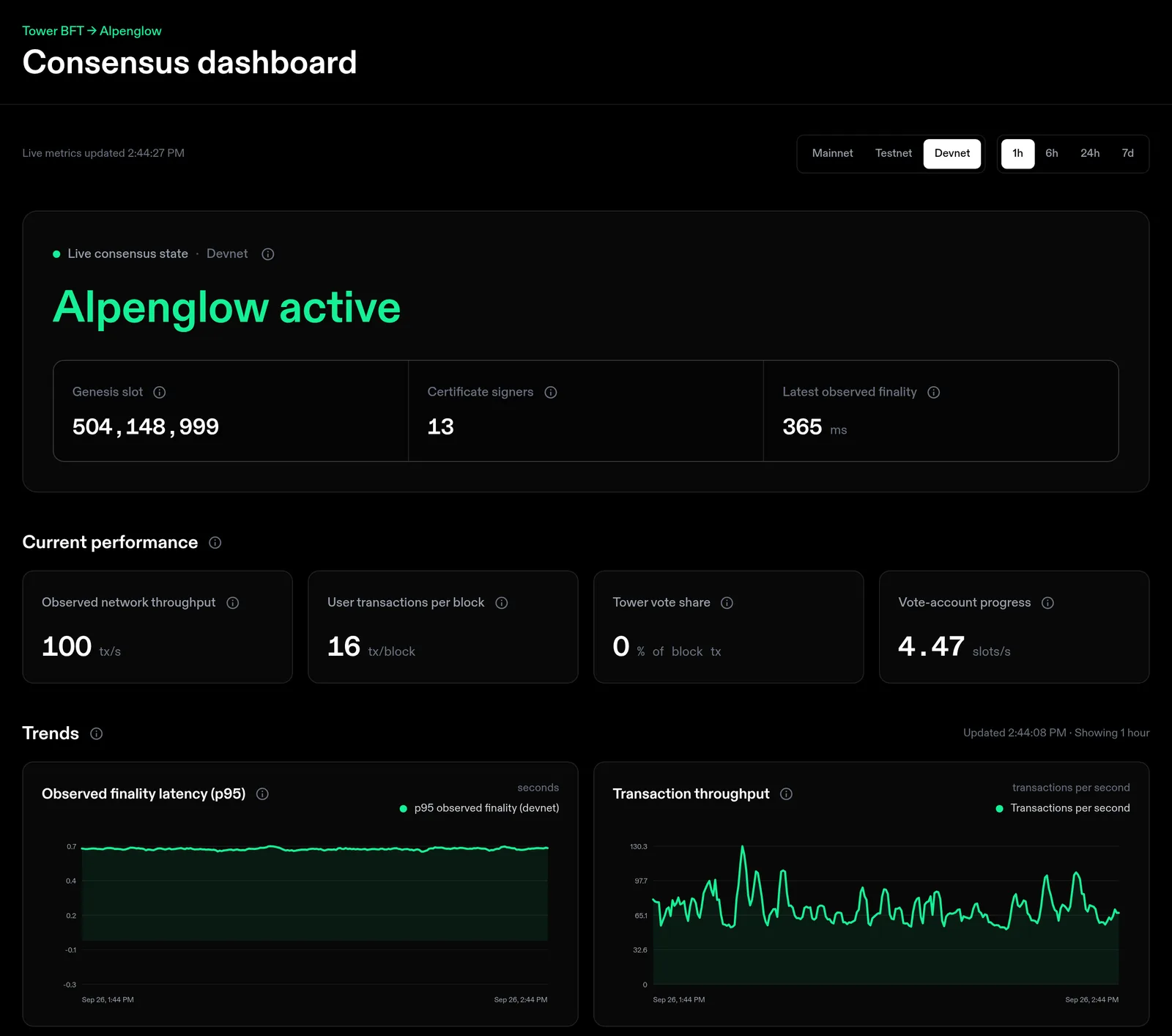
The Solana Foundation’s consensus dashboard read devnet’s latest observed finality at between 202 and 403 milliseconds across seven reads from 14:34 to 14:44 UTC on 26 September 2026. Its 95th-percentile line held close to 0.7 seconds over the hour before. Mainnet-beta, on TowerBFT, took a little over eight seconds in the same window.
| Network | Consensus | Latest observed finality, 14:34 to 14:44 UTC, 26 September 2026 |
|---|---|---|
| Mainnet-beta | TowerBFT | 8.14 to 8.36 seconds |
| Testnet | Alpenglow | 143 to 248 milliseconds |
| Devnet | Alpenglow | 202 to 403 milliseconds |
Mainnet-beta’s slots are shorter than when the 12.8-second figure was set. Solana cut them from 400 milliseconds to 350 on 19 August 2026 and to 300 on 25 August, in a separate upgrade.
Validator votes are leaving the blocks
Since Alpenglow took over testnet and devnet on 24 and 25 September 2026, validator votes on those networks travel directly between validators and have left the blocks entirely. On mainnet-beta they are still most of the traffic: 58.4 per cent of the 15.5 million transactions processed in the hour to 14:31 UTC on 26 September 2026 were votes, according to the network’s own performance samples. Devnet’s vote count over the same hour was zero. Solana’s raw transaction counts include those votes, as the 100,000-per-second burst of August 2025 did, and Solana’s upgrade page tells indexers to re-baseline any metric that counted them.
Voting also carries a cost. On TowerBFT, votes cost each validator about 2 SOL in fees per epoch, according to SIMD-0357. That is roughly $242 at CoinGecko’s SOL price of $120.96 at 14:29 UTC on 26 September 2026. The proposal replaces it with a flat Validator Admission Ticket of 1.6 SOL per epoch, about $194, charged to every voting validator, and SIMD-0326 burns the whole ticket. Alpenglow also caps the voting set at the 2,000 highest-staked validators; mainnet-beta had 687 vote accounts on 26 September.
For app developers, sending transactions and running programs stay the same. The changes are in how blocks are streamed, confirmed and timed, according to Anza’s Alpenglow documentation. A slot can now carry more than one candidate block, so Geyser streams tag each event with a bank_id. The confirmed and finalized commitment levels become one. With Proof of History no longer pacing blocks, tick entries leave the shred stream and the leader sets each block’s timestamp. A new RPC method, getAgGenesisCert, shows which system a network runs: on 26 September it returned the genesis certificate on devnet and testnet, and null on mainnet-beta.
Mainnet-beta is the last network on TowerBFT
Mainnet-beta is now the only public Solana network on TowerBFT, and Anza says it migrates after the devnet observation period. Validators approved Alpenglow in a governance vote a year earlier: 98.27 per cent voted yes, 1.05 per cent no and 0.69 per cent abstained, with 52 per cent of stake taking part, Solana Status reported on 2 September 2025.
The switch runs on Anza’s client. “Alpenglow activation on testnet only runs on Agave”, Anza told operators on 22 September 2026, asking those on Jump Crypto’s Firedancer and Frankendancer clients to move over “so your stake counts toward activation”. On mainnet-beta at 14:32 UTC on 26 September 2026, validators holding 81.1 per cent of stake reported an Agave 4.3 version, by YFarmX’s read of the network’s gossip and vote-account records. The handoff needs genesis votes from 82 per cent.
Solana’s upgrade page lists expected mainnet activation for the third quarter of 2026 on Anza’s v4.3 release schedule, and that tentative schedule resumes feature activations on mainnet-beta on 28 September 2026.
Questions people ask
- What is Solana's Alpenglow upgrade?
- Alpenglow is a new consensus protocol for Solana, published by Anza in May 2025, that replaces TowerBFT. Its first phase, Votor, has validators send votes directly to each other and bundle them into certificates, so a block is final after one round of voting when 80 per cent of stake agrees, or two rounds when 60 per cent responds. Solana targets finality of about 150 milliseconds, down from about 12.8 seconds under TowerBFT. Validators approved it in a governance vote announced on 2 September 2025, with 98.27 per cent of votes in favour.
- When did Alpenglow go live on Solana devnet?
- Alpenglow took over Solana's devnet on 25 September 2026. The feature switched on at the start of epoch 1167 at 19:40:38 UTC, the last TowerBFT block was slot 504,148,999 at 19:54:25 UTC, and Anza confirmed the handoff at 20:01 UTC. Testnet had switched a day earlier, on 24 September 2026, at slot 444,625,255.
- When will Alpenglow reach Solana mainnet?
- Anza says mainnet-beta migrates after an observation period on devnet, which began on 25 September 2026. Solana's Alpenglow upgrade page lists expected mainnet activation as the third quarter of 2026, on Anza's v4.3 release schedule, and that schedule resumes feature activation on mainnet-beta from 28 September 2026. The handoff needs genesis votes from 82 per cent of stake.
Sources
- Solana on X: Alpenglow is live on devnet, 25 September 2026x.com
- Anza on X: Alpenglow is officially running on devnet, handoff at slot 504148999, 25 September 2026x.com
- Anza on X: Alpenglow is officially running on testnet, handoff at slot 444625255, 24 September 2026x.com
- Anza on X: Alpenglow activation on testnet only runs on Agave, 22 September 2026x.com
- Solana Foundation: Alpenglow, Solana's next consensus upgradesolana.com
- Solana Foundation: Alpenglow consensus dashboard, read 26 September 2026solana.com
- Solana Foundation: Reduced slot timessolana.com
- Anza: Alpenglow, a new consensus for Solana, 19 May 2025anza.xyz
- SIMD-0326: Alpenglowgithub.com
- SIMD-0384: Alpenglow migrationgithub.com
- SIMD-0357: Alpenglow Validator Admission Ticketgithub.com
- Solana Status on X: SIMD-0326 governance vote passed, 2 September 2025x.com
- Anza: Agave v4.3 release schedulegithub.com
- Anza: Agave v4.3.0 release notesgithub.com
- Solana docs: getAgGenesisCert RPC methodsolana.com
- Anza docs: Alpenglow consensusdocs.anza.xyz
- Anza docs: commitment levels under Alpenglowdocs.anza.xyz
- Jump Crypto: Firedancer validator clientjumpcrypto.com
- CoinGecko: Solana (SOL) pricecoingecko.com