Researchers simulate fault-tolerant quantum computation through code switching
University of Southern California researchers numerically tested a code-switching protocol with quadratic error suppression in a postselected, error-detecting regime.

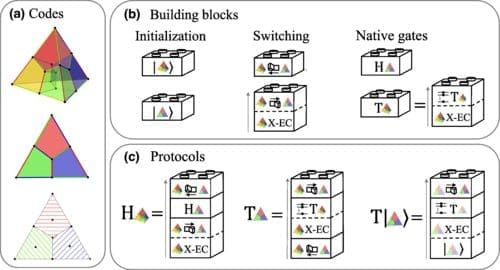
Researchers at the University of Southern California have numerically tested a protocol for universal, postselected fault-tolerant quantum computation using code switching, a technique that moves between two distinct quantum code types to circumvent fundamental limitations in quantum error correction.
The 16 March 2026 paper by Shixin Wu and colleagues uses numerical simulations to demonstrate that code-switching enables universal fault-tolerant computation by sidestepping the Eastin-Knill theorem, which prevents a universal transversal gate set within a single quantum code. By combining codes that support different gate types, the protocol achieves a sharp reduction in logical error rates during calculations.
 Fault-Tolerant Code-Switching Protocols
Quadratic Error Suppression
The simulations show quadratic suppression of logical error rates in the tested regime. The distance-2 codes detect single-qubit errors, and postselection discards runs in which an error is detected. This means the probability of errors scales with the square of the error rate, for the tested postselected circuits. Earlier error-detecting schemes also achieved quadratic suppression. As quantum computations become more complex and require a greater number of operations, this quadratic suppression becomes increasingly important for maintaining reliable results.
The method involves transitions between two distinct quantum code types, analogous to switching between different languages to perform a task. Each code type supports different gate operations, and the switching protocol ensures that the overall computation remains fault-tolerant throughout.
Implications for Practical Quantum Computing
The authors’ APS presentation, scheduled for 18 March, describes the code-switching construction. The protocol offers a candidate for early fault-tolerant machines; its resource savings depend on the costs of discarded runs and implementation. The numerical results establish how the proposed protocol behaves under the tested error model.
The results build on growing momentum in quantum error correction research, where multiple teams worldwide are pursuing different approaches to achieving fault tolerance. The code-switching approach adds another tool to the quantum computing toolkit, complementing techniques such as surface codes and concatenated codes.
Sources
- Wu and colleagues: original code-switching paper, 16 March 2026arxiv.org
- Authors’ APS presentation, 18 March 2026meetings-archive.aps.org
From the YFarmX archive · originally published on the previous site