
Anthropic
Claude Sonnet 4.6
the superseded mid-tier workhorse
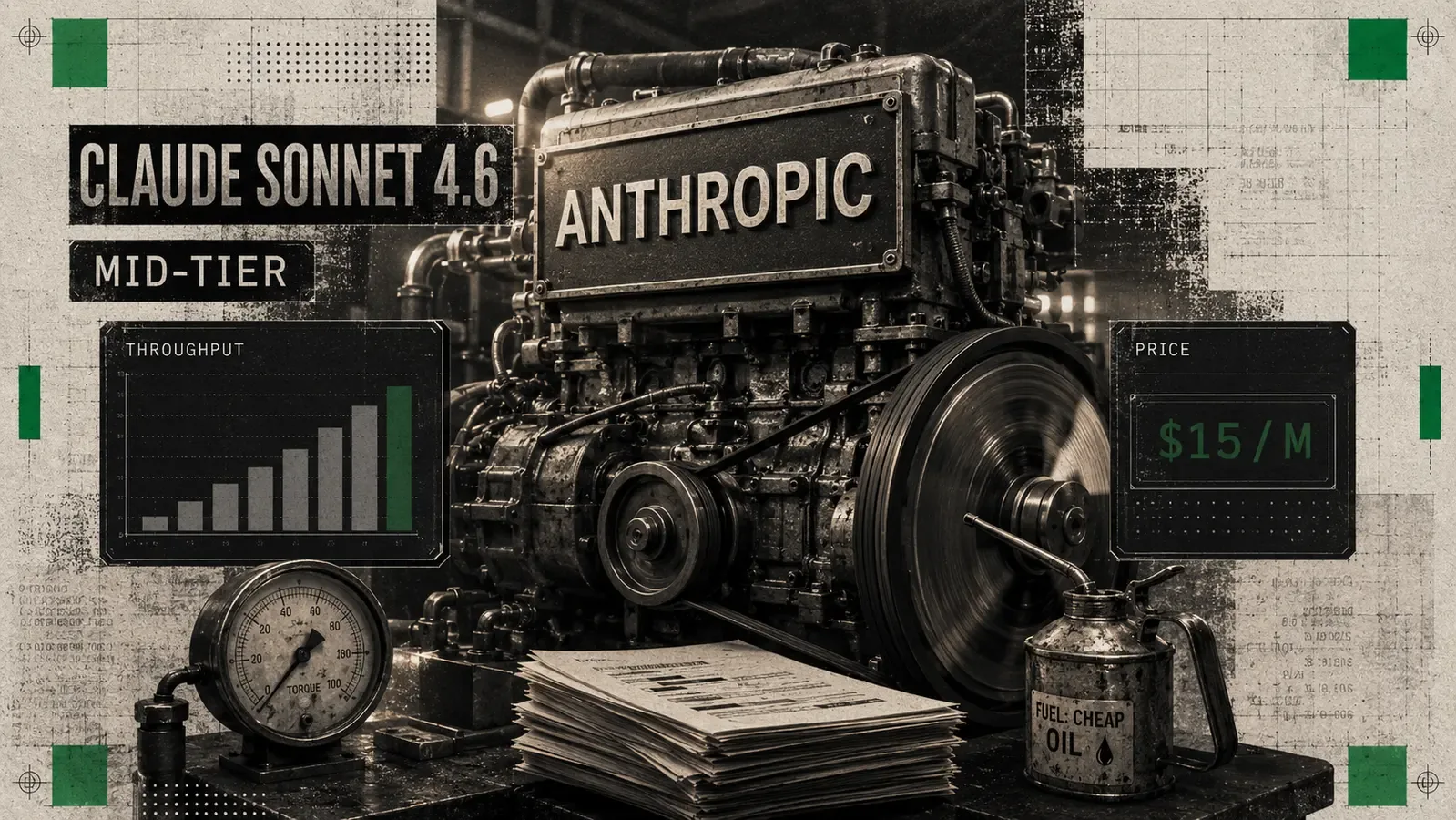
Key facts
- Supersededby Sonnet 5, 30 Jun 2026
- Status
- Sonnetmid-tier
- Tier
- 1Mtokens
- Context
- $15per M output
- Price
- claude-sonnet-4-6Claude API
- Model ID
The Sonnet-tier workhorse of early 2026, superseded by Claude Sonnet 5 on 30 June 2026. Still callable on the Claude API as claude-sonnet-4-6, now listed among Anthropic's legacy models.
What it is
Claude Sonnet 4.6 was Anthropic’s mid-tier model until 30 June 2026, when Claude Sonnet 5 replaced it at the head of the Sonnet tier. It remains callable on the Claude API under the identifier claude-sonnet-4-6, now listed among Anthropic’s legacy models, and it was built to be the workhorse of the range. Where a flagship is chosen for the hardest problems, Claude Sonnet 4.6 is the model teams reach for when they need dependable quality at a pace and price that make sense for everyday, high-volume work.
The workhorse idea
The idea of a mid-tier workhorse is worth unpacking, because it describes a deliberate design choice rather than a compromise. Most real-world use of large language models is not made up of fiendish reasoning puzzles. It is a steady stream of ordinary tasks: drafting and summarising text, answering support questions, classifying documents, transforming data and powering the routine steps inside larger software systems. For work like that, a top-tier model is often more capability than the job requires, and a mid-tier model that runs faster and costs less does the job just as well at far greater scale. Claude Sonnet 4.6 is aimed squarely at that middle ground.
Balance is the whole point of a Sonnet-tier model. It sits below Anthropic’s flagship line in raw capability while offering more speed and lower cost, which is exactly the trade-off that counts for production deployments handling millions of requests. When a service processes that many calls, the difference in price and latency between tiers becomes the deciding factor, and paying flagship rates for work a workhorse can handle is simply wasteful. Choosing the right tier for the job is one of the first decisions any team building on the Claude API has to make.
The economics of scale
The economics are easy to overlook but decisive. Two costs govern a deployment at scale: the price per unit of text processed, and latency, the time the user waits for a reply. A mid-tier model improves both against the flagship, and when those savings are multiplied across millions of daily requests they dwarf the gap in quality on tasks the workhorse handles comfortably. This is why the tier a team selects often shapes whether an AI feature is affordable to run at all, well before any question of which provider is marginally cleverer.
A stable model string
The model string claude-sonnet-4-6 is the exact name developers pass to the Claude API to call this version, and the version number signals a line refined over several iterations. Keeping the string stable is practically useful: it lets developers pin their applications to a known model and update on their own schedule, rather than being moved to new behaviour without warning. For a business running a live service, that predictability is worth a great deal, since an unannounced change in how a model responds can silently break a carefully tested product.
Where the market is won, and what to watch
In competitive terms, the mid-tier is where a great deal of the real business of AI is won or lost. Rivals field their own workhorse models at similar price points, and for many buyers the choice between providers comes down to which mid-tier model gives the best blend of quality, speed and cost for their particular workload. A strong flagship draws headlines, yet a strong mid-tier model is what earns steady revenue, because it is the one that gets deployed at scale.
For anyone still running Claude Sonnet 4.6, the natural upgrade path is Claude Sonnet 5, which took over the tier on 30 June 2026. The sensible approach remains to test on the actual task rather than to rely on tier labels alone, and to consult Anthropic’s own documentation for current details. Our large language models hub sets it against the competing workhorse models, and the wider AI section tracks how the mid-tier contest develops. The Claude documentation at docs.claude.com lists the current model line for developers ready to build.
More in Large Language Models
All LLMs →- Google DeepMindGemini 4 Argonlonger reasoning, coding and cyber defence
- OpenAIGPT-5.6the flagship from 9 July to 3 September 2026
- OpenAIGPT-6 Astrathe new generation, rolling out from 3 September 2026
- OpenAIGPT-6.1 Solthe upgraded mid-price GPT-6 model, released 29 September 2026
- OpenAIGPT-6 Sol and Lunathe mid-price and budget GPT-6 models, released 22 September 2026
- AnthropicClaude Opus 5.5the first Claude 5.5 model, cheaper and faster than Opus 5