
Moonshot AI
Kimi K3
the largest open-weight model yet released
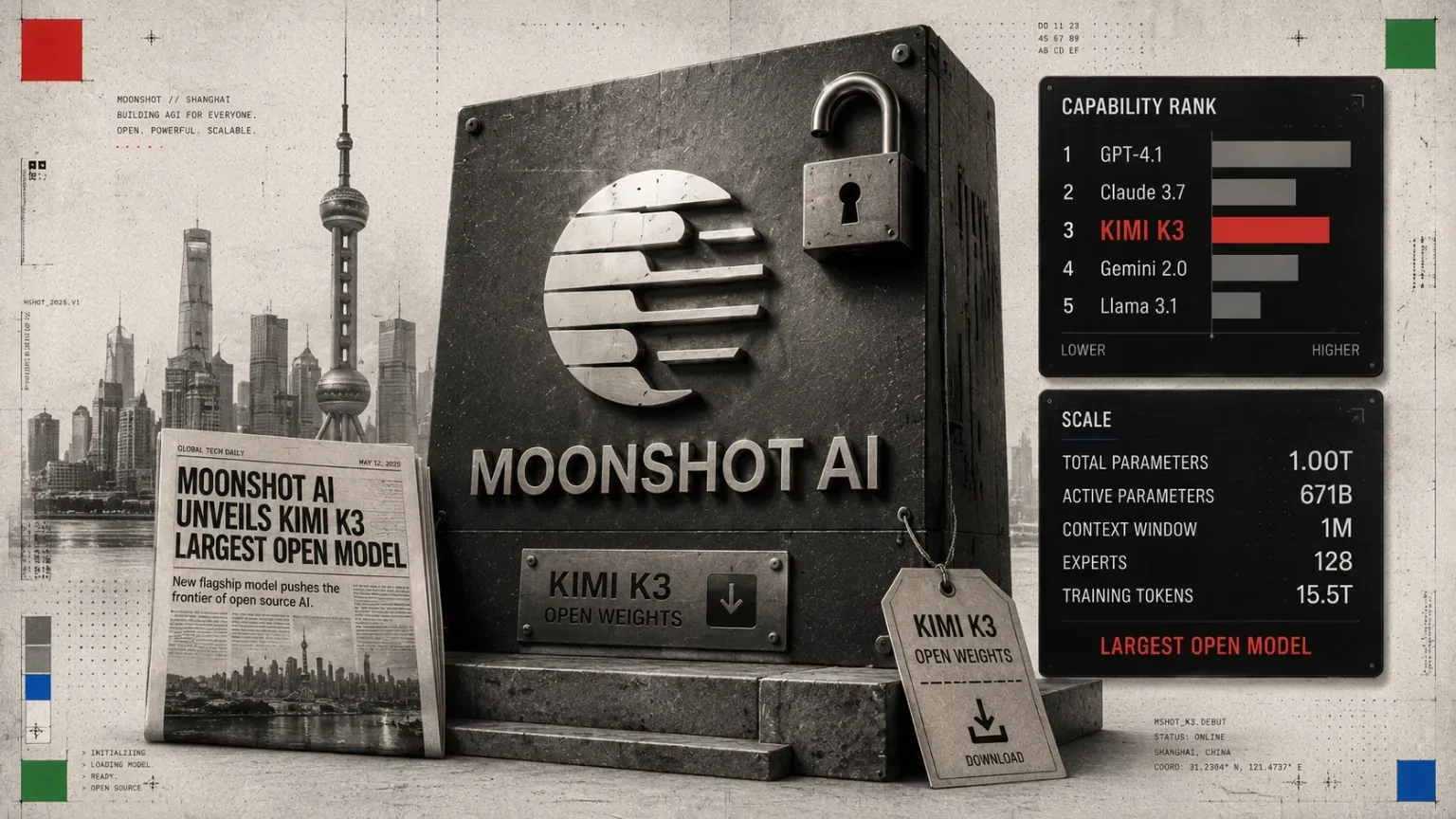
Key facts
- 2.8Ttotal params
- Parameters
- 1Mtokens
- Context
- $15per M output
- Price
- 17 Jul 2026weights out 27 Jul
- Released
- Open weightcustom Kimi K3 licence
- Licence
- $2bnMay 2026 raise
- Funding
Moonshot AI's 2.8-trillion-parameter flagship, announced 16 July and released 17 July 2026, days before the World AI Conference in Shanghai. The weights followed on 27 July, and remain the largest open-weight release to date.
What it is
Kimi K3 is Moonshot AI’s flagship, and by parameter count the largest open-weight model released so far. Moonshot announced Kimi K3 on 16 July 2026 and released it on 17 July, days before the World AI Conference in Shanghai, timing that put a Chinese open-weight model at the front of the week’s news. Its own model card puts the model at 2.8 trillion total parameters with 104 billion activated per token, and describes it as “the world’s first open 3T-class model”. The full weights followed on 27 July: 1.56TB on disk even at four-bit precision, under a bespoke Kimi K3 licence that adds a revenue-triggered clause for model-as-a-service hosts. Because those terms are Moonshot’s own rather than an approved open-source licence, open-weight is the accurate description, not open source.
Nothing larger has been published since. As of 29 August 2026 the nearest challenger is Alibaba’s Qwen3.8-Max, whose open weights carry 2.4 trillion parameters, so Kimi K3 keeps the record it set in July. The largest new open releases of late August, Tencent’s Hy4 preview at 770 billion parameters and Z.ai’s GLM-5.3 at 753 billion, do not come close.
Features and architecture
Beyond raw size, Kimi K3 carries the features expected of a current frontier model: a one-million-token context window, native vision so it can read images as well as text, and an always-on “thinking mode” that has the model reason before it answers. A context window that large lets it hold very long documents or codebases in a single session, while native vision means images are handled directly rather than described to it. The architecture leans on two techniques Moonshot had previously published as open research: Kimi Delta Attention, a hybrid linear-attention scheme, and Attention Residuals. Building the flagship on openly documented methods fits the open-weight positioning, since the company is competing in the open rather than behind a wall of secret tricks.
How it compares
On performance, the natural question is how Kimi K3 stands against GPT-5.6, and here Moonshot is candid. Its launch charts placed Kimi K3 behind only Claude Fable 5 and GPT-5.6 Sol overall, while beating Claude Opus 4.8 and GPT-5.5 on some coding and agentic benchmarks. Moonshot stops short of claiming the top spot and instead claims a place just below the two leading US flagships, which for an open-weight model is a strong showing. These are the company’s figures, so independent testing will be the real test.
Pricing and adoption
Pricing sits in an interesting middle. At $3 per million input tokens and $15 per million output tokens, Kimi K3 is expensive by Chinese standards yet cheap next to the US flagships it trails. The model is compatible with the OpenAI SDK, which lowers the switching cost for developers already building against that interface and makes trying Kimi K3 a small change rather than a rewrite. That combination of near-frontier quality, open weights and familiar tooling is what makes the release awkward for the incumbents.
Moonshot AI comes to this from a position of strength. The company raised $2bn in May 2026 at a valuation above $20bn and is backed by Alibaba. Its models are already in commercial use: Cursor drew on Kimi to help build its Composer 2 coding tool, and DoorDash delegates lower-level work to the earlier K2.6. That real-world adoption gives Kimi K3 a credibility that benchmark charts alone cannot, and it explains why a Chinese open-weight release now commands attention across the field. The timing was no accident either: releasing days before the World AI Conference in Shanghai guaranteed Kimi K3 a prominent hearing among the researchers, officials and investors gathered there, and for Moonshot a well-received flagship at that moment is worth as much as any leaderboard placement.
What to watch
In the wider field, Kimi K3 sits at the sharp end of the open-weight challenge to the closed US labs. By landing a model just behind the leaders, releasing the weights and pricing below the flagships, Moonshot is testing whether openness plus value can erode the premium that GPT-5.6 and Claude Fable 5 command. For a Chinese lab to benchmark and price this close to the American leaders, and to publish the weights, is the sort of move that shifts expectations for the rest of the year. The weights are out, hosting partners carried the model from day one, and independent testing backed the positioning: Artificial Analysis rated Kimi K3 the strongest open-weight model on its Intelligence Index in August 2026. On 26 September it sits third among open-weight models on 44, behind Xiaomi’s MiMo V2.6 Pro on 46 and Z.ai’s GLM-5.3 on 45. For more, see our large language models hub and wider AI coverage.
More AI
All AI →
Kimi K3 open weight model puts China at the frontier
Moonshot AI released the Kimi K3 open weight model on 16 July with no keynote, no launch event and no advance briefing, simply switching on a new option at kimi.com overnight.

Moonshot opens Kimi K3's weights: what the licence allows, and what hosting 2.8 trillion parameters really costs
Moonshot AI published Kimi K3's full weights on 27 July: 2.8 trillion parameters, 1.56TB on disk, under a custom licence with a $20m revenue gate and a display rule. Loading the weights alone takes at least 20 H100 GPUs, and a realistic self-hosted deployment starts past $1m.
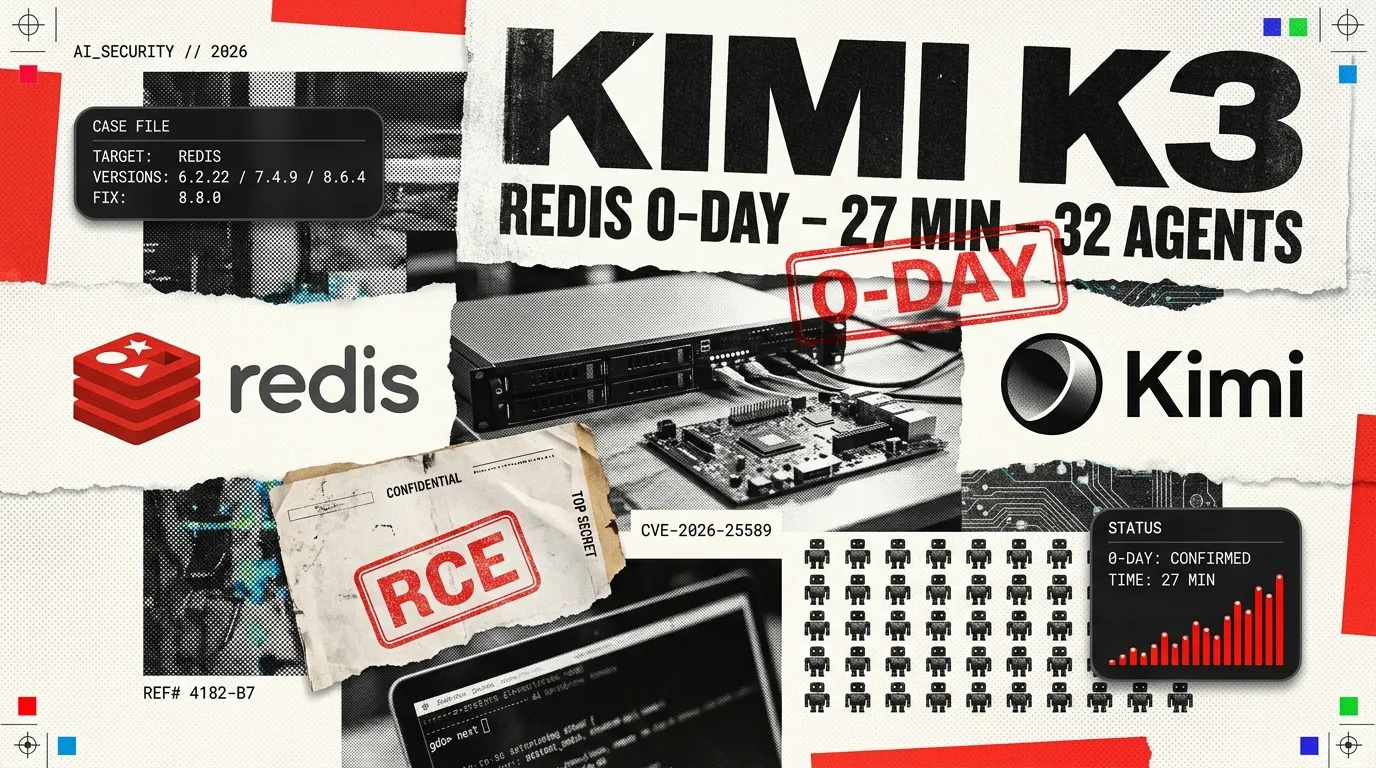
Moonshot's Kimi K3 found a Redis zero-day and wrote a working exploit in 27 minutes
Security researcher Chaofan Shou directed Moonshot's open-weight Kimi K3 to find and weaponise a zero-day in Redis, producing working remote-code-execution exploits for four versions in 27 minutes with 32 agents. He calls it the first AI model willing to write a real exploit.
More in Large Language Models
All LLMs →- Google DeepMindGemini 4 Argonlonger reasoning, coding and cyber defence
- OpenAIGPT-5.6the flagship from 9 July to 3 September 2026
- OpenAIGPT-6 Astrathe new generation, rolling out from 3 September 2026
- OpenAIGPT-6.1 Solthe upgraded mid-price GPT-6 model, released 29 September 2026
- OpenAIGPT-6 Sol and Lunathe mid-price and budget GPT-6 models, released 22 September 2026
- AnthropicClaude Opus 5.5the first Claude 5.5 model, cheaper and faster than Opus 5