
Alibaba
Qwen3.8-Max
the first Qwen Max released with open weights
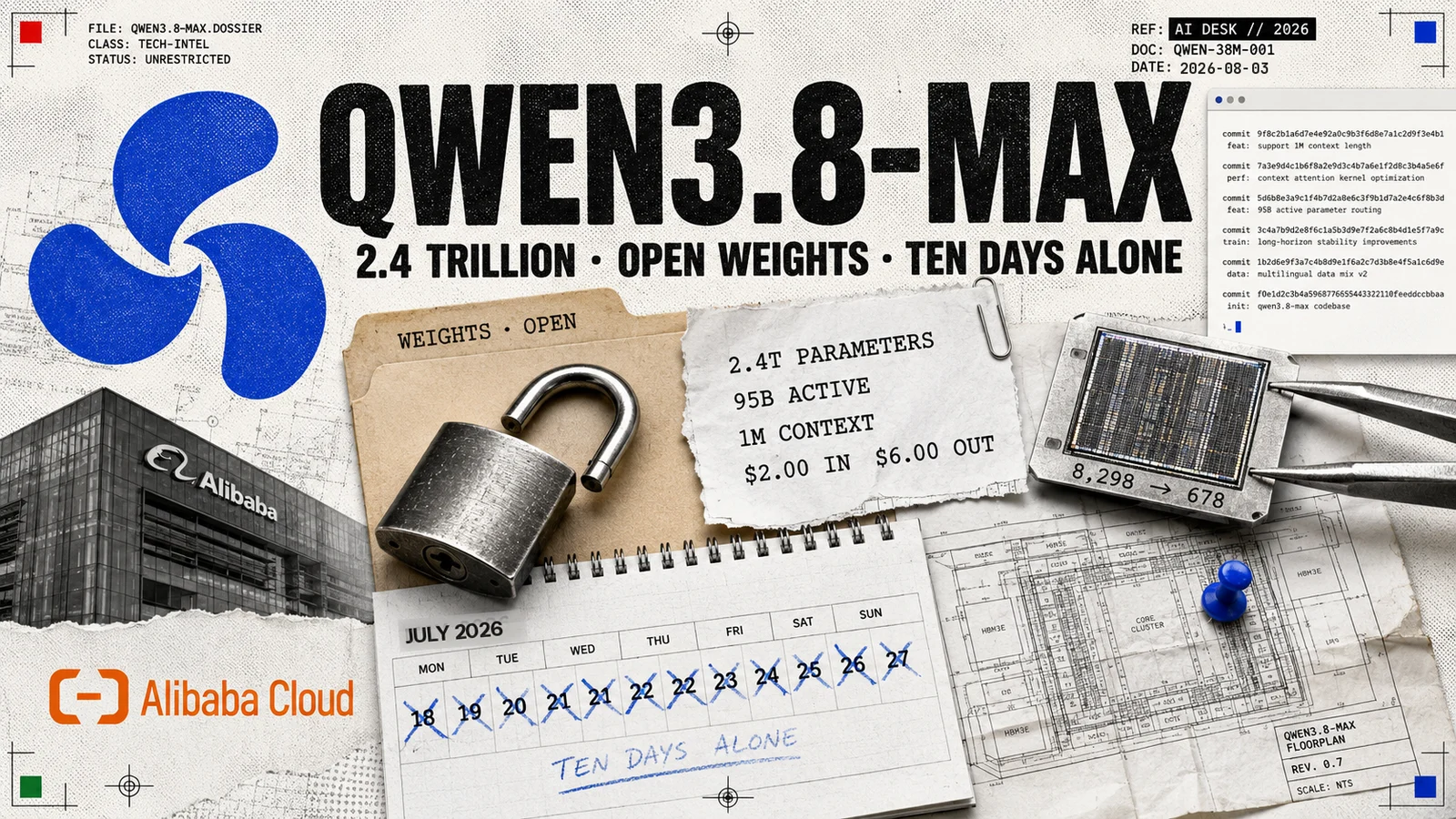
Key facts
- AlibabaQwen
- Lab
- 2.4T95B active
- Parameters
- 1Mtokens
- Context
- $2.00per M tokens
- Input
- $6.00per M tokens
- Output
- Opencustom qwen3.8-max licence
- Weights
The top tier of the Qwen line, and the first one Alibaba has published the weights for. It is built to be left running: ten days building a working command-line tool from an empty folder, five days reproducing a research paper and then improving on it, 500 turns shrinking a chip design to a twelfth of its size, a simulated year running online shops. It costs $2.00 per million tokens in and $6.00 out.
Qwen3.8-Max is the top model in Alibaba’s Qwen family, released on 3 August 2026. It has 2.4 trillion parameters, of which about 95 billion are active on any given token, a one-million-token context window, and a price of $2.00 per million tokens in and $6.00 per million out. It is natively multimodal, it is available to anyone from launch day, and it is the first Max-tier Qwen whose weights Alibaba has published.
What it is built for is length. The capability Alibaba leads on is the multi-day project rather than the single reply: ten days alone in an empty folder until a working command-line tool exists, five days reproducing a research paper and then improving on it, 500 turns cutting a chip design down to a twelfth of its original size, a simulated year of running online shops through fraud, typhoons and cash-flow crunches. Each of those runs happened without a person in the loop, and the artefacts they produced are the substance of the launch.
Update, 2 September 2026. Alibaba upgraded the API flagship to Qwen3.8-Max-0902, announced on X. The refresh keeps the 2.4 trillion parameters, the one-million-token context and the $2.00 and $6.00 per million pricing, and the open weights remain the 13 August release.
The launch
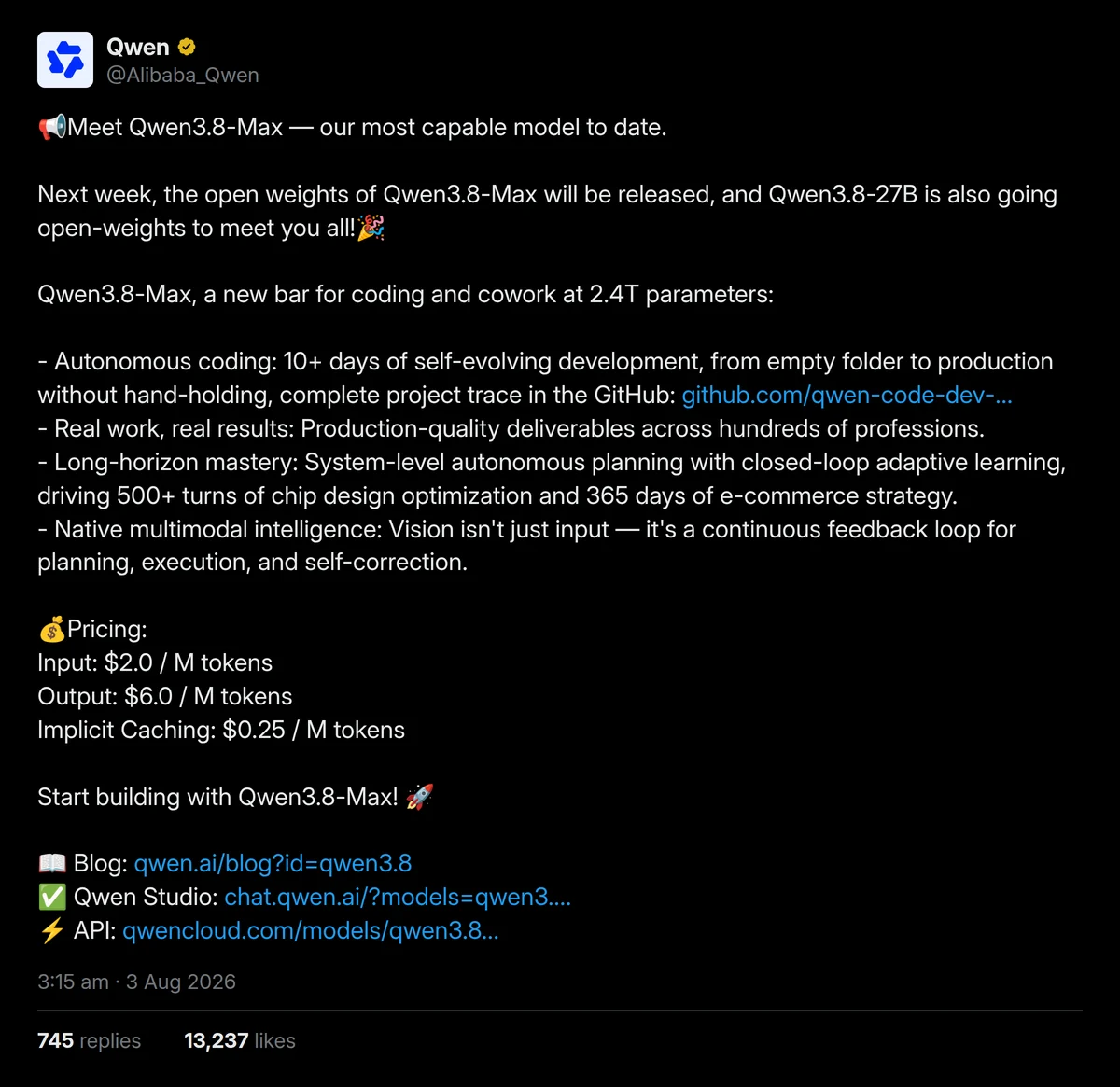
Half an hour later the same account posted the detail: the parameter count, the four capability claims, the price list and the promise of open weights.
The open-weights turn
Qwen built its reputation on open-weight models that anyone could download and run, while holding the Max tier back: our page on Qwen3.7-Max recorded it as API-only, with closed weights, on 24 July 2026.
Qwen3.8-Max opens that tier. In Alibaba’s own words, this “marks the first time we will open-source the weights of a Qwen-Max-class model”, with publication on Hugging Face and ModelScope set for the week beginning 10 August, alongside a 27-billion-parameter Qwen3.8 small enough to run on ordinary hardware.
The weights duly arrived. The Max-class model is on Hugging Face as Qwen/Qwen3.8-2.4T-A95B, 2.4 trillion total parameters with 95 billion activated, the repository created on 8 August 2026 and last updated on 12 August. The card puts the point in Qwen’s own words: “For the first time, Qwen3.8 brings a Qwen-Max-class model to open release.” The smaller sibling, Qwen/Qwen3.8-27B, is live alongside it.
Today, we are officially releasing Qwen 3.8-Max, the most capable model in the Qwen family to date. This also marks the first time we will open-source the weights of a Qwen-Max-class model.
The licence, which is the term that decides what a downloader may build with the weights, turned out not to be a standard one. The Hugging Face card for the 2.4-trillion-parameter model carries a custom licence named qwen3.8-max rather than Apache 2.0, so commercial use is governed by Alibaba’s own terms. The 27-billion-parameter sibling is the exception: it ships under Apache 2.0. On scale, this is the second-largest open-weight release to date, behind Kimi K3 at 2.8 trillion parameters.
What it is
- 2.4 trillion parameters, about 95 billion active. A sparse mixture-of-experts design, so only a fraction of the network fires on each token. Alibaba describes it as built on the architectural foundation of Qwen 3.5.
- One million tokens of context, carried over from the previous Max generation.
- Natively multimodal. Text, images, documents and video in, and vision used during execution rather than only at the input stage.
- Served through QwenCloud, with endpoints in Beijing, Singapore and US East (Virginia), and API modes compatible with the OpenAI and Anthropic interfaces. The model identifier is
qwen3.8-max. - Reasoning depth is a dial.
reasoning_effortacceptsxhigh(the default),mediumandlow, so cost can be traded against thoroughness on a per-call basis.
| Per million tokens | |
|---|---|
| Input | $2.00 |
| Output | $6.00 |
| Implicit caching | $0.25 |
For scale, that is a fraction of what the Western frontier tiers charge for output, which is the commercial argument Alibaba is making underneath the technical one.
Ten days alone in an empty folder
The headline capability is a piece of software that exists and can be inspected. Alibaba pointed Qwen3.8-Max at an empty repository and asked it to build oh-my-cli, a command-line coding agent, then left it running for more than ten days.
The model did not write code straight from a plan. It first assembled a small engineering process, then worked inside it:
- A state machine for the work. New requirements land as GitHub issues; an agent claims one and moves it through
ready,leased,active; finished work triggers end-to-end tests and CI; the pull request merges only after they pass. A dispatcher hands out tasks, a monitor watches them and a watchdog recovers the ones that stall. - Self-testing after every change. Build, unit tests, end-to-end tests and a desktop lifecycle check run on each update, and anything that fails is routed back to the issue or pull request that caused it.
- Feedback treated as input. Community practice and user reports were converted into executable work, which is how features such as
/goal,/resume, session replay and the desktop build arrived.
The loop it built before it built the product
The output is public and durable. Alibaba’s own count, taken on 30 July after roughly sixteen days of unattended operation, was 265 commits, 127 pull requests and 151 issues. When we checked the repository on 3 August it stood at 439 commits, 181 stars, 8 forks and 67 open issues, Apache-2.0 licensed and written in TypeScript. The commit history is readable by anyone, so the quality of the work can be judged directly rather than through a score.
The project runs under an autonomy contract with a protected governance plane. The bot proposes changes and executes them, while policy changes go through GitHub workflows and code-owner review. The model runs the project; the rules of the project stay in human hands.
The paper it reproduced, then beat
The second demonstration is closer to research than engineering. Alibaba handed the model a paper, “Unified Data Selection for LLM Reasoning”, along with some GPUs and nothing else. No starter code, no pipeline. The task was to reproduce the experiment, then improve on it.
Working alone for about five days, roughly 125 hours, the model wrote around 7,600 lines of code, took more than 1,100 actions and ran 33 rounds of GPU training. The first 37 hours went on rebuilding the paper’s pipeline from zero and reproducing its six main findings, including the paper’s headline result that its selection method beats picking training data at random by 7.7 points on the AIME24 maths benchmark.
The remaining 88 hours were spent trying to beat it. The model formed hypotheses, wrote the code, ran it, read the results and tried again, inventing and testing 18 ideas of its own across four rounds. The method it ended up with scores 2.7 points above the paper’s own approach on AIME24.
A third case put the model into a live competition on Alibaba Cloud’s Tianchi platform: the WWW2025 multimodal dialogue intent recognition challenge, against 526 human teams, with a 24-hour limit. It read the rules, fine-tuned and ensembled three Chinese language models for the text, fine-tuned a vision-language model for the product screenshots, and fused them into a weighted-voting system whose weights it calibrated by cross-validation, adding extra image voters to break ties. Across 45 submissions its accuracy climbed from 0.60 to 0.853, finishing ahead of 458 of the 526 teams, 87 per cent of the field.
The chip that shrank
The hardware run is the most precisely scored of the three, because a synthesis tool counts the gates and the whole trajectory is recorded.
The target was a GCD/RSA cryptographic accelerator. The model was given a task description, an empty module template and an evaluation script, then had to produce a design that stayed bit-exact across four bit widths under a randomised verification framework while using as few logic gates as possible. It worked in a sandbox wired to the standard open toolchain: Iverilog for simulation, Yosys for synthesis, OpenROAD for physical layout.
Over roughly 500 turns and 71 evaluations it took its first working design from 8,298 gates down to 678.
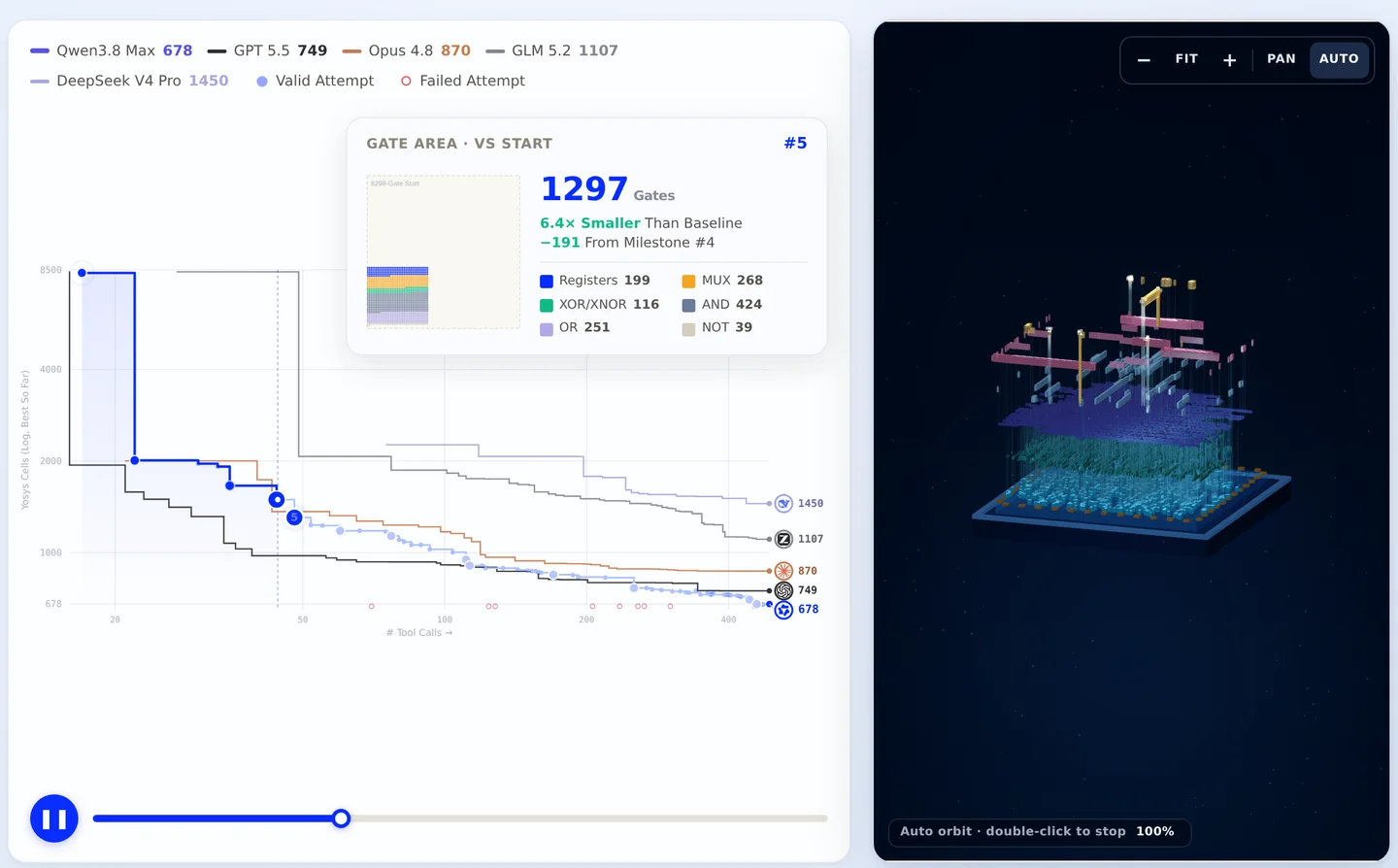
The shape of the descent is what the run demonstrates. The gains keep arriving deep into the session: a structural rewrite lands at turn 22, module fusion at turn 252, and the last 87 gates come out between turns 443 and 500.
Where the gates went, and when
Alibaba then pushed the design through place-and-route to check that the savings survived contact with physical layout. They did: the die went from 106 by 106 microns to 46 by 46, wire length from 33,369 microns to 4,187, and a design that started with a 4.46-nanosecond timing violation closed timing at 500 MHz with 0.66 nanoseconds to spare.
The shop it ran for a year
The commercial equivalent is E-Commerce Bench, a 365-day simulation built on desensitised Taobao and Tmall data: twelve store types, sixty product categories, roughly 600 suppliers, 7,000 products and ¥100,000 of starting capital. Suppliers negotiate in natural language with their own personalities and concession strategies. Seasonal swings, promotion peaks and supply-chain shocks arrive on their own schedule. And 152 of the suppliers are frauds, running membership-fee traps, low-price bait and goods that are not as described.
Qwen3.8-Max finished the year on ¥416,252, a 4.16-times return, 38 per cent ahead of second-placed GLM 5.2 and 152 per cent above its own predecessor. Alibaba’s reading is that the model kept learning inside the run: it probed the same suppliers repeatedly, got their prices down round by round, and generalised what worked to similar products, while rival models’ negotiating gains flattened out mid-year. During the year-end promotion alone it cleared more than ¥100,000 of net profit, about 2.4 times what GLM 5.2 managed over the same peak.
A simulated trading year, on the published figures
Vision that watches the work
The multimodal claim is framed as a change of role rather than a change of capability. Vision is used during execution, not only at the point of input.
In practice that means the model checks its own output by looking at it: inspecting page layouts, object orientations, spatial relationships and animation quality, spotting that a television in a generated 3D room is facing the wrong way or that an interface is misaligned, and correcting without being told. Alibaba has built a benchmark around the idea, RecreationBench, in which the model may only observe a running application as a black box across five platforms, with no source code and no internet access, and must rebuild it from what it can see and click.
On the input side the numbers are large: financial documents over 200 pages, video over 100 hours organised into what Alibaba calls a video memory graph of people, events, timestamps and scenes.
The professions test
The launch film leads on breadth. Alibaba tested the model across several hundred high-value professions and published six worked examples, each with its own timing and the conventional workflow it was measured against. All figures in this table are Alibaba’s.
| Profession | What it produced | Alibaba’s claimed time | Its stated baseline |
|---|---|---|---|
| Compliance counsel | 1,284 relevant clauses surfaced across hundreds of documents in one pass | Under an hour | A paralegal team, about a week |
| UI/UX designer | An eight-screen banking app prototype on a consistent design system | One shot, no revisions | Three to five revision rounds |
| Restaurant founder | A 26-dish menu from 100-plus supply briefs, calories and provenance annotated, food cost held at 33.8% | One pass | Weeks of recipe testing and costing |
| Structural engineer | A 30-storey tower’s seismic model in the browser, period, base shear and drift inspectable on hover | Not stated | Over a week in specialist software |
| Rehabilitation therapist | A 2D assessment form turned into a rotatable 3D demo with anatomical overlays | Not stated | A studio, two to four weeks |
| Sports analyst | Around 8,400 possessions per player parsed into a coaching report | Tens of minutes | Several working days |
The common thread is delivery in one pass: a finished menu, a finished prototype, a finished model, rather than a draft for someone to complete.
The benchmarks
Alibaba published its full table, covering more than seventy benchmarks across coding, general agent work, reasoning and every multimodal category, with the rows where Qwen3.8-Max comes second printed alongside the rows where it leads.
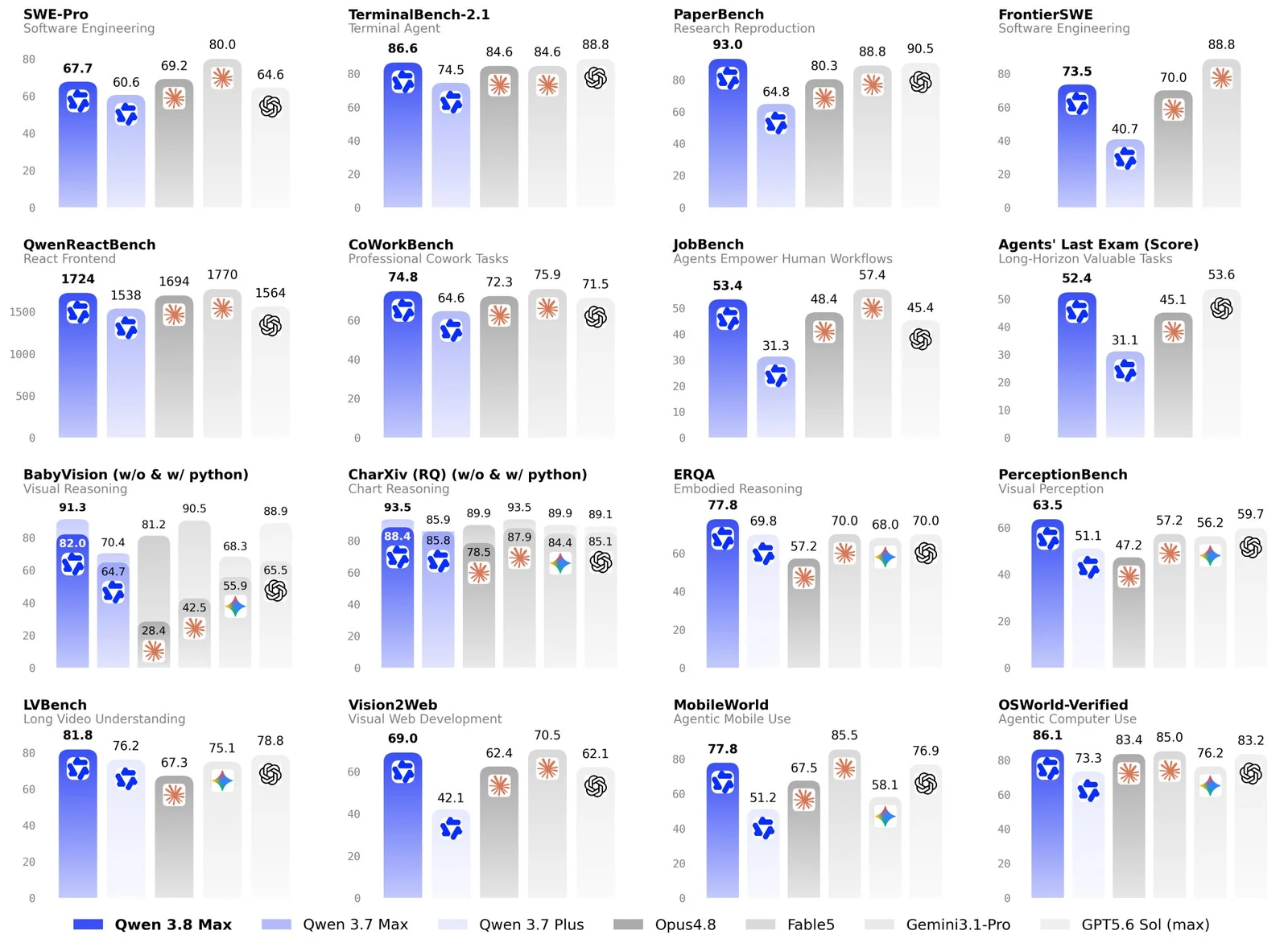
The coding and cowork rows, which are the ones the launch is named after:
| Benchmark | Qwen3.8-Max | Qwen3.7-Max | Leader |
|---|---|---|---|
| Terminal Bench 2.1 | 86.6 | 74.5 | 88.8 GPT-5.6 Sol |
| SWE-bench Pro | 67.7 | 60.6 | 80.0 Fable 5 |
| FrontierSWE | 73.5 | 40.7 | 88.8 Fable 5 |
| DeepSWE 1.1 | 56.6 | 21.6 | 73.0 GPT-5.6 Sol |
| PaperBench | 93.0 | 64.8 | Qwen3.8-Max |
| AndroidBench | 75.1 | 56.5 | 84.5 Fable 5 |
| CoWorkBench | 74.8 | 64.6 | 75.9 Fable 5 |
| JobBench | 53.4 | 31.3 | 57.4 Fable 5 |
| WideSearch | 81.9 | 75.2 | Qwen3.8-Max |
| IFBench | 82.8 | 79.1 | Qwen3.8-Max |
| Humanity’s Last Exam | 43.6 | · | 53.3 Fable 5 |
| GPQA Diamond | 92.6 | · | 94.1 GPT-5.6 Sol |
The last two rows are reasoning suites rather than coding ones, and Alibaba’s table sets them out against its full comparison set rather than against the previous Max generation, so the Qwen3.7-Max cell is left empty. The leader figure printed is the highest score in Alibaba’s own table: on Humanity’s Last Exam that is Claude Fable 5 at 53.3, and on GPQA Diamond it is 94.1, with the frontier tier bunched within two points of it.
Read across the row, not down the column
Where the figures come from
Every number on this page is Alibaba’s own, published on launch day. No independent evaluation existed when the model launched on 3 August 2026, so the methodology below is worth knowing when comparing these scores against another lab’s.
- Nine benchmarks are in-house. QwenSWEBench, QwenQoderBench, QwenReactBench, QwenSVGBench, CoWorkBench, QwenBlenderBench, QwenVisualOffice, RecreationBench and E-Commerce Bench are described in the announcement as Alibaba’s own, built to measure sustained tool-heavy work that existing public suites do not cover.
- Harnesses differ between columns. Qwen ran its own Terminal Bench figure through Claude Code, averaged over ten runs with a five-hour timeout, and took rival figures from the best published score across harnesses on other people’s leaderboards. Alibaba documents each of these choices in its footnotes, along with a note that the Fable 5 results may involve fallbacks.
- The profession timings are Alibaba’s estimates on both sides, for its own run and for the conventional workflow it is compared against.
- The chip run and the code repository leave artefacts. The gate count came out of a synthesis tool, and the commit history is public, so both can be checked independently of the announcement.
- The open weights shipped under a custom licence. Qwen3.8-2.4T-A95B went up on Hugging Face in the week of 10 August 2026 under Alibaba’s own
qwen3.8-maxterms rather than a standard open-source licence. Only the 27-billion-parameter sibling is Apache 2.0.
Using it
Getting a call out the door
qwen3.8-maxThe model identifier on QwenCloud.reasoning_effort: “xhigh”The default.mediumbalances accuracy against speed,lowoptimises for cost.DASHSCOPE_API_KEYThe environment variable the official examples read the key from.…/compatible-mode/v1OpenAI-compatible base URL. There is an Anthropic-compatible interface too.dashscope-intl.aliyuncs.comThe Singapore endpoint. Beijing and US East (Virginia) are the other two.
Alibaba's own code sample uses the openai Python client unchanged, with the base URL pointed at QwenCloud, so an existing integration usually needs a key, a URL and a model name rather than a rewrite. Full detail in the launch announcement ↗.
How it compares
| Model | Maker | Weights | Strongest at |
|---|---|---|---|
| Qwen3.8-Max | Alibaba | Open, custom licence | Long autonomous runs |
| Claude Fable 5 | Anthropic | Closed | Software engineering, reasoning |
| GPT-5.6 Sol | OpenAI | Closed | Terminal work, general capability |
| Kimi K3 | Moonshot AI | Open | Open-weight scale |
On scale and price: Qwen3.8-Max is 2.4 trillion parameters with 95 billion active, at $2.00 per million input tokens, with a one-million-token context. Fable 5 also carries a million-token context but publishes neither its scale nor a comparable per-token price, and the same is true of GPT-5.6 Sol. Kimi K3 publishes its scale and sits at the low end on price.
The position Qwen3.8-Max takes against Claude Fable 5 and GPT-5.6 is duration and cost: a model priced to be left running for days, at a fifth or less of the output price, with the weights published a week later. Against Kimi K3 it is the second Chinese lab in a month to put a very large open-weight model into the field, and the smaller of the two.
What to watch
What the custom licence allows. The 2.4-trillion-parameter weights carry Alibaba’s own qwen3.8-max terms rather than Apache 2.0, so anyone planning commercial use has to read them rather than assume. The 27-billion-parameter sibling raises no such question: it is Apache 2.0.
Whether the long runs reproduce. The oh-my-cli repository is the most testable part of the launch: the commit history is public and other teams can now run the same model at the same task and compare.
Whether the in-house benchmarks get adopted. CoWorkBench, RecreationBench and E-Commerce Bench measure sustained, tool-heavy, multi-day work that existing public suites do not cover. Their value as a yardstick grows if labs other than Alibaba start running them.
The Max tier from here. Our Qwen3.7-Max page recorded that tier closed. One release later it has opened, and the next two releases will show whether that is the new policy. For the wider field, see our large language models hub and the AI desk.
Sources
- Qwen3.8-Max: A New Bar for Coding and Cowork, Qwen Team, 3 August 2026. The launch announcement, 5,068 words, and the source of every benchmark figure, run length, gate count and simulation result on this page.
- Qwen on X, the launch film and the announcement post, both 3 August 2026, for the pricing and the open-weights promise. Post text and engagement figures verified against X’s own syndication data on 3 August 2026.
- qwen-code-dev-bot/oh-my-cli, the repository built during the autonomous coding run, checked on 3 August 2026 for commit, star, fork and issue counts, the Apache-2.0 licence and the autonomy contract.
- Qwen Studio, checked 3 August 2026 for availability of the model to the public.
- Qwen/Qwen3.8-2.4T-A95B and Qwen/Qwen3.8-27B on Hugging Face, checked 21 August 2026 for the published parameter counts, the repository dates and the licence on each card.
- Screenshots on this page were taken on 3 August 2026 and are reproduced for review. The two X cards were rebuilt by YFarmX from the posts’ verified text, official avatar and official thumbnail.
More in Large Language Models
All LLMs →- AlibabaQwen3.7-MaxQwen's premium, API-only tier
- AnthropicClaude Fable 5the first model in Anthropic's Mythos class
- OpenAIGPT-5.6the flagship from 9 July to 3 September 2026
- Moonshot AIKimi K3the largest open-weight model yet released
- Z.ai / ZhipuGLM-5.2strongest open-weight all-rounder before K3 landed
- Google DeepMindGemini 4 Argonlonger reasoning, coding and cyber defence