
Z.ai / Zhipu
GLM-5.2
strongest open-weight all-rounder before K3 landed
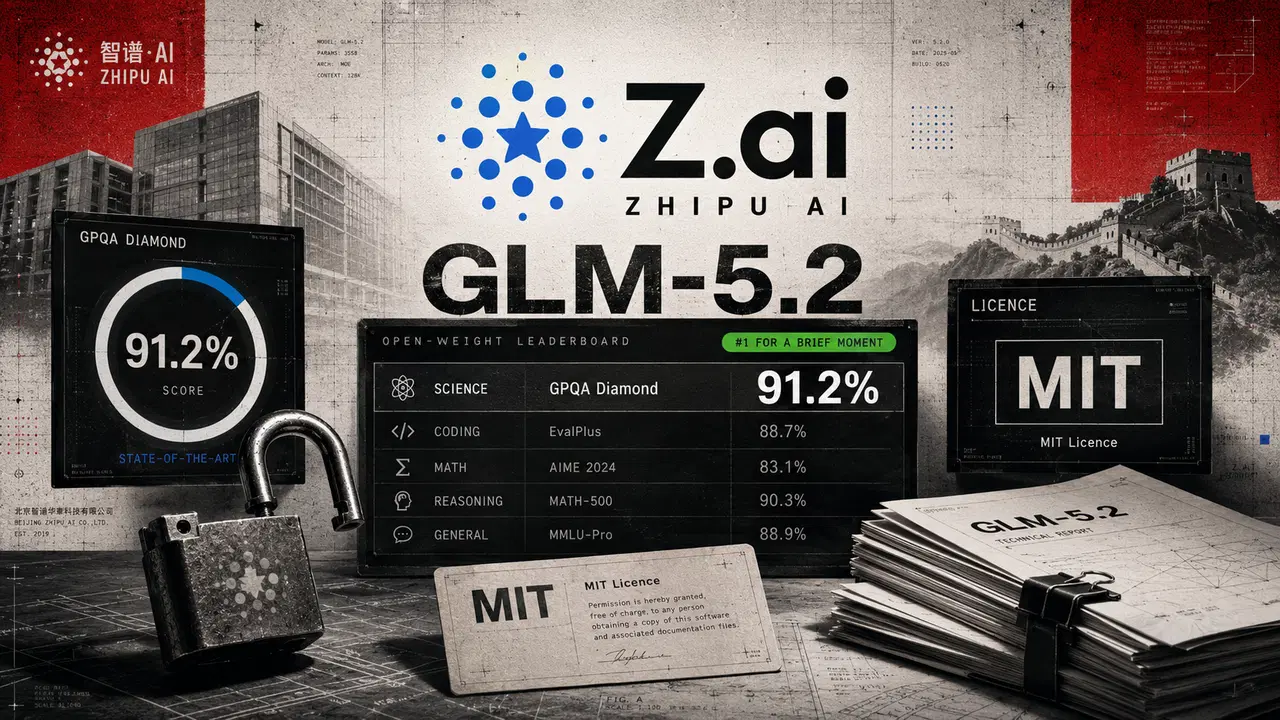
Key facts
- ~753Btotal, per Hugging Face
- Parameters
- 1Mtokens
- Context
- 91.2%graduate science
- GPQA Diamond
- $4.40per M output
- Price
- Jun 202613 June
- Released
- MITopen weight
- Licence
Strongest open-weight all-rounder before K3 landed. Released 13 June 2026, with the MIT-licensed open weights following on 16 June.
What it is
GLM-5.2, the large language model from the Chinese lab Z.ai (formerly known as Zhipu), arrived on 13 June 2026, and remains the base underneath GLM-5.3, which added only post-training in August 2026. It landed first through Z.ai’s paid tier, as the strongest all-rounder of its class before Moonshot’s K3 later took the crown. The open weights followed three days later, on 16 June, under a permissive MIT licence, after which GLM-5.2 could be downloaded, inspected, fine-tuned and run by anyone, and for several weeks it topped the open-weight rankings across a broad spread of tasks rather than winning on any single narrow benchmark.
Why open weights count
The phrase open-weight is worth defining, because it is the crux of the story. An open-weight model is one whose trained parameters are published for anyone to download and run, in contrast to a closed model reached only through a company’s own service. Open weights let organisations audit a model, host it on their own machines and adapt it to a task without asking permission, which is why the strongest open-weight release at any given time is watched closely by developers who cannot or will not depend on a single provider’s cloud. For a frontier-grade model to appear under such terms, rather than behind a paywalled interface, changes what smaller teams can realistically attempt.
Inside the architecture
The architecture explains much of the appeal. The model is a mixture-of-experts (MoE) design, meaning only a fraction of the network fires on each step, which keeps the running cost far below what the headline parameter count implies. The count itself is worth stating carefully, because the published figures disagree: Hugging Face’s own file metadata for the released checkpoint totals about 753 billion parameters, while Z.ai’s own launch copy for GLM-5.3 in August 2026 describes the shared base as “the 743B base model”. An earlier version of this page carried 744 billion, which matches neither, and no primary source we can find states the active-parameter count. Paired with a context window of up to one million tokens, it can hold very long documents, codebases or transcripts in view at once, which is a large part of why reviewers rated it so highly for long-context work.
Benchmarks, price and licence
On the harder reasoning tests it posted 91.2% on GPQA Diamond, a set of graduate-level science questions designed to resist quick lookup and to reward genuine understanding. Scores like that placed it within reach of the leading closed models of the period, an unusual position for a freely licensed release. In multiple July 2026 roundups, GLM-5.2 was ranked the best open-weight model then available, with reviewers singling out long-context coding, general reasoning and agentic work, meaning tasks where the model plans, calls tools and carries out multi-step jobs with limited supervision.
On price, output ran at around $4.40 per million tokens, competitive for a model of this capability and cheaper still for anyone with the hardware to self-host under the MIT terms. That licence deserves attention. MIT is one of the most permissive in software, placing few restrictions on commercial use or redistribution, which lowers the barrier for start-ups and researchers who want to build on the model without negotiating a bespoke agreement. With the weights published openly on hosts such as Hugging Face, GLM-5.2 became an easy default for teams that need to keep data in-house or run offline.
How it compares and what to watch
Buyers frequently set it against DeepSeek V4, the other open-weight release most often named in the same breath, though the choice between them usually came down to the specific workload rather than a clear overall winner. That kind of close competition, with several strong open models trading places within weeks, defined the open-weight scene through the first half of 2026.
The “before K3 landed” line in the tagline is the real story. GLM-5.2 held the top spot only briefly before Moonshot’s K3 arrived, and that rapid turnover is characteristic of open models in this period. For a fuller picture of how these systems compare, see our large language models hub and the wider AI section. What to watch is whether Z.ai can repeat the feat with its next release, and whether MIT-licensed models keep pace with the closed frontier.
More AI
All AI →
Open source coding models close the gap in a single week
Two releases on 18 June changed the arithmetic for anyone paying for a frontier coding model. Z.ai published GLM-5.2, a 753 billion parameter mixture of experts model under an MIT licence with a one million token context window.
More in Large Language Models
All LLMs →- Google DeepMindGemini 4 Argonlonger reasoning, coding and cyber defence
- OpenAIGPT-5.6the flagship from 9 July to 3 September 2026
- OpenAIGPT-6 Astrathe new generation, rolling out from 3 September 2026
- OpenAIGPT-6.1 Solthe upgraded mid-price GPT-6 model, released 29 September 2026
- OpenAIGPT-6 Sol and Lunathe mid-price and budget GPT-6 models, released 22 September 2026
- AnthropicClaude Opus 5.5the first Claude 5.5 model, cheaper and faster than Opus 5