Meta opens Muse Glimmer under Apache 2.0, dropping the Llama licence rules
Muse Glimmer is a 30B dense model with a vision encoder, published on Hugging Face under Apache 2.0 with no user cap and no naming clause. Zuckerberg says Muse Spark 1.2's weights follow.
Listen to this podcastListen
Meta published the weights of a new model called Muse Glimmer on Monday under the Apache 2.0 licence, and Mark Zuckerberg said the weights of the company’s current flagship will follow. It is the first Muse model anyone outside Meta can download, and the first open release of any kind from the company since Llama 4 in April 2025.
Zuckerberg, on X: “Today we’re also opening the weights for Muse Glimmer, a great 30B parameter dense model that can run locally. Soon we’ll also release the weights for Muse Spark 1.2, our latest foundation model. Meta is a strong supporter of open source and I’m proud of these releases.”
The licence is the news
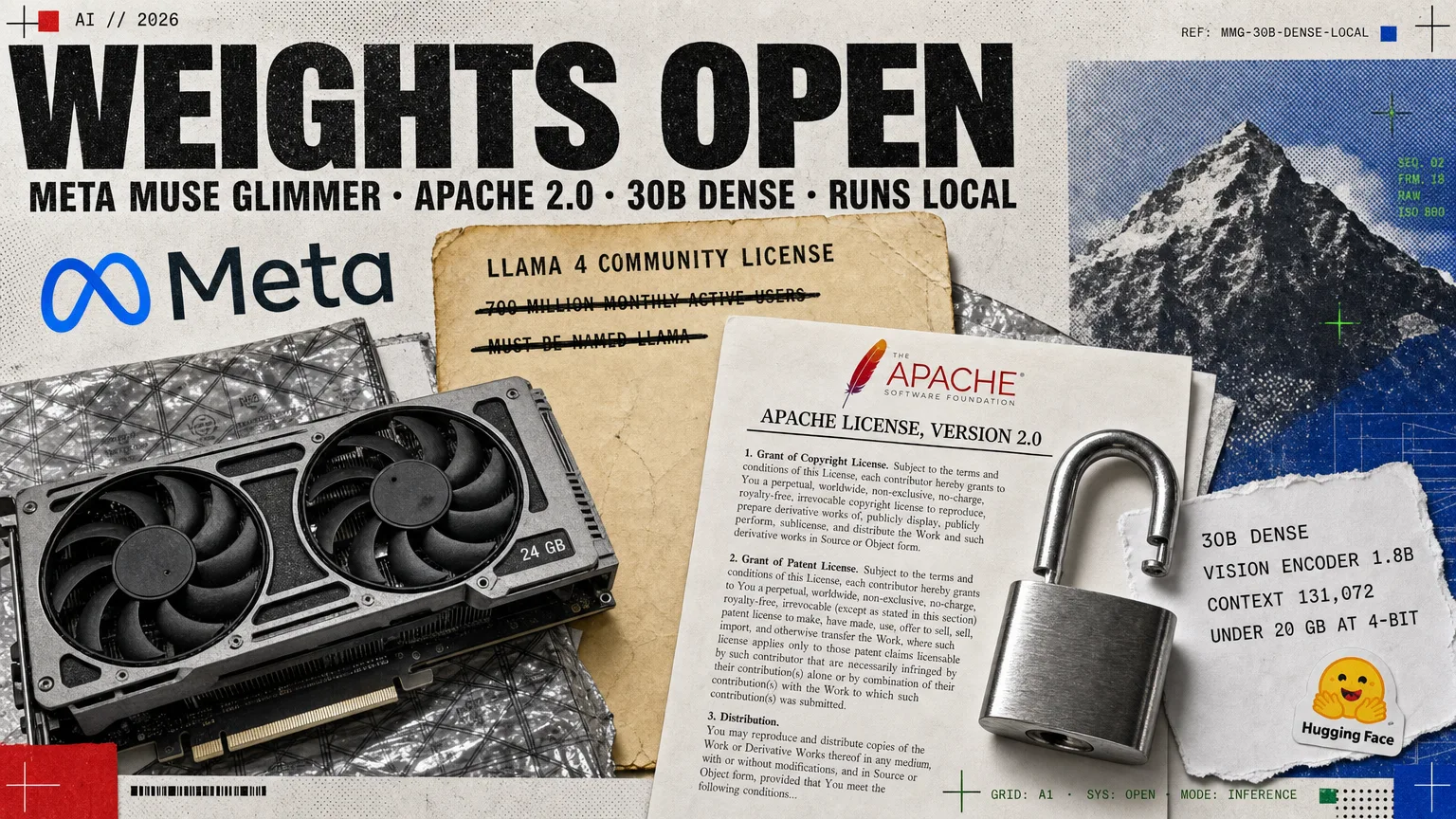
Every open Llama shipped under Meta’s own Community Licence, which carried two conditions that kept it out of the open-source category proper. Any company with more than 700 million monthly active users had to come and ask for separate terms. And anyone releasing a derivative model had to “include ‘Llama’ at the beginning of any such AI model name”.
Apache 2.0 has neither. It is an OSI-approved licence with a patent grant, no user ceiling and no permission to seek, and the download is ungated. Meta layers a separate usage policy on top, barring weapons, fraud and use by under-18s, but that is an acceptable-use document rather than a condition on redistribution.
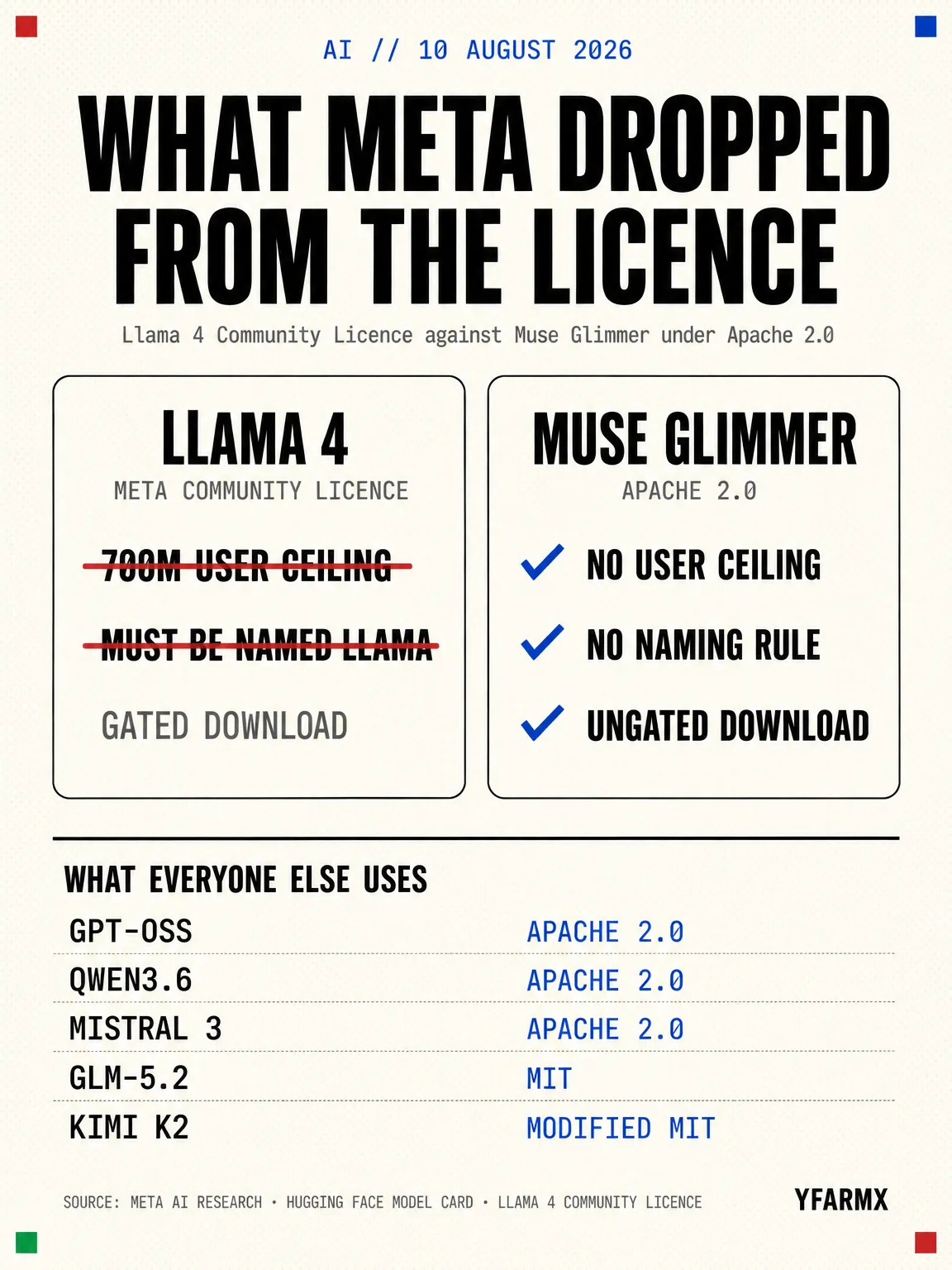
This brings Meta level with the field rather than ahead of it. OpenAI’s gpt-oss models, Alibaba’s Qwen3.6 and Mistral 3 are all Apache 2.0; GLM-5.2 is MIT and Moonshot’s Kimi K2 family is a modified MIT. Permissive licensing became the norm among open-weight labs while Meta was not releasing anything.
What it is, and what it runs on
Muse Glimmer is a dense causal transformer of about 29.6 billion parameters, including a 1.8 billion parameter vision encoder, so it takes interleaved text and images and returns text. Meta gives the context window as 131,072 tokens or more. It is not a video model: the model card states the model “is not explicitly optimized for video; video input is processed as individual frames”.
It was distilled from Muse Spark, Meta’s closed flagship, by training on the larger model’s output logits. The knowledge cutoff is 4 January 2026, and the training data is described only as “publicly available data, data provided by third parties and information from Meta’s products and services”.
The engineering worth noting is what makes it fit. At full precision the model would need “over 55 GB of memory”, which no consumer card offers. Quantised to roughly 4-bit it drops “under 20 GB”, leaving room for the key-value cache, the vision encoder and a speculative-decoding drafter inside a 24GB budget, with “minimal to no degradation on agentic tasks”. It is built for agent work, runs with OpenClaw and other orchestrators, and handles more than 100 languages.
Is it actually the best model of its size?
No, and Meta’s own table says so. Against Gemma4-31B and Qwen3.6-27B in thinking mode, Muse Glimmer leads on some tests and trails on others.
| Benchmark | Muse Glimmer | Gemma4-31B | Qwen3.6-27B |
|---|---|---|---|
| MCP Atlas | 75.5 | 54.2 | 62.5 |
| SWE-Bench Verified | 76.0 | 66.6 | 77.2 |
| SWE-Bench Pro | 51.2 | 36.9 | 50.2 |
| TerminalBench 2.1 | 51.7 | 43.4 | 60.7 |
| AIME 2026 | 94.7 | 89.2 | 94.1 |
| GPQA Diamond | 83.5 | 85.7 | 84.2 |
| MMMU Pro | 74 | 73 | 75 |
Glimmer wins the tool-use test by a wide margin and takes the maths. Qwen takes both the terminal and software-engineering tests, and Gemma takes the science questions. These are Meta’s figures on Meta’s harness. Artificial Analysis, which runs its own evaluations, scores Glimmer at 35 on its intelligence index and lists the usable context as 256k, which does not match Meta’s own number.
The reversal this ends
Meta previewed Llama 4 Behemoth on 5 April 2025 at roughly two trillion parameters and never shipped it. A year later it launched Muse Spark, a proprietary family from Meta Superintelligence Labs, and everything since has been closed: Muse Image, Muse Video, Muse Spark 1.1 and 1.2, and the Muse Code agent that shipped five days ago.
Zuckerberg gave the reason on the Q2 earnings call on 29 July: “in ramping up Meta Superintelligence Labs, in some ways, actually counterintuitively, it takes some more work to do open source models… I just wanted to make sure that the MSL team was uninhibited in building out the most intelligent models that we could.”
Twelve days later he published an essay, “The Future is for Everyone”, putting it more firmly.
“Open source is a positive and important force for empowering people and preventing centralization that is detrimental for both safety and the economy. Now that Meta Superintelligence Labs are up and running, we will resume releasing some open source models soon.”
Mark Zuckerberg, 10 August 2026
A distilled 30B is not a frontier model, and that is the deal
What Meta has opened is a small, capable, genuinely unencumbered model that a developer can run on a desktop and ship in a product without a lawyer. On the licence it is the most permissive thing the company has ever released. On capability it is a distillation of the model Meta is keeping.
The EU AI Act rewards the choice, too. Article 53(2) exempts genuinely open models from parts of the general-purpose documentation duties, and at 30 billion parameters Glimmer sits nowhere near the 10^25 FLOPs systemic-risk threshold in Article 51. Opening a small model is cheap in every sense. The promise worth holding Meta to is the flagship, and the date on that promise is “soon”.
Sources
- Meta AI Research, 'Introducing Muse Glimmer: An Open Agentic Model That Runs on Your Device' (10 August 2026)research.meta.ai
- Muse Glimmer 30B model card, Hugging Face (August 2026)huggingface.co
- Mark Zuckerberg on X, 'Today we're also opening the weights for Muse Glimmer' (10 August 2026)x.com
- Mark Zuckerberg, 'The Future is for Everyone', Meta Newsroom (10 August 2026)about.fb.com
- Meta Q2 2026 earnings call transcript (29 July 2026)s21.q4cdn.com
- Meta, 'The Llama 4 herd', including the Behemoth preview (5 April 2025)ai.meta.com
- Llama 4 Community License Agreement, with the 700m monthly-active-user and naming clausesdeveloper.meta.com
- Meta, 'Introducing Muse Spark from Meta Superintelligence Labs' (8 April 2026)about.fb.com
- Apache License, Version 2.0apache.org
- Regulation (EU) 2024/1689, the Artificial Intelligence Act, consolidated texteur-lex.europa.eu