
Meta
Llama 4
the community's default base
Key facts
- 10Mtokens, Scout
- Context
- Apr 2025Scout, Maverick
- Released
- Open weightMeta
- Licence
The community's default base. The April 2025 family (Scout, Maverick) is still the last Llama-branded open release; Meta's newest open weights carry the Muse name, with Muse Glimmer 30B published under Apache 2.0 on 10 August 2026.
What it is
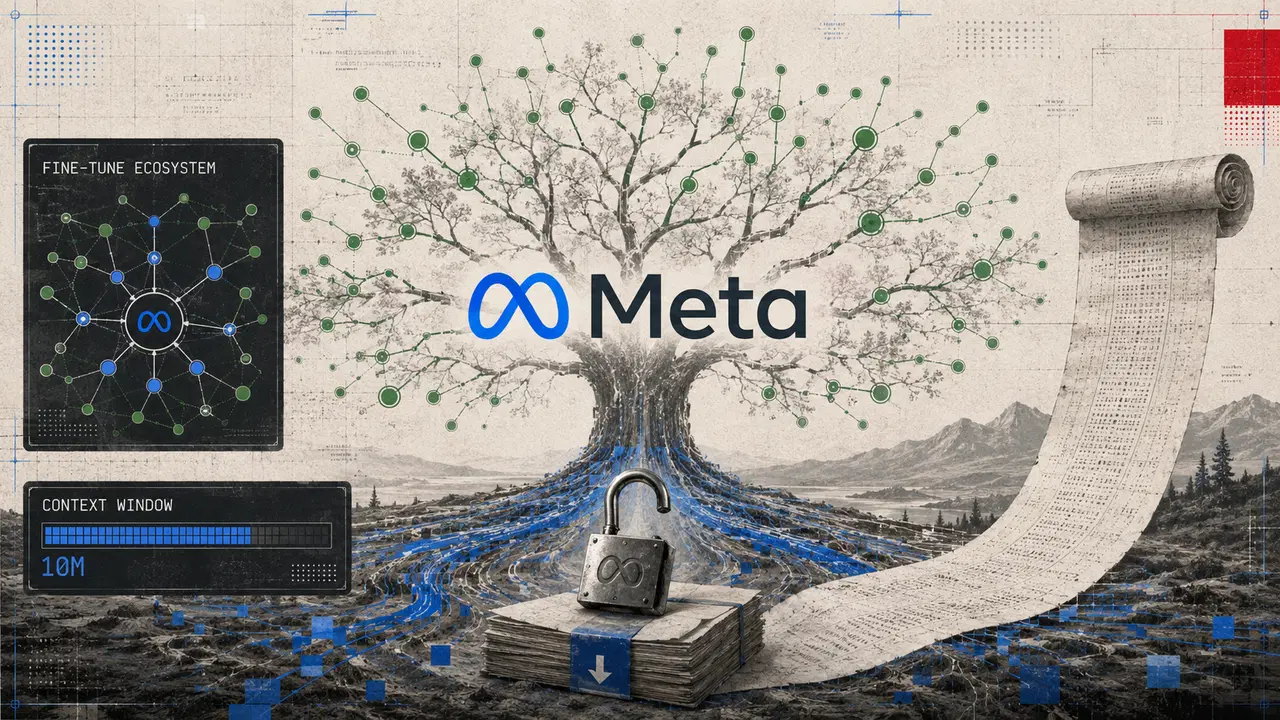
Llama 4, Meta’s open model family, has become the community’s default base: the set of weights that more independent developers build on, fine-tune and ship than any other. First released in April 2025, the Llama 4 family, led by the models named Scout and Maverick, is still the last open release to carry the Llama name, and it was Meta’s most recent open release of any kind until 10 August 2026, when the company published Muse Glimmer 30B under the Apache 2.0 licence. That is an unusually long stretch at the front of a fast-moving field.
Why the ecosystem holds
Its staying power owes a lot to reach. Because so many people already run it, the ecosystem of fine-tunes, tools and tutorials built around it is the largest of any open family. For a developer starting a project, that gravity is hard to resist: whatever the task, someone has probably already adapted the model for something close to it, and the documentation and community support are there to lean on.
A word on what that ecosystem is built from. A fine-tune is a version of a base model trained a little further on a narrower set of examples so that it does one thing especially well, whether that is medical summaries, a particular coding style or a company’s own tone of voice. Because Meta publishes the base weights openly, thousands of these adaptations can be produced by outside teams and shared freely, and each one makes the family more useful to the next arrival. That compounding effect is hard for a newer model to overcome, however impressive its raw scores, because the surrounding library of ready-made tools and guides takes years to accumulate.
The long-context outlier
One technical feature still stands out. Scout, the lighter model in the family, ships with a context window of up to ten million tokens, which as of July 2026 remained the long-context outlier among widely used models. A context window is the amount of text a model can consider at one time, and a larger one removes the need to chop long inputs into pieces and stitch the answers back together, a workaround that is fiddly and prone to error. A window that large lets the model take in enormous documents, whole codebases or long histories in a single pass, and no rival has matched it at that scale, which keeps Llama 4 relevant for jobs that others simply cannot hold in memory.
A turbulent year at Meta
The picture is complicated by events inside Meta itself. The company’s AI lab has had a turbulent year, and the question of what follows has now been partly answered, though not with a Llama 5. In April 2026 Meta Superintelligence Labs released Muse Spark, the first model in a new proprietary Muse family, and positioned it as the company’s frontier line. Llama continues as the open base beneath it, though the Muse family is no longer wholly closed: on 10 August 2026 Meta published Muse Glimmer, a 30-billion-parameter model distilled from Muse Spark, under a permissive Apache 2.0 licence. That Llama 4 has held the line for so long is partly a sign of its strength and partly a reflection of how much has been in flux behind the scenes.
What it means, and what to watch
Meta’s decision to keep publishing open weights has shaped the whole field. By giving away capable models, the company seeded a vast base of downstream work that smaller labs and individual developers could never have funded alone, and much of the open-source tooling now assumes a Llama-shaped model underneath. Open weights also let researchers probe a model for flaws and biases directly, a kind of scrutiny that closed systems can resist, and that openness has become part of Meta’s public case for the strategy. That is the practical meaning of the community’s default base. It is rarely the outright benchmark winner, yet it remains the safe, well-supported starting point that teams return to.
Where Llama goes next now sits alongside the Muse family: Meta’s frontier effort has moved there, and so, since Muse Glimmer 30B on 10 August 2026, has its open publishing. Whether the Llama name carries the next set of weights is the thing to watch. For now Llama 4 stays the backbone of open AI development. Our large language models hub compares it with the newer open families, and the wider AI section follows Meta’s strategy as it unfolds.
More in Large Language Models
All LLMs →- Google DeepMindGemini 4 Argonlonger reasoning, coding and cyber defence
- OpenAIGPT-5.6the flagship from 9 July to 3 September 2026
- OpenAIGPT-6 Astrathe new generation, rolling out from 3 September 2026
- OpenAIGPT-6.1 Solthe upgraded mid-price GPT-6 model, released 29 September 2026
- OpenAIGPT-6 Sol and Lunathe mid-price and budget GPT-6 models, released 22 September 2026
- AnthropicClaude Opus 5.5the first Claude 5.5 model, cheaper and faster than Opus 5