Meta ships Muse Code, and its own charts put Claude Code first
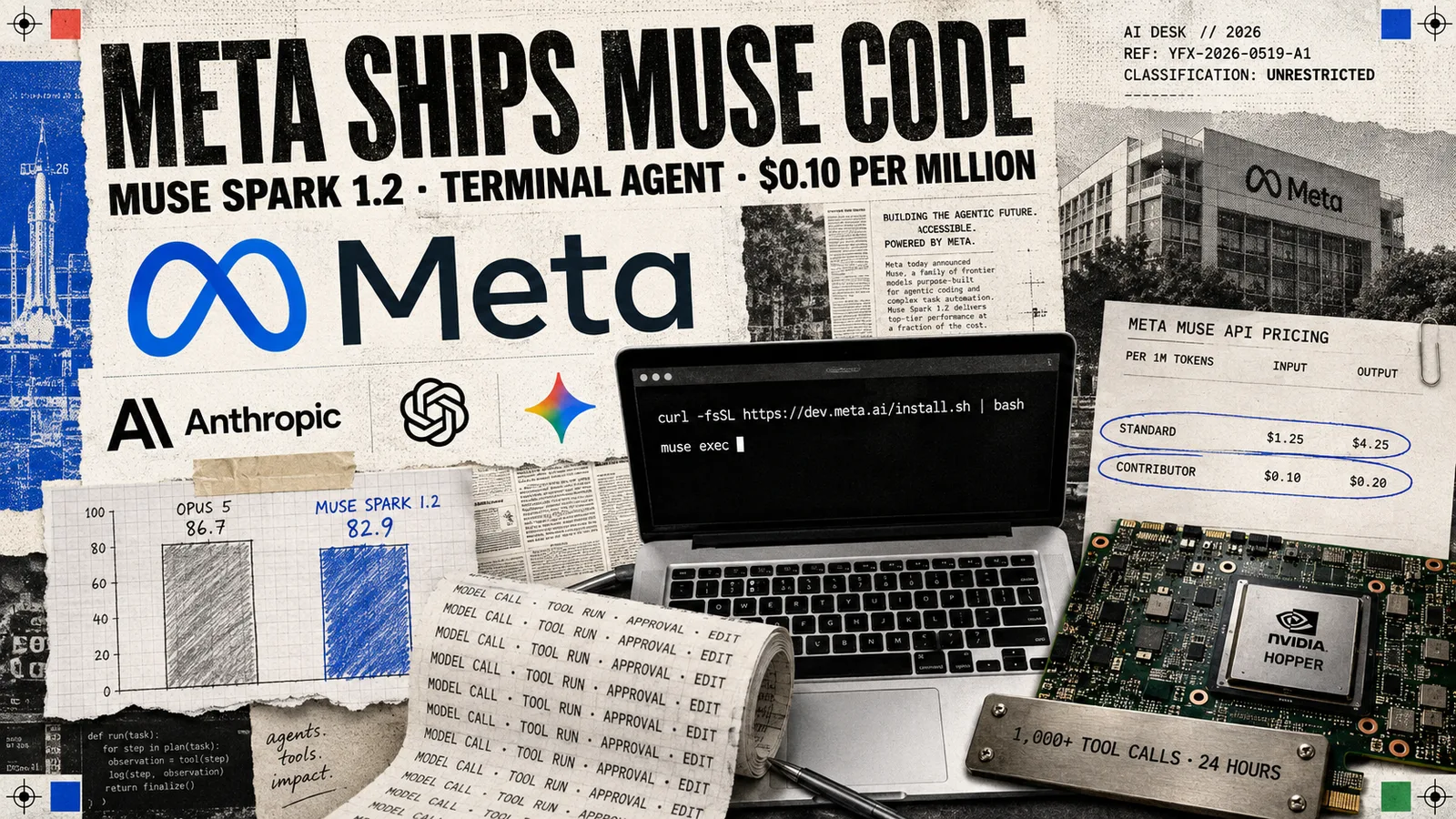
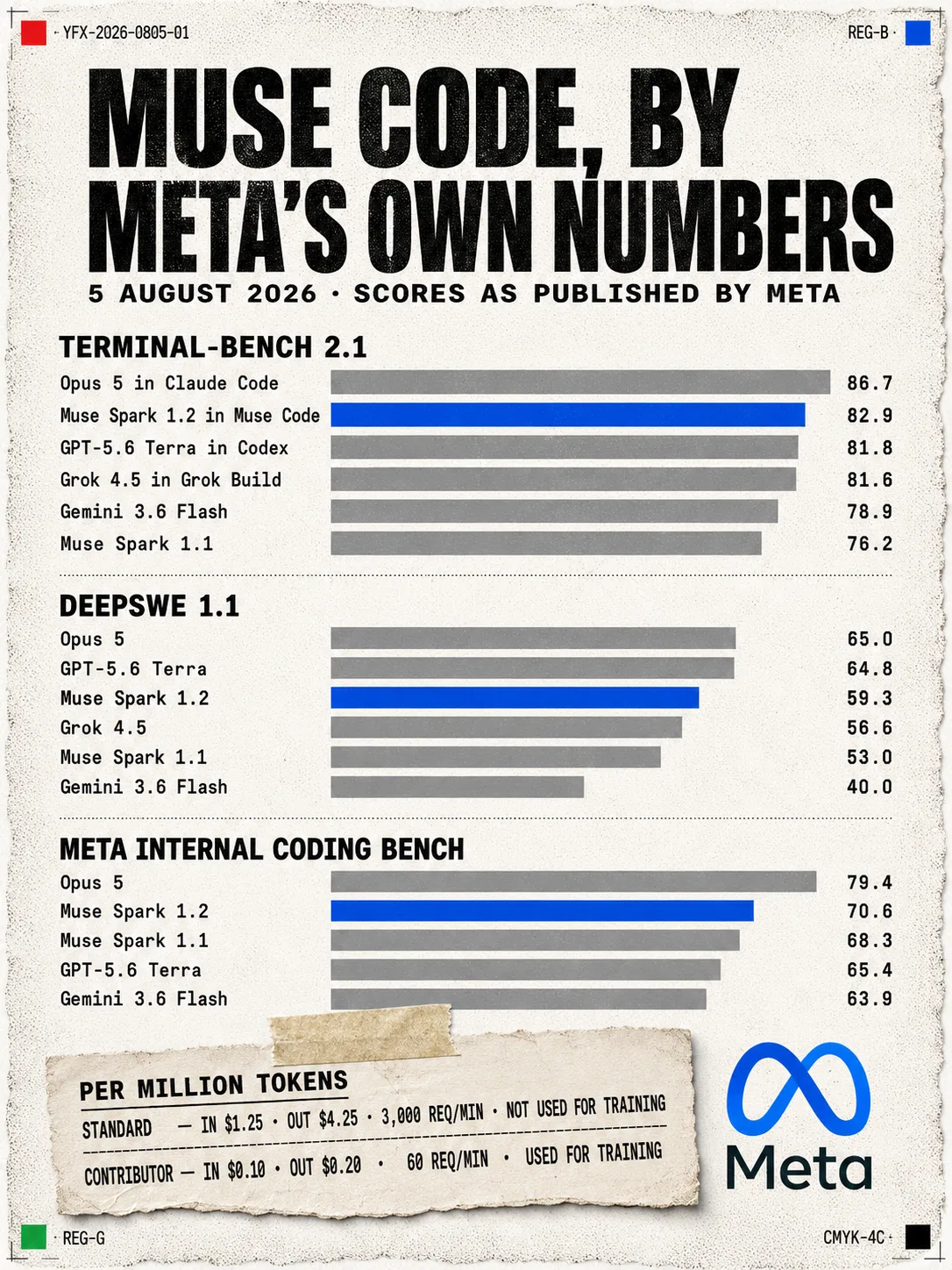
Meta released Muse Code in beta on 5 August, a terminal coding agent running the new Muse Spark 1.2. Opus 5 in Claude Code tops all three benchmark charts Meta published, including Meta's own internal one.
Listen to this articleListen
Meta published three benchmark charts with Muse Code on Wednesday, and Claude Opus 5 wins on all three. That includes Meta Internal Coding Bench, the evaluation Meta built for itself and did not have to show anyone.
Muse Code is a terminal coding agent, released in beta on 5 August and powered by a new model, Muse Spark 1.2. It installs on macOS and Linux with a single command, runs interactively with slash commands and approvals, or headlessly through muse exec "<prompt>" for scripts and CI. Approvals and an operating-system sandbox are on from the first run. It is Meta’s answer to Claude Code and Codex, and Mark Zuckerberg announced it himself on X.
The numbers Meta chose to publish
Opus 5 in Claude Code came first on every one, and the order behind it barely moved: Muse Code and Codex traded second and third, Grok Build and Antigravity followed, and the outgoing Muse Spark 1.1 came last.
| Agent | Terminal-Bench 2.1 | DeepSWE 1.1 | Meta internal |
|---|---|---|---|
| Opus 5 in Claude Code | 86.7 | 65.0 | 79.4 |
| Muse Spark 1.2 in Muse Code | 82.9 | 59.3 | 70.6 |
| GPT-5.6 Terra in Codex | 81.8 | 64.8 | 65.4 |
| Grok 4.5 in Grok Build | 81.6 | 56.6 | not run |
| Gemini 3.6 Flash in Antigravity CLI | 78.9 | 40.0 | 63.9 |
| Muse Spark 1.1 in mini-swe-agent | 76.2 | 53.0 | 68.3 |
Two figures out of that carry the story. Muse Code trails Claude Code by 8.8 points on Meta’s own internal test. And a full generation of work moved Meta 2.3 points on it, from 68.3 to 70.6.
The longest test Meta ran set six models to optimising KDA and MLA GPU kernels for NVIDIA Hopper and left them running for up to 24 hours, more than 1,000 tool calls each. Opus 5 finished furthest ahead of the baseline implementation at 74.0 per cent faster; Muse Spark 1.2 landed mid-field at 68.7, behind GPT-5.6 Sol and Opus 4.8. The finding Meta wanted is in the shape of the curves rather than the finishing order: every model was still turning up improvements hundreds of tool calls in, long after the exploring should have been over.
Ten cents, and what it buys
The Meta Model API price list is where the launch has teeth. Muse Spark 1.2 on the standard tier costs $1.25 per million input tokens and $4.25 per million output, with cached input at $0.15. Those are the same rates Meta set when it opened its first paid API with Muse Spark 1.1 on 9 July.
Then there is muse-spark-1.2-contributor: $0.10 per million input tokens, $0.20 per million output, $0.002 for cached input. Twelve and a half times cheaper on input, twenty-one times cheaper on output, for the identical model.
The documentation is direct about the trade. The contributor tier gives “heavily discounted token pricing in exchange for permission to use your prompts and completions to train future Meta models”. The standard tier states the opposite: “your prompts and completions are not used to train Meta models.”
The rate limits separate the two further. Standard is 3,000 requests a minute and 4 million tokens a minute per team. Contributor is 60 requests a minute and 2.1 million tokens. Sixty requests a minute is enough for one developer working in a terminal and not enough to run an agent fleet, which is the point: the cheap tier is priced to collect training data from individuals, not to serve production traffic.
For a solo developer or a startup on a credit card, $0.10 in and $0.20 out is a different category of expense from anything else at this capability level. What is being sold is not the model, it is the price. What is being bought is the code people write with it.
The engineering underneath
Muse Code keeps a local event log, and every model call, tool run, approval and edit is appended to it before it happens. Meta calls the result “replay-exact and restart-safe”: after a crash the agent resumes precisely where it stopped rather than re-deriving its state from a conversation transcript. Anyone who has watched an agent lose 40 minutes of context to a dropped connection will understand why that is in the launch post.
“Muse Code runs specialized background agents that stay active your whole session, so they build up context over time instead of starting from scratch on every task.”
Mark Zuckerberg, announcing the release on X
Three skills ship with it. /plan turns a task into an approval-gated plan, /grill stress-tests that plan until it holds up, and /goal works toward completion of a stated objective. When a job is large enough the agent fans out to sub-agents working in parallel in isolated git worktrees, leaving the working copy untouched. Zuckerberg’s example: six features built simultaneously for a game, with no collisions.
Muse Spark 1.2 was co-trained with the harness itself, using rejection-sampled trajectories from Muse Code, and trained on whole-repository generation and long end-to-end projects. That is the same approach OpenAI and Anthropic have converged on, and it is why the benchmark rows read “model in harness” rather than model alone.
Price is a strategy, second place is a position
Meta has the one balance sheet in this fight that does not need inference to pay for itself. Advertising revenue funds the clusters, so a coding agent can be sold at a loss for as long as it takes to build a habit, and the contributor tier turns that loss into a training corpus. Anthropic and OpenAI cannot answer $0.10 per million tokens without damaging the business they actually have.
The capability gap is still open, and Meta published the evidence itself. On the test it wrote for its own engineers, the best agent available is still someone else’s.
Sources
- Meta AI, Introducing Muse Code and Muse Spark 1.2 (5 August 2026)research.meta.ai
- Meta developer documentation, Muse Code overviewdev.meta.ai
- Meta developer documentation, pricing and rate limitsdev.meta.ai
- Meta developer documentation, using the Model API with coding agentsdev.meta.ai
- Meta AI, Introducing Muse Spark 1.1 and the Meta Model API (9 July 2026)ai.meta.com
- Mark Zuckerberg (@finkd) launch thread, X, 5 August 2026x.com