OpenRouter's Ori configures four coding agents in one command
OpenRouter has released Ori, a CLI that launches Claude Code, Codex, OpenCode and Hermes already wired to OpenRouter, with per-model settings the company says cut Claude Code's system prompt by almost half.
Listen to this articleListen
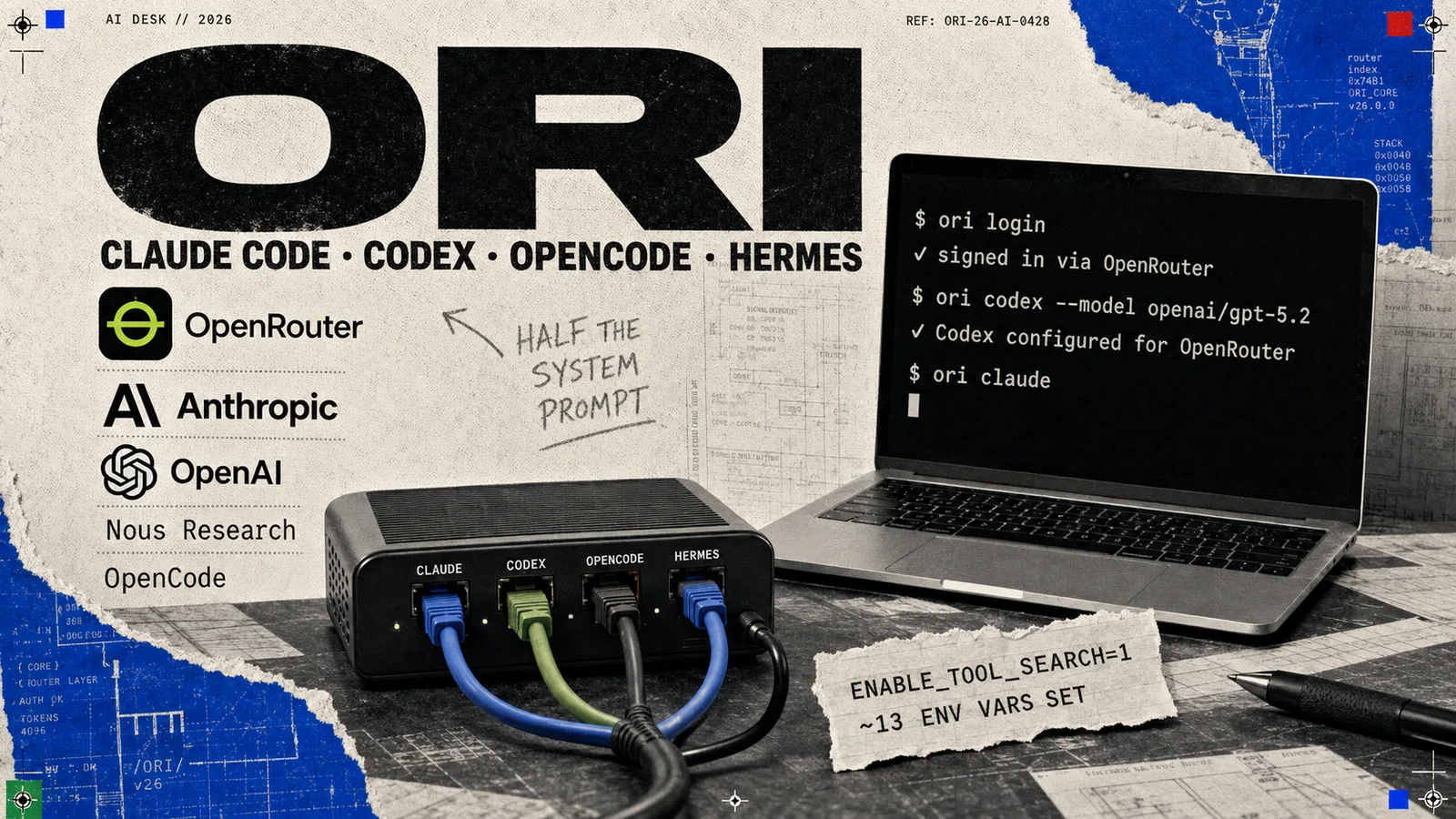
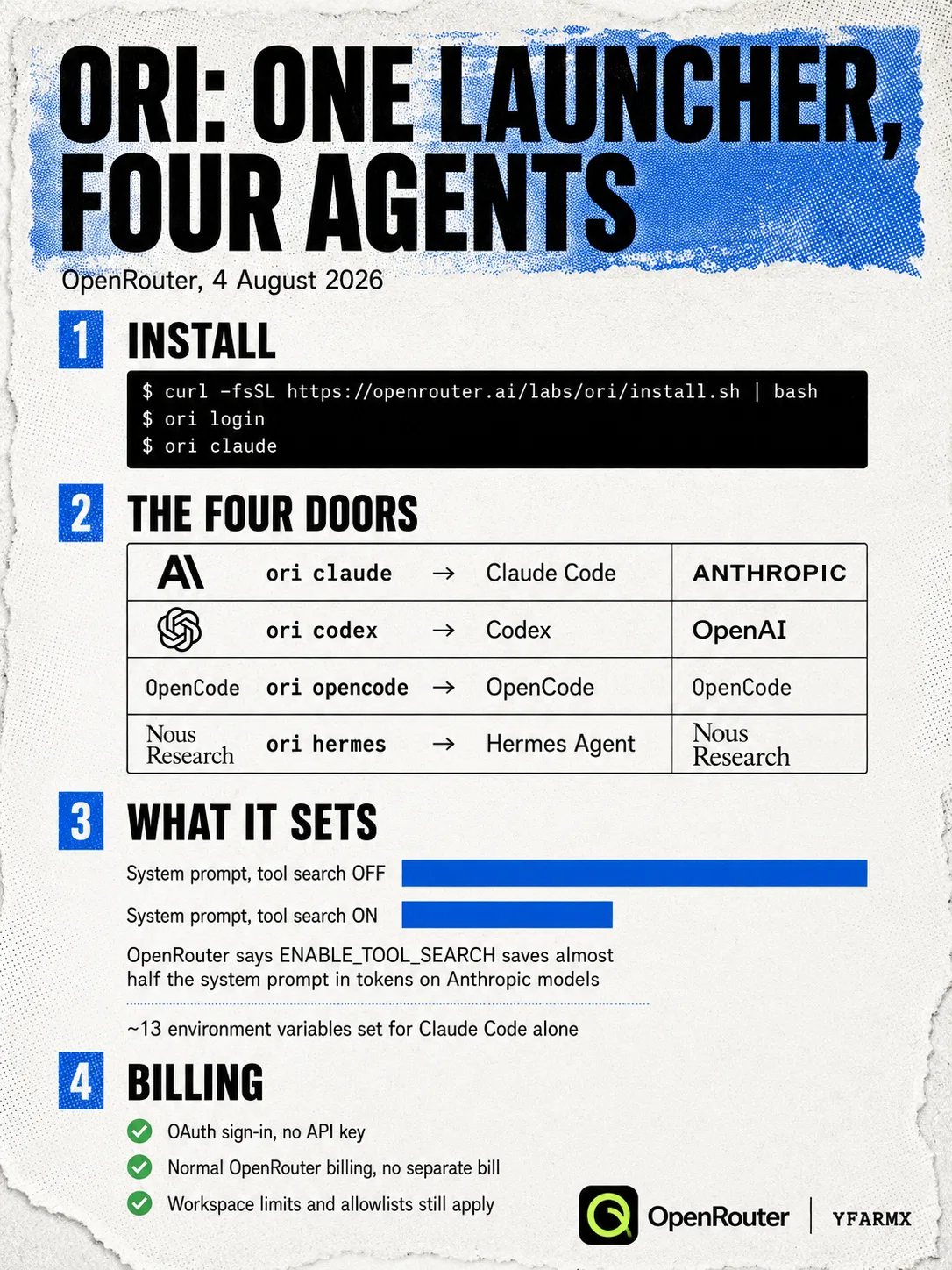
OpenRouter has released Ori, a command-line tool that starts four existing coding agents with OpenRouter already configured underneath them. The four are Claude Code, Codex, OpenCode and the Hermes Agent from Nous Research. One command installs it, a browser sign-in authorises it, and each agent runs with the flags it always took.
curl -fsSL https://openrouter.ai/labs/ori/install.sh | bash
ori login
ori claude
The company’s framing is that nothing about the agent changes. In its words, Ori runs “the agent CLI you already use on OpenRouter, with OpenRouter credentials, models, and environment set up for you”.
The configuration was doing more work than most people set
The argument for Ori sits in what goes between an agent and a model. OpenRouter’s post says that running Claude Code through a gateway and getting the same experience as Anthropic’s own harness takes “a lot of environment variables you need to set”. Ori sets around 13 of them for Claude Code alone: the base URL, the auth token, model defaults per tier, and feature flags including ENABLE_TOOL_SEARCH and CLAUDE_CODE_SKIP_FAST_MODE_ORG_CHECK.
One flag carries most of the weight. OpenRouter says that on Anthropic models, enabling ENABLE_TOOL_SEARCH “will save you almost half the system prompt in tokens”, and that Claude Code switches it on by default when it detects Anthropic’s first-party harness. Point the same agent at a gateway without it and the saving goes.
The company also says the effect reaches past the token count:
Tool search meaningfully changes the agent’s behavior as well: when tool search is disabled, Claude uses more tokens, more turns to accomplish the same task, and uses the Todo tool more.
Same weights, same task, a different bill and a different number of steps, decided by a setting most people running a gateway never touch.
One fixed config would be the wrong config
Ori reads the --model flag and changes what it sets accordingly. OpenRouter’s stated reason is blunt: “most open models today do not support tool search at all.” A profile tuned for Claude, applied to an open-weights model on the same gateway, would enable a capability the model does not have.
ori claude --model anthropic/claude-sonnet-4.6
ori codex --model openai/gpt-5.2
ori hermes --model deepseek/deepseek-v4-flash-lite
Everything after the model flag passes through untouched to the underlying CLI, so existing scripts and aliases keep working. ori update updates the tool itself.
The four doors
| Command | Agent |
|---|---|
ori claude |
Claude Code |
ori codex |
Codex |
ori opencode |
OpenCode |
ori hermes |
Hermes Agent |
Ori launches the CLI already installed on the machine rather than shipping its own copy of each agent. OpenRouter says more harnesses are coming.
The Hermes entry is the one worth a second look. Hermes Agent is Nous Research’s open-source, self-hosted agent, and it now sits in the same launcher as two agents built by the labs whose models it competes with. The list treats first-party and open-source agents as interchangeable front ends over one billing account.
Billing, keys and the parts a team will care about
Sign-in is OAuth PKCE against an existing OpenRouter account, so there is no key to copy into a shell profile and no second account to create. Usage lands in normal OpenRouter billing and appears in Usage Accounting and Activity Export alongside everything else, with no separate Ori bill.
The control side is the more consequential half for anyone running this across a team. OpenRouter says its guardrails, allowlists, workspace permissions and budget limits apply to Ori traffic whichever agent generated the request. Four agents, four vendors, one place where the spending cap lives.
The token and turn figures are the company’s own description of its own product, given as claims rather than as a measured benchmark with numbers attached; nothing published compares any model’s task runs with and without the Ori profile. The roadmap names better desktop app support, a toolbar widget for usage tracking, and a WebSearch plugin for OpenCode and Pi.
A gateway is only as good as its defaults
The pitch here is not a new model or a new agent. It is the admission that the layer between them had a cost, paid in tokens and turns by everyone who wired a harness to a gateway by hand and left the defaults alone. Ori’s value stands or falls on whether OpenRouter’s per-model profiles are better than the ones developers were writing themselves, and that is something a week of billing data will answer more honestly than a launch post.