Stripe is in talks to buy OpenRouter at about $10bn
The Wall Street Journal reports Stripe is in talks to acquire OpenRouter at around $10bn, about eight times the valuation reported for its May funding round. Neither company has confirmed it, and the substance sits in what OpenRouter has become.
Listen to this articleListen
Every so often a company nobody outside a particular trade has heard of turns out to sit underneath a large part of it. OpenRouter is one of those.
The Wall Street Journal reported on 24 July that Stripe is in talks to acquire it at a valuation around $10bn. Neither company has confirmed anything. The report itself says an agreement “could still dissolve or attract competing suitors”. Treat the price as reporting rather than record.
What is on the record is more interesting anyway, because it explains why anyone would pay it.
What OpenRouter actually is
If you write software that calls an AI model, you face a small, permanent annoyance. Every provider has its own API, its own pricing, its own rate limits and its own outages. Committing to one means rewriting code when a better or cheaper model appears, which in this field is roughly monthly.
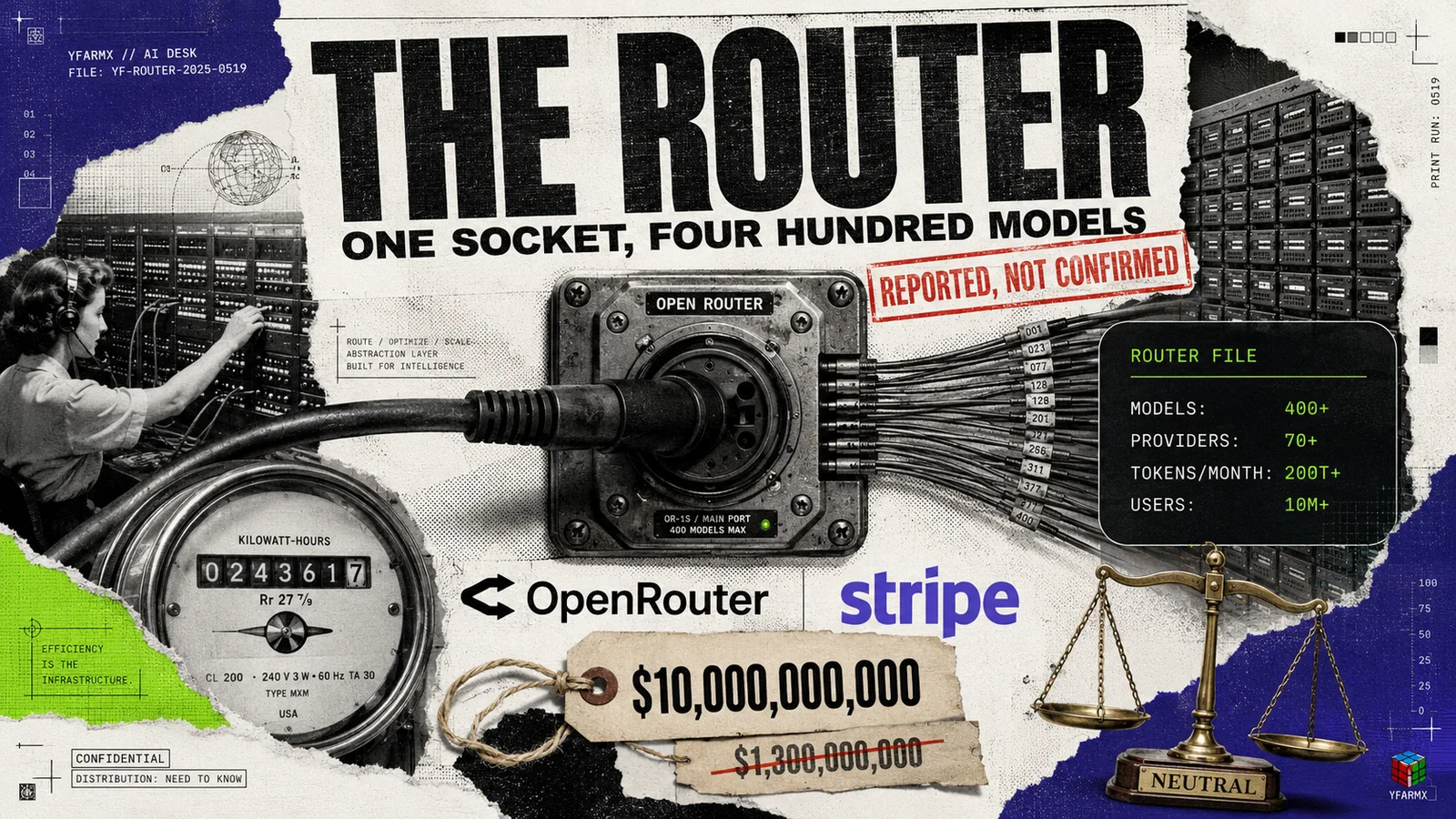
OpenRouter removes that. It offers one interface that reaches, by its own count, more than 400 models across more than 70 providers, and it falls back to another provider when one goes down. It sells credits rather than subscriptions, so the same balance works across any model. Its own front page describes it as “The Unified Interface For LLMs”, and claims more than 200 trillion tokens processed monthly and over 10 million users.
Why the number moved
The growth is the part that is hard to argue with, and it comes from OpenRouter’s own announcements rather than anyone’s estimate.
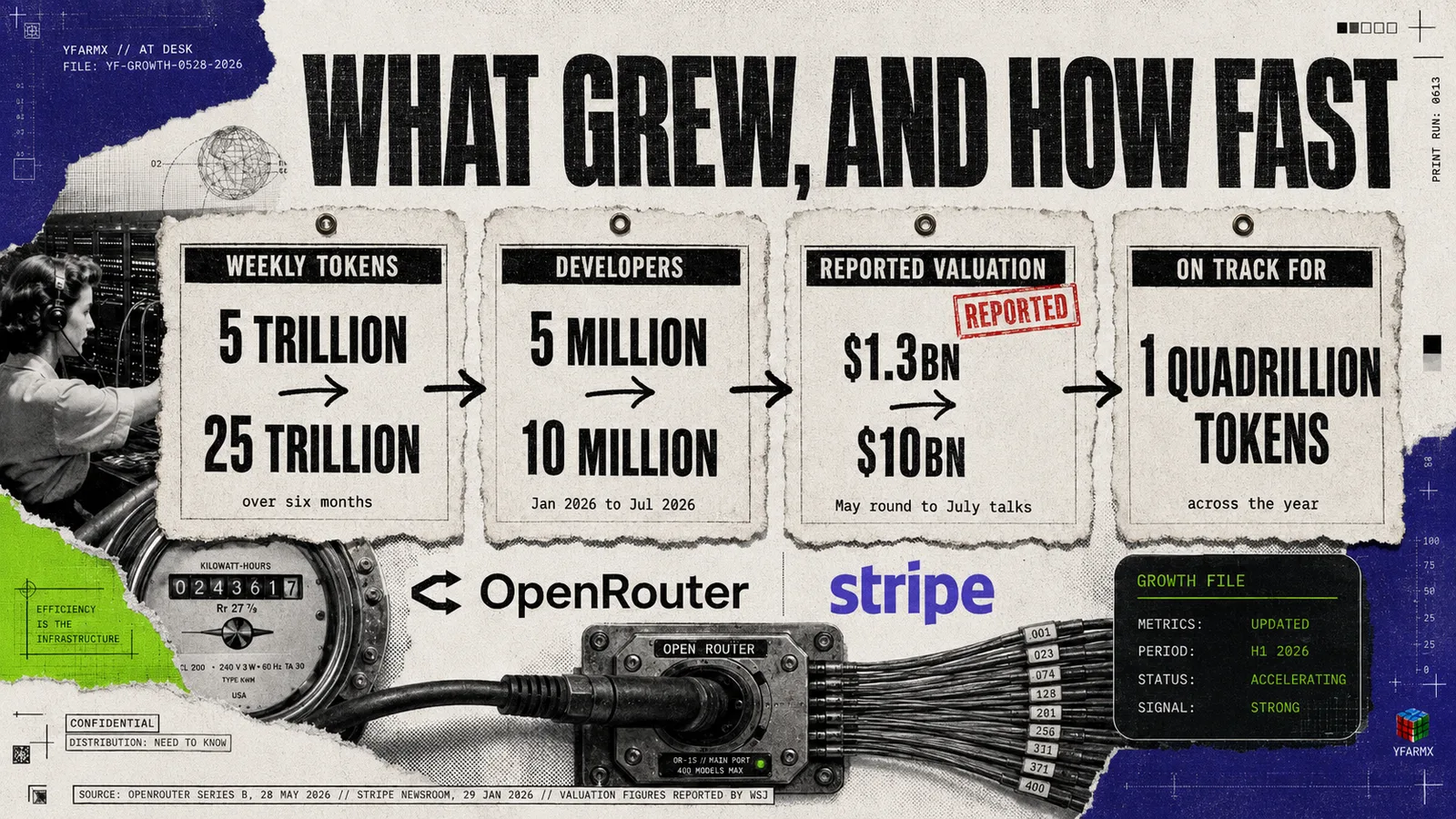
When Stripe published a customer story about OpenRouter on 29 January, it described a company serving “over 5 million developers”. OpenRouter’s site now says more than 10 million users. In its Series B announcement on 28 May, the company said weekly volume had grown from 5 trillion to 25 trillion tokens over six months, and that it expected to process more than a quadrillion tokens across the year.
That round raised $113m and was led by CapitalG, Alphabet’s independent growth fund, with Nvidia’s NVentures joining alongside ServiceNow, MongoDB, Snowflake and Databricks ventures arms, plus existing backers Andreessen Horowitz and Menlo Ventures. The Journal puts that round’s valuation at $1.3bn. If the reported $10bn is right, the price has moved roughly eightfold in under two months, on a business whose volume is compounding rather than its user count alone.
What Stripe would be buying
Stripe and OpenRouter are not strangers. Stripe’s own newsroom confirms OpenRouter runs its billing on Stripe Invoicing, calculates tax through Stripe Tax and screens fraud with Radar. Alex Atallah, OpenRouter’s cofounder and chief executive, is quoted there saying Stripe “handles payment complexity in an elegant way so we can focus on making AI models accessible”. Atallah also cofounded OpenSea in 2017, which makes this his second turn at building a marketplace layer over a fragmented market.
The strategic fit is legible without a press release. Stripe’s business is metering and settling transactions between parties who would rather not build that plumbing. OpenRouter meters and settles consumption of AI capacity between developers and model providers. Both take a small cut of something that happens constantly and invisibly. Owning the router would put Stripe underneath AI spending the way it already sits underneath online payments, and it would come with a direct read on which models developers actually choose, at what price, at a granularity no model provider can see across the whole market.
Stripe is also pursuing PayPal jointly with Advent International, an unsolicited $53bn approach that was rebuffed as inadequate. A company making moves at that scale is not short of ambition beyond card processing.
The question this raises
The reason developers route through OpenRouter is that it has no stake in which model wins. It sends a request to whichever provider is cheapest, fastest or simply up. Neutrality is the entire product.
Ownership complicates that, and not only for Stripe. Alphabet’s growth fund already led the last round while Alphabet ships Gemini; Nvidia’s venture arm sits on the cap table while selling the hardware underneath every provider on the platform. A payments company is arguably a cleaner owner than a model lab, since Stripe does not make models and has no obvious reason to favour one. That argument is reasonable. It is also the argument every acquirer of neutral infrastructure makes, and it holds until incentives change.
The practical question for anyone building on the router is narrower: does pricing stay transparent, does provider selection stay honest, and does the credit system stay portable. Those are answerable in time, not on announcement day.
A quadrillion tokens either way
The talks may conclude or collapse, the $10bn may move, and the report says other bidders have circled. What stands regardless: a service most people have never heard of now moves a quadrillion tokens a year on its own account, doubled its users in six months, and is being discussed at a number that would make it one of the larger private software acquisitions in the field. Even if this particular deal never happens, that fact stands on its own.