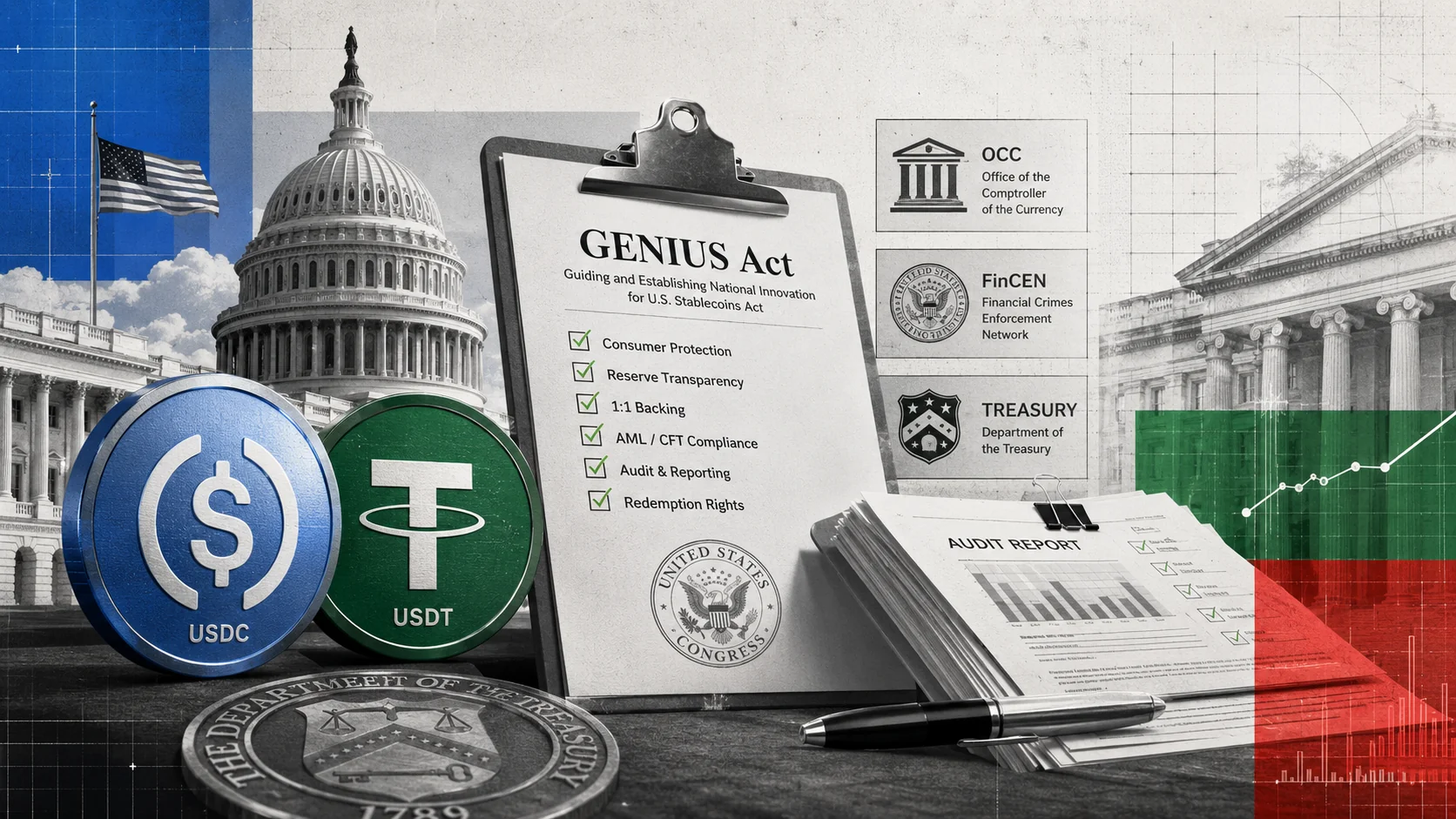
Banks could issue their own stablecoins under proposed Fed rules
The US Federal Reserve Board proposed two GENIUS Act rules on 24 September 2026. One sets reserve, capital and redemption standards for the stablecoin issuers it supervises; the other sets how its member banks apply to issue one. Comments run for 60 days.
Listen to this articleListen
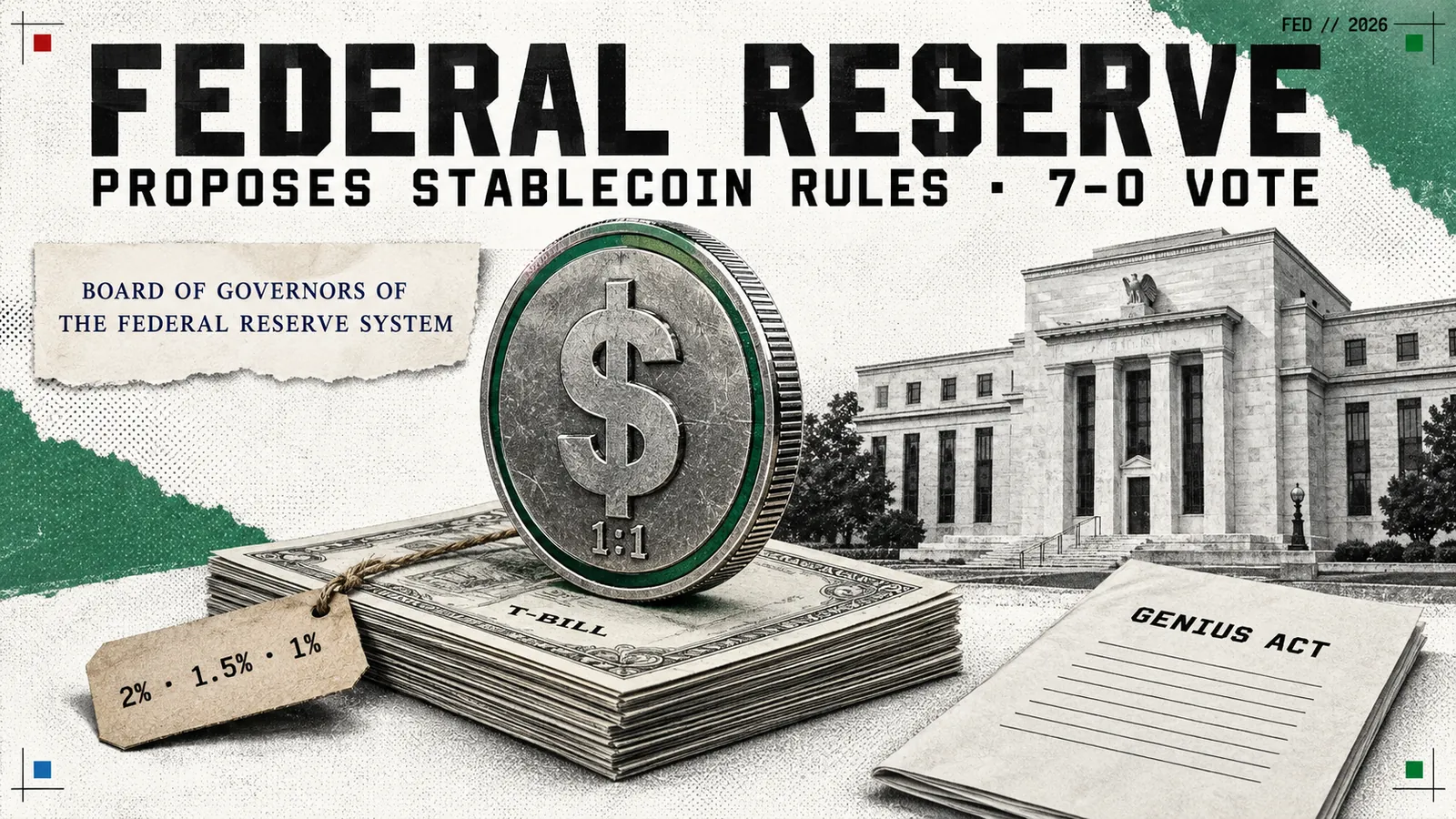
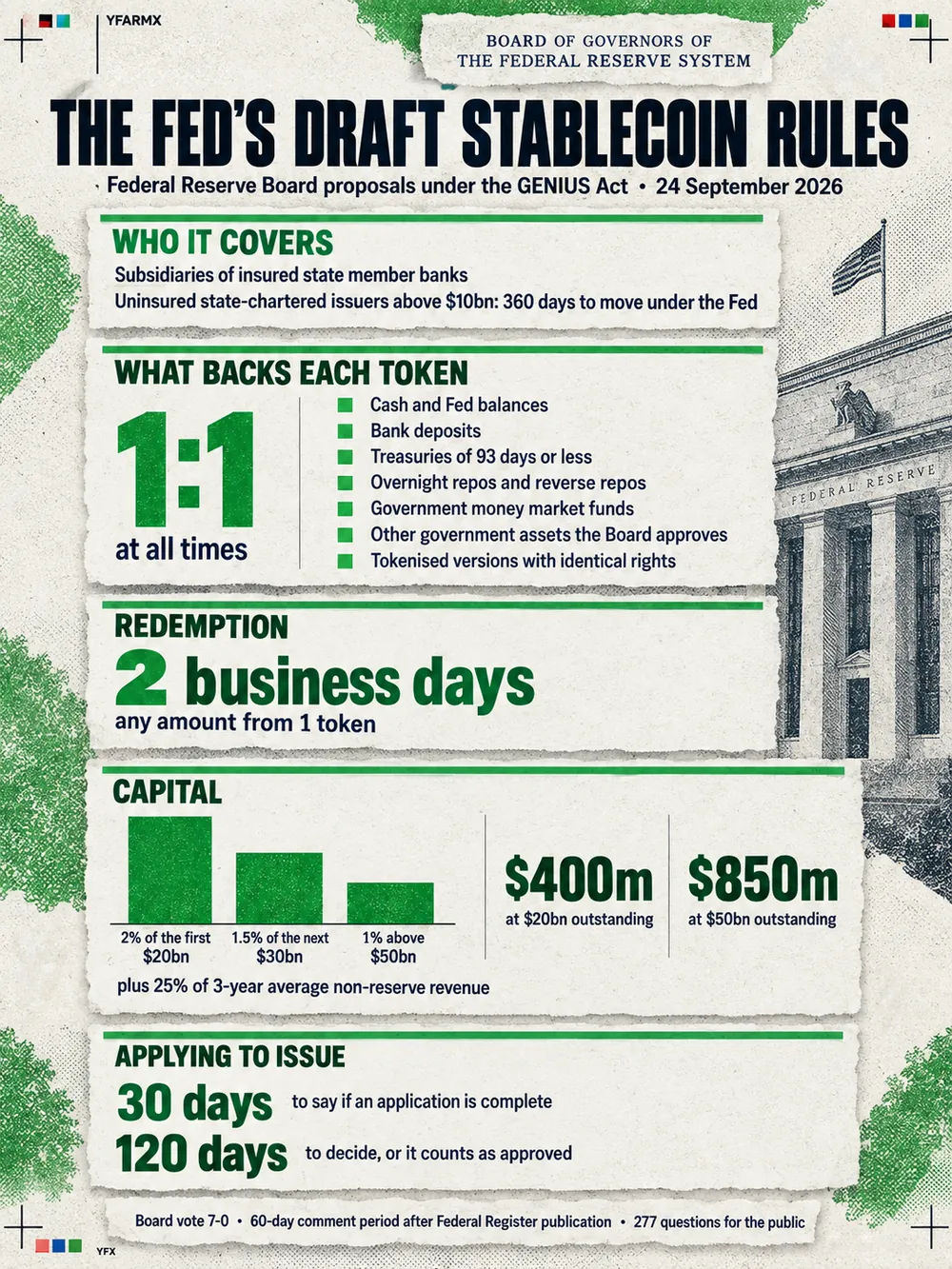
The US Federal Reserve Board proposed two rules on 24 September 2026 that set out how the banks it supervises could issue their own dollar stablecoins under the GENIUS Act. The first would require every token to be fully backed by cash, bank deposits and Treasuries maturing within 93 days, redeemable within two business days, with capital set by a published formula. The second sets how a state member bank applies for permission to issue one through a subsidiary. All seven governors voted for both, according to the Board’s voting record.
The comment period runs for 60 days from the day the two notices are published in the Federal Register. The Fed is the last of the Act’s four primary federal stablecoin regulators to publish its version; the OCC, the FDIC and the National Credit Union Administration went first. Governor Michael Barr backed the package in a statement: “Stablecoins will only be stable if they can be reliably and promptly redeemed at par in a range of conditions.”
Which stablecoin issuers would the Fed supervise?
The Fed’s rules would cover two kinds of issuer: subsidiaries of insured state member banks that the Board approves, and state-licensed issuers that are uninsured state-chartered depository institutions with $10bn or more in circulation. State member banks are state-chartered banks that belong to the Federal Reserve System. A state-licensed issuer that crosses $10bn must move under Fed oversight within 360 days or stop net new issuance, unless the Board grants a waiver, under the main proposal.
| Who | What the proposal does |
|---|---|
| Subsidiaries of insured state member banks | Full rulebook, and Board approval before issuing |
| Uninsured state-chartered issuers above $10bn | Move to Fed oversight within 360 days, stop net issuance, or win a waiver |
| Every approved US issuer, whoever supervises it | Anti-tying rule: a service may carry no condition to buy another product or avoid a competitor |
| Fed-supervised custodians | Standards for holding reserves, collateral stablecoins and issuing keys |
The Fed’s own economic analysis says the state member banks active in stablecoins today provide services to other issuers, such as managing their reserve assets. So the first Fed-supervised issuer would be a new one.
What can back the tokens?
Each token would need reserves worth at least its face value at all times, drawn from a set list, held apart from the issuer’s own assets and valued every day at 5pm.
| Reserve asset | Condition |
|---|---|
| US coins and notes, balances at a Federal Reserve Bank | Always eligible |
| Deposits at insured banks | Uninsured sums concentrated in one or a few banks must be managed |
| Treasury bills, notes and bonds | 93 days or less to maturity |
| Cash raised through repos | Overnight, backed by Treasury bills of 93 days or less |
| Reverse repos | Overnight, Treasury collateral, tri-party, cleared or with a creditworthy counterparty |
| Government money market funds | Invested only in the assets above |
| Other similarly liquid assets issued by the US government | Only if the Board approves them |
| Tokenised versions of these assets | Legal rights identical to the original |
An issuer would publish its reserve mix monthly and redeem any amount from one token upwards within two business days. The Board could extend that window if an issuer’s safety or financial stability were under threat. An issuer whose reserves slip below one-to-one would have to tell the Fed, then sell its reserves and redeem every token, unless the Board directs it to follow a plan back to full backing.
Fed staff compared the two biggest coins’ attested reserves in April 2026, counting Treasuries, Treasury-backed repos and bank deposits as higher-quality assets. Tether held about 1.04 in reserves per USDT, about 0.74 of it in those assets, and Circle held a full 1.0 per USDC in them.
How much capital would an issuer need?
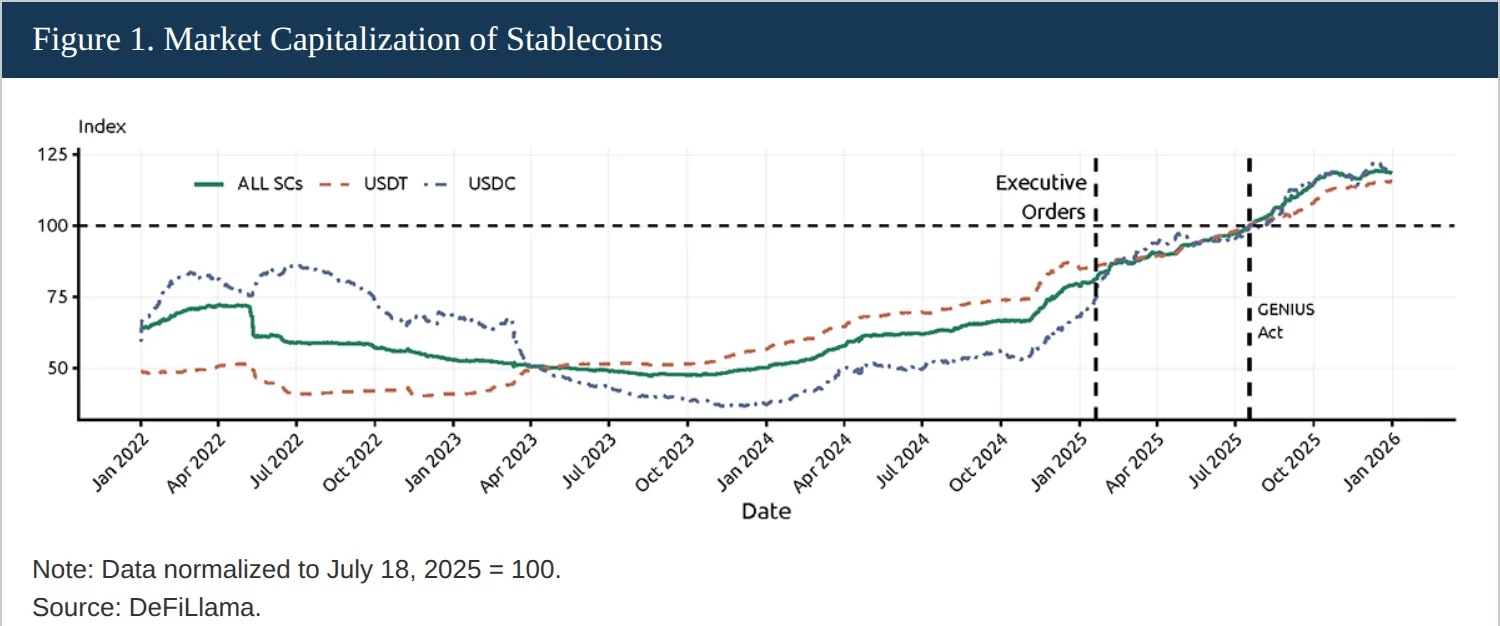
The Fed proposes a fixed formula: 2 per cent of the first $20bn of stablecoins in circulation, 1.5 per cent of the next $30bn and 1 per cent above $50bn, plus 25 per cent of the issuer’s three-year average revenue from outside its reserves. A separate 2 per cent charge covers reserves held as uninsured deposits or undercollateralised reverse repos. A loss scalar moves the operational charge up or down with an issuer’s realised losses, and the dollar thresholds are indexed to nominal US GDP.
| Stablecoins in circulation | Issuance-based capital charge |
|---|---|
| $10bn | $200m |
| $20bn | $400m |
| $50bn | $850m |
| $100bn | $1.35bn |
The Board’s own table puts the charge at $400m for an issuer with $20bn outstanding and $850m at $50bn; at $100bn the same percentages give $1.35bn. An issuer short of its minimum at a quarter-end would file a plan, and one still short a quarter later would have to sell its reserves and redeem every token. A parent bank would deduct its subsidiary’s requirement from its own common equity tier 1 capital.
The OCC took another route in its March proposal: it sets each issuer’s capital individually at licensing, with a $5m floor during an issuer’s first three years. Its experience chartering national trust banks for stablecoin programmes put the capital needed at $6.05m to $25m.
The yield ban reaches affiliates and white-label partners
The proposal bans a Fed-supervised issuer from paying holders interest or yield, in cash, tokens or anything else, solely for holding, using or keeping its stablecoin, as the GENIUS Act requires. The proposal adds a presumption borrowed from the OCC’s March draft: if the issuer pays an affiliate or a “related third party”, and that party pays yield to the issuer’s holders, the arrangement is presumed to be banned yield. Related third parties include firms paying yield as a service for the issuer and brands the issuer issues for under a white-label deal.
The issuer can rebut the presumption in writing. Merchant discounts for paying in stablecoins stay allowed, and so does sharing profits with a non-affiliated white-label partner. The OCC’s and the Fed’s drafts now treat yield paid through affiliates and partners the same way, the question at the centre of the yield-ban fight.
How a bank would apply
An insured state member bank would apply to the Fed by letter, with a business plan, financial information, policies, capital-structure documents, biographical reports and certifications, under the application proposal. The Board says it would use information it already holds as the bank’s supervisor wherever possible. Where several banks issue through one jointly owned company, the Board may accept a single application for all its state member bank owners; 21 financial institutions committed on 1 September 2026 to set up a company to issue a dollar stablecoin.
| Step | Deadline, from the GENIUS Act |
|---|---|
| Fed says whether the application is complete | 30 days after receipt |
| Fed decides | 120 days after the complete submission, or it counts as approved |
| Written reasons for a denial | 30 days after the denial |
| Bank asks for a hearing | 30 days after the denial notice |
| Fed holds the hearing | 30 days after the request |
| Final decision | 60 days after the hearing |
Issuing on an open, public or decentralised network is a protected choice under the Act, and a denied bank may apply again.
Tether and Circle hold 84.5 per cent of the stablecoin market
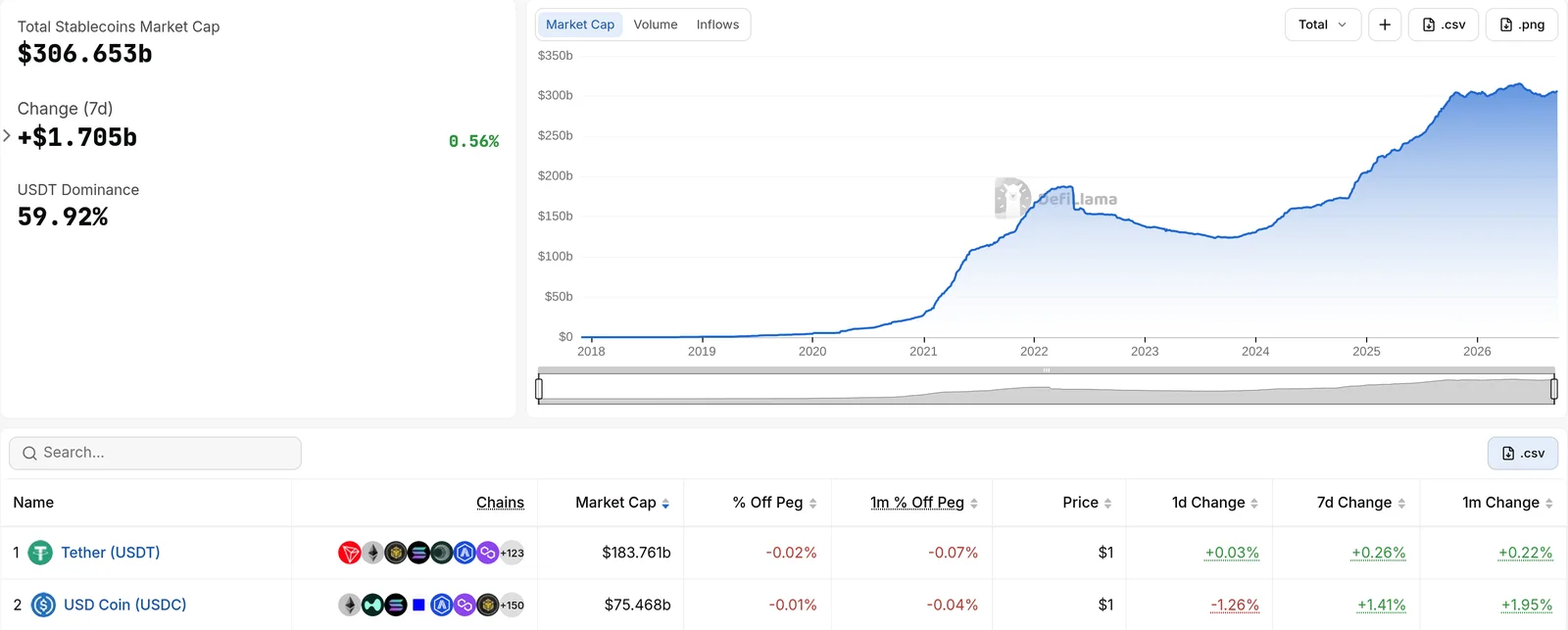
Stablecoins in circulation were worth $306.65bn on 26 September 2026, and Tether’s USDT at $183.76bn and Circle’s USDC at $75.47bn made up $259.23bn of it, according to DefiLlama. The Fed’s economic analysis describes stablecoin issuance as “duopolistic with a long tail of smaller participants”, and says the regulatory clarity the proposal brings would give new issuers a reason to enter.
The OCC, FDIC and NCUA went first
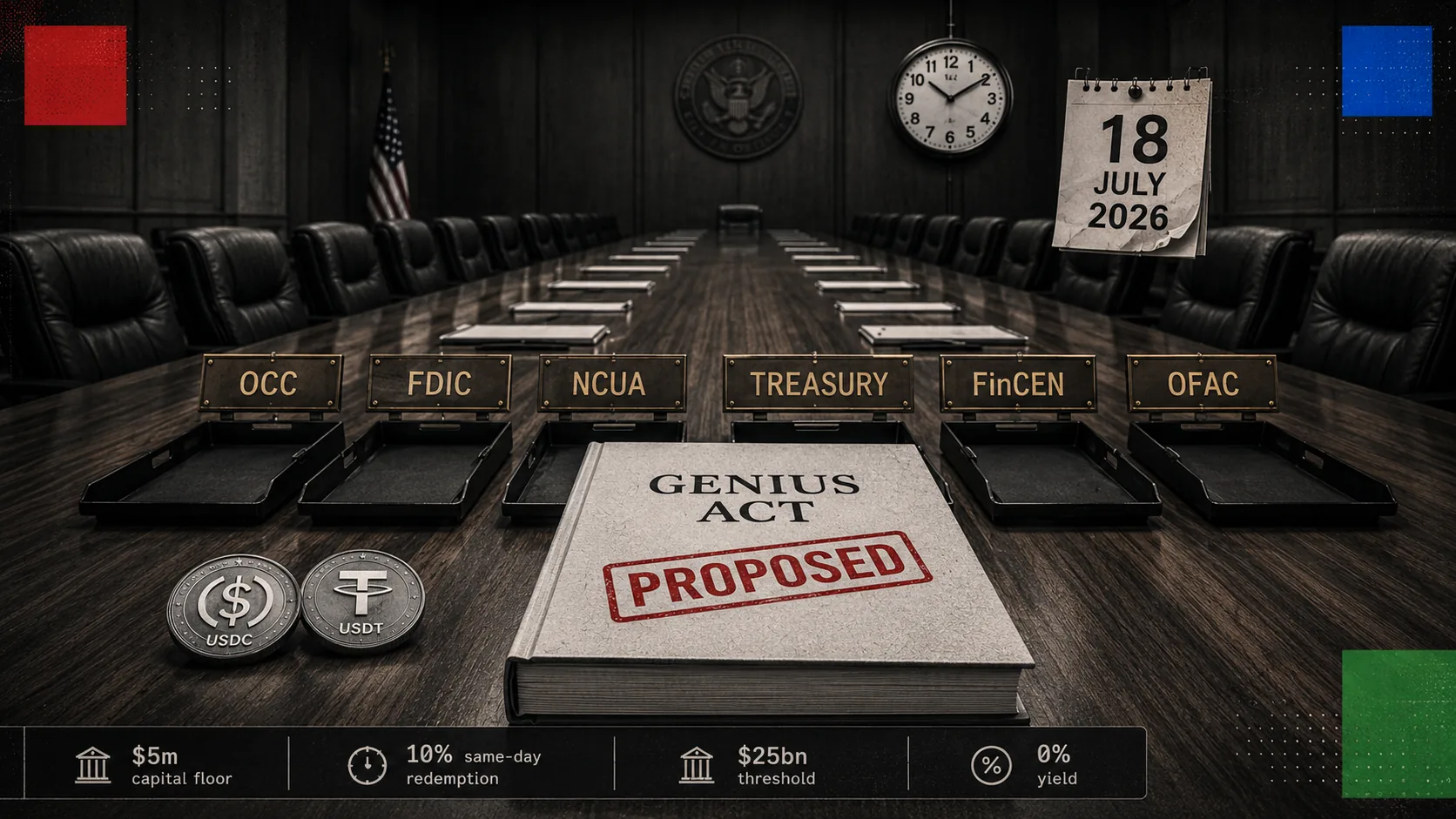

The Fed’s proposals arrive after the other three federal regulators and the Treasury had published theirs, and after 18 July 2026, the date the Act set for final rules. Stablecoin rules are one strand of US crypto regulation, and every item below still stood as a proposal on 26 September 2026.
| Regulator | Proposal | Federal Register |
|---|---|---|
| FDIC | How its banks apply to issue | 19 December 2025 |
| OCC | Full rulebook for its issuers | 2 March 2026 |
| FDIC | Reserves, capital, liquidity and risk | 10 April 2026 |
| NCUA | Issuance rules for credit union subsidiaries | 18 May 2026 |
| Treasury | Rules on issuing, offering and selling | 18 August 2026 |
| Federal Reserve | Two proposals | Board release 24 September 2026 |
The Act takes effect on the earlier of 18 January 2027, 18 months after it was signed, or 120 days after the federal regulators issue final rules. On the 18 July deadline, the OCC, FDIC and NCUA each held proposals, and the Treasury published its own on 18 August.
What Barr wants in the final rule
Governor Barr voted for both proposals and pressed on three points: interest-rate and currency risk, the anti-money-laundering standard, and redemption rights. “I am encouraged by provisions for reserve asset limitations, as well as transparent and standardized capital requirements,” he said, and asked for public comment on “whether the rule adequately addresses interest rate and foreign currency risks”.
Barr raised concerns about a clause that sets “significant or systemic” as the bar for the Board to act on an anti-money-laundering failure at an issuer, which he said “may have unknown effects on the Board’s ability to effectively substantiate that an institution establishes and maintains compliant programs.” His view of the package as a whole: “further work will undoubtedly be required if stablecoins are to be reliable payment instruments.”
The two proposals put 277 numbered questions to the public, 254 in the main rule and 23 in the application rule. Barr’s test for the final text is redemption: “it will be important that universal redemption rights are clear in the final rule to support public confidence in access to their funds.”
Questions people ask
- What did the Federal Reserve propose on 24 September 2026?
- The Federal Reserve Board proposed two rules under the GENIUS Act on 24 September 2026. The first sets reserve, redemption, capital, risk-management, custody and anti-tying rules for the payment stablecoin issuers the Fed supervises. The second sets how an insured state member bank applies for Board approval for a subsidiary to issue payment stablecoins. Comments run for 60 days after the notices are published in the Federal Register.
- What assets can back a stablecoin issued under Federal Reserve supervision?
- Under the Fed's 24 September 2026 proposal, reserves must be worth at least the stablecoins in circulation at all times and may include only US coins and notes, balances at a Federal Reserve Bank, eligible bank deposits, Treasuries with 93 days or less to maturity, overnight repos and reverse repos tied to Treasuries, government money market funds holding only those assets, other similarly liquid government-issued assets the Board approves, and tokenised versions that carry identical legal rights.
- How much capital would a Fed-supervised stablecoin issuer need?
- The Fed's 24 September 2026 proposal sets an operational risk charge of 2 per cent of the first $20 billion of stablecoins outstanding, 1.5 per cent of the next $30 billion and 1 per cent above $50 billion, plus 25 per cent of the three-year average of revenue from outside the reserves. The issuance charge comes to $400 million at $20 billion outstanding and $850 million at $50 billion. A separate 2 per cent charge applies to uninsured deposits and undercollateralised reverse repos held as reserves.
Sources
- Federal Reserve Board: press release on two GENIUS Act proposals, 24 September 2026federalreserve.gov
- Federal Reserve Board: proposed rule, Implementing the Board's responsibilities under the GENIUS Act, Docket R-1899, 24 September 2026federalreserve.gov
- Federal Reserve Board: proposed rule, Application procedures for Board-supervised insured depository institutions, Docket R-1900, 24 September 2026federalreserve.gov
- Federal Reserve Board: staff memo to the Board on the GENIUS Act proposal, 3 September 2026federalreserve.gov
- Federal Reserve Board: statement by Governor Michael S. Barr, 24 September 2026federalreserve.gov
- Federal Reserve Board: Board votes, 2026federalreserve.gov
- GENIUS Act, Public Law 119-27, approved 18 July 2025govinfo.gov
- Federal Register: OCC proposed rule implementing the GENIUS Act, 2 March 2026govinfo.gov
- Federal Register: FDIC proposed approval requirements for stablecoin-issuing subsidiaries, 19 December 2025govinfo.gov
- Federal Register: FDIC proposed GENIUS Act requirements and standards, 10 April 2026govinfo.gov
- Federal Register: NCUA proposed rule on stablecoin issuance, 18 May 2026govinfo.gov
- Federal Register: Treasury proposed rule on payment stablecoin issuance, offer and sale, 18 August 2026govinfo.gov
- Federal Reserve FEDS Notes: Stablecoins in 2025, developments and financial stability implications, 8 April 2026federalreserve.gov
- DefiLlama: stablecoins by market capitalisation, read 26 September 2026defillama.com