Citi, Goldman and 19 others commit to a dollar stablecoin company that has no name yet
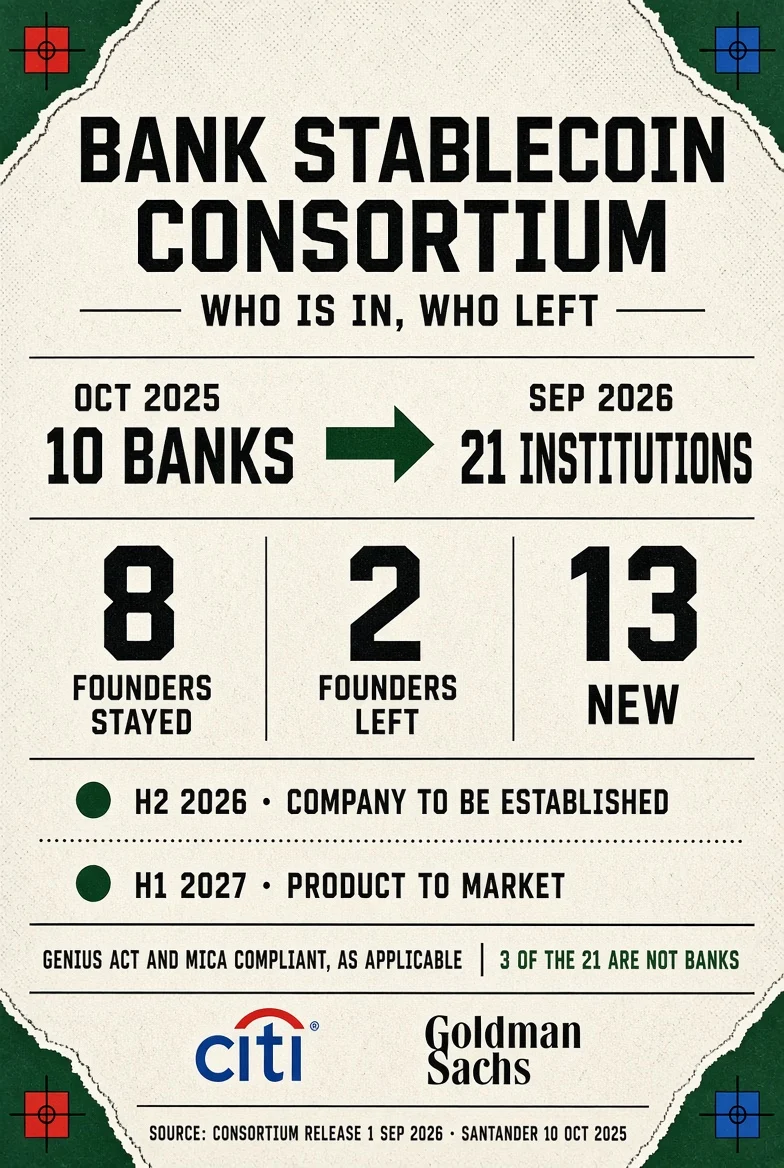
Twenty-one financial institutions said on 1 September 2026 that they have committed to establish a company to issue a dollar stablecoin. The release names no company, no chain and no executive, and two of the ten founding banks are missing from it.
The announcement went out at 09:31 New York time on Tuesday 1 September 2026, on a PR Newswire wire under a Brunswick Group contact line. None of the twenty-one institutions named in it published it on its own newsroom, and none of them put an executive’s name to it.
What they committed to is one sentence long: “Twenty-one leading international financial institutions have today announced that they have committed to establish a new company in H2 2026, subject to closing conditions, to support the issuance of a stablecoin solution.”
The company does not exist. Its formation is conditional. The product it will issue is aimed at the first half of 2027, and the release says its own name “will be announced in due course”.
What the release actually says
The first currency is the dollar. The new company “intends to operate globally, with its initial focus on a USD-denominated stablecoin offering and a longer-term ambition of expanding issuance into stablecoins denominated in additional G7 currencies, with a EUR offering as a priority.”
The product is meant for wholesale, institutional and retail use alike, and the release names cross-border payments and digital asset settlements as its examples.
On regulation the release gives one line: “The initiative intends to be GENIUS Act and MiCA-compliant, as applicable.” Intends, and as applicable.
Who is on the list
The release groups the twenty-one by the region each is headquartered in.
| Region | Institutions |
|---|---|
| North America | Bank of America, Capital One, Citi, Fidelity Investments, Goldman Sachs, PNC Financial Services, Scotiabank, TD Bank Group, Wells Fargo, WisdomTree |
| Europe | Banco Santander, BBVA, Commerzbank, Crédit Agricole, Deutsche Bank, Lloyds Banking Group, Coöperatieve Rabobank U.A., UBS |
| East Asia | MUFG Bank |
| Middle East | Sirius International Holding |
| Africa | Standard Bank |
Ten of the twenty-one are North American and eight are European, which leaves one institution each for East Asia, the Middle East and Africa. The release calls the group “leading international financial institutions” rather than banks, and the wording is doing real work: Fidelity Investments and WisdomTree are asset managers, and Sirius International Holding is the technology arm of Abu Dhabi’s International Holding Company, a group whose own published portfolio runs to sustainability engineering, digital services and a joint venture with Adani. It is not a bank.
Two of the ten founders are missing
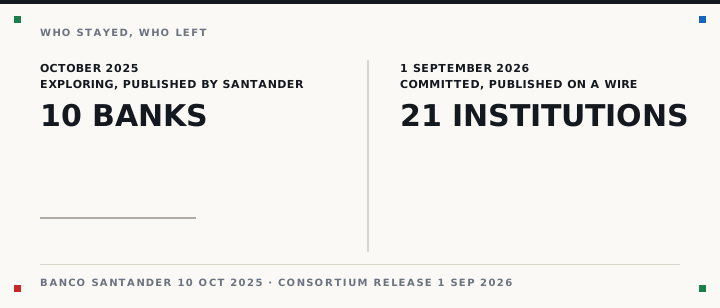
The October 2025 version of this group was ten banks, and it was published by one of them. Banco Santander’s press room carried it on 10 October 2025, describing a group “jointly exploring the issuance of a 1:1 reserve-backed form of digital money that provides a stable payment asset available on public blockchains, focused on G7 currencies”.
That release named its members: “Banco Santander, Bank of America, Barclays, BNP Paribas, Citi, Deutsche Bank, Goldman Sachs, MUFG Bank Ltd, TD Bank Group and UBS.”
Eight of those ten are on Tuesday’s list. Barclays and BNP Paribas are not, and the new release says only that the group “now comprises twenty-one leading financial institutions”, with no mention of anyone leaving.
One of the two departures has a documented destination. On 2 December 2025 CaixaBank published the launch of Qivalis, a euro stablecoin venture domiciled in Amsterdam and, in CaixaBank’s own words, “working towards Dutch Central Bank (DNB) authorization and supervision as an Electronic Money Institution (EMI)”. The same release recorded that BNP Paribas had joined it as a founding member on 1 December 2025. Its nine other founders are Banca Sella, CaixaBank, Danske Bank, DekaBank, ING, KBC, Raiffeisen Bank International, SEB and UniCredit, all of whom signed up on 25 September 2025.
Barclays’s absence has no published explanation, and we could not find one. The bank has said nothing about it.
What “GENIUS Act and MiCA-compliant, as applicable” would require
The GENIUS Act is Public Law 119-27, and the framework it sets is conventional finance rather than anything exotic: reserves backing tokens one for one, disclosure of those reserves, honoured redemption rights, anti-money-laundering obligations, audit and reporting, with oversight shared between the Office of the Comptroller of the Currency, the Financial Crimes Enforcement Network and the Treasury. Our explainer on stablecoins and the GENIUS Act sets out the requirements in full.
Treasury put its implementing rules out for comment on 18 August 2026, two weeks before this announcement, so the detail the consortium would have to build against is itself still a proposal. MiCA is the European counterpart, and it is the regime a euro issue would fall under, covered in our page on MiCA and the non-US regulatory map.
“As applicable” is the qualifier that carries the load. A dollar token issued into the United States falls under the GENIUS Act; a euro token issued into the European Union falls under MiCA; neither regime applies to the company until it exists and issues something. No charter application, master account request or securities filing has been made in the name of an entity that has not been formed, and none appears in the public record.
The market they would be joining
The sector they intend to enter carries about $310bn of circulating value, on our own count of DefiLlama’s circulation figures for the 335 dollar-pegged tokens among its 423 tracked stablecoins, taken on the morning of the announcement. Tether’s USDT is $183.3bn of that and Circle’s USDC is $73.6bn, which puts roughly five-sixths of the sector in two issuers. The next largest, Sky’s USDS, is $6.6bn.
Both incumbents are already regulated products with live rails, live redemption and years of circulation behind them. The consortium’s answer to that, in its own words, is “bank-grade compliance, strong governance, distribution and institutional risk management”, which is a claim about who the issuer is rather than about what the token does.
Qivalis is a year ahead on the currency they want second
The euro sits second in the consortium’s plan and first in its rival’s. Qivalis has a name, a domicile, a chief executive in Jan-Oliver Sell, and a target of the second half of 2026 for launch, which is the same window in which the twenty-one intend to have finished incorporating. What it does not have yet is permission. Its own site carried this line on 28 August 2026: “Qivalis B.V. has applied to De Nederlandsche Bank (DNB) for authorisation as an electronic money institution under the Dutch Financial Supervision Act… Qivalis is not yet authorised and does not currently issue electronic money or provide payment services to the public.”
Ten European banks are inside Qivalis and none of them, other than BNP Paribas, has ever been in the group announcing on Tuesday. Eight European institutions are inside the new consortium and none of them is in Qivalis. Two consortium projects, an overlap of one bank, and the euro is a stated priority for both.
A list of names, a timeline, and nothing yet to regulate
What exists today is a commitment by twenty-one institutions, a two-stage timeline, an intention to comply with two named regimes, and a promise that the company will be named later. What does not exist is the company, the token, the chain it would run on, the reserve manager, the distribution agreement or a single named person answerable for any of it.
The four to ten months between this release and the target launch window are where all of that has to be decided, in public, by twenty-one institutions with their own regulators, their own payment businesses and, on the evidence of Barclays and BNP Paribas, their own exits.
Sources
- Group of leading international financial institutions to establish stablecoin enterprise (the consortium's release, 1 September 2026)prnewswire.com
- Group of leading international banks explores issuance of a 1:1 reserve-backed form of digital money (Banco Santander, 10 October 2025)santander.com
- Qivalis, joint venture of a European banking consortium, to launch euro stablecoin in the second half of 2026 (CaixaBank, 2 December 2025)caixabank.com
- GENIUS Act, Public Law 119-27 (full text)govinfo.gov
- Treasury proposed rule: GENIUS Act regulations on payment stablecoin issuance, offer and sale (18 August 2026)federalregister.gov
- DefiLlama stablecoin circulation datastablecoins.llama.fi
- Sirius International Holding, company profilesiriusholding.com
- International Holding Company technology portfolio, listing Siriusihcuae.com
- Qivalis, company site and regulatory disclosureqivalis.eu