GENIUS Act rulemaking deadline passes with no final rules in sight
The GENIUS Act rulemaking deadline passed on 18 July with six federal agencies holding only proposals and no final stablecoin rules, leaving 18 January 2027 as the backstop.
Listen to this articleListen
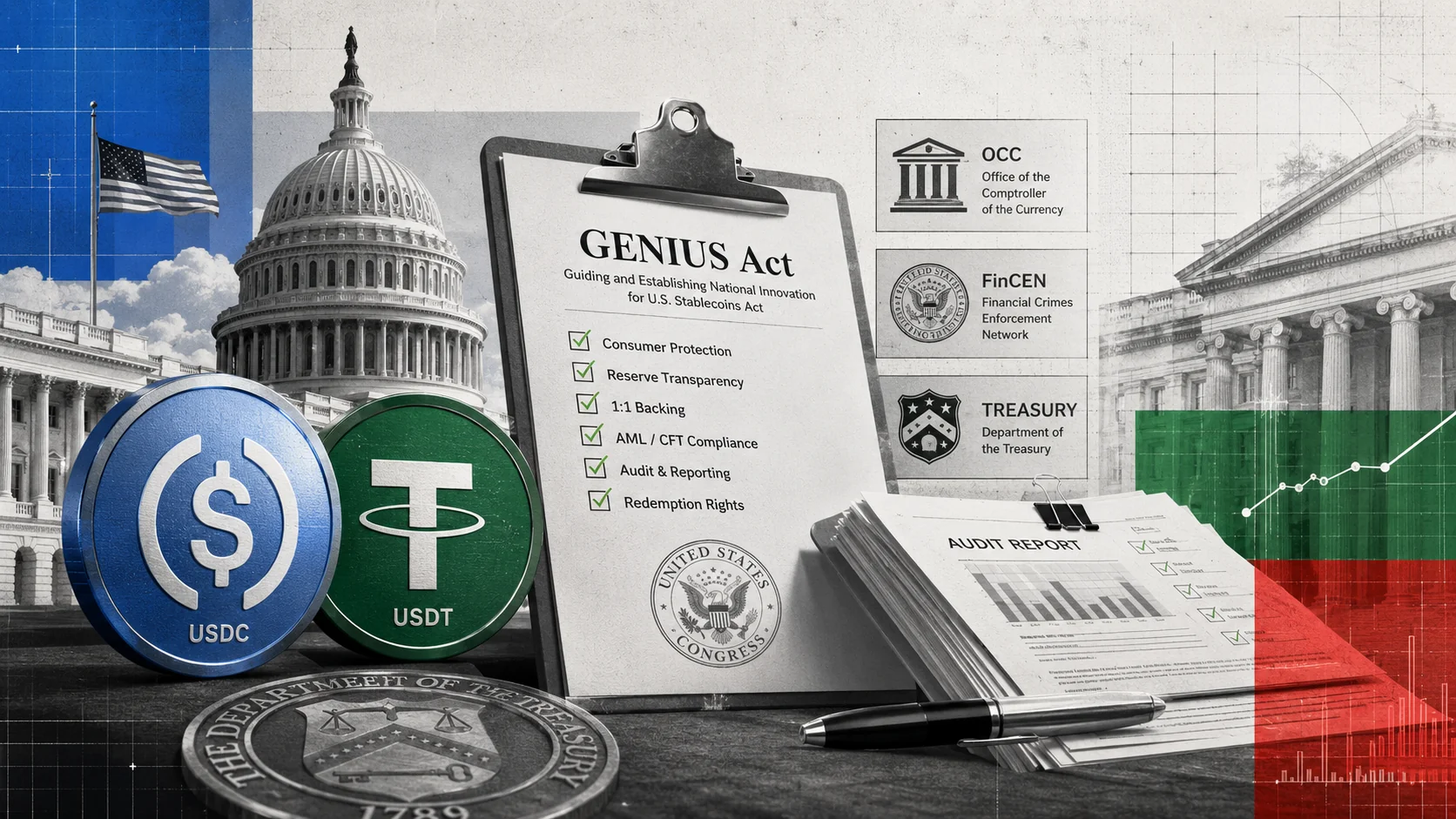
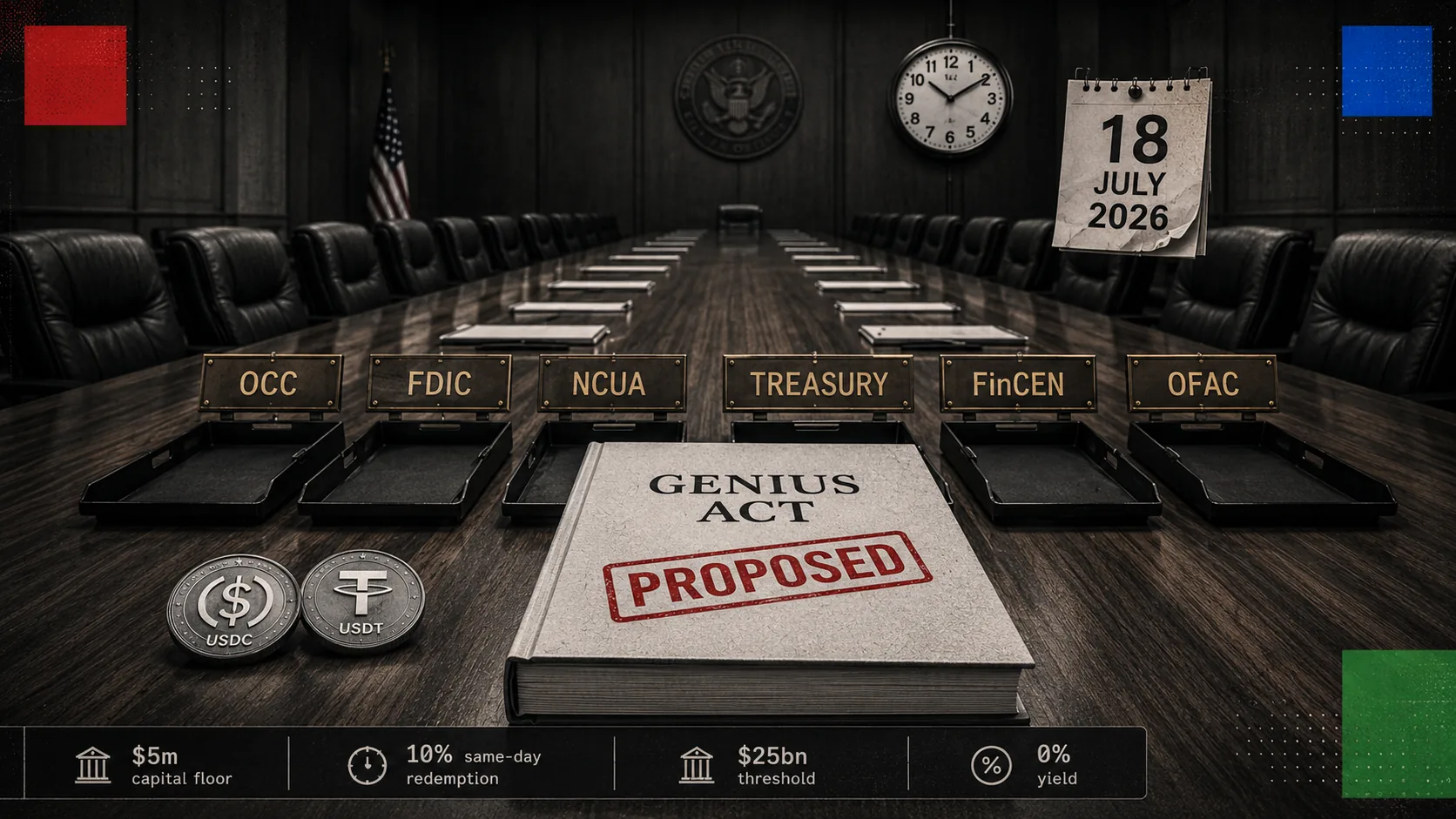
The GENIUS Act rulemaking deadline fell on Saturday and passed without a single federal agency publishing final rules. Section 13 of the Act obliged every primary federal payment stablecoin regulator, the Treasury Secretary and state regulators to promulgate implementing regulations within one year of enactment. President Trump signed the law on 18 July 2025. The year expired, and the Office of the Comptroller of the Currency, the Federal Deposit Insurance Corporation, the National Credit Union Administration, the Treasury, FinCEN and OFAC all arrived at the date holding proposals. Finished text was nowhere.
The absence of consequence is the striking part. The GENIUS Act rulemaking deadline carries no penalty clause, no enforcement mechanism and no fallback provision that fills the gap when the date goes by. Congress wrote a mandatory instruction and attached nothing to it. Regulators have therefore missed a statutory obligation with the same practical result as meeting it, which is a lesson in drafting that will be studied by anyone negotiating the next digital asset bill.
Nothing switches off when a GENIUS Act rulemaking deadline lapses. The Act takes effect on the earlier of eighteen months after enactment, meaning 18 January 2027, or 120 days after the primary federal regulators issue final regulations. With no final regulations, the January date becomes the operative one. Stablecoins continue to trade, issuers continue to issue, and the market that has grown past $320bn in outstanding value carries on without interruption.
What the delay costs is planning certainty, and it lands hardest on the firms with the least room to improvise. New federal applicants, foreign issuers seeking access to the United States and state-qualified issuers relying on Treasury’s substantially similar equivalence test all need finished text before they can commit capital to a compliance build. Treasury cannot assess whether a state regime is substantially similar to a federal framework that has not been finalised.
The provisions still in play are commercially material. The OCC’s proposed 12 CFR Part 15, published in March under Bulletin 2026-3, sets a $5m minimum capital floor for new issuers and a three tier liquidity framework requiring the capacity to meet 10 per cent of redemptions same day. It also proposes that issuers above $25bn in outstanding supply hold 0.5 per cent of reserves as insured deposits, capped at $500m. That threshold reaches Circle’s USDC directly and touches Tether’s foreign issuer pathway. Reserves must sit in a permitted list covering US Treasury securities maturing inside two years, insured bank deposits and overnight repurchase agreements.
The FDIC has settled one question that consumers regularly get wrong: holders of payment stablecoins do not receive deposit insurance, and that holds whether or not the issuer is bank affiliated.
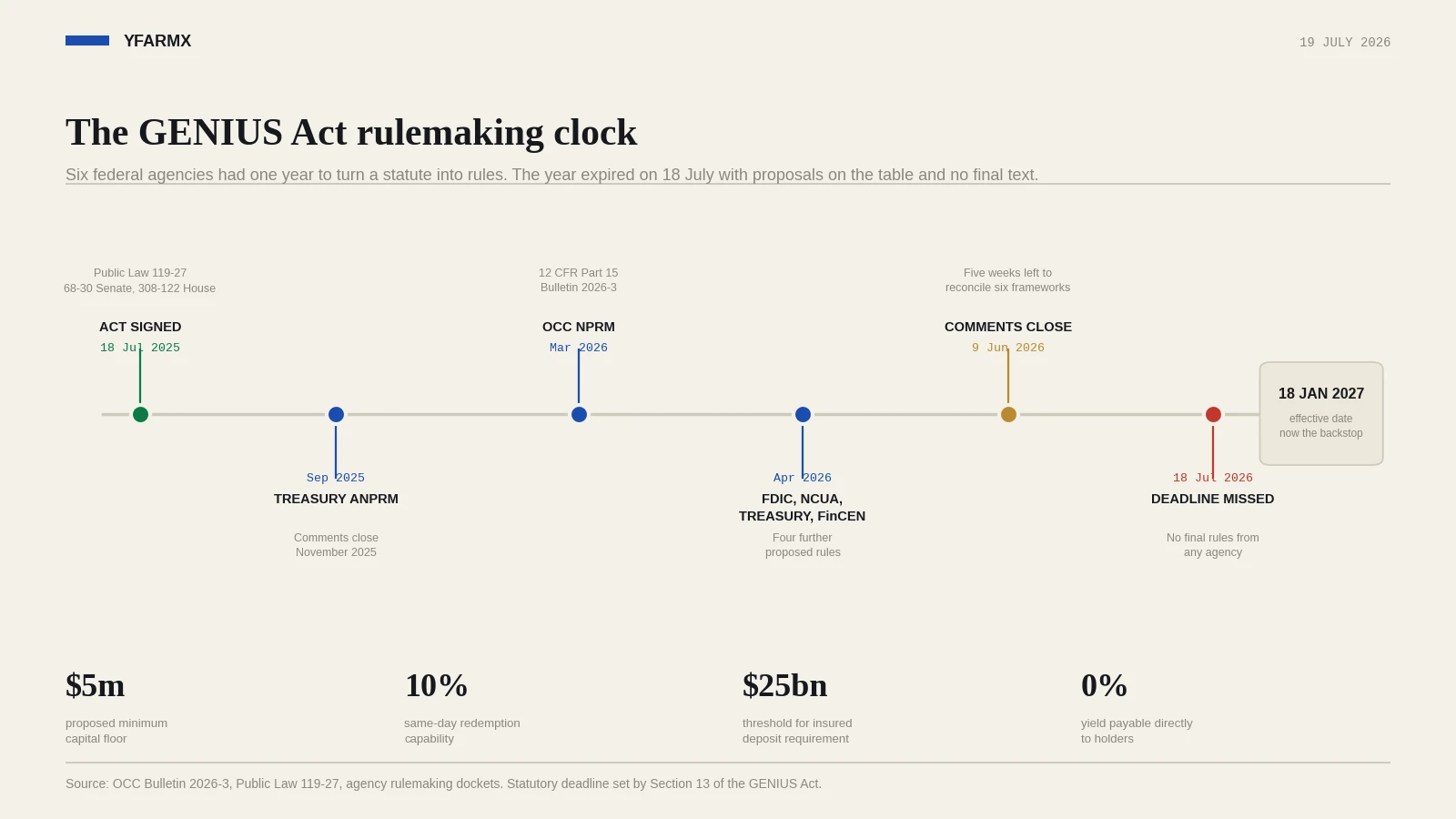
The most contested element remains the no yield prohibition, which bars permitted issuers from paying interest directly to holders. The same dispute is what stalled the CLARITY Act in the Senate, where disagreement over stablecoin yield restrictions has held up the bill’s path to a floor vote since it cleared the Banking Committee 15 votes to 9 in May, pushing it toward a narrowing window before the August recess. Two of the most consequential pieces of US digital asset policy are therefore held up by the same argument about whether a dollar token may pay interest.
The timeline shows agencies working hard throughout. Treasury published an advance notice of proposed rulemaking in September 2025 with comments closing that November. The OCC proposed its rules in March 2026 with comments closing on 1 May. The FDIC and Treasury published in April, and FinCEN and OFAC issued their joint anti money laundering proposal the same month, with those comment periods closing by 9 June. But two of the six frameworks were still taking shape inside the deadline window: the NCUA’s second and much longer proposal, covering the actual issuance standards, did not appear until 18 May and took comments until 17 July, one day before the deadline, and the OCC’s dedicated anti money laundering and sanctions rule for stablecoin issuers arrived on 24 June with comments closing on 24 July, six days after the deadline had passed. Parts of the framework were still open for comment when the date arrived.
For issuers the practical guidance is unchanged. Build to the proposed text, because the gap between proposal and final rule is usually narrower than the gap between having a plan and having none. Track all three workstreams separately, since Treasury, the FinCEN and OFAC anti money laundering rule, and the OCC framework will not finalise together. And assume January 2027 as the effective date until an agency says otherwise.
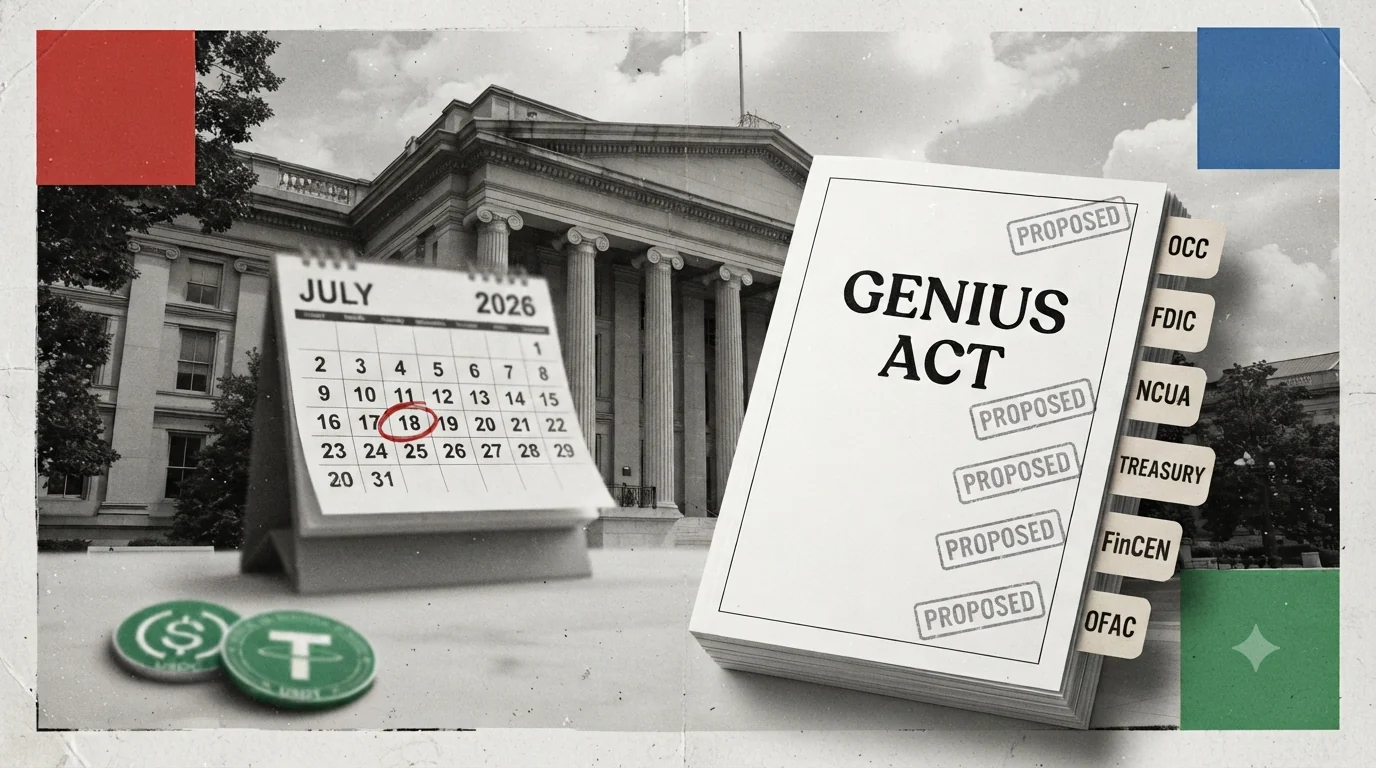
The GENIUS Act was written to end the regulatory grey zone around stablecoins. A year on, the grey zone has a statute, six proposals and a missed deadline in it.
Sources
- OCC Bulletin 2026-3occ.treas.gov
- Congress.govcongress.gov
- US Treasuryhome.treasury.gov
- Federal Registerfederalregister.gov