
Fake bots are posing as ChatGPT, Claude and Perplexity to hunt for passwords and API keys
Scanners are copying the names of AI assistants and crawlers to slip past website rules and hunt for .env files, cloud keys and Git settings. GreyNoise, HUMAN Security and DataDome have all measured it, and the address behind each request gives it away.
Automated scanners have started wearing the names of the best-known AI assistants on the web. They announce themselves as ChatGPT-User, Claude-User or Perplexity-User, the labels those assistants use when they read a page for someone, then ask for the files a careless web server leaves lying about: /.env, /service-account.json, /.git/config, /key.pem.
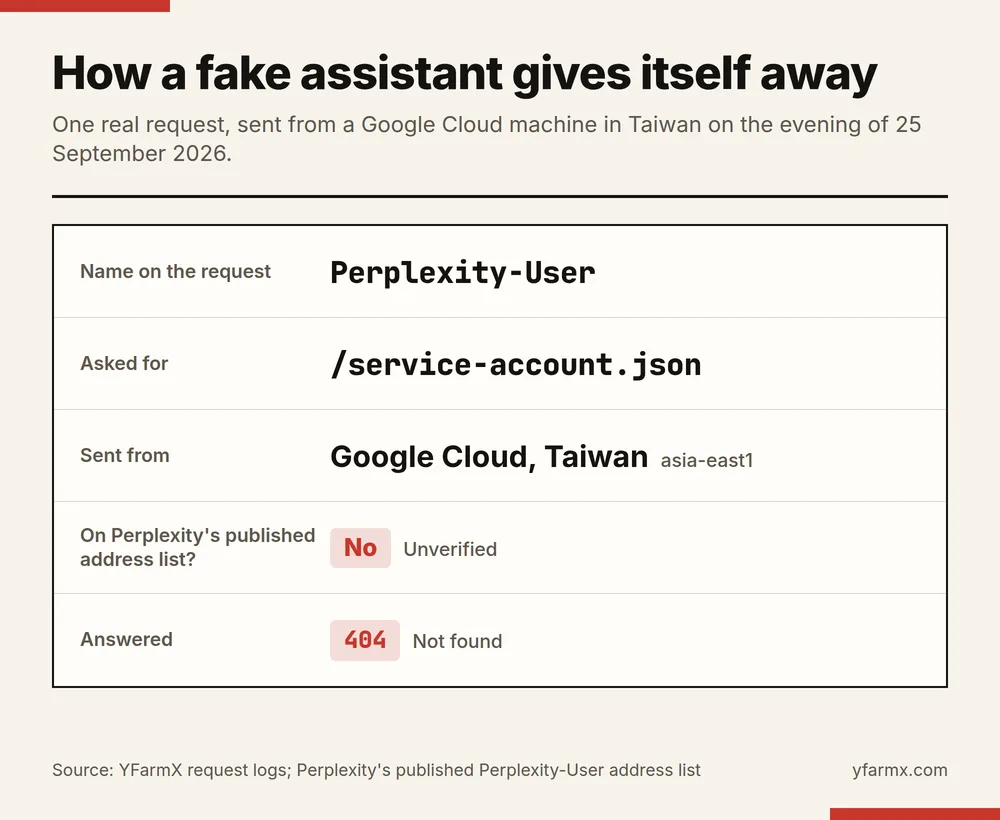
Security companies have been measuring it. GreyNoise traced six forged AI crawler names to 824 addresses hunting for credentials between 28 July and 23 August 2026, and DataDome counted 7.9 million requests faking ChatGPT-User in the first months of 2026. YFarmX’s own logs show the same pattern: on one sampled day, 25 September, about one in nine of the requests reaching the site under AI crawler names came from two scanning machines in Taiwan.
What are ChatGPT-User, Claude-User and Perplexity-User?
ChatGPT-User, Claude-User and Perplexity-User are the names AI assistants give when a person asks a question and the assistant goes to read a web page live to answer it. OpenAI’s crawler documentation says that “when users ask ChatGPT or a CustomGPT a question, it may visit a web page with a ChatGPT-User agent”. Anthropic’s help page says the same of Claude-User, and Mistral documents MistralAI-User for its Vibe assistant. They sit apart from the training crawlers, GPTBot and ClaudeBot, which collect pages in bulk.
Each company publishes the internet addresses its assistant fetches from, so a site can check a visitor’s claim. OpenAI and Perplexity also say their assistants may pass over robots.txt, the file where a site states which bots may read what, while Anthropic says all its bots follow it.
| Name | Address list | In the company’s words |
|---|---|---|
| ChatGPT-User | OpenAI’s list | “robots.txt rules may not apply” |
| Claude-User | Anthropic’s list, shared with ClaudeBot | “honoring industry standard directives in robots.txt” |
| Perplexity-User | Perplexity’s list | “generally ignores robots.txt rules” |
| MistralAI-User | Mistral’s list | “it may visit a web page to help answer” |
OpenAI’s reason is that “because these actions are initiated by a user, robots.txt rules may not apply”. Perplexity’s documentation puts it as “since a user requested the fetch, this fetcher generally ignores robots.txt rules”.
Why would a scanner pretend to be an AI assistant?
A scanner wears an assistant’s name because some sites wave that name through. Sites that want to be quoted in ChatGPT, Claude and Perplexity answers let these fetchers past rules that stop other automated traffic, and the name is the easiest thing to check. GreyNoise, a company that runs sensors across the internet to watch scanning, set out the weakness on 28 August 2026: “The user agent is a client-supplied header, so a control that checks the name but not the address can be bypassed by forging it.”
How widespread is it?
Three security companies have measured AI crawler impersonation, each from a different vantage point: GreyNoise runs sensors across the internet, while DataDome and HUMAN Security sell bot detection to websites. The biggest AI labs’ names turn up in all three.
| Study | What it found |
|---|---|
| GreyNoise, 28 August 2026 | Six AI crawler names from OpenAI, Anthropic, Google and Perplexity sent from 824 addresses across 795 networks between 28 July and 23 August 2026, asking for environment files, cloud access keys, private encryption keys and password stores |
| DataDome, 16 March 2026 | 16.4 million spoofed requests using Meta’s crawler name and 7.9 million using ChatGPT-User; nearly 2.4 per cent of requests claiming to be PerplexityBot were fraudulent |
| HUMAN Security, 9 September 2025 | One in every 18 requests using an AI crawler name was a fake, and ChatGPT-User was spoofed most, at one fake for every five real requests |
GreyNoise found every one of its 824 addresses outside the ranges the four companies publish. Its fakes arrived in almost identical volume per name, the mark of a script cycling through a list.
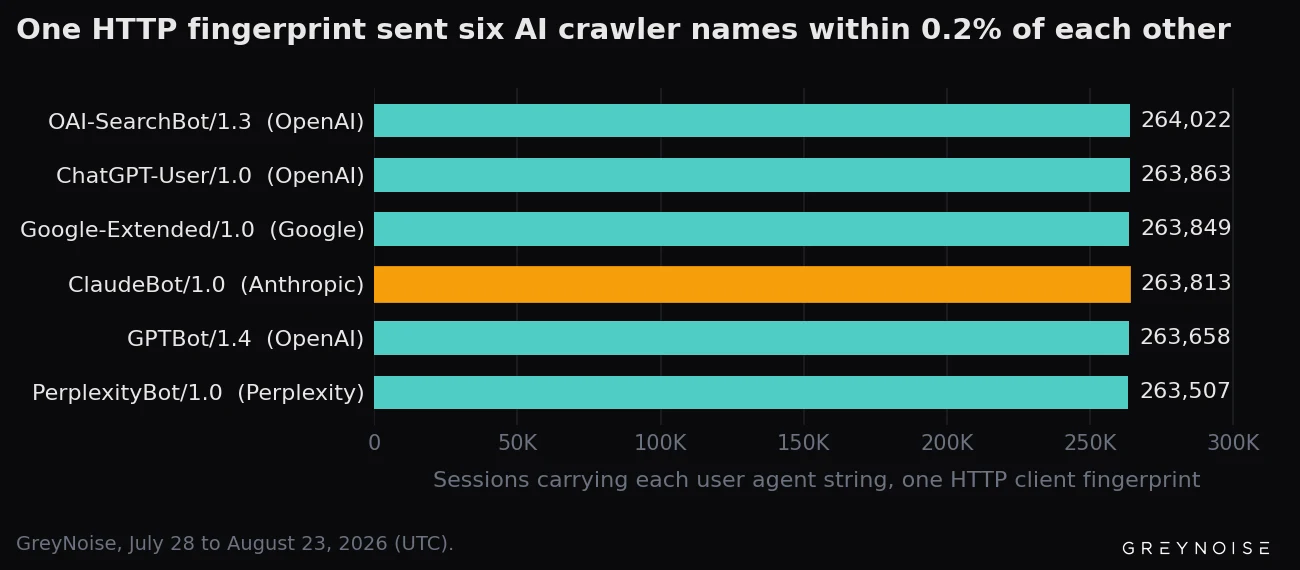
One of those names gives itself away on sight. GreyNoise counted 263,849 sessions carrying Google-Extended as a user agent, and Google’s crawler documentation says Google-Extended “doesn’t have a separate HTTP request user agent string”. It is a word publishers write in robots.txt to opt out of AI training, so every request wearing it is somebody else.
HUMAN Security put the ChatGPT-User finding in one line: “OpenAI’s ChatGPT-User crawler stands out as the most heavily spoofed, with a striking spoof ratio of 1:5”.
How do you tell a fake from the real thing?
A fake fails on the address it comes from, and often on the name itself. In the fakes that reached YFarmX in September 2026, the ChatGPT-User string was a character-for-character copy of the one OpenAI documents, and the other three each carried a mistake a careful reader can spot.
| Name | How the real one ends | How the fake one ended |
|---|---|---|
| ChatGPT-User | ChatGPT-User/1.0; +https://openai.com/bot |
Identical |
| Claude-User | Claude-User/1.0; [email protected] |
Claude-User/1.0; [email protected] |
| Perplexity-User | Perplexity-User/1.0; +https://perplexity.ai/perplexity-user) |
Perplexity-User/1.0; +https://perplexity.ai/perplexitybot) |
| MistralAI-User | MistralAI-User/1.0; +https://docs.mistral.ai/robots) |
MistralAI-User/1.0; +https://mistral.ai/) |
The real Claude-User ending comes from the verified Claude-User requests in yfarmx.com’s own logs, because Anthropic’s help page names the bot without printing its string. The other three real endings are the companies’ own documentation.
The address check is the one a scanner cannot fake by typing. YFarmX checked every address that sent these names to the site more than a handful of times over the 30 days to 26 September against OpenAI’s, Anthropic’s, Perplexity’s and Mistral’s published lists, downloaded that day. Every one fell outside every list, and Google Cloud’s published ranges place the addresses behind about 98 per cent of those requests inside Google Cloud. Real assistants use Google Cloud too, since Anthropic’s own list includes Google Cloud addresses, so the exact address is what settles it.
Cloudflare’s verified bots programme runs the same test automatically. A bot qualifies when “it declares who it is deterministically, through a cryptographic Web Bot Auth signature, a published IP list with a stable user-agent, or reverse DNS”. It labels the genuine ChatGPT-User and Claude-User fetches AI Assistant, and a copy sent from anywhere else arrives unverified.
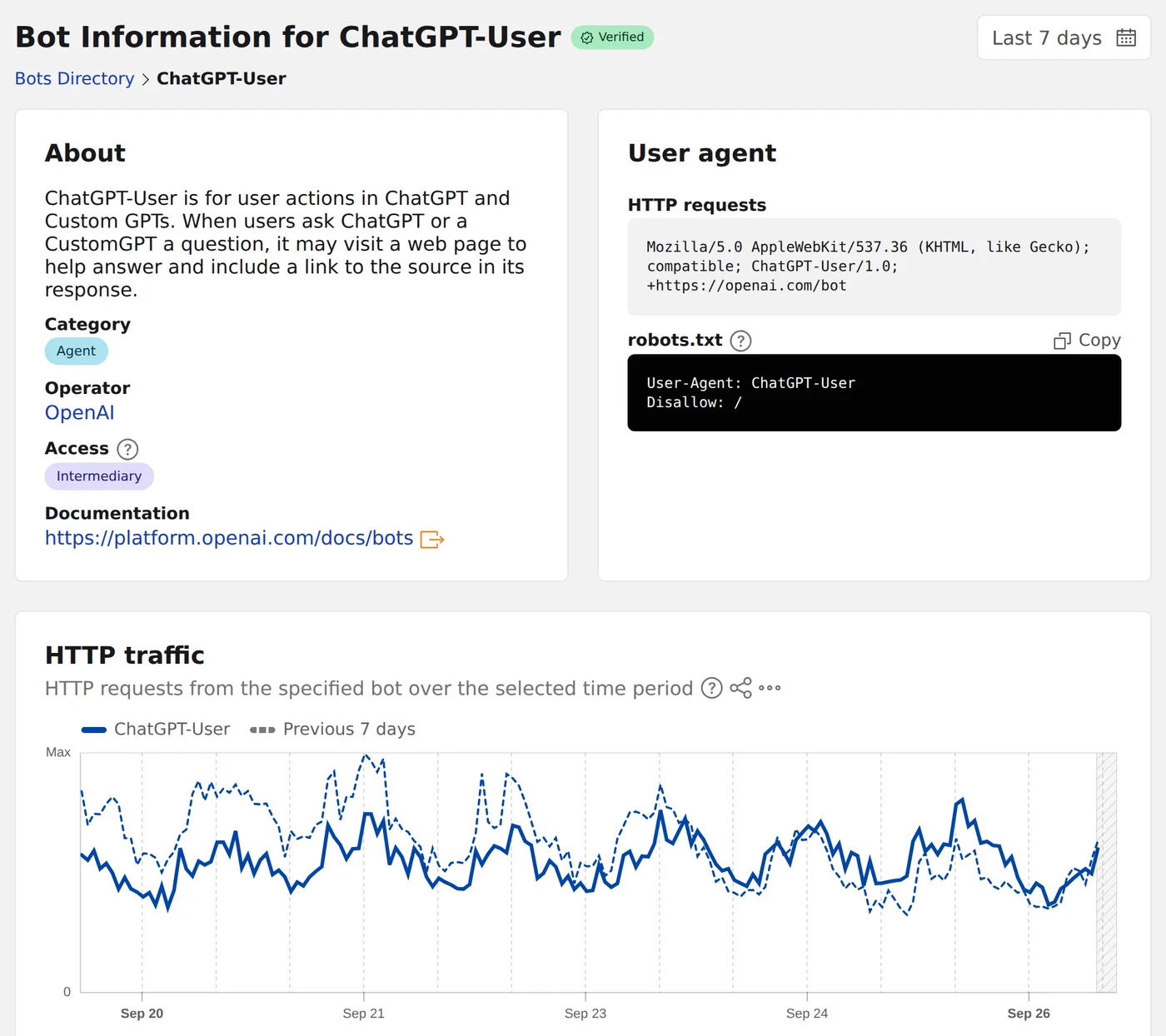
Some unverified requests are genuine. In YFarmX’s logs, a few unverified Claude-User requests carried a Claude Code version tag, came from ordinary home and office connections and fetched articles, the pattern of a developer’s own copy of Anthropic’s coding tool reading a page.
Perplexity-User needs the address list for a different reason. Cloudflare de-listed Perplexity as a verified bot on 4 August 2025, after accusing it of crawling with undeclared, browser-like user agents; Perplexity replied that Cloudflare had confused its traffic with a third-party browser service. Since then every Perplexity-User request arrives unverified, the real ones included. On 10 September Perplexity-User requests from an address inside Perplexity’s published list fetched a YFarmX article, and Cloudflare marked those unverified as well.
What it looks like on one website

YFarmX’s own Cloudflare logs show the pattern up close. Between 22 and 25 September 2026, four Google Cloud machines, two in Google’s us-west1 region in The Dalles, Oregon, and two in asia-east1 in Changhua County, Taiwan, according to Google Cloud’s region list, probed the site in eight bursts, each one fitting inside a single clock hour.
They wore more than 30 identities between them. About four requests in five carried the name of an AI crawler or assistant, and most of the rest posed as an Android phone running Chrome. Besides the four assistant names, they claimed to be crawlers from xAI, ByteDance, DuckDuckGo, Moonshot’s Kimi, OpenAI, Cohere, DeepSeek, Apple, Huawei, Brave, Tencent, Anthropic, Perplexity, Meta, You.com, 01.AI, Baidu, Alibaba’s Qwen, Zhipu, Amazon, Common Crawl and Google, Google-Extended included. Like the fakes GreyNoise measured, they skipped robots.txt, the file a real crawler reads first.
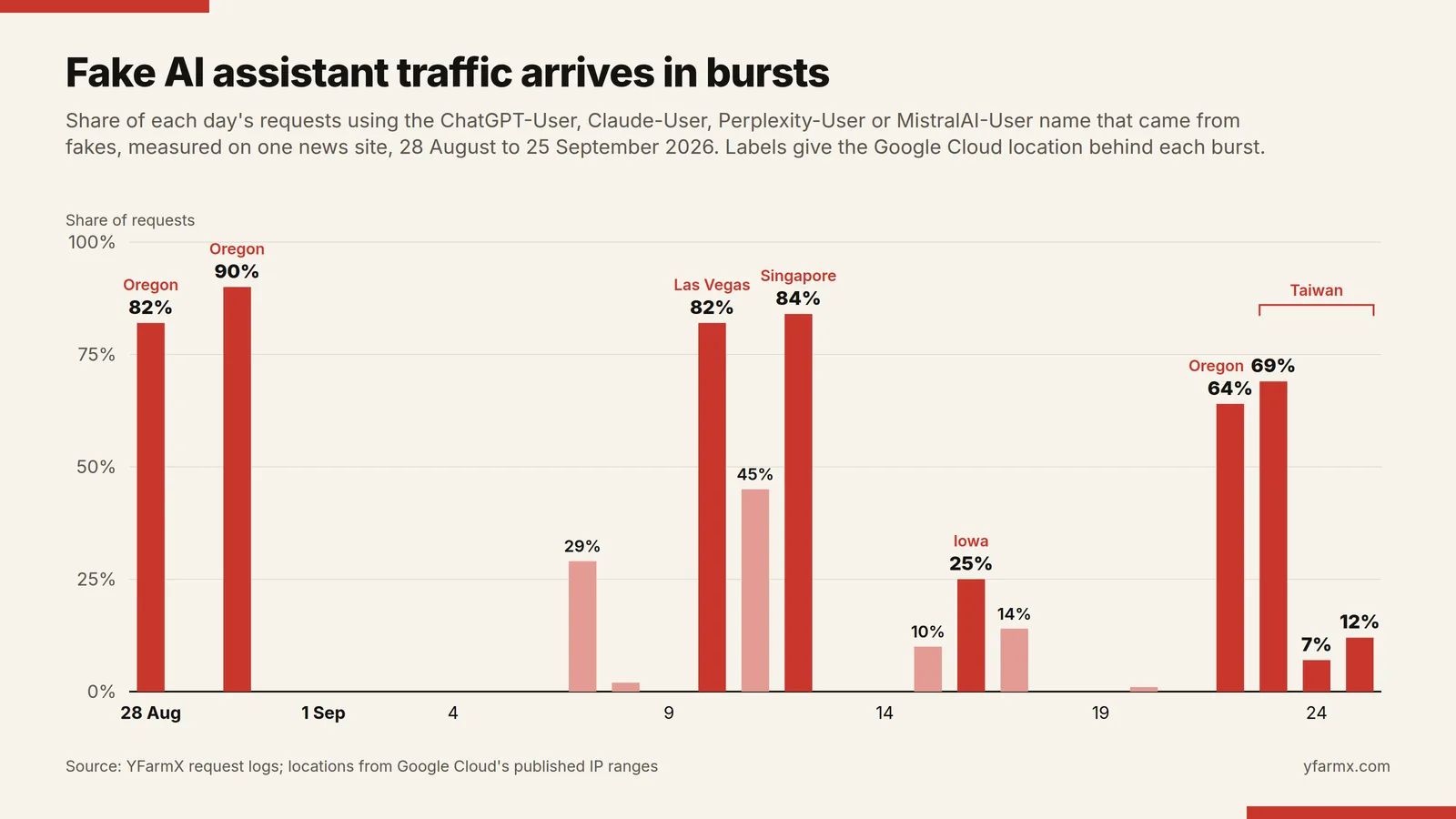
On one sampled day, 25 September, about 6,000 requests reached YFarmX under the names of AI crawlers and assistants, and roughly one in nine came from the two Taiwan machines. Over the 30 days to 26 September, about a third of all requests reaching the site under the four assistant names were fakes, arriving in bursts on half of those days, and about 98 per cent of the fakes came from Google Cloud addresses. Every request for a secret file failed.
What are the fake bots looking for?
The fake bots are looking for credentials: the passwords, keys and tokens that let someone into a company’s cloud account, database or AI subscription. GreyNoise lists environment files, cloud access keys, private encryption keys and password stores. The fakes that reached YFarmX asked for paths in a handful of families, and each one targets a mistake with a documented history.
| What they ask for | What sits there on a careless server | The record |
|---|---|---|
/.env, //.env, /secrets.env, /sendgrid.env, /frontend/.env |
Environment files holding database passwords, cloud keys and API tokens | Unit 42 traced an extortion campaign that scanned more than 230 million targets and copied exposed .env files from at least 110,000 domains (15 August 2024) |
/service-account.json, /firebase-service-account.json, /gc-service.json |
Google Cloud and Firebase service account keys | Google warns a stolen key can be used “to escalate their privileges” |
/.git/config, /key.pem, /.ssh/id_rsa, /terraform.tfstate |
Code repository settings, SSH and TLS keys, infrastructure state | HashiCorp: state is “a plaintext file, which includes any secret values” |
/@fs/.../root/.env, /@fs/.../proc/self/environ |
Files read through a Vite development server left open to the internet | A family of Vite bugs; CVE-2025-31125 has been on CISA’s exploited list since 22 January 2026 |
POST /cgi-bin/php-cgi.exe |
PHP running as CGI on Windows | CVE-2024-4577, rated 9.8 of 10 |
/actuator/configprops, /_debugbar/open, /app_dev.php/_profiler, /__debug__/ |
Debug consoles for Spring Boot, Laravel, Symfony and Django | Symfony: never enable the profiler in production |
POST /api/v1/validate/code, /api/v1/node-load-method/customMCP |
Langflow and Flowise, two tools for building AI agents | CVE-2025-3248 and CVE-2025-59528, both letting a stranger run code |
/api/v1/models, /mcp |
Self-hosted model servers and MCP servers | /v1/models is the route an OpenAI-style API uses to list its models |
The AI rows are the newer part of the list. Langflow’s bug was fixed in version 1.3.0, and the US vulnerability database describes it in one line: “A remote and unauthenticated attacker can send crafted HTTP requests to execute arbitrary code.” CISA added it to its catalogue of vulnerabilities exploited in the wild on 5 May 2025. Flowise’s CustomMCP bug, fixed in 3.0.6, is rated 10 out of 10. A scanner dressed as an AI assistant, hunting for the servers AI developers run, is going after the people most likely to have left one exposed.
Check where a request comes from
The lesson for anyone running a website is to let a published address list or a verified-bot check decide who counts as an AI assistant. Cloudflare’s verified flag does that work for ChatGPT-User and Claude-User; for Perplexity-User, since the August 2025 de-listing, the company’s own list is the check. The same goes for GPTBot, ClaudeBot, Googlebot and every other name a site might wave through.
The longer fix is a signature. Cloudflare already accepts Web Bot Auth, an IETF draft whose goal is “to allow automated HTTP clients to cryptographically sign outbound requests, allowing HTTP servers to verify their identity with confidence”. A signed request carries proof a scanner cannot copy out of a documentation page. Until the assistants sign, the address is the proof, and the name on a request is only a claim.
Questions people ask
- Can a website trust a request that calls itself ChatGPT-User?
- Only after checking where it came from. The user agent is a line of text the client writes itself, and a scanner can copy it exactly. OpenAI publishes the addresses ChatGPT-User fetches from at openai.com/chatgpt-user.json, and Cloudflare marks genuine ChatGPT-User traffic as a verified bot. A request from any other address is somebody else using the name.
- What are fake AI crawlers looking for?
- Credentials. GreyNoise's August 2026 report lists environment files, cloud access keys, private keys and password stores, and the fakes that reached YFarmX in September 2026 asked for .env files, Google Cloud service account keys, Git settings, Vite and PHP-CGI exploit paths, and the Langflow and Flowise bugs that let a stranger run code on an AI agent server.
- Why does Cloudflare mark every Perplexity-User request as unverified?
- Cloudflare removed Perplexity from its verified bots programme on 4 August 2025, after accusing it of crawling sites with undeclared browser-like user agents, which Perplexity disputed. Genuine Perplexity-User requests therefore arrive unverified too. Perplexity publishes its Perplexity-User addresses at perplexity.com/perplexity-user.json, which is the check that separates the real fetcher from a copy.
Sources
- DataDome: The AI traffic report (published 16 March 2026)datadome.co
- DataDome: Report finds most organizations flying blind as agentic traffic surges (16 March 2026)datadome.co
- OpenAI: Overview of OpenAI crawlers (ChatGPT-User, GPTBot, OAI-SearchBot)developers.openai.com
- OpenAI: published ChatGPT-User IP rangesopenai.com
- Anthropic: Does Anthropic crawl data from the web, and how can site owners block the crawler?support.claude.com
- Anthropic: published IP ranges for ClaudeBot, Claude-User and Claude-SearchBotclaude.com
- Perplexity: Perplexity crawlersdocs.perplexity.ai
- Perplexity: published Perplexity-User IP rangesperplexity.com
- Mistral AI: robots and user agentsdocs.mistral.ai
- Cloudflare: Verified botsdevelopers.cloudflare.com
- Cloudflare: Perplexity is using stealth, undeclared crawlers to evade website no-crawl directives (4 August 2025)blog.cloudflare.com
- Perplexity: Agents or bots? Making sense of AI on the open webperplexity.ai
- IETF: HTTP Message Signatures for automated traffic, architecture draftdatatracker.ietf.org
- GreyNoise: Threat actors are posing as OpenAI, Anthropic and DeepSeek to target credentials and secrets (28 August 2026)greynoise.io
- HUMAN Security: AI crawler spoofing exposed (9 September 2025)humansecurity.com
- Google: Google's common crawlers (Google-Extended)developers.google.com
- Google Cloud: published IP address rangesgstatic.com
- Google Cloud: regions and zonescloud.google.com
- Palo Alto Networks Unit 42: Leaked environment variables allow large-scale extortion operation in cloud environments (15 August 2024)unit42.paloaltonetworks.com
- Google Cloud: Best practices for managing service account keysdocs.cloud.google.com
- NVD: CVE-2025-3248, Langflow unauthenticated code injectionnvd.nist.gov
- CISA adds one known exploited vulnerability to catalog (Langflow, 5 May 2025)cisa.gov
- Flowise security advisory GHSA-3gcm-f6qx-ff7p (CVE-2025-59528, CustomMCP node)github.com
- Vite security advisory GHSA-4r4m-qw57-chr8 (CVE-2025-31125)github.com
- CISA adds four known exploited vulnerabilities to catalog (Vite, 22 January 2026)cisa.gov
- NVD: CVE-2024-4577, PHP-CGI argument injection on Windowsnvd.nist.gov
- Symfony documentation: Profilersymfony.com
- OpenAI API reference: List modelsdevelopers.openai.com
- HashiCorp: Manage sensitive data in Terraformdeveloper.hashicorp.com