Kimi K3 open weight model puts China at the frontier
Moonshot AI released the Kimi K3 open weight model on 16 July with no keynote, no launch event and no advance briefing, simply switching on a new option at kimi.com overnight.
Listen to this articleListen
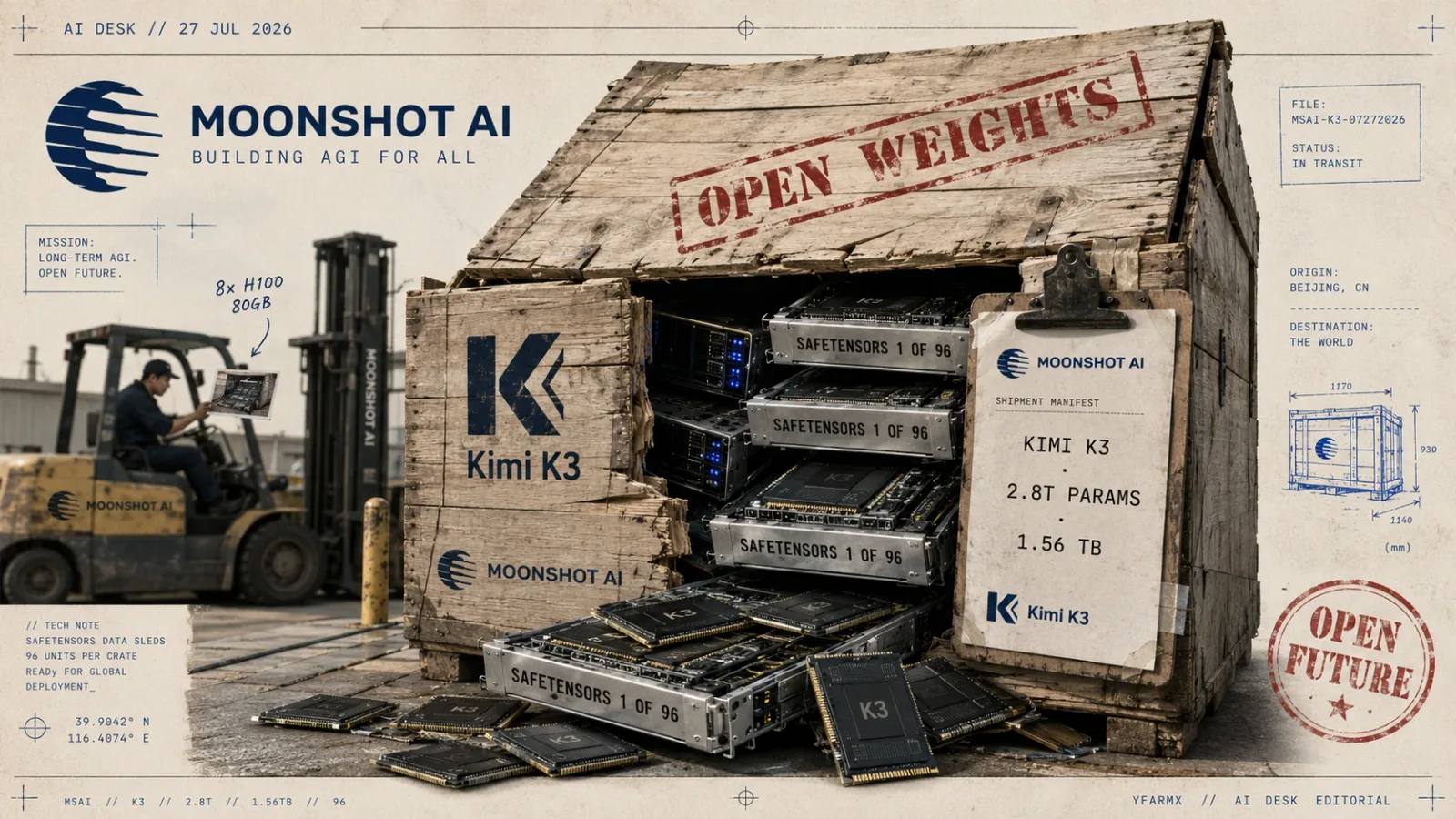
Moonshot AI released the Kimi K3 open weight model on 16 July with no keynote, no launch event and no advance briefing, simply switching on a new option at kimi.com overnight. The company describes it as its most capable system to date, with 2.8 trillion total parameters in a sparse mixture of experts design and a one million token context window. Full weights are promised by 27 July, at which point the Kimi K3 open weight model becomes the largest of its kind that anyone can download.
The benchmark results explain why the release moved markets before most people had read the model card. On Arena’s Frontend Code leaderboard, which ranks blind human preferences, K3 took first place with 1,679 points ahead of Claude Fable 5 on 1,631 and GPT-5.6 Sol on 1,618. That is a jump of seventeen places from Kimi K2.6. K3 ranked first in six of the seven frontend categories, losing only in gaming. On the broader Artificial Analysis Intelligence Index it scores 57 and sits fourth of 189 models, level with Claude Opus 4.8 and GPT-5.5, behind only Fable 5 and Sol.
Architecture and serving economics are where the release becomes interesting for anyone running production workloads. The model activates 16 of 896 experts at a time. Weights ship in MXFP4 format, which brings the full 2.8 trillion parameters down to roughly 1.4 terabytes of storage against the 5.6 terabytes that FP16 would require. That puts self hosting within reach of an organisation with eight to sixteen nodes of current generation accelerators, which is a serious commitment but no longer an impossible one. Moonshot serves the model on its Mooncake disaggregated inference stack, separating prefill from decode across different node pools, and reports a 90 per cent cache hit rate on coding workloads.
API pricing is set at $3 per million input tokens and $15 per million output tokens, with cached input at $0.30. That is roughly half the published cost of Claude Opus 4.8 and around a third of Fable 5. It is worth noting that this is not the deep discount that Chinese labs have historically used to buy attention. K3 is priced close to a Western mid tier model, which suggests Moonshot believes it is selling capability, and pricing accordingly.
The market reaction was immediate and unkind to Moonshot’s domestic peers. Shares in Z.ai fell around 27 per cent and MiniMax around 16 per cent on the announcement, as analysts reassessed pricing power across the sector. Moonshot itself raised $2 billion at a $20 billion valuation in May and is reported to be in fresh talks at $30 billion. Alibaba holds roughly 36 per cent of the company, which employs about 300 people.
The strategic reading is straightforward. Anthropic released Fable 5 five weeks earlier. OpenAI released GPT-5.6 a week earlier. The comfortable assumption that American laboratories hold a lead of several months over Chinese ones is difficult to sustain when an open weight model from a 300 person company sits fourth on the general index and first on frontend code. Mozilla’s chief technology officer Raffi Krikorian framed the competitive question in comments to Axios, arguing that US laboratories would have little reason to lobby Washington against open weight models unless they regarded them as a genuine threat.
Two caveats deserve emphasis. Until the weights are published on 27 July, no independent party can inspect, modify or run the model outside Moonshot’s own infrastructure, so every published figure is either vendor stated or drawn from public leaderboards on a hosted endpoint. And the model is built for long running autonomous software work, analysing large codebases, coordinating tools and checking its own output through screen captures, which is precisely the category where benchmark scores translate least reliably into daily experience.
The timing is not accidental. The release lands days before the 2026 World Artificial Intelligence Conference in Shanghai, where Chinese policy priorities for the sector are expected to be set out. An open weight model at the frontier, priced for global adoption and downloadable by anyone, makes a more persuasive argument than any speech. Chinese open weight models already account for roughly 30 per cent of usage on OpenRouter, up from 1.2 per cent eleven months earlier. The Kimi K3 open weight model is the clearest signal yet that the gap is measured in weeks.
Sources
- Moonshot (Kimi)kimi.com
- Moonshot (Kimi)platform.kimi.ai
- Simon Willisonsimonwillison.net