Cohere
Command R+ / Command A
retrieval and RAG for enterprises
Key facts
- CohereCommand family
- Maker
- RAGretrieval-augmented
- Built for
- 256KCommand A line
- Context
- Enterpriseregulated buyers
- Segment
- Own cloudcustomer infrastructure
- Deploys in
- Command A+succeeds Command R+
- Flagship
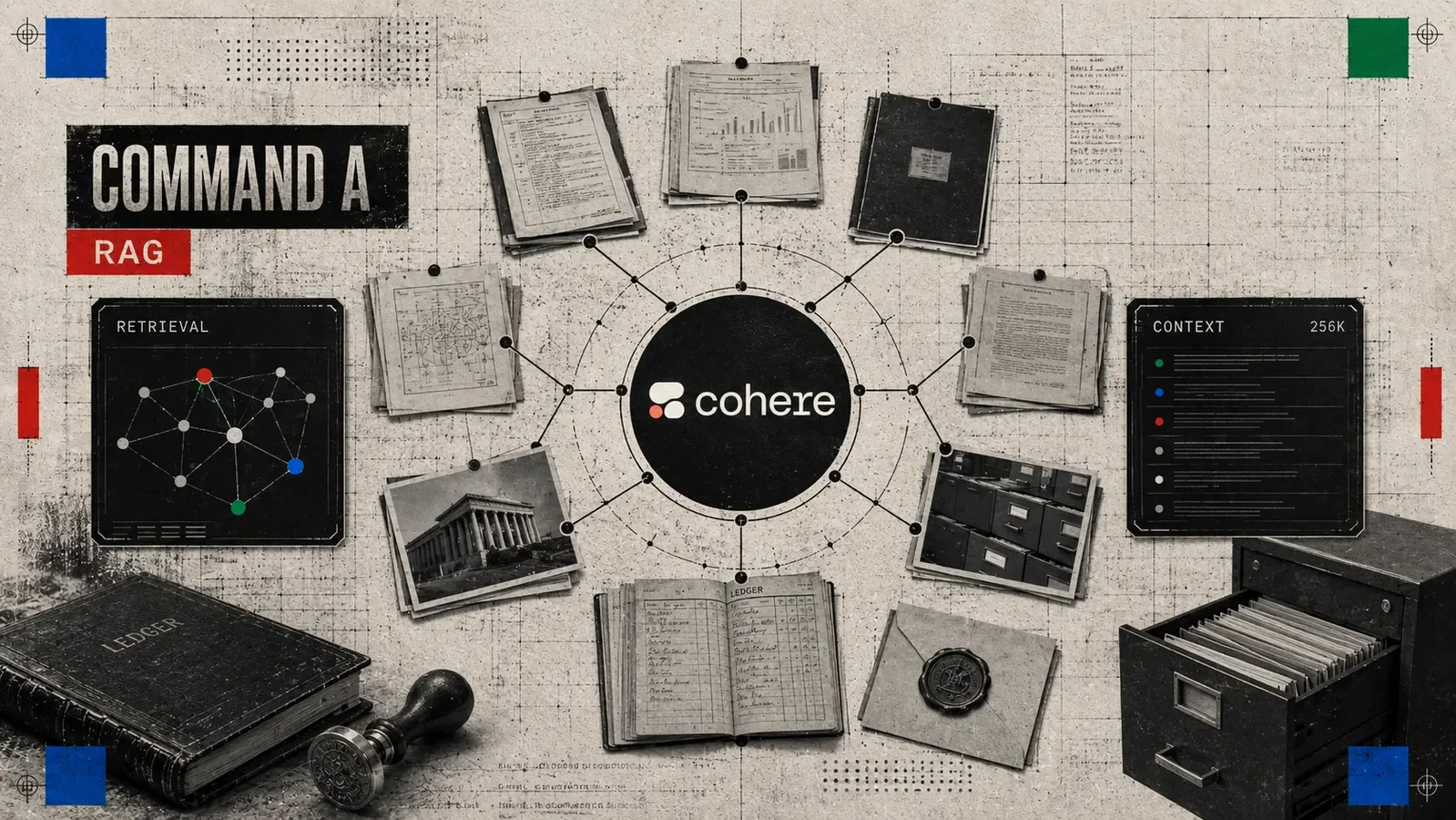
Retrieval and RAG for enterprises. Cohere's enterprise line, consistently recommended for retrieval-augmented generation.
What it is
Cohere Command is the enterprise line of language models built by Cohere, and it is consistently recommended for retrieval-augmented generation, the technique that lets a model answer using an organisation’s own documents rather than only what it absorbed during training. Sold under names including Command R+, Command A and, since 20 May 2026, the flagship Command A+, a mixture-of-experts model with vision and text input, the Cohere Command family is aimed squarely at businesses rather than consumers, and that focus shapes almost everything about it.
How RAG works
Retrieval-augmented generation, usually shortened to RAG, addresses a basic weakness of large language models. A model trained on general text has no reliable knowledge of a particular company’s contracts, policies or support histories, and it can state things confidently that are simply wrong. RAG closes the gap by fetching relevant passages from an approved source at the moment a question is asked, then handing them to the model as context so the answer is grounded in real documents. In effect the model sits an open-book exam instead of being asked to recall everything from memory, which is a far more reliable way to handle facts that change or that the model never saw.
Why enterprises pick it
The enterprise emphasis explains why the Cohere Command line is recommended so often for this work. Businesses that adopt language models tend to care less about a chatbot’s personality and more about accuracy, data control and predictable cost. Cohere has built its reputation on serving those buyers, offering models that can be deployed inside a customer’s own cloud or infrastructure rather than only through a public interface, which suits organisations bound by strict rules on where their data may travel. For a bank, a law firm or a government department, that control is often the deciding factor.
This is why grounding features are treated so seriously by enterprise buyers. An answer that cites its source can be checked; an ungrounded one has to be trusted on faith, which few compliance teams will accept. By tuning these models to quote and attribute the documents they draw on, Cohere gives customers a way to verify what the system says, which is often the difference between a pilot project and a deployment a regulated business will actually approve.
Cohere’s focus
Cohere’s position is unusual because it does not run a mass-market consumer assistant. That independence is deliberate. Instead of competing for public attention, the company concentrates on the retrieval and grounding features that enterprise customers actually deploy, and the Cohere Command models are the result. The approach keeps the family less visible in the public conversation than the best known chatbots, yet it appears repeatedly in serious enterprise shortlists precisely because it is built for the task.
Buyers should confirm the current flagship name before committing, because Cohere has revised its branding as the models have advanced, moving from the Command R and Command R+ generation to Command A and then Command A+, the flagship since 20 May 2026. The underlying promise has stayed steady even as the labels changed: a model tuned for retrieval-augmented generation and secure enterprise deployment rather than for open-ended chat.
Where it sits
Where the Cohere Command line sits in the wider field is clear enough. As more organisations try to put language models to practical use, grounding answers in trustworthy sources has become one of the central problems of the field, and RAG is the dominant solution to it. Cohere’s decision to specialise here has kept it relevant while larger rivals chase the frontier on raw capability. As retrieval becomes standard practice rather than a niche technique, a model designed around it from the outset has a durable role to play. For how this fits alongside the general-purpose systems it competes with, see our large language models hub and the wider AI section.
More in Large Language Models
All LLMs →- Google DeepMindGemini 4 Argonlonger reasoning, coding and cyber defence
- OpenAIGPT-5.6the flagship from 9 July to 3 September 2026
- OpenAIGPT-6 Astrathe new generation, rolling out from 3 September 2026
- OpenAIGPT-6.1 Solthe upgraded mid-price GPT-6 model, released 29 September 2026
- OpenAIGPT-6 Sol and Lunathe mid-price and budget GPT-6 models, released 22 September 2026
- AnthropicClaude Opus 5.5the first Claude 5.5 model, cheaper and faster than Opus 5